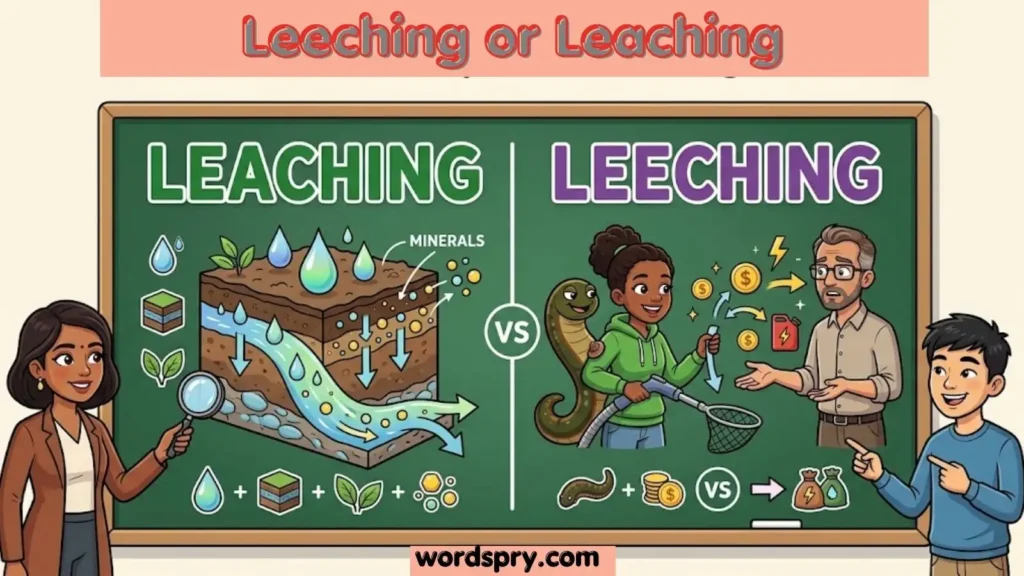
Leeching and leaching sound almost identical, but they describe very different ideas. One involves a parasite, a person who takes advantage of others, or even a blood-sucking worm. The other describes a process in which a liquid removes soluble substances from a material.
For example, after heavy rain, nutrients may leach from the soil. However, if someone constantly depends on another person for money, you might say that person is leeching off them.
That tiny difference in spelling can completely change the meaning of a sentence. This explains why people often search for leeching or leaching when writing about science, gardening, relationships, health, or technology.
The good news? The rule is easier than it first appears. Leaching relates mainly to liquids, soil, chemicals, minerals, and extraction. Leeching relates to leeches, parasites, exploitation, or taking resources from someone without giving much back.
Once you connect each spelling with its meaning, the confusion quickly disappears.
Table of Contents
- Quick Answer
- What Does Leaching Mean?
- What Does Leeching Mean?
- Leaching vs. Leeching: Definitions
- Origin and History
- British English vs. American English
- Which One Should You Use?
- Common Mistakes
- Everyday Examples
- Usage Trends and Contexts
- Comparison Table
- Special Rules and Important Uses
- Frequently Asked Questions
- Conclusion
⚡ Leeching or Leaching: Quick Answer
Leaching means removing soluble substances from a material through a liquid, usually water.
Leeching means acting like a leech by clinging to someone, taking advantage of them, or draining their resources. It can also describe the activity of a leech.
Easy memory trick
- Leaching = liquid
- Leeching = leech
Think of the “a” in leaching as standing for action involving a liquid.
Think of the “ee” in leeching as the spelling of leech, the blood-feeding creature.
What Does Leaching Mean?
Leaching is the process of removing soluble substances from a solid material when a liquid passes through or contacts it.
The liquid often carries dissolved materials away. Water is especially important in natural leaching processes.
For instance, rainwater can move through soil and carry certain nutrients, salts, or contaminants deeper into the ground. The U.S. Environmental Protection Agency describes environmental leaching as the transfer of chemical substances from solid materials into contacting water.
Examples of leaching
- Heavy rain can cause leaching of nutrients from soil.
- Water may leach chemicals from treated wood.
- Some minerals leach out of rocks over time.
- Excess water can cause important nutrients to leach away.
- Scientists study leaching when testing contaminated materials.
Correct and incorrect examples
Correct:
Heavy rainfall caused nutrients to leach from the soil.
Incorrect:
Heavy rainfall caused nutrients to leech from the soil.
The second sentence uses the wrong spelling because it describes movement caused by water.
The verb leach means to dissolve or remove substances through the action of a percolating liquid. It can also describe substances passing out or through a material.
What Does Leeching Mean?
Leeching comes from the verb leech.
A leech is a type of segmented worm, with many species living in freshwater environments. Some species feed on blood. The word also developed a figurative meaning for someone who takes advantage of another person.
Merriam-Webster defines leech as both a blood-feeding worm and a person who seeks advantage or gain by clinging to someone else.
Examples of leeching
- The parasite was leeching blood from its host.
- He keeps leeching off his parents.
- She accused her roommate of leeching money from her.
- Some people leech off friends instead of paying their share.
- The child watched a documentary about leeches in wetlands.
In figurative English, leeching usually suggests unfair dependence or exploitation.
Correct and incorrect examples
Correct:
He has been leeching off his wealthy relatives.
Incorrect:
He has been leaching off his wealthy relatives.
The second sentence is wrong when the intended meaning involves taking unfair advantage of someone.
Leaching vs. Leeching: Definitions at a Glance
The two words have different meanings despite their nearly identical pronunciation.
Leaching
Leaching refers to the removal or movement of soluble substances through a liquid.
Common contexts include:
- Soil science
- Gardening
- Agriculture
- Chemistry
- Environmental science
- Mining
- Waste management
- Food preparation
Leeching
Leeching refers to the behavior of a leech or someone who takes advantage of another person.
Common contexts include:
- Wildlife
- Biology
- Health history
- Relationships
- Money
- Social behavior
- Figurative language
- Online technology
The distinction is straightforward: leaching involves a substance moving through liquid, while leeching involves a leech or parasitic behavior.
Origin and History
The histories of these words are surprisingly interesting.
The word leech has a long history in English. Merriam-Webster traces the noun to Middle English leche and Old English lǣce, a word associated with a physician or healer. Historical medicine helps explain the connection because physicians once used leeches for bloodletting.
The verb leech later developed meanings connected with bleeding, draining, and exploiting. The figurative idea of a person who “clings” to someone for personal gain naturally developed from the behavior of a parasitic leech.
The history of leach is different. Etymological sources connect the verb with the idea of washing or draining something through water. The word became associated with technical processes involving extraction and percolation.
Merriam-Webster records the modern verb leach with a first known use in 1796.
So although leeching and leaching sound like close relatives, their histories and meanings are distinct.
British English vs. American English
There is no major British-versus-American spelling difference between leaching and leeching.
Both varieties of English use:
- leaching for the process involving liquids
- leeching for behavior associated with leeches or parasitic dependence
For example, both British and American writers can say:
Rainwater is leaching minerals from the soil.
And both can say:
He is leeching off his friends.
The spelling does not change simply because the writer uses British or American English.
Which One Should You Use?
Choose the spelling according to the meaning you want.
Use leaching when discussing:
- Water
- Soil
- Chemicals
- Minerals
- Nutrients
- Pollutants
- Extraction
- Dissolving
- Percolation
Use leeching when discussing:
- Leeches
- Blood-feeding
- Parasites
- Exploitation
- Free-loading
- Unfair dependence
- Taking resources from another person
A simple decision test
Ask yourself:
“Is a liquid removing or carrying something away?”
If yes, choose leaching.
“Am I talking about a leech or someone behaving like one?”
If yes, choose leeching.
Common Mistakes
Because the words sound alike, spelling mistakes are easy to make.
Mistake 1: Using “leeching” for soil
❌ The rain is leeching nutrients from the soil.
✅ The rain is leaching nutrients from the soil.
Here, water carries nutrients away, so leaching is correct.
Mistake 2: Using “leaching” for exploitation
❌ He is leaching off his parents.
✅ He is leeching off his parents.
The sentence describes someone taking advantage of others, so leeching fits.
Mistake 3: Confusing a creature with a process
❌ We found several leaching attached to the animal.
✅ We found several leeches attached to the animal.
A leech is the creature. Leaching describes a process.
Mistake 4: Mixing up scientific terminology
❌ Scientists measured chemical leeching from the material.
✅ Scientists measured chemical leaching from the material.
Scientific writing commonly uses leaching for the movement of chemicals from solid materials into water. The EPA uses the term extensively in environmental assessment and testing.
Everyday Examples
These examples show how each word works in real situations.
In emails
The report shows that heavy rain caused leaching of minerals from the soil.
Please stop leeching off the department budget for personal expenses.
The first example is scientific. The second uses the figurative meaning.
On social media
Too much rain can increase leaching in sandy soil.
He keeps leeching off his friends and never pays them back.
In news reports
Environmental news may discuss leaching of chemicals into groundwater. The EPA notes that leaching can move contaminants toward soil, groundwater, or surface water.
Social commentary, meanwhile, may describe a person as leeching off family members.
In the classroom
A science teacher might explain:
“Water can cause leaching when it carries soluble substances through soil.”
An English teacher might explain:
“Someone who constantly takes advantage of others can be called a leech.”
In daily life
Too much watering may increase nutrient leaching.
My brother has been leeching off our parents for years.
Usage Trends and Popularity
The two words appear in different subject areas, so their usage depends heavily on context.
Leaching is especially common in technical and educational writing. You may encounter it in articles about soil, agriculture, environmental pollution, mining, chemistry, groundwater, and waste materials. The EPA, for example, uses leaching as a central term in environmental testing and contaminant-release studies.
Leeching appears more often when writers discuss parasites, wildlife, blood-feeding organisms, or people who exploit others.
It can also appear in specialized technology contexts. In some peer-to-peer file-sharing discussions, leeching refers to downloading data from other users, particularly when the user contributes little or nothing in return.
Therefore, neither spelling is simply “more correct.” The context determines the appropriate form.
Comparison Table
| Feature | Leaching | Leeching |
|---|---|---|
| Base word | Leach | Leech |
| Main meaning | Removing substances through liquid | Acting like a leech or exploiting others |
| Related noun | Leaching | Leech |
| Common field | Science and environment | Biology and figurative language |
| Typical subject | Soil, water, chemicals | Parasites, people, resources |
| Example | Rain causes nutrient leaching. | He is leeching off his parents. |
| Memory clue | A = action involving liquid | EE = leech |
Special Rules and Important Uses
1. “Leach out” is common
English frequently uses leach out when a substance leaves a material.
Water can leach out harmful chemicals.
You can also say:
Chemicals leached out of the material.
2. “Leach into” is also common
Use leach into when something moves into another substance or environment.
Pollutants can leach into groundwater.
This construction appears frequently in environmental writing.
3. “Leech off” describes dependence
The expression leech off someone means to take advantage of that person, especially by depending on their money, resources, or support.
He continues to leech off his parents.
4. “Leech” can be literal or figurative
A sentence about a real organism uses the literal meaning:
A leech attached itself to his leg.
A sentence about an exploitative person uses the figurative meaning:
That man is a leech who never contributes anything.
Frequently Asked Questions
Is “leeching” or “leaching” correct?
Both are correct words, but they have different meanings. Use leaching for the movement or removal of substances through liquid. Use leeching for leeches or parasitic behavior.
What is the difference between leeching and leaching?
Leaching involves a liquid carrying soluble substances away from a material. Leeching involves a leech, a parasite, or a person taking unfair advantage of someone.
Is it “leaching off someone” or “leeching off someone”?
The correct expression is “leeching off someone.” It describes unfairly depending on another person.
Is water leaching or leeching through soil?
The correct word is leaching.
Water is leaching through the soil.
The sentence describes water moving through soil and carrying soluble substances with it.
What does leeching mean in a relationship?
In a relationship, leeching usually means repeatedly taking money, support, attention, or other resources without making a fair contribution.
Is “leach” related to “leech”?
They look and sound similar, but they have different meanings and histories. Leech is associated with the organism and its figurative meanings, while leach refers to extraction or movement through liquid.
How can I remember the difference?
Remember this simple pair:
Leaching = liquid
Leeching = leech
If water is doing the work, think leaching. If a parasite or parasitic person is involved, think leeching.
Conclusion
The difference between leeching or leaching becomes simple once you focus on meaning rather than pronunciation.
Use leaching when a liquid removes, carries, or dissolves substances. You will commonly see it in discussions about soil, water, minerals, nutrients, chemicals, pollution, and environmental science. Scientific sources such as the EPA use leaching to describe the movement of chemical constituents from solid materials into contacting water.
Use leeching when you are talking about a leech or someone who behaves like one. The word can describe literal parasitic activity or figurative exploitation, such as someone constantly taking money or support from another person.
When you are unsure, ask yourself one quick question: Is a liquid involved in removing something? If yes, choose leaching. If a parasite or exploitative person is involved, choose leeching.
That tiny spelling difference can save your sentence from becoming a completely different story.

Hi, I’m Victoria Lane, the voice behind Wordspry!
I’m passionate about helping students and readers master English grammar, vocabulary, and writing through simple, friendly, and easy-to-follow content.