
The quick answer is simple:
“hierarchical” is the standard and most widely accepted form, while “hierarchal” is a less common variant that still appears in some contexts.
Imagine writing a school essay, office report, or LinkedIn post. You type “hierarchal structure,” and suddenly the spell checker underlines it in red. That moment makes many people wonder: Is hierarchal wrong? Or are both words correct?
Many people confuse these two words because they both come from the same root word, hierarchy. Their similar spelling and pronunciation make them easy to mix up, and they often appear interchangeably in online content. However, hierarchical is the preferred form in modern English and is used much more frequently in academic papers, business documents, and professional communication.
You’ll learn the difference between hierarchical vs hierarchal, where each word comes from, which one experts prefer, and how to use them naturally in everyday writing. You’ll also see examples, common mistakes, and simple tips that make the choice easy.
Learn more about: Ago or Before: Easy Grammar Rules Explained
Table of Contents
- Quick Answer
- What Does “Hierarchical” Mean?
- What Does “Hierarchal” Mean?
- Origin and History
- British English vs American English
- Which One Should You Use?
- Common Mistakes
- Everyday Examples
- Usage Trends and Popularity
- Comparison Table
- Important Grammar Tips
- FAQs
- Conclusion
⚡ Hierarchical vs Hierarchal: Quick Answer
| Word | Correct? | Common Usage |
|---|---|---|
| Hierarchical | ✅ Yes | Standard and preferred |
| Hierarchal | ✅ Technically yes | Less common variant |
Simple Rule:
Use hierarchical in most situations because it sounds more natural and appears more often in professional and academic English.
Example:
- ✅ The company has a hierarchical management system.
- ⚠️ The company has a hierarchal management system.
Both are understandable, but the first sentence feels more polished and standard.
What Does “Hierarchical” Mean?
The word hierarchical describes something arranged in levels or ranks.
It is commonly used in:
- Business
- Education
- Government
- Technology
- Biology
Examples:
- The school follows a hierarchical structure.
- Many corporations use a hierarchical leadership model.
- Computer databases can store information in a hierarchical format.
Easy Definition:
Hierarchical = organized from top to bottom in levels.
What Does “Hierarchal” Mean?
Hierarchal has almost the same meaning as hierarchical. It also refers to ranked systems or layered structures.
However, this version is much less common.
Examples:
- The organization uses a hierarchal order.
- Ancient societies often had hierarchal systems.
Although the word is not technically wrong, many readers see it as unusual or outdated.
Definitions with Examples
Hierarchical
Meaning: Organized into different ranks or levels.
Correct Examples:
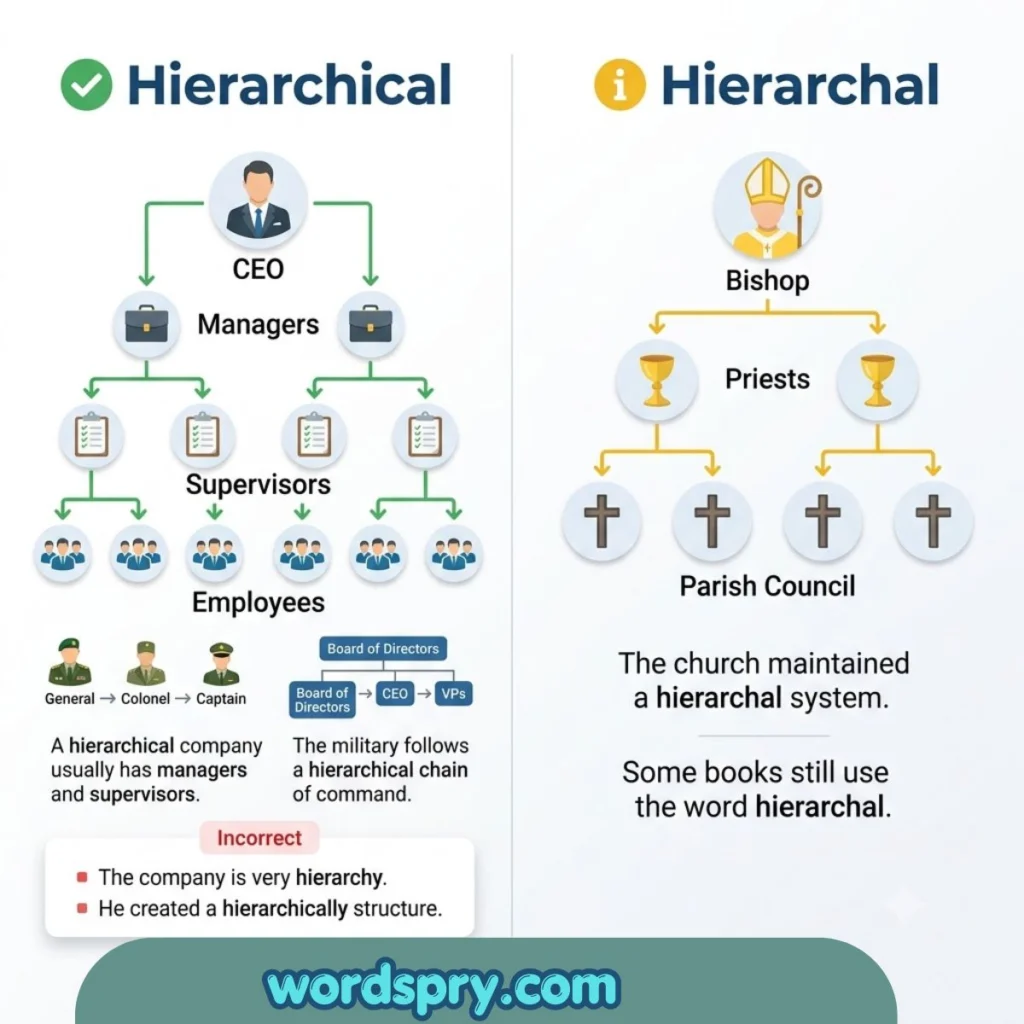
- ✅ A hierarchical company usually has managers and supervisors.
- ✅ The military follows a hierarchical chain of command.
Incorrect Usage:
- ❌ The company is very hierarchy.
- ❌ He created a hierarchically structure.
Hierarchal
Meaning: A less common variation of hierarchical.
Correct Examples:
- ✅ The church maintained a hierarchal system.
- ✅ Some books still use the word hierarchal.
Less Preferred:
- ⚠️ Modern business writing usually avoids this form.
Origin and History
Both words come from the noun hierarchy, which entered English through Greek and Latin roots.
Word Breakdown:
- Hierarchy → a ranking system
- -ical → adjective-forming suffix
- -al → another adjective-forming suffix
Over time, English speakers began using:
- Hierarchical
- Hierarchal
However, hierarchical became the dominant form in dictionaries, schools, universities, and professional writing.
That is why it sounds more natural today.
British English vs American English
Interestingly, both British and American English strongly prefer hierarchical.
There is no major regional difference here.
Common Across Both:
- ✅ hierarchical organization
- ✅ hierarchical structure
- ✅ hierarchical system
Rare in Both:
- ⚠️ hierarchal organization
So regardless of location, hierarchical remains the safer choice.
See also: Realize vs Realise: What Is the Difference and Which Spelling Should You Use?
Which Term Is the Better Choice?
Use “Hierarchical” When:
- Writing essays
- Sending emails
- Creating reports
- Posting professional content
- Writing academic papers
- Working in business or technology
Avoid “Hierarchal” Unless:
- You are quoting older texts
- You prefer stylistic variation
- The publication specifically uses it
Simple Tip:
If unsure, “always choose hierarchical.”
It is clearer, more modern, and more widely accepted.
Common Mistakes
People often confuse these forms because they sound alike.
Wrong vs Correct Examples
| Wrong | Correct |
|---|---|
| ❌ Hierarchal structure is better. | ✅ Hierarchical structure is better. |
| ❌ The system is hierarchy. | ✅ The system is hierarchical. |
| ❌ A hierarchically arranged team | ✅ A hierarchically arranged team |
Everyday Examples
Emails
- “Our company uses a hierarchical approval process.”
Social Media
- “Modern startups often avoid strict hierarchical systems.”
News Articles
- “The government introduced a more hierarchical administration model.”
Classroom
- “Biology students learn about the hierarchical classification of species.”
Daily Life
- “Large families sometimes have a hierarchical decision-making style.”
Usage Trends and Popularity
Today, hierarchical is far more popular than hierarchal.
You will notice it in:
- Academic journals
- Corporate documents
- Tech articles
- Scientific research
- Online dictionaries
Meanwhile, hierarchal appears only occasionally.
Why?
Because language naturally favors smoother and more familiar patterns. Over time, hierarchical became the dominant standard.
Comparison Table
| Feature | Hierarchical | Hierarchal |
|---|---|---|
| Meaning | Ranked structure | Same meaning |
| Commonness | Very common | Rare |
| Preferred in formal writing | ✅ Yes | ❌ Usually no |
| Dictionary accepted | ✅ Yes | ✅ Yes |
| Modern usage | Standard | Less common |
| Best for SEO/content writing | ✅ Yes | ❌ Less ideal |
Special Rules and Important Uses
In Technology
The term hierarchical structure is extremely common in:
- File systems
- Databases
- Networks
- Programming
In Business
Companies often describe:
- Hierarchical management
- Hierarchical leadership
- Hierarchical reporting
In Education
Teachers may discuss:
- Hierarchical learning systems
- Hierarchical organization charts
In all these cases, hierarchical is the preferred term.
FAQs
Q1.Is “hierarchal” a real word?
Yes. It is a real dictionary word, but it is less common than hierarchical.
Q2.Which is more correct: hierarchical or hierarchal?
Both are technically correct, but hierarchical is the standard and preferred form.
Q3.Why do people confuse hierarchical vs hierarchal?
They come from the same root word and sound very similar.
Q4.Is hierarchal outdated?
Not completely, but many writers consider it old-fashioned or uncommon.
Q5.Which word should students use?
Students should almost always use hierarchical in essays and assignments.
Q6.Is hierarchical used in technology?
Yes. It is widely used in computing, databases, and software systems.
Q7.Can I use hierarchal in formal writing?
You can, but most editors and readers prefer hierarchical.
Conclusion
The difference between hierarchical vs hierarchal is mostly about usage and popularity rather than meaning. Both words relate to systems arranged in ranks or levels. However, hierarchical is the standard form used in modern English.
You will see it far more often in schools, businesses, technology, and professional writing. Meanwhile, hierarchal survives as a less common alternative that some writers still use occasionally.
If you want your writing to sound natural, polished, and widely accepted, choose hierarchical almost every time. It is the safer option for emails, essays, articles, and workplace communication.
A simple habit can help: whenever you describe levels, ranks, or structured systems, think of the phrase “hierarchical structure.” That wording fits naturally in nearly every context.

Hi, I’m Henry Collins, the educator behind Wordspry.com
I’m dedicated to helping English learners build confidence through easy grammar explanations, writing tips, and everyday language learning resources.
Pingback: Inquiry vs Enquiry: What Is the Difference and Which Spelling Is Correct? - wordspry.com