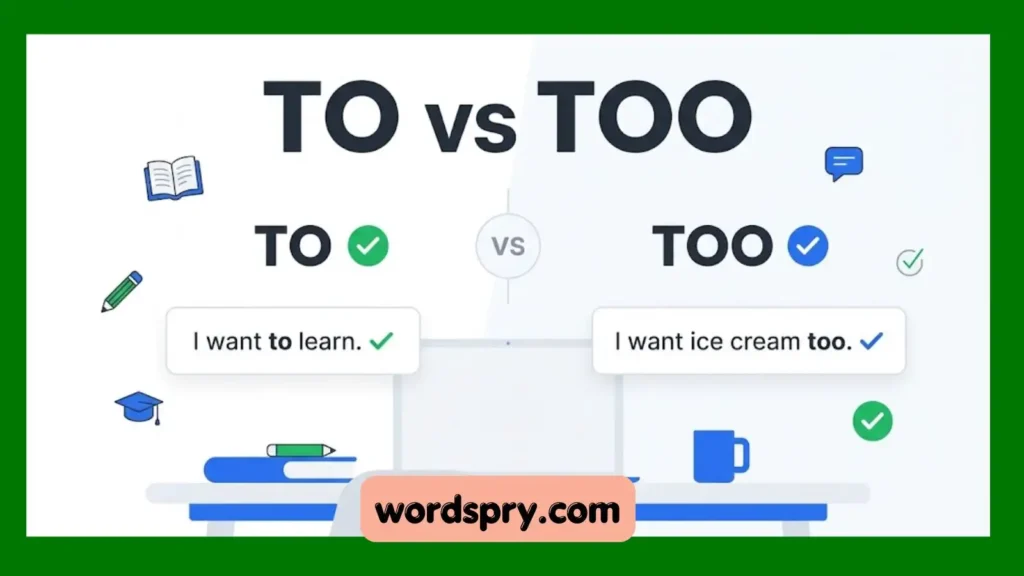
Use to for direction, purpose, or as part of an infinitive. Use too to mean “also” or “more than enough.”
Have you ever sent a text that said, “I want too go,” only to notice the mistake after pressing send? Almost everyone has mixed up these two tiny words. They sound exactly alike, yet they have different jobs in English. That is why many students, writers, and even native speakers search for to or too online.
Understanding to or too is easier than you might think. The word to often shows movement, direction, or connects a verb with another action. Meanwhile, too means “also” or “excessively.” A single extra “o” changes the meaning of your sentence.
This guide clears up the confusion once and for all. You will learn the meanings, grammar rules, examples, common mistakes, and practical tips. By the end, you will feel confident every time you choose between to or too.
Pronunciation
To
- US IPA: /tu/, /tə/
- UK IPA: /tuː/, /tə/
Too
- US IPA: /tu/
- UK IPA: /tuː/
Both words sound the same. They are homophones, which is one reason people confuse them.
Now that you know how they sound, let’s explore how they differ.
Difference Between To and Too
1. Meaning
To shows direction or purpose.
Examples:
- “We walked to school.”
- “I want to learn.”
Too means “also” or “more than needed.”
Examples:
- I want ice cream too.
- The bag is too heavy.
2. Function
To acts as a preposition or part of an infinitive.
Examples:
- Go to bed.
- She likes to read.
Too acts as an adverb.
Examples:
- He came too.
- It is too cold.
3. Movement
To often shows where someone or something goes.
Examples:
- Drive to the park.
- Send it to me.
Too never shows movement.
Examples:
- I am coming too.
- That costs too much.
4. Extra Meaning
To never means “also.”
Examples:
- Talk to your teacher.
- Return to work.
Too often means “also.”
Examples:
- She likes pizza too.
- We laughed too.
5. Excess
To cannot show excess.
Examples:
- Walk to town.
- Listen to music.
Too shows more than enough.
Examples:
- The room is too noisy.
- The soup is too hot.
6. Sentence Position
To usually comes before a noun or verb.
Examples:
- Go to work.
- Ready to leave.
Too often appears at the end or before an adjective.
Examples:
- I agree too.
- It is too late.
7. Grammar Role
To connects words.
Examples:
- Give it to Sam.
- Need to study.
Too adds meaning.
Examples:
- I want one too.
- It is too expensive.
8. Frequency
To appears in almost every English text.
Examples:
- Time to eat.
- Go to class.
Examples:
- She smiled too.
- It was too easy.
9. Common Mistakes
People often write too instead of to.
Wrong:
- I need too study.
Correct:
- I need to study.
10. Easy Memory Tip
Think of the extra O in too as extra.
Examples:
- Too much sugar.
- I want cake too.
Nature and Behaviour of To and Too
To
- Part of speech: Preposition and infinitive marker
- Shows direction, destination, purpose, or relationship
- Connects verbs in infinitive form
- Used in almost every type of writing
Too
- Part of speech: Adverb
- Means “also” or “excessively”
- Adds extra information
- Common in speech and writing
Why People Get Confused About To and Too
Several reasons cause confusion:
- They sound exactly the same.
- They look very similar.
- People type quickly.
- Autocorrect sometimes misses the error.
- English learners memorize pronunciation before spelling.
- Many children first learn them by sound instead of grammar.
Comparison Table
| Feature | To | Too |
|---|---|---|
| Meaning | Direction, purpose | Also, excessively |
| Part of speech | Preposition, infinitive marker | Adverb |
| Function | Connects ideas | Adds meaning |
| Formality | Formal and informal | Formal and informal |
| Common mistake | Written as “too” | Written as “to” |
| Example | Go to school | I came too |
| Similarity | Same pronunciation | Same pronunciation |
| Difference | Shows relationship | Shows addition or excess |
The Origin of To and Too
To
The word to comes from Old English tō. It has shown direction and purpose for more than one thousand years.
Too
The word too comes from Old English tō, meaning “besides” or “in addition.” Over time, English spelling changed, and the extra “o” helped separate its meaning from to.
British vs American English
Both British and American English use to and too the same way.
- Spelling is identical.
- Pronunciation is almost identical.
- Grammar rules are the same.
- Schools teach the same distinction.
Examples:
- UK: “I am going to London.”
- US: “I am going to New York.”
- UK:” I like tea too.”
- US:” I like coffee too.”
Which One Should You Use?
Choose to when you talk about:
- Direction
- Purpose
- Actions
- Relationships
Choose too when you mean:
- Also
- More than enough
The rule stays the same in American English, British English, business writing, academic work, emails, and social media.
Common Mistakes
❌ I want too eat.
✅ I want to eat.
❌ She went too school.
✅ She went to school.
❌ It is to expensive.
✅ It is too expensive.
❌ Me to.
✅ Me too.
❌ I have to many books.
✅ I have too many books.
Everyday Usage Examples
“I would like to schedule a meeting.”
School
“I want to improve my grades.”
Office
“Please send the report to Sarah.”
Text Message
“I’m coming too.”
Social Media
“That video was funny too.”
Newspaper
“The team traveled to France.”
Blog
“You don’t need to spend a lot.”
Academic Writing
“This study aims to explain the results.”
Usage Trends
The word to is one of the most common words in English because it appears in countless sentences. Too appears less often because it has fewer meanings. However, many online grammar searches focus on to or too because writers frequently confuse the two.
Metaphors and Similes
- “His kindness spread to everyone like sunshine.”
- “The backpack felt too heavy, like carrying a mountain.”
These examples show figurative language while keeping the correct grammar.
Connotative Meaning
Neutral
- I walked to school.
Positive
- I love this song too.
Negative
- The coffee is too bitter.
Idioms and Proverbs
Although to appears in thousands of idioms because it is a grammar word, too often appears in common expressions.
Examples:
- Too little, too late.
- Too good to be true.
Sentence:
“The offer looked too good to be true, so I checked it carefully.”
Literature and Movies
Literature
Pride and Prejudice by Jane Austen (1813), a classic romance novel, naturally uses to and too throughout its dialogue and narration because they are essential parts of English grammar.
Movies
Toy Story (1995, USA) includes everyday conversations where characters naturally use to and too in different contexts, helping learners hear them in real speech.
Why This Difference Matters
Knowing the difference helps students write better essays. It helps professionals send clearer emails. It also helps businesses appear more trustworthy. Small grammar mistakes can change how readers judge your writing.
Usefulness in Daily Life
Understanding to and too improves:
- Everyday conversations
- School assignments
- Job applications
- Business emails
- Social media posts
- Professional reports
- Online learning
A small grammar habit can make a big difference.
Situational Preference
Use to whenever you show direction, purpose, or connect a verb with another action. Use too whenever you want to say “also” or “more than enough.” Before writing, ask yourself a simple question. Am I talking about movement or purpose? If yes, choose to. Am I adding another person, another idea, or describing something excessive? If yes, choose too. This quick check works in school essays, office emails, casual texts, and formal reports.
Frequently Asked Questions
1. What is the difference between to and too?
To shows direction or purpose. Too means “also” or “more than enough.”
2. Is too always used to mean “also”?
No. It can also mean “excessively,” such as “too cold.”
3. Can to and too be pronounced differently?
No. They are usually pronounced the same.
4. How can I remember the difference?
Remember that too has an extra O, which stands for something extra.
5. Is using too instead of to a grammar mistake?
Yes. It changes the meaning and makes the sentence incorrect.
6. Which word is more common?
To is far more common because it performs many grammar functions.
7. Are the rules the same in British and American English?
Yes. Both varieties follow the same grammar rules.
Conclusion
The difference between to and too is simple once you know each word’s job. To points toward a place, shows purpose, or connects a verb in its basic form. Too means “also” or “more than enough.” Although they sound the same, they do very different jobs in a sentence.
The best way to remember them is to think about the extra O in too. That extra letter reminds you of something extra, whether it means “also” or “too much.” Reading often, writing regularly, and checking your sentences before sending them will help you avoid mistakes. With practice, choosing between to and too will become natural, making your writing clearer, stronger, and more professional.

Hi, I’m Mason Clark, the writer behind Wordspry!
My goal is to make grammar learning easier with straightforward explanations, useful examples, and engaging English lessons that help you grow every day.