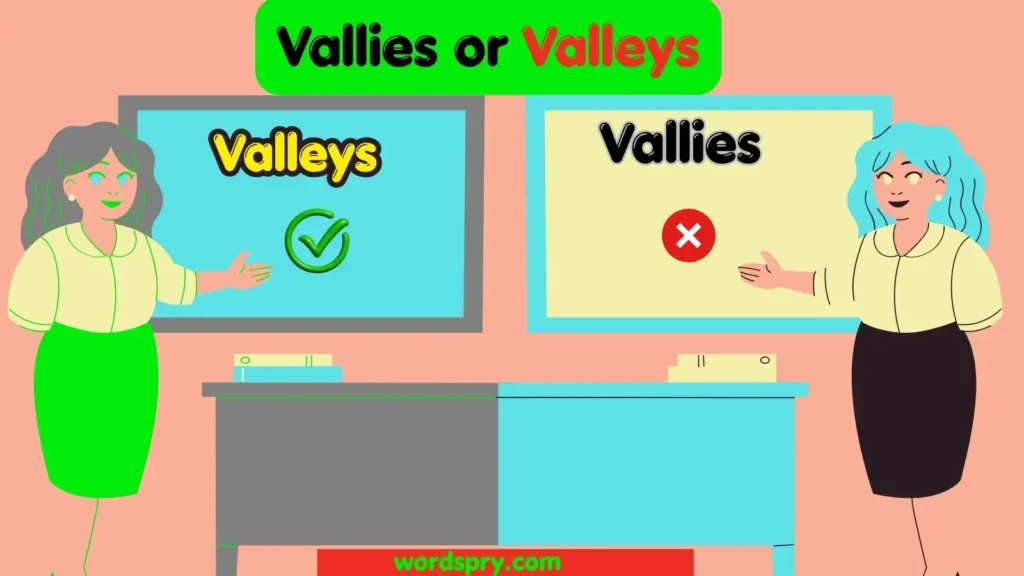
Valleys is the correct spelling; “vallies” is generally incorrect.
Valleys is the plural of valley, meaning low areas of land between hills or mountains.
Have you ever written “vallies” and wondered whether it is the correct spelling? You are not alone. This spelling can be confusing because “valleys” is the correct plural form of the common geographical word “valley,” while “vallies” is generally considered a misspelling in standard modern English.
Understanding the difference is useful for students, writers, researchers, and anyone who wants to improve their English spelling and vocabulary. In this guide, we will explain vallies or valleys, their meanings, correct spelling, pronunciation, synonyms, examples, common mistakes, and how to use the word correctly in everyday and academic writing.
Meaning of Valley
A valley is a low area of land between hills or mountains, often containing a river or stream. Valleys can be formed by rivers, glaciers, erosion, tectonic activity, and other natural processes.
For example:
The river flows through a beautiful green valley.
The plural of valley is valleys.
The region contains several deep valleys.
Therefore, when referring to more than one valley, use valleys, not “vallies.”
Five Synonyms for Valley
Depending on the context, some words that can have a similar meaning to valley include:
- Vale – a valley, especially one that is broad or picturesque.
- Dale – a valley, often used in literary or geographical descriptions.
- Glen – a narrow valley, particularly one associated with Scotland or Ireland.
- Hollow – a small valley or low area between hills.
- Depression – a general geographical term for a lower area of land.
These words are not always interchangeable because their meanings can depend on geography and context.
What Is the Correct Spelling: Vallies or Valleys?
The correct spelling is valleys when you are talking about more than one valley.
The singular form is:
Valley
The plural form is:
Valleys
Example:
- One valley
- Two valleys
- Several valleys
- Mountain valleys
- River valleys
- Deep valleys
The spelling “vallies” is normally incorrect when intended as the plural of “valley.”
Why Is It Valleys Instead of Vallies?
The spelling rule is related to how English forms plurals.
Words ending in consonant + y usually change the y to ies when forming the plural.
For example:
- baby → babies
- city → cities
- country → countries
- family → families
However, valley ends in vowel + y because the letter before the final y is e.
When a word ends in a vowel followed by y, English normally adds s rather than changing y to ies.
Examples include:
- valley → valleys
- boy → boys
- day → days
- key → keys
- toy → toys
This is why “vallies” is not the standard plural spelling.
Vallies or Valleys: The Main Difference
The easiest way to remember the difference is:
| Word | Correct? | Use |
|---|---|---|
| Valley | Yes | One low area of land |
| Valleys | Yes | More than one valley |
| Vallie | Generally no | Not the standard singular form |
| Vallies | Generally no | Not the standard plural form |
If you are writing about multiple geographical valleys, always choose valleys.
Examples of Correct Usage
Here are several examples:
- The valleys were covered with snow.
- Several valleys surround the mountain range.
- Farmers live in the fertile valleys.
- The rivers have carved deep valleys into the landscape.
- Scientists studied the ecosystems found in the mountain valleys.
Examples of Incorrect Usage
The following sentences contain the common spelling mistake:
- The vallies were covered with snow.
- Several vallies surround the mountains.
- The river flows through different vallies.
Replace vallies with valleys in each sentence.
How to Use Valley Correctly
Understanding whether you need the singular or plural form is important.
Use valley when referring to one geographical area.
The village is located in a narrow valley.
Use valleys when referring to two or more areas.
The researchers explored several valleys during the expedition.
The same distinction applies in scientific, geographical, travel, historical, and everyday writing.
Valley in Geography
In geography, a valley is generally described as an elongated low area between higher areas such as hills or mountains. Many valleys contain rivers, streams, roads, settlements, or agricultural land.
Valleys can have different shapes and origins.
River Valleys
River valleys are formed largely through erosion caused by flowing water. Over long periods, rivers can cut downward and sideways into the landscape.
These valleys may have relatively steep sides or broader floodplains depending on the stage and environment of river development.
Glacial Valleys
Glaciers can dramatically reshape landscapes. A glacier moving through a mountainous region can widen and deepen an existing valley, producing the characteristic U-shaped valley associated with glacial erosion.
V-Shaped Valleys
Young rivers often produce narrow valleys with relatively steep sides. These are commonly described as V-shaped valleys because their cross-section resembles the letter V.
U-Shaped Valleys
Glacial erosion commonly produces wider, deeper valleys with relatively steep sides and broad floors. These are known as U-shaped valleys.
Valley vs. Vale
Valley and vale can have similar meanings, but they are not always used in exactly the same way.
A vale is another word for a valley and often appears in literary, poetic, historical, or place-name contexts.
For example:
The travelers passed through a peaceful green vale.
In ordinary modern English, valley is much more common.
Valley vs. Dale
Dale is another synonym for valley. It is especially common in literary or regional English and in geographical names.
For example:
The small village lies in a quiet dale.
Again, valley is the safest general-purpose word when you want a clear and widely understood term.
Common Mistakes With Valleys
Mistake 1: Writing “Vallies”
The most common error is assuming that every word ending in y changes to ies in the plural.
This is not true.
Compare:
- city → cities
- valley → valleys
The difference is the letter immediately before the final y.
Mistake 2: Confusing Singular and Plural
Remember:
Valley = one
Valleys = more than one
Incorrect:
There are several valley in this region.
Correct:
There are several valleys in this region.
Mistake 3: Using an Incorrect Possessive Form
For one valley:
The valley’s river is polluted.
For multiple valleys:
The valleys’ rivers are polluted.
The apostrophe changes depending on whether the noun is singular or plural.
How to Remember the Correct Spelling
A simple memory trick is to look at the letter before y.
In valley, the final part is ey.
Because the word ends in vowel + y, simply add s:
valley + s = valleys
You can compare it with:
- day → days
- boy → boys
- key → keys
- valley → valleys
This pattern makes the correct spelling easier to remember.
Professional and Academic Usage
Researchers, geographers, environmental scientists, historians, and students should use valleys in formal writing when referring to multiple valleys.
For example:
Researchers compared vegetation patterns across three mountain valleys.
This sentence is clear, grammatically correct, and suitable for academic writing.
When describing geographical features, precision is especially important because spelling errors can reduce the professionalism of reports, research papers, presentations, and educational material.
Benefits of Using the Correct Spelling
Using valleys instead of “vallies” provides several advantages.
Better Communication
Correct spelling makes your meaning immediately clear to readers.
Professional Writing
Correct grammar and spelling improve the quality of academic, business, and professional documents.
Better Search Results
Correct spelling is also important for online searches and SEO. People searching for information about multiple geographical valleys are much more likely to use the standard spelling valleys.
Improved Vocabulary
Learning the difference between similar spelling patterns helps develop stronger English language skills.
Troubleshooting Guide
| Problem | Possible Cause | Solution |
|---|---|---|
| Writing “vallies” | Applying the wrong plural rule | Remember that valley ends in vowel + y, so add “s.” |
| Confusing valley and valleys | Singular/plural confusion | Use valley for one and valleys for more than one. |
| Confusing vale and valley | Similar meanings | Use valley for general modern English. |
| Spelling errors in academic work | Lack of proofreading | Check plural nouns before submitting your work. |
| Incorrect possessive form | Confusing plural and possessive forms | Use valley’s for one and valleys’ for multiple valleys. |
Professional Tips for Writers and Students
When writing about geographical features, follow these practical guidelines:
- Use valley for a single geographical depression.
- Use valleys for multiple geographical depressions.
- Avoid using vallies as the standard plural form.
- Check whether a word ending in y follows the consonant + y or vowel + y pattern.
- Proofread geographical names and terminology carefully.
- Use precise geographical vocabulary in academic writing.
- Consult a reputable dictionary when you are uncertain about spelling.
Frequently Asked Questions
Is “vallies” a correct word?
“Vallies” is generally not the standard spelling for the plural of valley. The correct plural form is valleys.
Is it valley or valleys?
Use valley when talking about one area and valleys when talking about more than one.
Why is the plural of valley valleys?
Because valley ends in vowel + y. In this pattern, English normally forms the plural by adding s, producing valleys.
What are five synonyms for valley?
Five possible synonyms are vale, dale, glen, hollow, and depression, although their meanings and appropriate contexts can differ.
What is the plural of valley?
The plural of valley is valleys.
Is vallies a misspelling?
When “vallies” is intended as the plural of valley, it is normally considered a misspelling. The standard form is valleys.
How do you pronounce valleys?
Valleys is pronounced approximately VAL-eez. The final -s has a /z/ sound.
What is the difference between valley and vale?
Both can describe a low area between higher areas, but valley is the common everyday and geographical term, while vale is more literary or traditional.
Conclusion
When choosing between vallies or valleys, the correct standard spelling for the plural of valley is valleys. The word refers to more than one low area of land, often located between hills or mountains.
The reason for the spelling is simple: valley ends in vowel + y, so its plural is formed by adding s, not by changing y to ies. Remembering this rule can help prevent one of the most common spelling mistakes involving words ending in y.
Whether you are writing a school assignment, scientific report, travel article, geographical study, or online content, using valleys will make your writing more accurate, professional, and easier to understand.

Hi, I’m Henry Collins, the educator behind Wordspry.com
I’m dedicated to helping English learners build confidence through easy grammar explanations, writing tips, and everyday language learning resources.