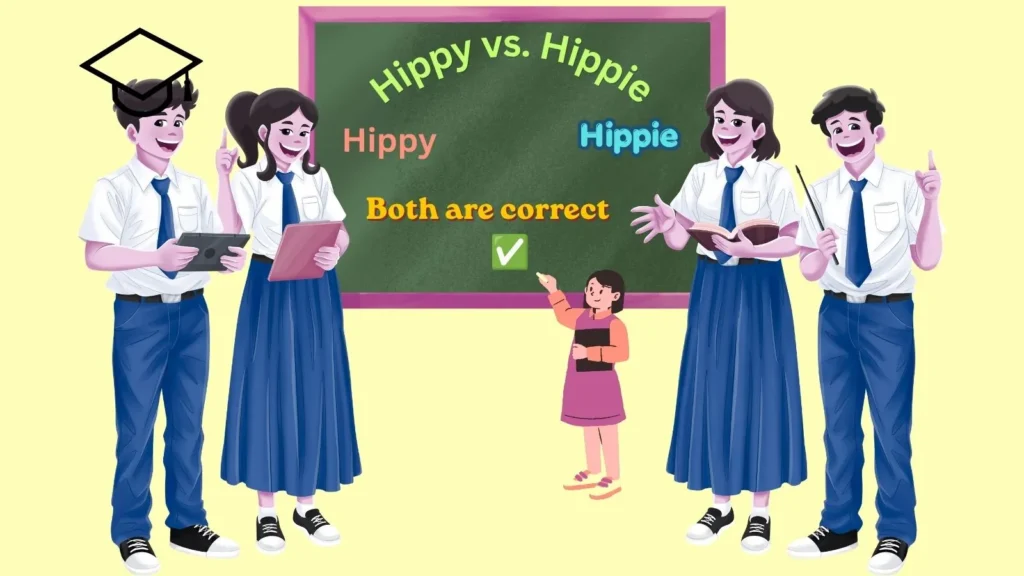
Have you ever stopped while writing hippy or hippie because you were not sure which spelling was right? Many people search for “hippy or hippie” because both words appear online, in books, and even in dictionaries. At first glance, they seem identical, but they actually have different meanings depending on the context.
The confusion often comes from the famous counterculture movement of the 1960s. Most people know members of that movement as hippies, but the spelling hippy is also a real English word. In fact, it usually describes someone with large hips or something related to the hips rather than the cultural movement.
This guide explains the difference in simple language. You’ll learn which spelling is correct, where each word came from, how British and American English use them, and which version you should choose in different situations. By the end, you’ll know exactly when to write hippy and when to write hippie with confidence.
See also: Stigmatism vs Astigmatism: Which Term Is Correct for the Eye Condition?
Hippy or Hippie – Quick Answer
The correct spelling depends on what you mean.
- Hippie = A person associated with the 1960s counterculture movement.
- Hippy = Someone with large hips or relating to hips.
Examples
✅ My grandmother was a hippie in the 1970s.
The festival attracted thousands of hippies.✅
✅ She joked that her jeans suited her hippy figure.
If you are talking about the peace-loving, free-spirited culture, hippie is almost always the correct spelling.
Hippy vs. Hippie: Synonyms and Meanings
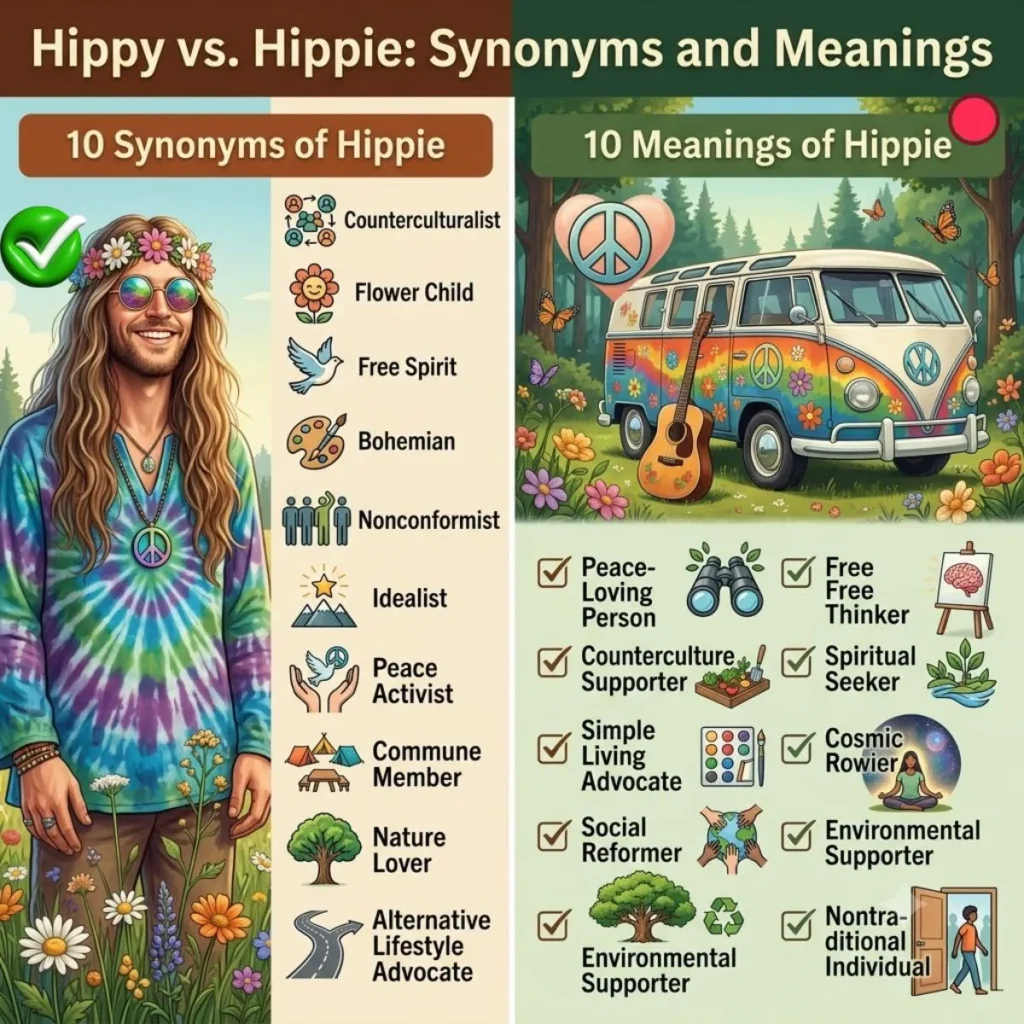
Although hippie is the standard spelling and hippy is a less common variant, both words describe a person associated with the 1960s counterculture movement that valued peace, freedom, and alternative lifestyles.
10 Synonyms of Hippie
| Synonym | Meaning |
|---|---|
| Counterculturalist | A person who rejects mainstream social values. |
| Flower Child | A peaceful young person from the 1960s hippie movement. |
| Free Spirit | Someone who lives independently and follows their own path. |
| Bohemian | A person with an artistic, unconventional lifestyle. |
| Nonconformist | Someone who refuses to follow traditional rules or customs. |
| Idealist | A person guided by high ideals and positive beliefs. |
| Peace Activist | Someone who promotes peace and opposes violence. |
| Commune Member | A person living in a shared, cooperative community. |
| Nature Lover | Someone who enjoys and respects the natural world. |
| Alternative Lifestyle Advocate | A person who embraces nontraditional ways of living. |
10 Meanings Associated with Hippie
| Meaning | Explanation |
|---|---|
| Peace-Loving Person | Someone who believes in nonviolence and harmony. |
| Counterculture Supporter | A person connected to the social movement of the 1960s. |
| Free Thinker | Someone who forms independent opinions. |
| Nature Enthusiast | A person who values the environment and outdoor living. |
| Simple Living Advocate | Someone who prefers a modest and uncomplicated lifestyle. |
| Creative Individual | A person who expresses themselves through art, music, or writing. |
| Social Reformer | Someone who supports positive social change. |
| Spiritual Seeker | A person interested in personal growth and spirituality. |
| Environmental Supporter | Someone who promotes conservation and sustainable living. |
| Nontraditional Individual | A person who chooses an unconventional way of life. |
History of the Words “Hippy” and “Hippie”
The word hippie appeared during the 1960s in the United States. It comes from the word hip, which meant fashionable, aware, or connected with modern culture. Earlier, people used the term hipster for jazz lovers and people who followed new cultural trends.
As the counterculture movement grew, young people who promoted peace, music, freedom, and simple living became known as hippies.
The spelling hippy is much older as a descriptive adjective. It simply means someone with noticeable hips or wide hips. Because both words sound the same, many writers accidentally swap them.
Why the spelling difference exists
- Hippie became the accepted spelling for the cultural movement.
- Hippy remained an adjective describing physical appearance.
- The similar pronunciation causes frequent spelling mistakes.
British English vs American English Spelling
Unlike many English words, hippie is spelled the same in both British and American English when referring to the counterculture movement.
The word hippy also exists in both varieties of English, but it keeps its different meaning.
Examples
| Meaning | British English | American English |
| 1960s counterculture member | Hippie | Hippie |
| Person with large hips | Hippy | Hippy |
Comparison Table
| Feature | Hippie | Hippy |
| Refers to 1960s culture | ✅ Yes | ❌ No |
| Means wide-hipped | ❌ No | ✅ Yes |
| Common in modern writing | ✅ Very common | ❌ Rare |
| Used worldwide | ✅ Yes | Limited |
Key point:
There is no British vs American spelling difference for this word. The spelling changes because the meanings are different, not because of regional English.
Which Spelling Should You Use?
Your audience helps determine the correct choice.
For American readers
Use hippie when discussing the 1960s movement, music festivals, or free-spirited lifestyles.
For British readers
Use hippie for the cultural meaning. Use hippy only if describing someone’s body shape.
For Commonwealth countries
Australia, Canada, New Zealand, and other English-speaking countries also prefer hippie for the counterculture movement.
For international audiences
Choose hippie unless you specifically mean someone with wide hips.
Common Mistakes with Hippy or Hippie
Many writers confuse these spellings because they sound identical.
| Incorrect | Correct |
| He was a famous hippy from the 1960s. | He was a famous hippie from the 1960s. |
| Thousands of hippys attended the festival. | Thousands of hippies attended the festival. |
| The hippie dress suited her wide hips. | The hippy dress suited her wide hips. |
Tips to remember
- Think of hippie = peace and love.
- Think of hippy = hips.
- When writing about history or culture, use hippie.
Hippy or Hippie in Everyday Examples
My father was a hippie during his university years.
News
The museum opened an exhibition about the hippie movement.
Social Media
I love the colourful hippie fashion from the 1960s.
Formal Writing
The hippie movement influenced music, fashion, and social values throughout the late twentieth century.
Describing Appearance
The tailor designed clothes for women with hippy figures.
Hippy or Hippie – Google Trends & Usage Data
Search interest strongly favours hippie because people often search for:
- Hippie meaning
- Hippie culture
- Hippie fashion
- Hippie lifestyle
- Hippie music
The spelling hippy receives much less attention because it has a limited meaning.
Popularity by Country
| Country | Most Common Search |
| United States | Hippie |
| United Kingdom | Hippie |
| Canada | Hippie |
| Australia | Hippie |
| New Zealand | Hippie |
Usage Context
| Word | Common Context |
| Hippie | Culture, history, fashion, music |
| Hippy | Body shape, physical description |
Hippy or Hippie Comparison Table
| Feature | Hippie | Hippy |
| Correct for 1960s movement | ✅ | ❌ |
| Means person with large hips | ❌ | ✅ |
| Common spelling | ✅ | Rare |
| Used in books and media | Very common | Uncommon |
| Suitable for historical writing | ✅ | ❌ |
Hippy vs. Hippie FAQs
Is hippie the correct spelling?
Yes. Hippie is the correct spelling when referring to the famous counterculture movement.
Is hippy a real word?
Yes. Hippy is a real English word that usually means someone with wide or noticeable hips.
Are hippie and hippy interchangeable?
No. They have different meanings and should not be used interchangeably.
Which spelling is more common?
Hippie is far more common in books, newspapers, websites, and everyday conversation.
Do British and Americans spell hippie differently?
No. Both use hippie for the counterculture movement.
Why do people confuse hippy and hippie?
They sound exactly the same when spoken, making spelling mistakes common.
Should I use hippie in formal writing?
Yes. It is the accepted spelling in academic, historical, and professional writing about the counterculture movement.
Conclusion
The difference between hippy and hippie is simple once you know their meanings. If you are writing about the famous 1960s counterculture, music festivals, peace movements, or free-spirited lifestyles, hippie is always the correct spelling. This is the standard form used in American English, British English, and other English-speaking countries.
The spelling hippy is also correct, but it has a completely different meaning. It describes someone with wide hips or relates to physical appearance. Because this meaning is uncommon, most people who write hippy actually intend to write hippie instead.
A helpful memory trick is to connect hippie with peace, music, and the 1960s, while hippy relates to hips. This simple rule prevents mistakes in emails, articles, academic writing, and social media posts.
Whenever you are unsure, ask yourself what you are describing. If it’s the counterculture movement, choose hippie. If it’s body shape, hippy is the correct word. Knowing this difference will make your writing clearer, more accurate, and more professional.

Hi, I’m William Parker, the creator behind Wordspry.com
I enjoy breaking down complex grammar rules into clear and practical lessons that help learners write and speak English more effectively.