✅ Quick Answer:
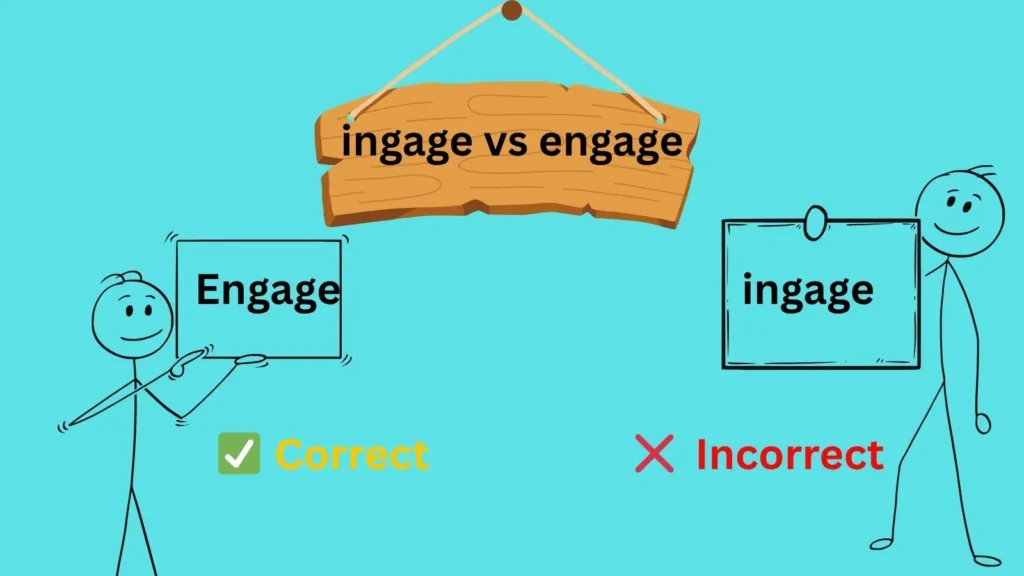
Engage is the correct English word. Ingage is usually a misspelling of engage.
Imagine writing an email to your boss or posting on social media. You type, “I want to ingage with customers.” It may look fine at first. But spell check quickly marks it wrong. Many people make this mistake because both words sound almost the same.
The confusion around ingage vs engage is very common. English learners, students, bloggers, and even native speakers often search for these words online. They want to know which spelling is correct and why people sometimes write “ingage.”
The word engage means to join, connect, involve, attract attention, or participate. On the other hand, ingage is not accepted in standard English dictionaries. It is mainly a spelling error.
See also: “Give It a Rest” Meaning: Definition, Origin, Usage, and Examples
🔹 Now let’s explore the full difference between these confusing words.
Pronunciation 🔊
| Word | US Pronunciation | UK Pronunciation |
|---|---|---|
| Engage | /ɪnˈɡeɪdʒ/ | /ɪnˈɡeɪdʒ/ |
| Ingage | /ɪnˈɡeɪdʒ/ | /ɪnˈɡeɪdʒ/ |
✅ Both sound almost the same.
❌ But only engage is correct in modern English.
Difference Between Ingage vs Engage ⚖️
1. Correctness ✅❌
Engage is correct.
Ingage is incorrect in modern English.
Examples:
- ✅ We should engage with readers.
- ❌ We should ingage with readers.
- ✅ Teachers engage students in class.
- ❌ Teachers ingage students in class.
2. Dictionary Acceptance 📖
Engage appears in dictionaries.
Ingage usually does not.
Examples:
- ✅ I found engage in the dictionary.
- ❌ I found ingage in the dictionary.
- ✅ Engage has many meanings.
- ❌ Ingage is treated as an error.
3. Professional Writing 💼
Companies use engage in business writing.
Examples:
- ✅ Engage your audience online.
- ❌ Ingage your audience online.
- ✅ Good ads engage customers.
- ❌ Good ads ingage customers.
4. School Usage 🎓
Teachers teach engage, not ingage.
Examples:
- ✅ Students should engage in debate.
- ❌ Students should ingage in debate.
- ✅ Books engage young minds.
- ❌ Books ingage young minds.
5. Grammar Rules ✍️
Engage follows standard spelling rules.
Examples:
- ✅ Please engage carefully.
- ❌ Please ingage carefully.
- ✅ Engage with the lesson.
- ❌ Ingage with the lesson.
6. Search Engine Results 🌐
Google recognizes engage more often.
Examples:
- ✅ “Engage meaning”
- ❌ “Ingage meaning”
- ✅ “How to engage users”
- ❌ “How to ingage users”
7. Usage in Media 📺
News and books use engage.
Examples:
- ✅ The article engaged readers.
- ❌ The article ingaged readers.
- ✅ Movies engage emotions.
- ❌ Movies ingage emotions.
8. Historical Usage 🕰️
Ingage appeared in old texts long ago.
Examples:
- ✅ Old writers sometimes used ingage.
- ✅ Modern writers use engage.
- ✅ Language changed over time.
- ✅ Engage became standard.
9. Popularity 📈
Engage is widely used today.
Examples:
- ✅ Brands engage customers daily.
- ❌ Brands ingage customers daily.
- ✅ Social apps engage users.
- ❌ Social apps ingage users.
10. Formal Acceptance 🏛️
Schools and publishers accept engage only.
Examples:
- ✅ Editors prefer engage.
- ❌ Editors reject ingage.
- ✅ Use engage in essays.
- ❌ Avoid ingage in exams.
Nature and Behaviour of Ingage vs Engage 🌱
Engage ✅
- Correct English verb
- Used worldwide
- Formal and informal
- Positive and active
- Common in education, business, and media
Ingage ❌
- Mostly a spelling mistake
- Rare in modern writing
- Not accepted in standard grammar
- Seen in typing errors
Why People Get Confused About Ingage vs Engage 🤔
People get confused because both words sound alike. The beginning sound “en” and “in” often create spelling mistakes in English.
Also:
- Fast typing causes errors
- Auto-correct may miss it
- Some old texts used “ingage”
- Pronunciation sounds similar
Comparison Table 📊
| Feature | Engage | Ingage |
|---|---|---|
| Correct spelling | ✅ Yes | ❌ No |
| Modern English | ✅ Common | ❌ Rare |
| Used in schools | ✅ Yes | ❌ No |
| Seen in dictionaries | ✅ Yes | ❌ Usually no |
| Professional writing | ✅ Accepted | ❌ Rejected |
| Pronunciation | Same | Same |
| Meaning | Connect or involve | Misspelling |
The Origin of Engage 🌍
The word engage came from Old French engagier. It later entered Middle English. The word originally meant “to pledge” or “bind.”
Over time, its meaning grew:
- involve
- attract
- participate
- connect
The spelling ingage appeared in older English centuries ago, but modern English standardized the spelling as engage.
British vs American English 🇬🇧🇺🇸
Both British and American English use engage.
| Type | British English | American English |
|---|---|---|
| Correct word | Engage | Engage |
| Ingage accepted? | No | No |
Examples:
- 🇬🇧 British teachers engage students.
- 🇺🇸 American brands engage customers.
Which One Should You Use? ✅
Use engage in:
- Emails
- School work
- Social media
- Business writing
- Blogs
- News articles
Avoid ingage everywhere unless discussing old historical spelling.
🌎 Global English always prefers engage.
Common Mistakes ❌
| Wrong | Correct |
|---|---|
| Ingage customers | Engage customers |
| Ingage in class | Engage in class |
| Ingage readers | Engage readers |
| Ingage users online | Engage users online |
Everyday Usage Examples 🗣️
Emails 📧
- Please engage with the client politely.
- We need to engage new customers.
Social Media 📱
- Good content engages followers.
- Funny videos engage viewers fast.
News 📰
- The campaign engaged young voters.
- Sports events engage fans worldwide.
Formal Writing 📚
- Teachers should engage students actively.
- Leaders engage communities through discussion.
Usage Trends 📈
Today, engage is extremely popular worldwide. It is common in:
- Marketing
- Education
- Politics
- Technology
- Social media
The spelling ingage appears mostly in typing mistakes or old texts.
Metaphors and Similes 🌟
Metaphors
- “Her speech engaged the crowd like a magnet.”
- “Books engage the mind.”
Similes
- “The game engaged kids like a powerful movie.”
- “His story engaged listeners like music.”
Connotative Meaning 🎭
| Word | Feeling | Example |
|---|---|---|
| Engage | Positive | Engage with your team |
| Engage | Neutral | Engage the machine |
| Ingage | Negative | Seen as incorrect spelling |
Idioms and Proverbs 💡
“Engage your brain”
Meaning: Think carefully.
Sentence:
- Please engage your brain before answering.
“Be fully engaged”
Meaning: Completely involved.
Sentence:
- She was fully engaged in the project.
Literature and Movies 🎬📚
Literature
The word engage appears in many English novels and educational books.
- Genre: Fiction and education
- Writers: Many modern authors
- Years: 1800s to today
Movies
The word is common in movie dialogue.
Examples:
- Star Trek (USA, 1966 onward) famously used: “Engage!”
- Used in science fiction and action films.
Why This Difference Matters 🌍
Correct spelling matters because it affects:
- Communication
- School grades
- Professional image
- Online credibility
Using engage shows strong English skills. Using ingage may confuse readers or appear careless.
This small difference helps learners write better English.
Usefulness in Daily Life 🛠️
Knowing the correct word helps in:
- Writing emails
- Posting online
- Creating content
- Speaking professionally
- Passing exams
Good spelling builds confidence and trust.
Situational Preference 🎯
In every modern situation, engage is the better choice. Use it in schools, offices, websites, social media posts, and formal reports. Teachers, editors, and companies all expect the standard spelling. The spelling ingage may appear in very old books or historical texts, but modern readers see it as incorrect. If you want clear communication, always choose engage. This is important for students, bloggers, writers, and business owners. Correct spelling helps people understand your message quickly and improves your professional image online and offline.
FAQs ❓
Is ingage a real word?
❌ Not in modern standard English.
Which spelling is correct?
✅ Engage is correct.
Why do people write ingage?
Because it sounds similar to engage.
Is ingage used in old English?
Yes, some old texts used it.
Should I use ingage in essays?
❌ No. Always use engage.
Do British people use ingage?
❌ No. They use engage.
Can engage mean attract attention?
✅ Yes. It often means involve or attract.
Conclusion 🏁
The debate around ingage vs engage is actually simple once you understand the spelling rules. Engage is the correct and accepted English word. It means to involve, connect, attract, or participate. The spelling ingage is mostly a mistake and should not be used in modern writing.
Many people confuse these words because they sound almost identical. Old historical texts also add to the confusion. Still, schools, dictionaries, businesses, and publishers all prefer engage today.
Using the correct spelling helps you communicate clearly. It improves your writing and makes your English look more professional. Whether you are sending emails, writing essays, posting on social media, or creating business content, choosing engage is always the safest option.
So next time you type the word, remember this easy rule:
✅ Engage = Correct
❌ Ingage = Incorrect modern spelling
Small spelling choices can make a big difference in strong communication. ✨

Hi, I’m Victoria Lane, the voice behind Wordspry!
I’m passionate about helping students and readers master English grammar, vocabulary, and writing through simple, friendly, and easy-to-follow content.