Ever typed a quick message about food and suddenly wondered whether you should write dessert or desert? You are not alone. These two words look almost identical, but one can satisfy your sweet tooth while the other can leave you searching for water.
So, what does this even mean? Is it an English spelling trap, a geography lesson, or a secret rule designed to make spelling harder than it needs to be?
The difference becomes simple once you understand what each word means. Dessert refers to sweet food served after a meal, while desert usually refers to a dry, sandy region with very little rainfall. The two words also have different pronunciations and origins.
In this guide, you will learn the meaning of each word, see their differences in clear examples, discover common mistakes, and learn an easy memory trick. By the end, you should never have to guess whether your meal ends with dessert or a desert again.
RELATED: Passtime or Pastime: Which Spelling Is Correct?
Table of Contents
- What Does Dessert vs Desert Mean?
- Background and Origin of Dessert and Desert
- Contexts Where Dessert and Desert Are Commonly Used
- Usage Across Different Platforms
- Common Misconceptions About Dessert and Desert
- Common Mistakes When Using Dessert and Desert
- Similar Words and Alternatives
- How to Remember Dessert vs Desert
- Dessert and Desert in Different Languages and Cultures
- Difference Between Dessert, Desert, and Similar Words
- Dessert and Desert in Online Conversations and Social Media
- Popularity and Trends Over Time
- Trusted References
- FAQs
- Conclusion
What Does Dessert vs Desert Mean?
Dessert means a sweet food that people typically eat after a meal. Examples include cake, ice cream, pudding, pie, and cookies.
Desert usually means a dry region that receives very little rainfall. The Sahara, Mojave, and Gobi are well-known examples.
Here is the difference at a glance:
| Word | Meaning | Example |
|---|---|---|
| Dessert | Sweet food eaten after a meal | We had chocolate cake for dessert. |
| Desert | A very dry region with little rainfall | The camel crossed the desert. |
Dessert
Dessert is a noun for a sweet course served at the end of a meal.
Example:
We ordered cheesecake for dessert.
Desert
Desert can refer to a dry geographical region.
Example:
The Sahara Desert covers a huge area of North Africa.
The word desert can also work as a verb meaning to abandon someone or something.
Example:
The soldiers were warned not to desert their post.
A Simple Memory Trick
Remember this:
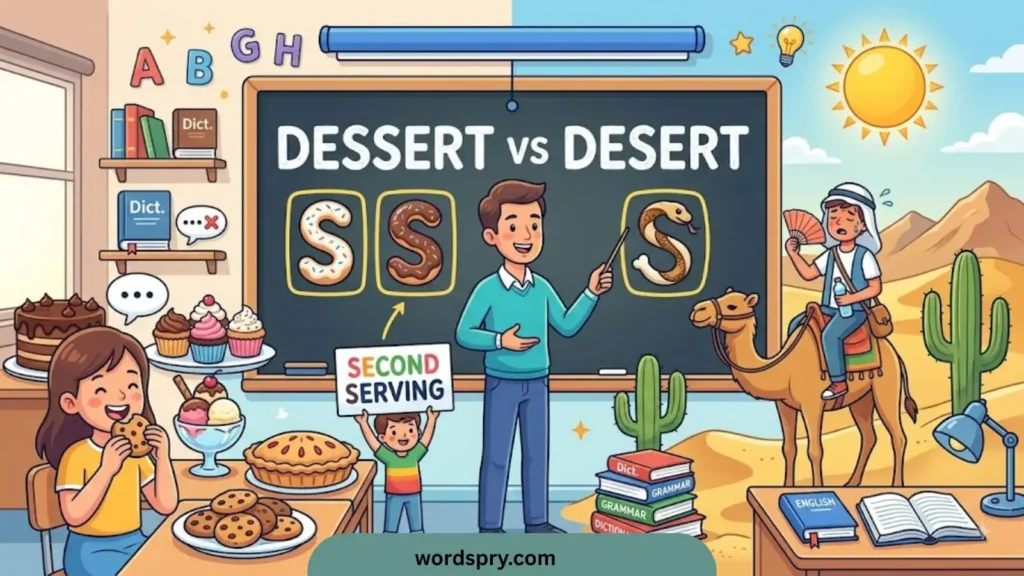
Dessert has two S’s because you always want seconds.
The extra S can remind you that you want more dessert.
Desert has only one S because you may want to leave a hot, dry desert as quickly as possible.
Quick Example
Friend 1: “What are we having after dinner?”
Man 2 “Chocolate cake for dessert!”
Friend 1: “Great. I was worried you said desert.”
That one extra S can save your sentence from becoming a geography lesson.
Background & Origin of Dessert and Desert
Although dessert and desert look similar, they developed from different historical roots.
The noun dessert comes from French desservir, which means “to clear the table.” Over time, the word became associated with food served after the main meal.
The geographical noun desert comes through French from Latin desertum, meaning a deserted or abandoned place. It eventually developed its modern meaning of a dry, sparsely populated region.
The verb desert shares the same general historical family and means to abandon or leave.
Why Do They Look So Similar?
English borrowed both words from other languages, and their spellings eventually became very close.
The biggest difference appears in the spelling:
- Dessert = two S’s
- Desert = one S
Their meanings, however, remain completely different.
Unlike modern internet slang, these words did not become popular through Reddit, Discord, TikTok, gaming, or Snapchat. They have centuries of history behind them.
Contexts Where Dessert and Desert Are Commonly Used
In Serious Conversations
Both words appear frequently in ordinary and formal English.
Dessert:
“The restaurant offers several dessert options.”
Desert:
“The researchers studied wildlife in the desert.”
Between Friends
Friends often use dessert when discussing food.
Example:
“Do you want ice cream for dessert?”
They may also use desert when talking about travel.
Example:
“I would love to visit the desert someday.”
Online Gaming
These words can appear in gaming conversations when players discuss maps, environments, or food.
Example:
“This desert map has almost no water.”
A player might also joke about dessert after a gaming session:
Example:
“Pizza first, dessert later!”
Social Media
Social media posts often use dessert in food content.
Examples include:
- Dessert recipes
- Cake photos
- Ice cream reviews
- Restaurant recommendations
- Baking videos
Desert appears frequently in travel photography, nature content, and geography posts.
Dating Apps
Dessert might appear in casual conversations about restaurants or dinner dates.
Example:
“Coffee or dessert after dinner?”
Desert might appear when someone discusses travel plans.
Example:
“I’ve always wanted to take a desert road trip.”
Usage Across Different Platforms
| Platform | Example | Notes |
|---|---|---|
| “What dessert did you order?” | Casual conversation | |
| Messenger | “Let’s get dessert tonight.” | Common in friendly chats |
| Discord | “This game has a huge desert map.” | Gaming or community discussions |
| TikTok | “Easy dessert recipe!” | Food content |
| “Best dessert in town.” | Food and restaurant posts | |
| Twitter/X | “That dessert looks amazing.” | Comments and reactions |
| Snapchat | “Desert sunset!” | Travel and lifestyle content |
| Slack | “The team ordered dessert.” | Workplace conversation |
| Teams | “We’ll have dessert after lunch.” | Professional but casual |
Unlike slang acronyms, these words do not change meaning simply because someone uses them online.
Common Misconceptions About Dessert and Desert
Misconception 1: Dessert and desert mean the same thing
They do not.
Dessert means sweet food, while desert usually means a dry region.
Misconception 2: Desert always refers to sand
Not every desert consists entirely of sand.
Deserts can contain rocks, gravel, mountains, salt flats, and other landscapes. The defining feature involves extremely low precipitation.
Misconception 3: Dessert always comes after dinner
Dessert commonly follows a meal, but people can enjoy sweet foods at many times of day.
For example:
“Let’s have ice cream for dessert after lunch.”
Misconception 4: The extra S does not matter
It absolutely matters.
Changing dessert to desert changes the meaning completely.
Common Mistakes When Using Dessert and Desert
Mistake 1: Writing “desert” when you mean sweet food
Incorrect:
“We had ice cream for desert.”
Correct:
“We had ice cream for dessert.”
Mistake 2: Writing “dessert” for a dry region
Incorrect:
“The camel crossed the dessert.”
Correct:
“The camel crossed the desert.”
Mistake 3: Forgetting the memory trick
If you constantly mix them up, remember:
Dessert = two S’s = seconds.
You want seconds of dessert.
Mistake 4: Relying only on pronunciation
In many varieties of American English, dessert and the geographical noun desert have different pronunciations.
- Dessert: dih-ZURT
- Desert: DEZ-ert
The verb desert is pronounced differently from the geographical noun:
- Desert: dih-ZURT
So context matters.
Similar Words and Alternatives
| Word | Meaning | When to Use It |
|---|---|---|
| Dessert | Sweet food after a meal | Food discussions |
| Sweet | A sweet food or candy | General food talk |
| Pastry | Baked food made with dough | Bakery items |
| Desert | Dry geographical region | Geography and travel |
| Wasteland | Barren or unproductive land | Descriptions of harsh areas |
| Arid region | Very dry area | Geography and science |
There is no true synonym that can replace dessert in every sentence. Likewise, desert has several possible alternatives depending on its meaning.
How to Remember Dessert vs Desert
The easiest trick is:
Dessert = two S’s = seconds.
Imagine sitting at a restaurant.
You finish your meal.
The server asks, “Would you like dessert?”
You immediately say, “Yes, and I’ll have seconds!”
That mental connection makes the spelling easier to remember.
For desert, think about the dry landscape.
Desert = one S = sand and sun.
You can also remember the phrase:
You want seconds of dessert, but you do not want to get stranded in the desert.
Dessert and Desert in Different Languages and Cultures
Different languages use different words for these concepts, so English learners often encounter spelling challenges.
| Language | Dessert | Desert |
|---|---|---|
| Spanish | postre | desierto |
| Arabic | حلوى / تحلية | صحراء |
| Hindi | मिठाई / डेज़र्ट | रेगिस्तान |
| Urdu | میٹھا / ڈیزرٹ | صحرا |
| Tagalog | panghimagas | disyerto |
| Tamil | இனிப்பு / டெசர்ட் | பாலைவனம் |
| Malayalam | മധുരപലഹാരം | മരുഭൂമി |
| Marathi | मिष्टान्न | वाळवंट |
English speakers around the world may also use the English word dessert in restaurants, menus, recipes, and online content.
Difference Between Dessert, Desert, and Similar Words
The biggest distinction involves meaning and pronunciation.
| Word | Pronunciation | Meaning |
|---|---|---|
| Dessert | dih-ZURT | Sweet food |
| Desert | DEZ-ert | Dry region |
| Desert | dih-ZURT | To abandon |
| Deserted | dih-ZUR-tid | Empty or abandoned |
Notice something interesting: desert can have two pronunciations because it can function as different parts of speech.
That makes English slightly mischievous.
Dessert and Desert in Online Conversations and Social Media
Both words appear frequently online, but they usually appear in completely different contexts.
Memes
Dessert often appears in food memes.
Example:
“Me: I’m full.
Also me: Who wants dessert?”
TikTok
Food creators often use dessert in recipes, reviews, and baking videos.
Travel creators may use desert for landscapes, road trips, and adventure content.
You might see:
“Best dessert I’ve ever had!”
or:
“Sunset in the desert.”
Gaming
Desert commonly describes game environments, maps, or levels.
Discord and Reddit
Users may discuss recipes, restaurants, travel, geography, or jokes involving the two spellings.
Group Chats
The words often appear naturally:
“Want dessert?”
versus:
“Did you see that desert photo?”
The surrounding context usually makes the intended meaning obvious.
Popularity & Trends Over Time
Unlike internet slang, dessert and desert have remained standard English words for centuries.
| Period | Usage Trend |
|---|---|
| Before 1700 | Both words had established historical roots |
| 1700–1900 | Their modern English meanings became well established |
| 1900–2000 | Both became common in everyday American English |
| 2000–Present | Both remain widely used in speech, writing, media, and online communication |
Modern social media has not fundamentally changed their meanings.
However, online spelling mistakes can make the confusion more visible because people write these words quickly in captions, comments, and messages.
Trusted References
For additional information about these words, consult reliable dictionary resources such as:
- Cambridge Dictionary
- Merriam-Webster
- Oxford Learner’s Dictionaries
- Dictionary.com
These resources provide definitions, pronunciation information, usage examples, and historical details.
FAQs
What is the difference between dessert and desert?
Dessert means a sweet food eaten after a meal, while desert usually means a dry region with very little rainfall.
How do I remember dessert vs desert?
Remember that dessert has two S’s because you want seconds. This simple trick can help you remember the spelling.
Is desert always a place with sand?
No. Deserts can contain sand, rocks, gravel, mountains, or salt flats. Their defining characteristic involves very low precipitation.
Why does dessert have two S’s?
The spelling developed from the French word desservir. Today, the two S’s also provide a useful memory clue: you want seconds of dessert.
Is desert also a verb?
Yes. As a verb, desert means to abandon or leave someone or something.
Example:
“He decided not to desert his team.”
Which is correct: “ice cream for desert” or “ice cream for dessert”?
The correct sentence is:
“I had ice cream for dessert.”
Use dessert when you mean sweet food.
Conclusion
The difference between dessert vs desert looks small, but that extra S changes everything. Dessert is the sweet treat you enjoy after a meal, while desert usually describes a dry region with very little rainfall. The word desert can also function as a verb meaning to abandon someone or something.
If spelling these words feels tricky, use the easiest memory trick: dessert has two S’s because you want seconds. Picture yourself enjoying another slice of cake, another scoop of ice cream, or one more cookie. Suddenly, those two S’s make perfect sense.
So, the next time you write about dinner, travel, or a sandy landscape, pause for one second. You will know exactly which word belongs there. After all, nobody wants to order a desert when they meant dessert!

Hi, I’m Henry Collins, the educator behind Wordspry.com
I’m dedicated to helping English learners build confidence through easy grammar explanations, writing tips, and everyday language learning resources.