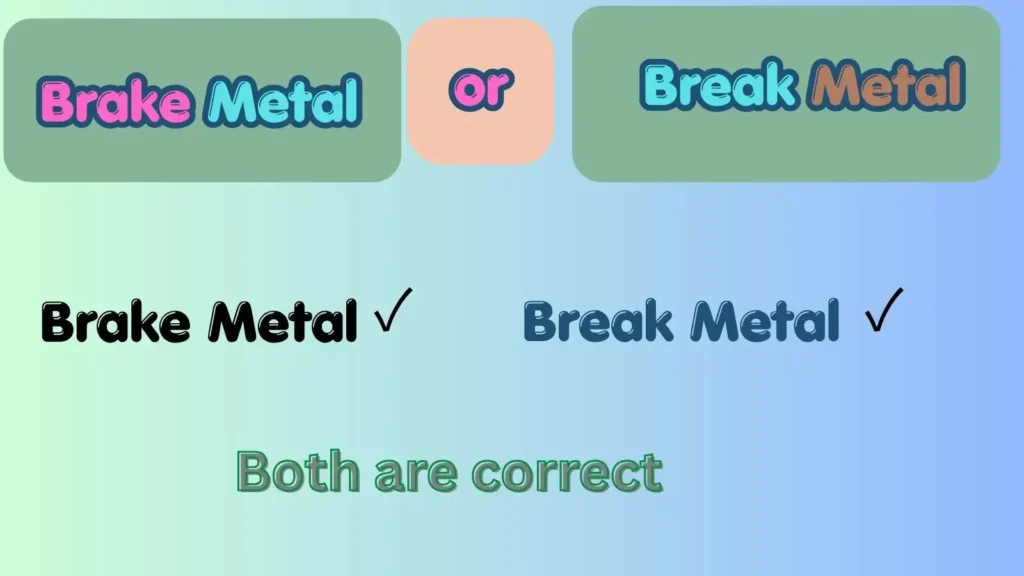
Brake metal or break metal can be confusing because these phrases contain words that sound alike but have very different meanings. If you have ever wondered whether you should write “brake metal” or “break metal,” the answer depends on what you are trying to say.
In standard English, brake relates to stopping or slowing movement, while break means to damage, split, crack, or separate something. Therefore, neither phrase automatically works as a standard expression without additional context.
This guide explains the difference between brake and break, shows you the correct usage, and provides simple examples. You will also learn related synonyms, antonyms, common mistakes, and practical sentence patterns.
RELATED: Ingage vs Engage: Which Word Is Correct and When Should You Use It?
Quick Answer: Brake Metal or Break Metal
“Brake metal” and “break metal” do not normally function as interchangeable phrases in standard English.
Brake is connected with a mechanism that slows or stops motion. Break describes an action that damages, fractures, separates, or interrupts something.
Examples:
- ✅ The mechanic repaired the brake system.
- ✅ Be careful not to break the metal.
- ❌ I need to brake the metal into pieces.
- ❌ The machine will break the car by using its brake.
If you mean metal used for or shaped by a brake, the correct wording depends on the technical context. However, if you mean damaging or splitting metal, break the metal is the natural expression.
What Does Brake Mean?
Brake is primarily a noun or verb associated with stopping or slowing movement.
As a noun, a brake is a mechanical device that reduces the speed of a vehicle, machine, wheel, or other moving object. Cars, bicycles, trains, and industrial equipment can all have braking systems.
For example:
The driver pressed the brake to stop the car.
As a verb, brake means to slow down or stop something that is moving.
She braked suddenly when a dog crossed the road.
Synonyms of Brake
Depending on the context, useful synonyms include:
- slow
- stop
- halt
- restrain
- reduce
- decelerate
- check
However, these words are not always perfect replacements. For example, decelerate means to reduce speed, whereas brake often refers specifically to using a braking mechanism.
Antonyms of Brake
Common opposites include:
- accelerate
- speed up
- advance
- proceed
- continue
For instance, brake and accelerate represent opposite actions when driving.
What Does Break Mean?
Break has several meanings, making it one of the more versatile words in English.
As a verb, it can mean to damage something physically, separate an object into pieces, interrupt something, or stop following a rule.
For example:
Do not break the glass.
When talking about metal, break can describe cracking, fracturing, or separating the material.
Excessive pressure may break the metal.
The word can also describe interruption:
We need to break the silence.
It can even refer to violating a rule:
He decided to break the agreement.
Therefore, break has a much broader range of meanings than brake.
Brake vs. Break: Main Difference
The easiest way to remember the distinction is to connect each word with its basic idea.
| Word | Meaning | Example |
|---|---|---|
| Brake | Slow or stop movement | Press the brake. |
| Break | Damage or separate something | Do not break the metal. |
| Brake | A stopping mechanism | The brake needs repair. |
| Break | Interrupt something | Take a short break. |
Although brake and break sound almost identical, their meanings differ considerably. They are therefore homophones: words that sound alike but have different spellings and meanings.
When Should You Use Brake?
Use brake when you are discussing stopping or reducing movement.
This word commonly appears in automotive, mechanical, transportation, and engineering contexts.
Examples:
- Press the brake gently before turning.
- The mechanic replaced the worn brake pads.
- The bicycle brake stopped working properly.
- He had to brake suddenly to avoid the obstacle.
- The train began braking before reaching the station.
Here, the meaning involves slowing, stopping, or controlling movement.
Related Words
Some related terms include:
- braking system
- brake pedal
- brake pad
- brake disc
- brake fluid
- emergency brake
- hand brake
- braking force
These expressions all relate to stopping or controlling motion.
When Should You Use Break?
Use break when you mean damage, fracture, split, interrupt, or separate.
When discussing metal, the verb usually describes physical damage or structural failure.
Examples:
- The heavy pressure could break the metal.
- The worker accidentally broke the metal rod.
- Extreme force may cause the metal to break.
- The machine broke the thin metal sheet.
- The old wire may break under tension.
In these examples, break refers to physical damage or separation.
Is “Break Metal” Correct?
Yes, “break metal” can be grammatically correct, but its meaning depends on the sentence.
For example:
The machine can break metal under extreme pressure.
Here, break functions as a verb. It means to damage, fracture, or separate the metal.
However, simply saying “break metal” without context can sound incomplete. A clearer sentence usually identifies the subject and action.
Instead of:
Break metal.
You could write:
The hydraulic press can break thick metal sheets.
This version gives the reader a clearer picture of what is happening.
Is “Brake Metal” Correct?
“Brake metal” is not normally used to mean damaging or splitting metal.
If you write:
The machine will brake the metal.
the sentence is generally incorrect if you mean the machine will damage the metal.
The correct word would usually be:
The machine will break the metal.
However, brake can appear with technical references to metalworking equipment. For example, a press brake is a machine used to bend sheet metal.
This distinction is important because “brake” can be technically related to metalworking without meaning “damage metal.”
Press Brake and Metalworking
A press brake is a machine used to bend sheet metal into specific shapes. It is widely associated with manufacturing, fabrication, construction, and engineering.
For example:
The technician used a press brake to bend the steel sheet.
Notice that brake is part of the technical name press brake. It does not mean that the machine “brakes” the metal in the ordinary sense of stopping it.
Therefore, if you encountered brake metal in an industrial or manufacturing context, the surrounding sentence matters.
Common Mistakes With Brake and Break
Because these words sound alike, writers often confuse them.
Mistake 1: Using Brake for Damage
❌ The pressure will brake the metal.
✅ The pressure will break the metal.
The second sentence is correct because the meaning involves damaging or fracturing metal.
Mistake 2: Using Break for a Vehicle Mechanism
❌ The mechanic repaired the break.
✅ The mechanic repaired the brake.
The correct word is brake because the sentence refers to a vehicle’s stopping mechanism.
Mistake 3: Confusing Brake With Break
❌ I need to break before the red light.
✅ I need to brake before the red light.
Here, brake means slow down or stop the vehicle.
Brake or Break: Easy Memory Trick
A simple memory trick can help you remember these words.
Think of brake = vehicle.
A car uses a brake to slow down or stop.
Then remember break = damage.
You can break glass, wood, plastic, or metal.
You can also remember:
Brake → stop
Break → damage
This small association can prevent many spelling mistakes.
Synonyms and Antonyms
Understanding synonyms and antonyms can make the distinction easier.
Synonyms for Brake
- slow
- stop
- halt
- restrain
- check
- decelerate
Antonyms for Brake
- accelerate
- speed up
- advance
- proceed
Synonyms for Break
- crack
- fracture
- split
- damage
- shatter
- rupture
- separate
Antonyms for Break
Depending on the meaning, possible opposites include:
- repair
- fix
- join
- connect
- preserve
- maintain
For example, break and repair can be opposites when discussing damaged equipment.
Brake Metal or Break Metal: Which Should You Use?
The answer depends on your intended meaning.
Use break metal when you mean damage, fracture, crack, or separate metal.
Use brake when discussing slowing or stopping movement.
If you are talking about metal fabrication, you may also encounter technical terms such as press brake, which refers to machinery used to bend sheet metal.
Therefore, always examine the surrounding words before choosing between brake and break.
Frequently Asked Questions
Is “break metal” grammatically correct?
Yes. “Break metal” can be correct when “break” means to damage, fracture, or separate metal.
Is “brake metal” correct English?
Not usually when you mean damaging metal. However, brake can appear in technical terms such as press brake, a machine used for bending sheet metal.
What is the difference between brake and break?
Brake relates to slowing or stopping movement, while break generally means to damage, fracture, separate, or interrupt something.
How do I remember brake and break?
Remember brake = stop and break = damage. This simple association works in many everyday situations.
Can metal break?
Yes. Metal can break, crack, fracture, bend, or deform when exposed to excessive force, stress, heat, or other conditions.
Conclusion
The difference between brake metal and break metal becomes much easier once you understand the meanings of brake and break. Brake relates to slowing or stopping movement, while break commonly means damaging, cracking, fracturing, or separating something.
So, if you mean that force can damage a piece of metal, say “break the metal.” If you are discussing a vehicle’s stopping mechanism, use “brake.” In technical manufacturing language, remember that press brake is a specialized term for equipment used to bend sheet metal.
When in doubt, connect brake with stopping and break with damage. This quick trick can help you choose the right word confidently.

Hi, I’m Liam Harper, the voice behind Wordspry!
I’m here to make English grammar simple, clear, and easy to understand for learners of all levels. Through practical lessons and helpful guides, I aim to help you improve your writing and communication skills with confidence.