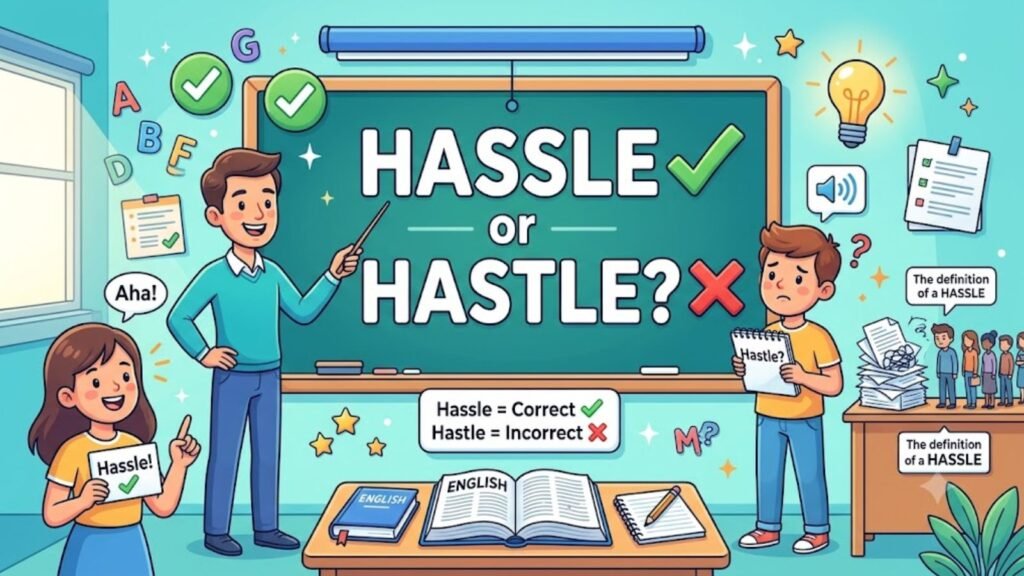
Quick answer: Hassle is the correct English word. Hastle is a common misspelling and should not be used in standard English.
Have you ever typed a word quickly and then stopped to check the spelling? You may have written, “This is such a hastle,” and wondered if something looked wrong. You are not alone. Many English learners mix up hassle and hastle because both spellings look possible. The correct form, however, is hassle.
The word hassle means trouble, difficulty, or something that causes extra work. It can also mean to annoy or bother someone. For example, you might say, “Getting a visa can be a hassle.” You can also say, “Stop hassling me.”
Hastle does not have a standard meaning in modern English. It usually appears because someone forgets the second s in hassle.
This small spelling mistake can matter in school, work, emails, and online writing. Knowing the difference helps you write with confidence and avoid an easy error.
RELATED: Hierarchical vs Hierarchal: Which Word Should You Use?
🔊 Pronunciation
| Word | US Pronunciation | UK Pronunciation | Status |
|---|---|---|---|
| hassle | /ˈhæs.əl/ | /ˈhæs.əl/ | ✅ Correct |
| hastle | No standard pronunciation as an English word | No standard pronunciation as an English word | ❌ Misspelling |
If someone intends to say hassle but writes hastle, they normally pronounce it like hassle.
Now, let’s look at the difference in a simple way.
Difference Between Hassle and Hastle
1. Correct Spelling
Hassle is the correct spelling.
Hastle is incorrect in standard English.
Examples:
- ✅ The trip was a hassle.
- ❌ The trip was a hastle.
2. Dictionary Status
Hassle appears in standard English dictionaries.
Hastle is not the normal dictionary spelling of this word.
Examples:
- “Moving house can be a hassle.”
- “I do not want the hassle of changing banks.”
3. Meaning
Hassle means trouble, inconvenience, or extra effort.
Hastle has no standard meaning when used as a spelling of this word.
Examples:
- The paperwork was a hassle.
- Parking downtown is a hassle.
4. Noun Use
Hassle can work as a noun.
It describes an annoying problem or difficult situation.
Examples:
- The long line was a hassle.
- Getting a refund became a hassle.
5. Verb Use
Hassle can also work as a verb.
As a verb, it means to annoy, bother, or pressure someone.
Examples:
- Please stop hassling me.
- The salesperson hassled us all afternoon.
6. Spelling Pattern
The correct word contains ss:
has + sle = hassle
The incorrect form drops one s:
hastle ❌
Examples:
- hassle → correct
- hastle → incorrect
7. Formal Writing
Use hassle in both everyday and formal writing when the meaning fits.
Avoid hastle because readers may see it as a spelling error.
Examples:
- The new system reduces paperwork hassles.
- The process caused unnecessary hassle.
8. Common Online Mistake
People often type hastle because the letters t and s can feel easy to mix up.
Autocorrect may also fail to catch every spelling mistake.
Examples:
- ❌ “What a hastle!”
- ✅ “What a hassle!”
9. Related Forms
The correct word creates several useful forms.
These include hassled, hassling, and hassles.
Examples:
- I was hassled by the seller.
- Stop hassling your brother.
10. Meaning in Daily Speech
Hassle is common in everyday English.
People use it when something takes too much time, effort, or patience.
Examples:
- Traveling with children can be a hassle.
- Finding a parking space is a hassle.
📌 Simple rule: If you mean trouble or inconvenience, always choose hassle, not hastle.
Nature and Behaviour of Hassle and Hastle
Hassle
Hassle has two main uses.
As a noun, it means trouble or inconvenience.
The paperwork was a hassle.
As a verb, it means to bother or pressure someone.
The staff kept hassling him.
It often describes something that is not impossible but is annoying, tiring, or time-consuming.
Hastle
Hastle is not the standard spelling of this word.
It normally appears because of a spelling mistake.
So, if you want to describe trouble or annoyance, use hassle.
Why People Get Confused About Hassle and Hastle
The confusion comes mainly from spelling.
English contains many words with unusual letter patterns. Learners may expect hastle because words such as castle contain stle.
The word hassle, however, uses ss before the final le.
Another reason is fast typing.
When people write quickly, they may accidentally replace one s with t.
The sound does not strongly reveal the spelling either. That makes the error easy to repeat.
💡 Memory trick: Think of hassle as something that causes stress. Both words contain ss.
Comparison Table
| Feature | Hassle | Hastle |
|---|---|---|
| Correct spelling | ✅ Yes | ❌ No |
| Standard English | ✅ Yes | ❌ No |
| Meaning | Trouble or annoyance | No standard meaning |
| Noun | ✅ Yes | ❌ No |
| Verb | ✅ Yes | ❌ No |
| Common in speech | ✅ Yes | ❌ No |
| Used in emails | ✅ Yes | ❌ No |
| Used in formal writing | ✅ Yes | ❌ No |
| Used in social media | ✅ Yes | ❌ No |
| Common spelling error | No | ✅ Yes |
The Origin of Hassle
The history of hassle is not completely certain.
The noun hassle, meaning “fuss” or “trouble,” is recorded in American English from the 1940s. The verb appeared soon after. Historical sources suggest several possible origins, but no single origin has been proved with complete certainty.
One possible connection is an older dialect word meaning to pant or breathe noisily. Another theory links it to older words connected with harassment or rough treatment.
What matters for modern writers is simple:
Hassle is the established English word.
Hastle is not an accepted alternative spelling.
British vs American English
There is no major British-American spelling difference here.
Both American English and British English use:
hassle
For example:
🇺🇸 American English:
Moving to a new apartment is a hassle.
🇬🇧 British English:
Moving to a new flat is a hassle.
The spelling stays the same.
The verb also stays the same:
- hassle
- hassles
- hassled
- hassling
So, unlike words such as color/colour or center/centre, this word does not change spelling between the two major varieties of English.
Which One Should You Use?
🇺🇸 In American English
Use hassle.
Dealing with traffic is a hassle.
🇬🇧 In British English
Use hassle.
The paperwork was a real hassle.
🌎 In Global English
Use hassle.
It is widely understood and works well in everyday English.
❌ Avoid hastle unless you are intentionally discussing the spelling mistake itself.
Common Mistakes
❌ Hastle
Wrong:
Booking a flight was a hastle.
Correct:
Booking a flight was a hassle.
❌ Hastled
Wrong:
The customer was hastled by the seller.
Correct:
The customer was hassled by the seller.
❌ Hastling
Wrong:
Stop hastling me.
Correct:
Stop hassling me.
❌ Hastles
Wrong:
I hate these little hastles.
Correct:
I hate these little hassles.
❌ A Lot of Hastle
Wrong:
It caused a lot of hastle.
Correct:
It caused a lot of hassle.
⭐ Remember: The correct family is hassle → hassles → hassled → hassling.
Everyday Usage Examples
📧 In Emails
Please let me know if there is any hassle with the payment.
We want to make the return process simple and hassle-free.
📱 On Social Media
Airport security was such a hassle today!
No more parking hassle!
📰 In News Writing
The new service aims to reduce travel hassles.
Residents say the new rule creates unnecessary hassle.
📝 In Formal Writing
The new process should reduce administrative hassle.
Online payment can remove several common hassles.
💬 In Conversation
Is it a hassle to get there?
Not really. It is quite easy.
Usage Trends
Hassle remains a common everyday English word.
People use it when talking about travel, work, shopping, paperwork, technology, transport, and daily problems.
It also appears often in the phrase hassle-free.
For example:
- hassle-free booking
- hassle-free service
- hassle-free returns
- hassle-free payment
- hassle-free travel
The misspelling hastle may appear in informal online writing, but that does not make it correct.
Search engines, spell-checkers, and language tools may help writers catch this error.
Metaphors and Similes
The word hassle can also appear in figurative expressions.
As a Metaphor
This paperwork is a mountain of hassle.
Here, mountain shows that the problem feels very large.
As a Simile
The trip was like a giant hassle.
The comparison makes the inconvenience sound stronger.
More Examples
Moving house felt like fighting a storm of hassles.
The new system turned into a maze of hassle.
These examples use creative language to make an ordinary problem feel more vivid.
Connotative Meaning
The word hassle usually has a negative feeling.
🔴 Negative Meaning
Dealing with this office is a hassle.
The speaker feels annoyed.
🟡 Neutral Meaning
The application process involves some hassle.
The sentence simply reports difficulty.
🟢 Positive Context
The word itself is rarely positive. However, something can be described as hassle-free, which creates a positive meaning.
The website offers a hassle-free checkout.
Here, hassle-free means easy and smooth.
Idioms and Proverbs
Hassle does not appear in many old English proverbs.
However, modern English has several common expressions built around it.
Hassle-Free
This means easy and without trouble.
The hotel offers hassle-free check-in.
No Hassle
This means there is little or no trouble.
You can return the item with no hassle.
Hassle Someone
This means to annoy, bother, or pressure someone.
Please do not hassle me while I am working.
Give Someone a Hard Time
This is a related expression.
My brother gave me a hard time about my new haircut.
It does not mean exactly the same thing, but both expressions can describe annoyance or pressure.
Literature and Movies
The word hassle fits naturally into modern American English because it has a casual, conversational feel.
A useful literary example is The Catcher in the Rye, a coming-of-age novel by J. D. Salinger, published in 1951. The novel is known for its informal voice and strong use of everyday speech. That style shows why words such as hassle feel natural in modern dialogue.
In movies, casual words like hassle often appear in conversations about work, money, travel, relationships, and everyday problems. American films from the late twentieth century onward frequently use this kind of informal vocabulary because it sounds natural in spoken dialogue.
The key point is that hassle belongs to normal modern English, especially casual speech.
Why This Difference Matters
A one-letter mistake can change the quality of your writing.
If you write hastle instead of hassle, readers may understand your meaning, but they will probably notice the spelling error.
This matters more in:
- school assignments
- job applications
- business emails
- websites
- blog posts
- social media
- professional documents
Correct spelling also builds trust.
When readers see clean writing, they are more likely to view the writer as careful and reliable.
For English learners, learning this difference also helps build better spelling habits.
Usefulness in Daily Life
You can use hassle in many everyday situations.
At Work
The new paperwork is a hassle.
While Traveling
Finding a taxi was a hassle.
While Shopping
Returning the product was a hassle.
With Technology
Setting up the printer is a hassle.
At Home
Cleaning the garage is a hassle.
With Friends
Stop hassling me!
The word works because it describes small problems that make life harder.
Situational Preference
Hassle is the right choice in almost every situation where you mean trouble, inconvenience, or annoyance. Use it in casual speech, emails, blogs, school writing, and professional communication when the tone allows everyday language. Use hassle-free when you want to describe something as simple and easy. Never choose hastle as an alternative spelling. It is only a common spelling error. If you are writing for an international audience, hassle remains the safest choice because English speakers widely recognize it. When the setting is very formal, you may replace it with words such as inconvenience, difficulty, or complication.
FAQs
Is hassle or hastle correct?
✅ Hassle is correct.
❌ Hastle is a misspelling.
What does hassle mean?
Hassle means trouble, inconvenience, annoyance, or extra effort.
The paperwork was a hassle.
Is hastle a real English word?
Hastle is not the standard spelling of the word meaning trouble or annoyance.
How do you spell hassle?
The correct spelling is:
H-A-S-S-L-E
Remember the two s letters.
Is hassle used in British English?
Yes. British English uses hassle too.
There is no British spelling such as hastle.
What is the plural of hassle?
The plural is hassles.
Daily hassles can make people tired.
What is the verb form of hassle?
The verb is also hassle.
Its common forms include:
- hassle
- hassles
- hassled
- hassling
The manager kept hassling him.
Conclusion
The difference between hassle and hastle is simple. Hassle is the correct English word, while hastle is a common spelling mistake.
Hassle can work as both a noun and a verb. As a noun, it means trouble, inconvenience, or something that causes extra work. As a verb, it means to bother, annoy, or pressure someone.
You can use hassle in American English, British English, and global English. The spelling does not change. You can also use related forms such as hassles, hassled, and hassling.
If you want an easy memory trick, remember this:
✅ HASSLE = correct
❌ HASTLE = incorrect
The next time you write about a difficult task, annoying process, or frustrating problem, choose hassle. One extra s keeps your spelling correct and your writing clear.
⭐ Final Answer
Hassle is correct. Hastle is incorrect.
Example:
Moving to a new city can be a hassle.
Meta Description
Hassle or Hastle: Which Spelling Is Correct?
Quick answer: Hassle is the correct English word. Hastle is a common misspelling and should not be used in standard English.
Have you ever typed a word quickly and then stopped to check the spelling? You may have written, “This is such a hastle,” and wondered if something looked wrong. You are not alone. Many English learners mix up hassle and hastle because both spellings look possible. The correct form, however, is hassle.
The word hassle means trouble, difficulty, or something that causes extra work. It can also mean to annoy or bother someone. For example, you might say, “Getting a visa can be a hassle.” You can also say, “Stop hassling me.”
Hastle does not have a standard meaning in modern English. It usually appears because someone forgets the second s in hassle.
This small spelling mistake can matter in school, work, emails, and online writing. Knowing the difference helps you write with confidence and avoid an easy error.
🔊 Pronunciation
| Word | US Pronunciation | UK Pronunciation | Status |
|---|---|---|---|
| hassle | /ˈhæs.əl/ | /ˈhæs.əl/ | ✅ Correct |
| hastle | No standard pronunciation as an English word | No standard pronunciation as an English word | ❌ Misspelling |
If someone intends to say hassle but writes hastle, they normally pronounce it like hassle.
Now, let’s look at the difference in a simple way.
Difference Between Hassle and Hastle
1. Correct Spelling
Hassle is the correct spelling.
Hastle is incorrect in standard English.
Examples:
- ✅ The trip was a hassle.
- ❌ The trip was a hastle.
2. Dictionary Status
Hassle appears in standard English dictionaries.
Hastle is not the normal dictionary spelling of this word.
Examples:
- “Moving house can be a hassle.”
- “I do not want the hassle of changing banks.”
3. Meaning
Hassle means trouble, inconvenience, or extra effort.
Hastle has no standard meaning when used as a spelling of this word.
Examples:
- The paperwork was a hassle.
- Parking downtown is a hassle.
4. Noun Use
Hassle can work as a noun.
It describes an annoying problem or difficult situation.
Examples:
- The long line was a hassle.
- Getting a refund became a hassle.
5. Verb Use
Hassle can also work as a verb.
As a verb, it means to annoy, bother, or pressure someone.
Examples:
- Please stop hassling me.
- The salesperson hassled us all afternoon.
6. Spelling Pattern
The correct word contains ss:
has + sle = hassle
The incorrect form drops one s:
hastle ❌
Examples:
- hassle → correct
- hastle → incorrect
7. Formal Writing
Use hassle in both everyday and formal writing when the meaning fits.
Avoid hastle because readers may see it as a spelling error.
Examples:
- The new system reduces paperwork hassles.
- The process caused unnecessary hassle.
8. Common Online Mistake
People often type hastle because the letters t and s can feel easy to mix up.
Autocorrect may also fail to catch every spelling mistake.
Examples:
- ❌ “What a hastle!”
- ✅ “What a hassle!”
9. Related Forms
The correct word creates several useful forms.
These include hassled, hassling, and hassles.
Examples:
- I was hassled by the seller.
- Stop hassling your brother.
10. Meaning in Daily Speech
Hassle is common in everyday English.
People use it when something takes too much time, effort, or patience.
Examples:
- Traveling with children can be a hassle.
- Finding a parking space is a hassle.
📌 Simple rule: If you mean trouble or inconvenience, always choose hassle, not hastle.
Nature and Behaviour of Hassle and Hastle
Hassle
Hassle has two main uses.
As a noun, it means trouble or inconvenience.
The paperwork was a hassle.
As a verb, it means to bother or pressure someone.
The staff kept hassling him.
It often describes something that is not impossible but is annoying, tiring, or time-consuming.
Hastle
Hastle is not the standard spelling of this word.
It normally appears because of a spelling mistake.
So, if you want to describe trouble or annoyance, use hassle.
Why People Get Confused About Hassle and Hastle
The confusion comes mainly from spelling.
English contains many words with unusual letter patterns. Learners may expect hastle because words such as castle contain stle.
The word hassle, however, uses ss before the final le.
Another reason is fast typing.
When people write quickly, they may accidentally replace one s with t.
The sound does not strongly reveal the spelling either. That makes the error easy to repeat.
💡 Memory trick: Think of hassle as something that causes stress. Both words contain ss.
Comparison Table
| Feature | Hassle | Hastle |
|---|---|---|
| Correct spelling | ✅ Yes | ❌ No |
| Standard English | ✅ Yes | ❌ No |
| Meaning | Trouble or annoyance | No standard meaning |
| Noun | ✅ Yes | ❌ No |
| Verb | ✅ Yes | ❌ No |
| Common in speech | ✅ Yes | ❌ No |
| Used in emails | ✅ Yes | ❌ No |
| Used in formal writing | ✅ Yes | ❌ No |
| Used in social media | ✅ Yes | ❌ No |
| Common spelling error | No | ✅ Yes |
The Origin of Hassle
The history of hassle is not completely certain.
The noun hassle, meaning “fuss” or “trouble,” is recorded in American English from the 1940s. The verb appeared soon after. Historical sources suggest several possible origins, but no single origin has been proved with complete certainty.
One possible connection is an older dialect word meaning to pant or breathe noisily. Another theory links it to older words connected with harassment or rough treatment.
What matters for modern writers is simple:
Hassle is the established English word.
Hastle is not an accepted alternative spelling.
British vs American English
There is no major British-American spelling difference here.
Both American English and British English use:
hassle
For example:
🇺🇸 American English:
Moving to a new apartment is a hassle.
🇬🇧 British English:
Moving to a new flat is a hassle.
The spelling stays the same.
The verb also stays the same:
- hassle
- hassles
- hassled
- hassling
So, unlike words such as color/colour or center/centre, this word does not change spelling between the two major varieties of English.
Which One Should You Use?
🇺🇸 In American English
Use hassle.
Dealing with traffic is a hassle.
🇬🇧 In British English
Use hassle.
The paperwork was a real hassle.
🌎 In Global English
Use hassle.
It is widely understood and works well in everyday English.
❌ Avoid hastle unless you are intentionally discussing the spelling mistake itself.
Common Mistakes
❌ Hastle
Wrong:
Booking a flight was a hastle.
Correct:
Booking a flight was a hassle.
❌ Hastled
Wrong:
The customer was hastled by the seller.
Correct:
The customer was hassled by the seller.
❌ Hastling
Wrong:
Stop hastling me.
Correct:
Stop hassling me.
❌ Hastles
Wrong:
I hate these little hastles.
Correct:
I hate these little hassles.
❌ A Lot of Hastle
Wrong:
It caused a lot of hastle.
Correct:
It caused a lot of hassle.
⭐ Remember: The correct family is hassle → hassles → hassled → hassling.
Everyday Usage Examples
📧 In Emails
Please let me know if there is any hassle with the payment.
We want to make the return process simple and hassle-free.
📱 On Social Media
Airport security was such a hassle today!
No more parking hassle!
📰 In News Writing
The new service aims to reduce travel hassles.
Residents say the new rule creates unnecessary hassle.
📝 In Formal Writing
The new process should reduce administrative hassle.
Online payment can remove several common hassles.
💬 In Conversation
Is it a hassle to get there?
Not really. It is quite easy.
Usage Trends
Hassle remains a common everyday English word.
People use it when talking about travel, work, shopping, paperwork, technology, transport, and daily problems.
It also appears often in the phrase hassle-free.
For example:
- hassle-free booking
- hassle-free service
- hassle-free returns
- hassle-free payment
- hassle-free travel
The misspelling hastle may appear in informal online writing, but that does not make it correct.
Search engines, spell-checkers, and language tools may help writers catch this error.
Metaphors and Similes
The word hassle can also appear in figurative expressions.
As a Metaphor
This paperwork is a mountain of hassle.
Here, mountain shows that the problem feels very large.
As a Simile
The trip was like a giant hassle.
The comparison makes the inconvenience sound stronger.
More Examples
Moving house felt like fighting a storm of hassles.
The new system turned into a maze of hassle.
These examples use creative language to make an ordinary problem feel more vivid.
Connotative Meaning
The word hassle usually has a negative feeling.
🔴 Negative Meaning
Dealing with this office is a hassle.
The speaker feels annoyed.
🟡 Neutral Meaning
The application process involves some hassle.
The sentence simply reports difficulty.
🟢 Positive Context
The word itself is rarely positive. However, something can be described as hassle-free, which creates a positive meaning.
The website offers a hassle-free checkout.
Here, hassle-free means easy and smooth.
Idioms and Proverbs
Hassle does not appear in many old English proverbs.
However, modern English has several common expressions built around it.
Hassle-Free
This means easy and without trouble.
The hotel offers hassle-free check-in.
No Hassle
This means there is little or no trouble.
You can return the item with no hassle.
Hassle Someone
This means to annoy, bother, or pressure someone.
Please do not hassle me while I am working.
Give Someone a Hard Time
This is a related expression.
My brother gave me a hard time about my new haircut.
It does not mean exactly the same thing, but both expressions can describe annoyance or pressure.
Literature and Movies
The word hassle fits naturally into modern American English because it has a casual, conversational feel.
A useful literary example is The Catcher in the Rye, a coming-of-age novel by J. D. Salinger, published in 1951. The novel is known for its informal voice and strong use of everyday speech. That style shows why words such as hassle feel natural in modern dialogue.
In movies, casual words like hassle often appear in conversations about work, money, travel, relationships, and everyday problems. American films from the late twentieth century onward frequently use this kind of informal vocabulary because it sounds natural in spoken dialogue.
The key point is that hassle belongs to normal modern English, especially casual speech.
Why This Difference Matters
A one-letter mistake can change the quality of your writing.
If you write hastle instead of hassle, readers may understand your meaning, but they will probably notice the spelling error.
This matters more in:
- school assignments
- job applications
- business emails
- websites
- blog posts
- social media
- professional documents
Correct spelling also builds trust.
When readers see clean writing, they are more likely to view the writer as careful and reliable.
For English learners, learning this difference also helps build better spelling habits.
Usefulness in Daily Life
You can use hassle in many everyday situations.
At Work
The new paperwork is a hassle.
While Traveling
Finding a taxi was a hassle.
While Shopping
Returning the product was a hassle.
With Technology
Setting up the printer is a hassle.
At Home
Cleaning the garage is a hassle.
With Friends
Stop hassling me!
The word works because it describes small problems that make life harder.
Situational Preference
Hassle is the right choice in almost every situation where you mean trouble, inconvenience, or annoyance. Use it in casual speech, emails, blogs, school writing, and professional communication when the tone allows everyday language. Use hassle-free when you want to describe something as simple and easy. Never choose hastle as an alternative spelling. It is only a common spelling error. If you are writing for an international audience, hassle remains the safest choice because English speakers widely recognize it. When the setting is very formal, you may replace it with words such as inconvenience, difficulty, or complication.
FAQs
Is hassle or hastle correct?
✅ Hassle is correct.
❌ Hastle is a misspelling.
What does hassle mean?
Hassle means trouble, inconvenience, annoyance, or extra effort.
The paperwork was a hassle.
Is hastle a real English word?
Hastle is not the standard spelling of the word meaning trouble or annoyance.
How do you spell hassle?
The correct spelling is:
H-A-S-S-L-E
Remember the two s letters.
Is hassle used in British English?
Yes. British English uses hassle too.
There is no British spelling such as hastle.
What is the plural of hassle?
The plural is hassles.
Daily hassles can make people tired.
What is the verb form of hassle?
The verb is also hassle.
Its common forms include:
- hassle
- hassles
- hassled
- hassling
The manager kept hassling him.
Conclusion
The difference between hassle and hastle is simple. Hassle is the correct English word, while hastle is a common spelling mistake.
Hassle can work as both a noun and a verb. As a noun, it means trouble, inconvenience, or something that causes extra work. As a verb, it means to bother, annoy, or pressure someone.
You can use hassle in American English, British English, and global English. The spelling does not change. You can also use related forms such as hassles, hassled, and hassling.
If you want an easy memory trick, remember this:
✅ HASSLE = correct
❌ HASTLE = incorrect
The next time you write about a difficult task, annoying process, or frustrating problem, choose hassle. One extra s keeps your spelling correct and your writing clear.
⭐ Final Answer
Hassle is correct. Hastle is incorrect.
Example:
Moving to a new city can be a hassle.

Hi, I’m Victoria Lane, the voice behind Wordspry!
I’m passionate about helping students and readers master English grammar, vocabulary, and writing through simple, friendly, and easy-to-follow content.