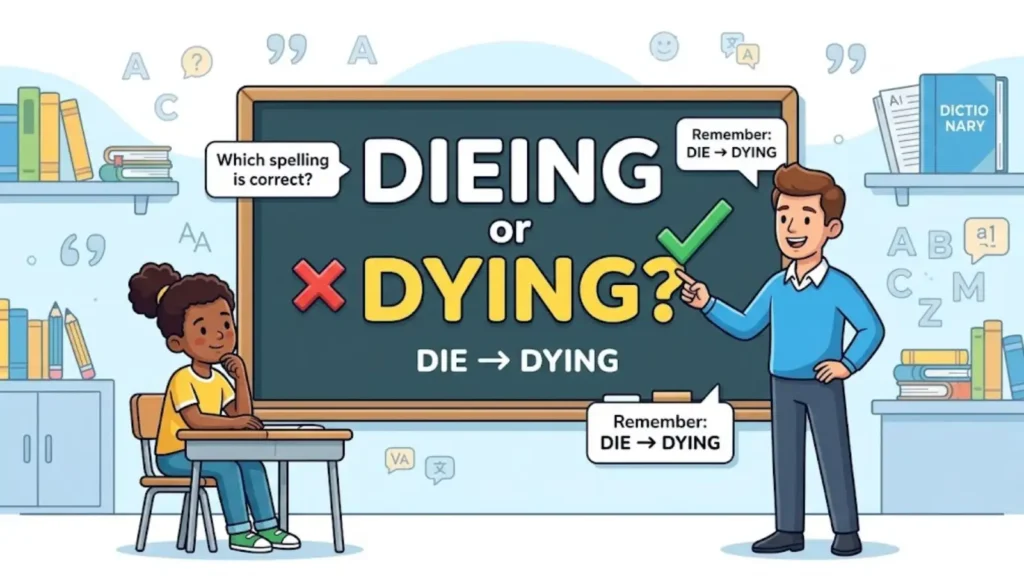
Have you ever stopped while writing and wondered whether “dieing” or “dying” is correct? You are not alone. This spelling can confuse English learners because the word die changes its spelling when we add -ing.
The correct spelling is dying. We remove the final e from die and change the spelling to dying. The form dieing is generally considered incorrect when you mean the present participle of die.
This confusion often appears in schoolwork, emails, social media posts, and everyday writing. People may also confuse dying with words such as lying, tying, and trying, which follow different spelling patterns.
RELATED: Hierarchical vs Hierarchal: Which Word Should You Use?
Dieing or Dying – Quick Answer
Dying is the correct spelling when you mean “in the process of death” or “ceasing to live.”
Dieing is normally incorrect for this meaning.
For example:
- Correct: The plant is dying.
- Correct: The old tree is dying.
- Incorrect: The plant is dieing.
- Incorrect: The old tree is dieing.
The base verb is die.
When we add -ing, English changes die to dying, not dieing.
Quick Comparison
| Form | Correct? | Meaning |
|---|---|---|
| die | ✅ Yes | To stop living |
| dying | ✅ Yes | In the process of dying |
| died | ✅ Yes | Past form of die |
| death | ✅ Yes | The end of life |
| dieing | ❌ Usually no | Incorrect spelling of dying |
Example:
“My flowers are dying because I forgot to water them.”
See also: Casi Algo Meaning: Full Guide to Love, Feelings, and Relationships
The Origin of Dieing or Dying
The word die has a very old history in English. It comes from Old Norse and Germanic language roots related to the idea of death.
Over time, English spelling changed. The modern word became die, while its related forms developed different spellings.
When English speakers add -ing to many verbs ending in e, the final e disappears.
Example:
- make → making
- write → writing
- hope → hoping
- use → using
However, die is slightly different. If we simply removed the final e, we would get diing. English does not use that spelling. Instead, ie changes to y, producing dying.
So:
die → dying
This spelling makes the pronunciation clear and follows an established English pattern.
The spelling dieing may look logical at first because writers sometimes expect to keep the letters from the base word. However, standard modern English uses dying.
Why Does the Spelling Change?
English spelling often changes when suffixes are added. These changes can preserve pronunciation and make words easier to read.
Compare:
- lie → lying
- tie → tying
- die → dying
All three words change ie to y before -ing.
That is why dying is the standard form.
British English vs American English Spelling
There is no major British-American spelling difference between dying and dieing.
Both American English and British English use dying.
Example:
- American English: The flowers are dying.
- British English: The flowers are dying.
The difference appears in many other words, such as color/colour and center/centre, but not with dying.
| Word or Form | American English | British English |
|---|---|---|
| Present form | die | die |
| -ing form | dying | dying |
| Past form | died | died |
| Noun | death | death |
| Incorrect form | dieing | dieing |
Important Spelling Rule
When using die, remember:
die → dying
Do not write:
die → dieing
This rule also appears with verbs such as:
- lie → lying
- tie → tying
These words change ie to y before -ing.
Which Spelling Should You Use?
Use dying in almost every standard English situation.
For American English
Use dying in:
- School assignments
- Emails
- Blogs
- Business writing
- News writing
- Social media
- Academic writing
Example:
“The company is dying because it failed to adapt.”
For British English
British English also uses dying.
Example:
“The flowers are dying in the summer heat.”
For Global English
If you write for an international audience, dying is still the correct choice.
You do not need to change it to dieing for British, American, Canadian, Australian, or other English-speaking readers.
Simple rule:
Always use “dying” when you mean the -ing form of “die.”
Common Mistakes with Dieing or Dying
Learners often make spelling mistakes because die looks as if it should become dieing.
Here are some common errors.
Mistake 1: Writing “dieing”
❌ The plant is dieing.
✅ The plant is dying.
The correct form changes ie to y.
Mistake 2: Confusing “dying” with “dyeing”
Dying and dyeing are different words.
- dying = losing life
- dyeing = coloring something
Examples:
The fish is dying.
She is dyeing her shirt blue.
This is an important distinction because both words sound similar.
Mistake 3: Using “dying” for “dyeing”
❌ I am dying my clothes red.
✅ I am dyeing my clothes red.
If you mean changing the color of something, use dyeing.
Mistake 4: Confusing “dying” and “died”
Dying describes an ongoing action.
Died describes something that happened in the past.
Compare:
The tree is dying.
The tree died last winter.
Dieing or Dying in Everyday Examples
The word dying appears in many types of writing.
In Emails
“The office plant is dying. Could someone water it?”
Here, dying describes the plant’s current condition.
In News Writing
“Experts warned that several fish species are dying because of pollution.”
News writers use dying when describing an ongoing situation.
On Social Media
People often use dying in informal expressions.
“I’m dying laughing!”
This does not usually mean actual death. It can mean that something is extremely funny.
Another example:
“I’m dying to see that movie!”
Here, dying to means wanting something very strongly.
In Formal Writing
“The researchers found that the trees were dying because of prolonged drought.”
This use is literal and appropriate for formal writing.
In Everyday Speech
“My phone battery is dying.”
This means the battery is almost empty.
So, dying can have both literal and figurative meanings.
Dieing or Dying – Google Trends & Usage Data
Searches for “dieing or dying” often come from people who know the base word die but are unsure how to add -ing.
The confusion is understandable. Many English verbs simply keep their main spelling when -ing is added:
- play → playing
- read → reading
- work → working
But some verbs change their spelling:
- lie → lying
- tie → tying
- die → dying
Search interest can also vary by country because English learners encounter different spelling rules and educational systems.
However, the standard spelling remains the same across major English varieties:
dying
There is no standard American-versus-British spelling difference here.
If you are writing an article, email, assignment, or social media post, dying is the safe standard form.
Dieing vs Dying: Comparison Table
| Feature | Dying | Dieing |
|---|---|---|
| Standard spelling | ✅ Yes | ❌ No |
| Base word | die | die |
| Meaning | In the process of dying | Not standard for this meaning |
| American English | ✅ Used | ❌ Not standard |
| British English | ✅ Used | ❌ Not standard |
| Formal writing | ✅ Correct | ❌ Avoid |
| Example | The plant is dying. | The plant is dieing. ❌ |
| Related word | death | — |
Remember This Trick
Think about:
lie → lying
tie → tying
die → dying
The ie changes to y before -ing.
This simple pattern can help you remember the correct spelling.
FAQs About Dieing or Dying
Is “dieing” a correct word?
Dieing is generally not the standard spelling when you mean the -ing form of die. Use dying instead.
Is it dying or dieing?
The correct spelling is dying.
Example:
“The flowers are dying.”
Why is dying spelled without “ie”?
The spelling changes from ie to y before -ing. Therefore, die + ing becomes dying.
Is dying the same in British and American English?
Yes. Both British and American English use dying.
What is the difference between dying and dyeing?
Dying relates to death or a figurative sense of extreme desire. Dyeing means coloring something.
The plant is dying.
She is dyeing the fabric.
What is the past tense of die?
The past tense is died.
His grandfather died many years ago.
Is “dying to” grammatically correct?
Yes. Dying to is a common expression meaning that someone wants something very strongly.
I’m dying to try that restaurant.
Conclusion: Dieing or Dying?
The correct spelling is dying, not dieing, when you mean the -ing form of die. This spelling works in both American and British English, so you do not need to choose a regional version.
The easiest way to remember it is to notice the spelling pattern. Die changes to dying, just as lie changes to lying and tie changes to tying.
Also remember that dying and dyeing have different meanings. Dying relates to death or can describe a strong desire, while dyeing means changing the color of something.
Whether you are writing an email, school assignment, blog post, news article, or social media caption, choose dying for the standard -ing form. Once you learn this small spelling rule, the dieing or dying confusion becomes much easier to avoid.

Hi, I’m Mason Clark, the writer behind Wordspry!
My goal is to make grammar learning easier with straightforward explanations, useful examples, and engaging English lessons that help you grow every day.