Quick answer:
“Sleeve” is the correct English word. “Sleave” is rare and mostly old-fashioned or literary.
Have you ever typed a word and felt unsure if it was right? Many people write “sleave” when they really mean “sleeve.” This happens a lot in clothing talks, fashion blogs, and even school writing. A student may write, “My shirt has long sleaves,” and then wonder why spellcheck marks it wrong. This small mistake is common because both words sound close.
The word “sleeve” means the part of a shirt, coat, or dress that covers the arm. The word “sleave” is very old and uncommon today. Most people never use it in daily English. That is why many learners search for “sleave or sleeve” online. They want to know which spelling is correct and when to use each one.
See also: Childlike vs Childish: Meaning, Differences, and Correct Usage
Pronunciation
Sleeve
- US Pronunciation: /sliːv/
- UK Pronunciation: /sliːv/
Sleave
- US Pronunciation: /sliːv/
- UK Pronunciation: /sliːv/
Both words sound almost the same.
Now, let’s look deeper at how these two words differ in real English.
Difference Between Sleave and Sleeve
1. Meaning
Sleeve means part of clothing.
Sleave means tangled silk or thread in old English.
Examples:
- Her dress has short sleeves.
- He rolled up his sleeves.
- The poet wrote about a sleave of silk.
- Old books may use the word sleave.
2. Modern Usage
Sleeve is common today.
Sleave is rare today.
Examples:
- I bought a long-sleeve shirt.
- This jacket sleeve is torn.
- Shakespeare used sleave in writing.
- Few people use sleave now.
3. Dictionary Presence
Sleeve appears in all modern dictionaries.
Sleave appears mostly in historical dictionaries.
Examples:
- Sleeve has many meanings.
- Check the word sleeve online.
- Sleave is marked old-fashioned.
- Sleave is uncommon in schools.
4. Use in Fashion
Sleeve is used in clothing and design.
Sleave is not used in fashion today.
Examples:
- The sleeve is too tight.
- Her sleeves are elegant.
- Designers rarely say sleave.
- Fashion books use sleeve instead.
5. Grammar Role
Sleeve works as noun and verb.
Sleave is mostly a noun.
Examples:
- The sleeve ripped.
- Please sleeve the document.
- The sleave was soft silk.
- The old cloth had sleave fibers.
6. Popularity
Sleeve is very popular online.
Sleave has very low search use.
Examples:
- Millions search sleeve yearly.
- Sleeve appears in ads.
- Sleave appears in old texts.
- Few websites use sleave.
7. Learning Difficulty
Sleeve is easy for learners.
Sleave confuses learners.
Examples:
- Kids learn sleeve early.
- Teachers explain sleeve often.
- Students misspell sleeve as sleave.
- Sleave creates spelling confusion.
8. Word Origin
Sleeve comes from Old English clothing terms.
Sleave comes from old textile language.
Examples:
- Sleeve relates to garments.
- Sleeve changed little over time.
- Sleave described thread.
- Sleave stayed rare.
9. Common Mistakes
People often spell sleeve as sleave.
Examples:
- Wrong: My shirt sleave is dirty.
- Correct: My shirt sleeve is dirty.
- Wrong: Long sleave jacket.
- Correct: Long sleeve jacket.
10. Professional Usage
Sleeve is used in business and daily life.
Sleave is mostly literary.
Examples:
- The engineer used a cable sleeve.
- Doctors use arm sleeves.
- Sleave appears in poetry.
- Sleave is not common in offices.
See also: Blatantly vs Bluntly – Which Word Should You Really Use?
Nature and Behaviour of Sleave and Sleeve
Sleeve
“Sleeve” is active in modern English. It appears in fashion, sports, medicine, and technology. It is flexible and widely accepted.
Sleave
“Sleave” is passive and historical. Most people only see it in literature or old texts. It is not part of normal daily speech.
Why People Get Confused About Sleave and Sleeve
People get confused because both words sound the same. Also, English spelling can be tricky. Some learners think “sleave” looks more natural because of words like “leave” and “weave.” Autocorrect and typing errors also add confusion.
Comparison Table
| Feature | Sleeve | Sleave |
|---|---|---|
| Common today | Yes | No |
| Meaning | Part of clothing | Old silk/thread term |
| Used in fashion | Yes | Rare |
| Used in daily speech | Yes | Almost never |
| Found in modern writing | Very common | Rare |
| Pronunciation | Same as sleave | Same as sleeve |
| Grammar role | Noun and verb | Mostly noun |
| Best for learners | Yes | No |
| Seen in literature | Sometimes | Mostly |
| Correct modern choice | Yes | Usually no |
The Origin of Sleeve
The word “sleeve” comes from Old English “sliefe.” It was used for the arm part of clothes many centuries ago. Over time, the spelling changed into “sleeve.” The word stayed common because clothing is part of daily life.
“Sleave” came from older textile language. Writers once used it for silk thread or soft fiber. Today, it is mostly historical.
British vs American English
Both British and American English use “sleeve” in the same way.
British English Examples
- Roll up your sleeves.
- She wore a long-sleeve jumper.
American English Examples
- His shirt sleeve is dirty.
- She bought a sleeveless dress.
“Sleave” is rare in both styles of English.
Which One Should You Use?
- Use “sleeve” in modern English.
- Use “sleave” only in historical or literary writing.
For US English
Use “sleeve” in all normal writing.
For UK English
Use “sleeve” in daily speech and writing.
For Global English
“Sleeve” is the safest and clearest choice.
Common Mistakes
| Wrong | Correct |
|---|---|
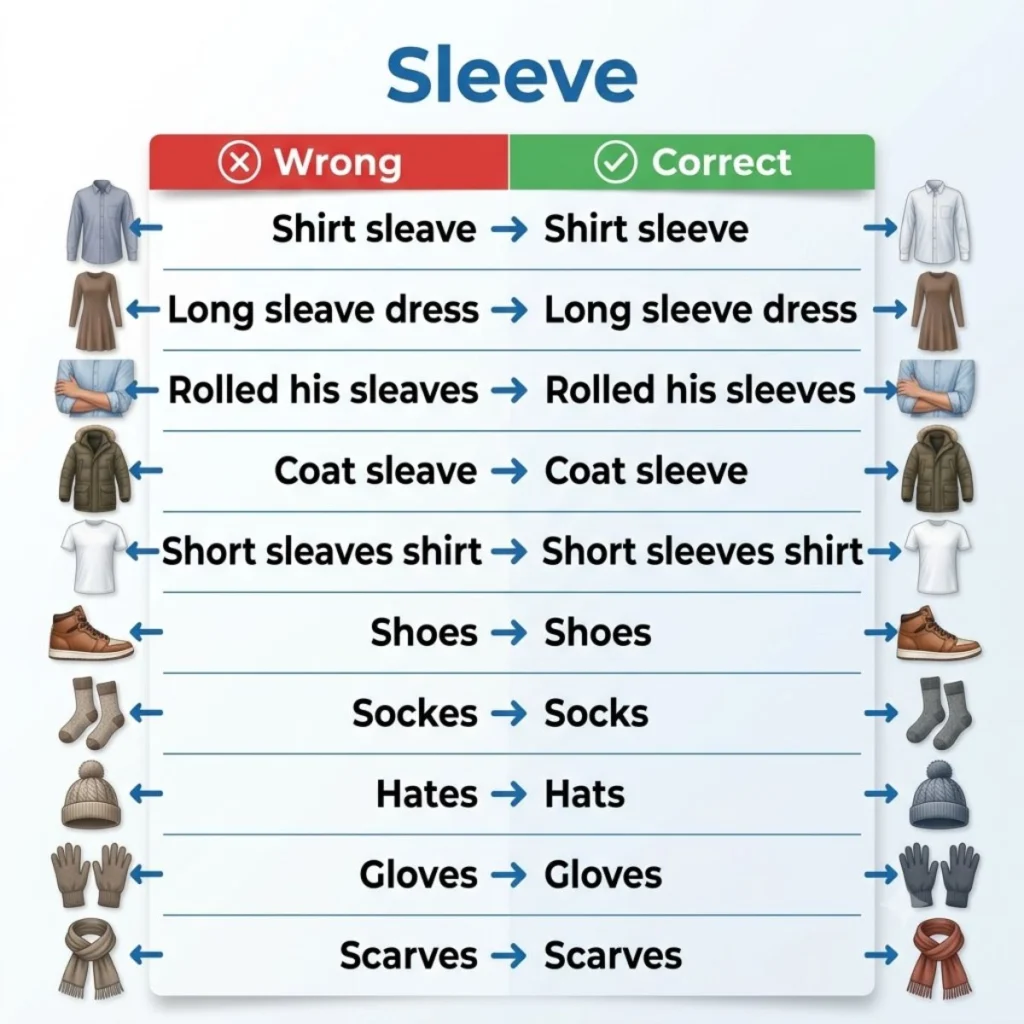
| Shirt sleave | Shirt sleeve |
| Long sleave dress | Long sleeve dress |
| Rolled his sleaves | Rolled his sleeves |
| Coat sleave | Coat sleeve |
| Short sleaves shirt | Short sleeves shirt |
Everyday Usage Examples
Emails
- Please wear long sleeves at work.
- The uniform sleeve needs repair.
Social Media
- Loving this oversized sleeve design.
- My hoodie sleeves are too long.
News
- The athlete wore arm sleeves during the match.
- Fire-resistant sleeves protect workers.
Formal Writing
- The sleeve length must match company rules.
- Protective sleeves reduce injury risk.
Usage Trends
“Sleeve” is used all over the world every day. It appears in fashion stores, online shopping, sports, and healthcare. “Sleave” is fading from common use. Most modern speakers never use it.
Metaphors and Similes
Sleeve Metaphors
- “He had a trick up his sleeve.”
- “She wore confidence like a sleeve.”
Similes
- “The sleeve hung like a flag.”
- “His loose sleeve moved like a sail.”
“Sleave” rarely appears in metaphors today.
Connotative Meaning
Sleeve
- Positive: stylish sleeve design
- Neutral: shirt sleeve
- Negative: torn sleeve
Sleave
- Neutral: historical textile term
- Literary: poetic feeling
- Rare: may confuse readers
Idioms and Proverbs

Idioms with Sleeve
- Up one’s sleeve — having a secret plan
- She has another idea up her sleeve.
- Wear your heart on your sleeve — show emotions openly
- He wears his heart on his sleeve.
There are almost no common idioms with “sleave.”
Literature and Movies
Literature
- Macbeth uses the word “sleave” in poetic language.
- Victorian literature also used “sleave” in textile descriptions.
Movies
- Phantom Thread discusses fashion and clothing details like sleeves.
- Cruella shows dramatic sleeve designs in costumes.
Why This Difference Matters
This difference matters because spelling affects meaning and trust. Correct spelling helps students, writers, and workers communicate clearly. Using “sleeve” instead of “sleave” prevents confusion. It also improves school grades, professional writing, and online communication.
Usefulness in Daily Life
Knowing the correct word helps in shopping, fashion, schoolwork, and office writing. You can describe clothes correctly and avoid spelling mistakes. It also improves confidence in English conversations.
Situational Preference
In almost every modern situation, “sleeve” is the better choice. Use it when talking about shirts, jackets, dresses, uniforms, sportswear, or protective clothing. It is accepted in schools, offices, fashion stores, and online writing. “Sleave” should only appear in old literature, poetry, or historical studies. If you use “sleave” in normal conversation, many people may think it is a spelling mistake. For learners, business writers, and social media users, “sleeve” is the safest option. It is clear, modern, and easy to understand worldwide.
FAQs
Is “sleave” a real word?
Yes, but it is very old and rare today.
Which spelling is correct for clothing?
“Sleeve” is correct.
Why do people write “sleave”?
Because both words sound the same.
Is “sleave” used in modern English?
Very rarely.
Can “sleeve” be a verb?
Yes. For example: “Please sleeve the documents.”
Do British and American English use different spellings?
No. Both use “sleeve.”
Which word should students use?
Students should use “sleeve” in almost all cases.
Conclusion
The debate around “sleave or sleeve” is simple once you understand the meanings. “Sleeve” is the correct and modern word used for clothing and many daily situations. It is common in schools, offices, fashion, sports, and technology. “Sleave,” on the other hand, is an old and uncommon word linked to silk or thread in historical writing.
Many people confuse these words because they sound alike. Yet their usage is very different. If you want clear and correct English, choose “sleeve” in normal writing and speech. Only use “sleave” when discussing literature, poetry, or historical language.
Learning this small difference can improve spelling, communication, and confidence. It also helps writers avoid mistakes in professional and academic work. In modern English, “sleeve” is the word you need almost every time.

Hi, I’m Henry Collins, the educator behind Wordspry.com
I’m dedicated to helping English learners build confidence through easy grammar explanations, writing tips, and everyday language learning resources.