Quick Answer
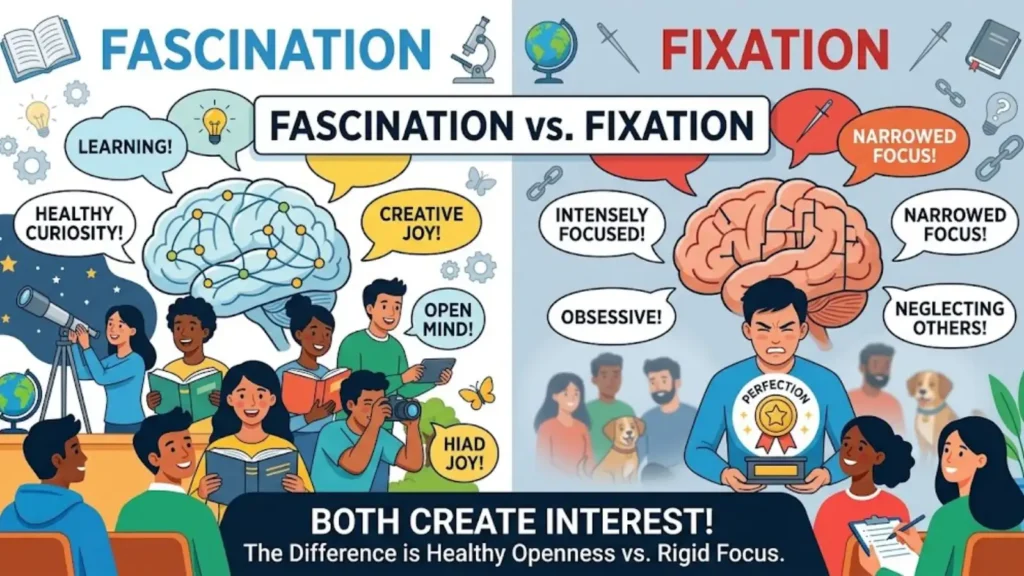
Fascination vs fixation describes two related but different ways of being strongly interested in something. Fascination means intense interest, curiosity, or attraction toward a person, subject, or activity. Fixation, however, means an unusually persistent focus on one thing that can become difficult to shift. For example, you may feel fascination with astronomy because you enjoy learning about space, while a fixation on one idea may cause you to think about it repeatedly. The key difference is usually curiosity and attraction versus persistent concentration.
Meaning of Fascination vs Fixation
Fascination refers to strong interest or attraction that captures someone’s attention. It often feels enjoyable and can encourage learning, exploration, or creativity. Fixation describes a concentrated and persistent focus on something, sometimes to the point that other thoughts or activities receive less attention.
These words can describe ideas, hobbies, people, skills, objects, and abstract qualities. For example, “Her fascination with languages encouraged her to learn Spanish,” while “His fixation on one detail delayed the project.”
Simple Examples
- Fascination: She has a fascination with ancient history.
- Fixation: He developed a fixation on getting every detail perfect.
- Fascination: His fascination with photography led him to study lighting.
- Fixation: Her fixation on one answer prevented her from considering alternatives.
Fascination vs Fixation: Key Difference
The clearest difference between fascination and fixation lies in the nature of attention. Fascination usually suggests strong interest, attraction, or curiosity, while fixation suggests persistent and concentrated attention.
| Word | Main Meaning | Typical Feeling | Example |
|---|---|---|---|
| Fascination | Strong interest or attraction | Curious or engaging | His fascination with space grew. |
| Fixation | Persistent focus | Intense or difficult to shift | Her fixation on the mistake continued. |
In simple terms, fascination invites exploration, whereas fixation keeps attention locked onto something.
Why People Misspell or Confuse These Words
People sometimes confuse fascination and fixation because both describe strong attention and contain similar-looking letters. However, they do not share the same spelling pattern or meaning.
English also contains many words with double letters, such as address, success, necessary, and embarrass. These patterns can create typing mistakes, especially when people write quickly. With this pair, however, the main challenge is usually word choice rather than a missing double “s.”
Common Spelling Reminders
- Fascination — correct
- Fixation — correct
- Fascinaton — incorrect
- Fixsation — incorrect
Remember that fascination comes from fascinate, while fixation comes from fix. Learning their word families makes the spelling easier.
Origin of Fascination and Fixation
The word fascination traces back to Latin fascinatio, related to fascinare, meaning “to enchant” or “bewitch.” English developed the word through French and Latin influences, eventually giving it the modern sense of powerful attraction or interest.
Fixation comes from Latin fixus, meaning “fixed,” from figere, meaning “to fasten” or “to attach.” English later developed fixation to describe the act or state of becoming fixed on something. Their different roots help explain their different meanings.
British vs American English
There is no spelling difference between British and American English for these two words. Both varieties use fascination and fixation with the same spelling.
| English Variety | Fascination | Fixation |
|---|---|---|
| American English | Fascination | Fixation |
| British English | Fascination | Fixation |
| Canadian English | Fascination | Fixation |
| Australian English | Fascination | Fixation |
Therefore, you do not need a different spelling when writing for readers in the United States or the United Kingdom.
When to Use Fascination
Use fascination when you want to describe strong interest, attraction, or curiosity. It works naturally in essays, assignments, emails, professional reports, and casual conversations.
For example, you might write, “Her fascination with marine biology influenced her career choice.” In an essay, you could say, “The author shows a fascination with nature.” The word generally carries a positive or neutral sense of being strongly interested in something.
When to Use Fixation
Use fixation when someone remains strongly focused on a particular person, object, idea, detail, or goal. The word often suggests that the attention is persistent or difficult to redirect.
For example, “His fixation on small errors affected his productivity.” In a professional report, you could write, “The team should avoid fixation on one solution and consider alternatives.” The surrounding context determines whether the word sounds neutral, critical, or simply descriptive.
Common Mistakes
One common mistake involves treating fascination and fixation as interchangeable synonyms. Although both can describe strong attention, they communicate different ideas.
Another mistake occurs when writers type too quickly and omit letters. For example, fascinaton is incorrect because it drops the i before the final “on,” while fixsation incorrectly inserts an “s.”
| Incorrect | Correct |
|---|---|
| Fascinaton | Fascination |
| Fascinattion | Fascination |
| Fixsation | Fixation |
| Fixasion | Fixation |
The best way to avoid these errors is to learn each word as part of its word family.
Everyday Examples of Fascination
Fascination works well when describing enjoyable or meaningful interest. It commonly appears in conversations about hobbies, education, science, history, art, and personal interests.
“My fascination with digital marketing encouraged me to take the course.”
Social Media
“Her fascination with old architecture makes her travel photos fascinating.”
Professional Writing
“The researcher has a long-standing fascination with human behavior.”
School Assignment
“My fascination with astronomy began when I studied the solar system.”
These examples show that fascination often involves curiosity and attraction.
Everyday Examples of Fixation
Fixation is useful when you want to emphasize persistent attention toward one particular thing.
“His fixation on one minor issue delayed the discussion.”
Social Media
“People sometimes develop a fixation on making everything perfect.”
Professional Writing
“A fixation on short-term results can distract teams from long-term goals.”
School Assignment
“The character’s fixation on revenge shapes many of his decisions.”
These examples show how fixation can describe intense concentration that becomes difficult to move away from.
Usage Comparison Table
| Context | Fascination | Fixation |
|---|---|---|
| Object | Her fascination with the painting grew. | His fixation on the painting became unusual. |
| Skill | His fascination with coding encouraged practice. | His fixation on perfect code slowed his work. |
| Legal term | The report describes a fascination with the case. | The document refers to a fixation on one legal argument. |
| Daily speech | I have a fascination with old movies. | I have a fixation on checking everything twice. |
| Education | Her fascination with science inspired her studies. | His fixation on one answer limited his thinking. |
| Career | His fascination with medicine shaped his goals. | Her fixation on one career path made alternatives difficult. |
The correct choice depends on whether you mean strong interest or persistent focus.
Fascination vs Fixation in a Sentence
Consider the difference between these two sentences:
“Maria has a fascination with classical music.”
This sentence suggests that Maria finds classical music interesting and enjoys exploring it.
“Maria has a fixation on one classical composer.”
This sentence suggests that her attention remains unusually concentrated on one particular composer.
The words can appear in similar contexts, but fascination emphasizes attraction and interest, while fixation emphasizes persistent focus.
How to Remember Fascination vs Fixation
A simple memory trick can make the distinction easier. Think of fascination as “I want to explore it” and fixation as “I cannot stop focusing on it.”
You can also connect fixation with the word fix. Something that is “fixed” stays in one position, so fixation can remind you of attention that stays focused on one target. For fascination, think about being fascinated by something because it captures your curiosity.
FAQs About Fascination vs Fixation
What is the difference between fascination and fixation?
Is fascination positive?
Fascination usually has a positive or neutral meaning because it describes strong interest or attraction. The context can influence its tone.
Is fixation always negative?
No. Fixation can simply describe persistent concentration, but it can sound negative when the attention becomes excessive or prevents someone from considering alternatives.
Are fascination and fixation synonyms?
They are related but not exact synonyms. Both involve strong attention, but fascination emphasizes interest and attraction, while fixation emphasizes persistent focus.
How do you spell fascination?
The correct spelling is fascination. A useful related word is fascinate, which can help you remember the spelling.
How do you spell fixation?
The correct spelling is fixation. It comes from the word fix, which can help you remember its spelling.
Are fascination and fixation spelled differently in British English?
No. Both fascination and fixation have the same spelling in British and American English.
Conclusion
Understanding fascination vs fixation becomes easier when you focus on the difference in attention. Fascination describes strong interest, curiosity, or attraction, while fixation describes persistent attention that remains centered on one thing. Neither word is simply a spelling variation of the other.
For accurate writing, remember the word families: fascinate → fascination and fix → fixation. Also watch for typing errors, especially when writing quickly. Choosing the right word will make your essays, emails, assignments, reports, and everyday conversations clearer and more precise.

Hi, I’m Liam Harper, the voice behind Wordspry!
I’m here to make English grammar simple, clear, and easy to understand for learners of all levels. Through practical lessons and helpful guides, I aim to help you improve your writing and communication skills with confidence.