Imagine you’re explaining a problem at work, and a coworker suddenly says, “You hit the nail on the head!” Or perhaps you see the phrase in a social media post, a motivational quote, or even a movie review. It sounds simple, but what does it really mean? Is it about construction, or does it carry a deeper message?
The idiom “hit the nail on the head” is one of the most common expressions in English. People use it when someone says or does something that is exactly right. Whether you’re writing an essay, giving a presentation, or chatting with friends, understanding this phrase can help you sound more natural and confident.
See also: No Cuts No Buts No Coconuts: Meaning, Origin and Examples
Quick Answer
“Hit the nail on the head” means to say or do something that is exactly correct. Literally, it refers to striking the head of a nail with a hammer. Figuratively, it describes accurately identifying a problem, solution, or truth. It is commonly used in conversations, education, business, and writing.
Table of Contents
- Meaning at a Glance
- What Does “Hit the Nail on the Head” Mean?
- Why Do People Search for This Idiom?
- The Deeper Meaning Behind the Phrase
- Background and Origin
- Common Contexts Where It’s Used
- Similar Idioms
- Common Mistakes
- FAQs
- Conclusion
Meaning at a Glance
| Aspect | Explanation |
|---|---|
| Literal Meaning | Striking the head of a nail accurately with a hammer. |
| Figurative Meaning | Saying or doing something exactly right. |
| Emotional Meaning | Confidence, accuracy, understanding, and insight. |
| Common Usage | Conversations, business, education, writing, presentations. |
| Tone | Positive, approving, and encouraging. |
| Related Topics | Idioms, communication, metaphor, problem-solving, English expressions. |
What Does “Hit the Nail on the Head” Mean?
The idiom “hit the nail on the head” describes someone who identifies the exact cause of a problem or gives a perfectly accurate answer. It praises precision and clear thinking.
Literal Meaning
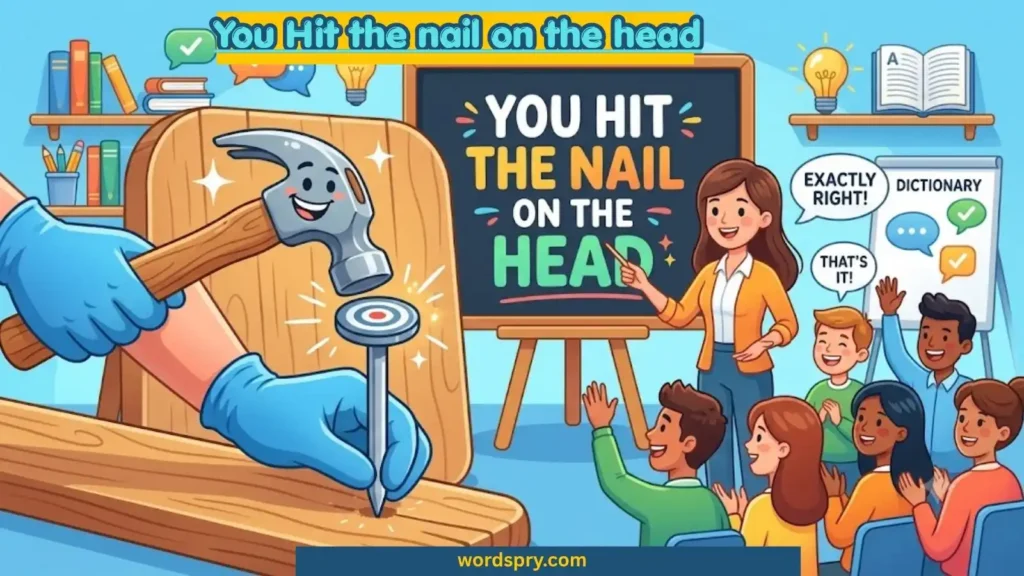
The literal image comes from carpentry. When building something, you must strike the head of the nail accurately with a hammer. Missing the nail wastes time and effort, while a perfect strike gets the job done efficiently.
Figurative Meaning
In everyday English, the phrase has nothing to do with tools. Instead, it means someone has expressed an idea or observation perfectly.
For example:
Emma: “Our customers aren’t leaving because of the prices—they’re leaving because of slow service.”
Manager: “You hit the nail on the head.”
The manager agrees that Emma found the real reason for the problem.
Symbolic Meaning
Symbolically, the idiom represents:
- Accuracy
- Wisdom
- Insight
- Clear communication
- Effective problem-solving
It reminds us that finding the real issue often matters more than discussing many possibilities.
Emotional Meaning
People often use the phrase to show appreciation when someone understands a difficult situation. Hearing “You hit the nail on the head” feels rewarding because it recognizes careful thinking and good judgment.
Why Do People Search for “Hit the Nail on the Head”?
Many English learners and native speakers search for this idiom because they encounter it in different places.
Social Media
Motivational pages frequently use the expression after sharing advice about success, relationships, or personal growth.
Example:
“This quote really hits the nail on the head.”
Books
Authors often include the idiom in dialogue because it sounds natural and conversational. Readers may search for its meaning after encountering it in novels.
Movies and TV Shows
Characters use the phrase when someone solves a mystery, identifies a hidden problem, or gives the perfect explanation.
Business Communication
Managers and coworkers commonly use the idiom during meetings to praise accurate observations.
Example:
“Your analysis hit the nail on the head.”
Online Discussions
Forums like Reddit, Quora, and blog comments frequently include the phrase when users strongly agree with someone’s opinion.
The Deeper Meaning Behind the Phrase
Although the idiom sounds simple, it reflects an important life lesson: finding the correct answer often matters more than speaking the loudest.
Creativity
Writers, artists, and designers constantly search for ideas that communicate their message clearly. When someone perfectly captures an emotion or concept, others may say they hit the nail on the head.
Storytelling
Great storytellers understand what their audience feels. A memorable character or scene often “hits the nail on the head” because it reflects real human experiences.
Personal Growth
Self-improvement begins with honest self-reflection. Recognizing the true reason behind a habit or challenge is often the first step toward positive change.
Communication
Successful communication depends on clarity. Instead of using many words, the best speakers identify the exact point that matters most.
This is why the idiom remains popular in schools, workplaces, and everyday conversations.
Background & Origin
The origin of “you hit the nail on the head” comes from carpentry and construction work, where accuracy determines success. Driving a nail correctly requires striking its head directly with a hammer.
Over time, English speakers began using this physical action as a metaphor for identifying the exact truth or giving the perfect answer.
Although historians cannot point to one specific person who invented the phrase, records show similar expressions appearing in English literature several centuries ago. By the 17th century, the idiom had become widely recognized.
Its popularity has continued because the imagery is simple and easy to understand. Almost everyone can picture someone accurately striking a nail with a hammer, making the metaphor memorable across cultures and generations.
Today, “hit the nail on the head” appears in newspapers, business meetings, classrooms, speeches, podcasts, books, blogs, and social media. Despite being centuries old, it remains one of the clearest ways to praise someone’s accuracy or insight.
Part 2 will include:
- Contexts Where It’s Used (Art, Literature, Business, Education, Social Media, etc.)
- Usage Across Different Platforms (table)
- Examples in Everyday Life
- When to Use It
- When to Avoid It
- Common Misconceptions
- Common Mistakes
- Similar Idioms Comparison Table
- Sentence Examples
- Featured Snippet Summary
- Trusted References
- 6 SEO FAQs
- Conclusion
- Meta Description
- Suggested Internal Links
- Image Alt Texts
part2
Contexts Where “Hit the Nail on the Head” Is Used
This idiom works in many situations because it celebrates accuracy and understanding. Here are some of the most common contexts where you’ll hear or read it.
Art & Painting
Artists and critics use the phrase when a painting perfectly captures an emotion, idea, or historical event.
Example:
“The artist hit the nail on the head by showing the loneliness of city life.”
Literature
Authors and book reviewers use the idiom when a writer describes characters or situations with remarkable accuracy.
Example:
“The novel hits the nail on the head when it explores family relationships.”
Movies & Documentaries
Film critics often praise movies that realistically portray social issues or human emotions.
Example:
“The documentary hit the nail on the head by explaining the environmental crisis in simple terms.”
Personal Development
Life coaches and motivational speakers use the expression when someone identifies the real cause of a challenge.
Example:
“You hit the nail on the head when you said confidence comes from practice.”
Business & Branding
Managers appreciate employees who identify problems or suggest practical solutions.
Example:
“Your customer feedback report really hit the nail on the head.”
Education
Teachers often use the phrase to encourage students who provide the correct explanation.
Example:
“You hit the nail on the head with your answer about climate change.”
Social Media
The idiom appears in captions, comments, and discussions whenever people strongly agree with an opinion.
Example:
“This post hits the nail on the head about work-life balance.”
Usage Across Different Platforms
| Platform | Typical Usage | Example |
|---|---|---|
| Inspirational captions | “This quote really hits the nail on the head.” | |
| TikTok | Reaction videos and life advice | “She hit the nail on the head!” |
| Motivational graphics | “Success starts with discipline.” | |
| Discussions and opinions | “You hit the nail on the head with that comment.” | |
| Professional feedback | “Your analysis hit the nail on the head.” | |
| YouTube | Video comments and reviews | “The presenter hit the nail on the head.” |
| Blogs | Educational and opinion articles | “This article hits the nail on the head.” |
Examples in Everyday Life
You’ll hear this idiom in many everyday situations.
- Daily conversation: “You hit the nail on the head—that’s exactly what I was thinking.”
- Classroom discussion: “Sarah hit the nail on the head with her explanation.”
- Business presentation: “Your market analysis hit the nail on the head.”
- Social media caption: “This meme hits the nail on the head.”
- Speech: “The speaker hit the nail on the head when discussing teamwork.”
- Blog title: “This guide hits the nail on the head for beginner writers.”
When Should You Use “Hit the Nail on the Head”?
This idiom is appropriate when someone has expressed an idea with precision.
Use it in:
- Workplace meetings
- Classroom discussions
- Blog posts
- Public speaking
- Creative writing
- Reviews
- Friendly conversations
- Motivational content
It adds warmth and appreciation while recognizing someone’s accurate thinking.
When Should You Avoid Using It?
Although common, the idiom doesn’t fit every situation.
Avoid using it in:
- Legal contracts
- Scientific research papers
- Technical manuals
- Medical reports
- Engineering specifications
- Formal policy documents
In these settings, direct and literal language is usually more appropriate than idiomatic expressions.
Common Misconceptions About “Hit the Nail on the Head”
1. It only refers to carpentry.
Incorrect.
The phrase began with carpentry imagery, but today it mainly describes accuracy in speech, writing, or problem-solving.
2. It means working hard.
Incorrect.
Hard work may help someone succeed, but this idiom specifically praises getting something exactly right.
3. It’s only used in business.
Incorrect.
People use it in education, entertainment, literature, family conversations, social media, and many other settings.
Common Mistakes When Using the Idiom
Using it without context
Don’t say someone “hit the nail on the head” unless they accurately identified something.
Thinking it has only one meaning
The phrase can praise a correct answer, observation, explanation, or solution.
Overusing it
Repeating the idiom too often can make your writing feel repetitive. Mix it with similar expressions.
Confusing it with literal hammering
In most conversations, the phrase is figurative rather than literal.
Similar Phrases & Alternatives
| Phrase | Meaning | Best Used When |
|---|---|---|
| Spot on | Exactly correct | Casual conversations |
| Right on the money | Completely accurate | Business or everyday speech |
| Exactly right | Perfectly correct | Formal and informal writing |
| Nailed it | Did something perfectly | Informal conversations |
| On point | Highly accurate or appropriate | Modern speech and social media |
| Couldn’t have said it better | Perfect explanation | Complimenting someone’s words |
How to Use “Hit the Nail on the Head” in a Sentence
Professional writing
“The consultant hit the nail on the head by identifying the company’s biggest challenge.”
Creative writing
“The detective hit the nail on the head before anyone else understood the mystery.”
Social media caption
“This quote hits the nail on the head.”
Inspirational quote
“Success begins when you hit the nail on the head and recognize your true strengths.”
Everyday conversation
“You hit the nail on the head—that’s exactly how I feel.”
Featured Snippet Summary
“Hit the nail on the head” is an English idiom that means to say or do something exactly right. It comes from the image of striking a nail accurately with a hammer. Today, people use it to praise correct observations, solutions, or explanations in conversations, education, business, and everyday life.
Trusted References
For authoritative definitions and usage examples, consult:
- Cambridge Dictionary
- Merriam-Webster Dictionary
- Oxford Learner’s Dictionaries
- Dictionary.com
These trusted sources explain the idiom’s meaning, usage, and examples in modern English.
Frequently Asked Questions (FAQs)
What does “hit the nail on the head” mean?
It means someone has identified the exact truth or given the correct answer.
Is “hit the nails on the head” an idiom?
Yes. It’s a well-known English idiom with a figurative meaning.
Is it a metaphor?
It functions as an idiomatic metaphor based on accurately striking a nail with a hammer.
Where did the phrase originate?
It originated from carpentry, where striking the head of a nail accurately represents precision and skill.
Is the idiom still popular today?
Yes. It remains widely used in business, education, media, and everyday conversations.
Can I use it in formal writing?
You can use it in speeches, articles, and presentations, but avoid it in highly technical or legal documents.
Conclusion
The idiom “hit the nail on the head” has remained popular for centuries because it expresses an idea everyone understands: accuracy matters. While its literal meaning comes from striking a nail correctly with a hammer, its figurative meaning is far more common today. It praises someone who identifies the exact problem, offers the perfect explanation, or expresses an idea with remarkable precision.
Whether you hear it during a business meeting, read it in a book, or spot it on social media, the phrase adds warmth and confidence to communication. It encourages thoughtful observation, clear thinking, and effective problem-solving.
Learning idioms like this not only improves your English vocabulary but also helps your conversations sound more natural and engaging. The next time someone gives the perfect explanation, you’ll know exactly what to say: “You hit the nail on the head!”

Hi, I’m Mason Clark, the writer behind Wordspry!
My goal is to make grammar learning easier with straightforward explanations, useful examples, and engaging English lessons that help you grow every day.