Have you ever watched coworkers argue over a project that has nothing to do with you?
Or maybe you’ve seen friends debating endlessly on social media while you quietly scroll past. In moments like these, someone might jokingly say, “Not my circus, not my monkeys.” The phrase is funny, memorable, and surprisingly wise.
Although it mentions a circus and monkeys, this popular idiom has nothing to do with performing animals. Instead, it reminds us that not every problem deserves our attention. In today’s fast-paced world, where people often feel pressure to fix everyone else’s issues, this expression encourages us to set healthy boundaries and focus on what we can actually control.
The saying has become popular in conversations, workplace discussions, motivational quotes, memes, and social media posts. Its colorful imagery makes it easy to remember, while its message about responsibility and emotional balance resonates with people of all ages.
The meaning of not my circus, not my monkeys, where it came from, why it became so popular, how to use it correctly, and when you should avoid using it. By the end, you’ll understand why this unusual phrase continues to spread across cultures and online communities.
RELATED: No Cuts No Buts No Coconuts: Meaning, Origin and Examples
Quick Answer
“Not my circus, not my monkeys” is an idiom that means “This problem isn’t my responsibility.” It comes from a Polish proverb and is commonly used to express that someone else’s conflict, drama, or mistake does not require your involvement. The phrase encourages healthy boundaries and focusing on your own responsibilities.
What Does Not My Circus, Not My Monkeys Mean?
The idiom combines humor with practical life advice. While the words create a funny picture of a circus full of mischievous monkeys, the real message is about knowing when to step back from situations that don’t concern you.
Literal Meaning
Literally, the phrase means that the circus belongs to someone else, along with all the monkeys inside it. Since neither belongs to you, you are not responsible for taking care of them or solving any problems they cause.
Of course, people rarely use the expression literally. It is almost always understood as a figurative saying.
Figurative Meaning
Figuratively, not my circus, not my monkeys means:
- This issue is not my responsibility.
- I don’t need to get involved.
- Someone else should handle the situation.
- I choose to stay out of unnecessary conflict or drama.
Rather than sounding cold or uncaring, the phrase often reflects wisdom. It reminds us that getting involved in every disagreement can waste time, energy, and emotional strength.
Symbolic Meaning
The power of this idiom comes from its symbolism.
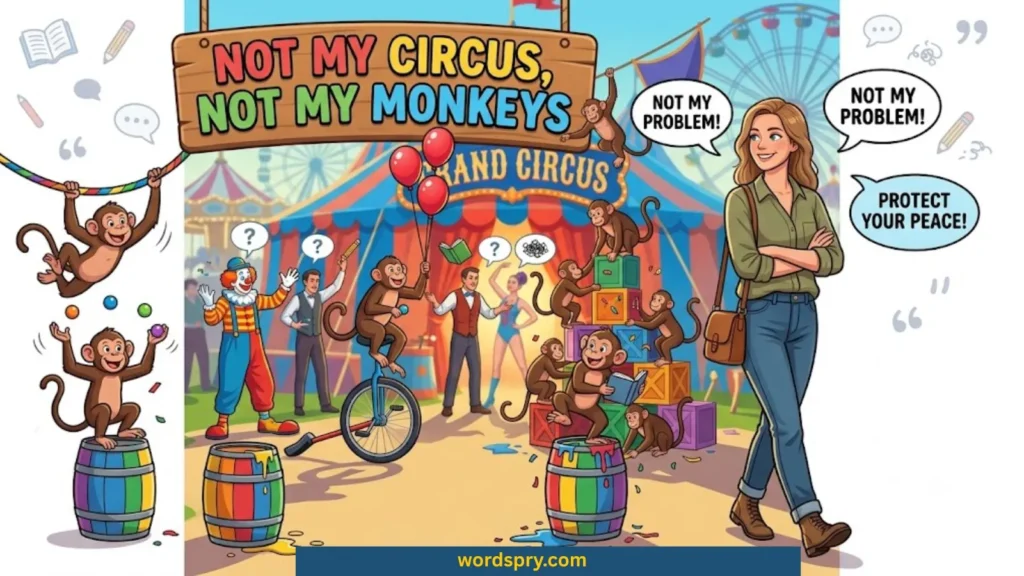
- The circus represents chaos, confusion, or a situation that feels out of control.
- The monkeys symbolize difficult people, unexpected problems, distractions, or ongoing drama.
Together, they create a vivid image of a hectic environment that belongs to someone else. The message is simple: if it isn’t your responsibility, you don’t have to manage it.
Emotional Meaning
Beyond its humor, the phrase carries an important emotional lesson. It encourages people to:
- Set healthy boundaries.
- Protect their peace of mind.
- Avoid unnecessary stress.
- Focus on what they can control.
- Respect other people’s responsibilities.
These ideas have made the idiom especially popular in discussions about mental health, emotional intelligence, and work-life balance.
Meaning at a Glance
| Aspect | Explanation |
|---|---|
| Literal Meaning | Someone else’s circus and monkeys are not your responsibility. |
| Figurative Meaning | Another person’s problems do not require your involvement. |
| Symbolic Meaning | The circus represents chaos; the monkeys represent problems or drama. |
| Emotional Meaning | Encourages healthy boundaries and reduced stress. |
| Tone | Casual, humorous, and thoughtful. |
| Common Usage | Conversations, workplaces, social media, leadership, and personal development. |
Where Did Not My Circus, Not My Monkeys Come From?
One of the most interesting things about this expression is its origin.
The phrase comes from the Polish proverb:
Nie mój cyrk, nie moje małpy.
Its direct English translation is:
“Not my circus, not my monkeys.”
For generations, Polish speakers have used this saying to remind people not to interfere with problems that belong to others. Like many traditional proverbs, it spread through everyday conversations rather than a single book or historical document. Because of this, no one knows exactly when it was first spoken.
As English speakers discovered the proverb through travel, translation, and the internet, it quickly gained popularity. Today, it is one of the best-known Polish sayings used in English.
Why Has This Phrase Become So Popular?
The popularity of not my circus, not my monkeys has grown rapidly over the last two decades. Several factors have contributed to its success.
1. It Creates a Memorable Image
Most idioms use ordinary words, but this one paints a funny picture of a circus filled with energetic monkeys. That unusual image helps people remember it long after hearing it for the first time.
2. It Fits Modern Life
Today’s world is full of distractions, online debates, workplace politics, and social media arguments. Many people feel overwhelmed by problems that don’t directly involve them.
This idiom offers a simple reminder to step back and focus on what truly matters.
3. It Supports Healthy Boundaries
Psychologists and life coaches often encourage people to establish clear emotional boundaries. The phrase captures this idea in just a few words, making it easy to share and remember.
4. It Works Across Many Situations
Unlike some idioms that fit only one context, this one can be used in family life, friendships, schools, workplaces, and online communities.
Its flexibility has helped it spread worldwide.
How Is Not My Circus, Not My Monkeys Used Today?
Although the proverb is centuries old, it feels surprisingly modern. People use it in many different ways.
Everyday Conversations
Friends often say it when discussing someone else’s disagreement or personal drama.
Example:
“The neighbors are arguing again, but not my circus, not my monkeys.”
At Work
Employees sometimes use the expression when a problem belongs to another department or team.
Example:
“The software issue belongs to IT—not my circus, not my monkeys.”
Of course, in formal business settings, a more direct phrase like “That isn’t within my responsibilities” may sound more professional.
On Social Media
Instagram, TikTok, Facebook, and Reddit have helped make the idiom famous.
You’ll often see it paired with memes, funny reaction videos, or captions about avoiding unnecessary drama.
Example Caption:
“Watching everyone argue in the comments like… not my circus, not my monkeys.”
In Personal Development
Many motivational speakers and self-help authors use the phrase when discussing:
- Emotional intelligence
- Stress management
- Time management
- Healthy relationships
- Personal responsibility
The saying reminds readers that they don’t need to solve every problem they encounter.
In Leadership
Good leaders understand the difference between supporting their teams and taking over someone else’s responsibilities.
The idiom can serve as a reminder that accountability works best when everyone owns their own tasks.
Why This Idiom Still Matters
Although the wording is humorous, the lesson behind the phrase is timeless.
Many people experience stress because they try to solve problems that don’t belong to them. They worry about other people’s decisions, become involved in unnecessary arguments, or carry emotional burdens they cannot control.
Not my circus, not my monkeys encourages a healthier mindset. It reminds us to help when appropriate, but also to recognize our limits. By focusing on our own responsibilities, we become more productive, less stressed, and better able to support others when it truly matters.
Instead of encouraging indifference, the proverb promotes wisdom. It teaches that choosing not to engage in every conflict is often the most responsible decision.
(Part 1 of 2 – approximately 800 words. Part 2 will include practical examples, when to use and avoid the phrase, common mistakes, similar idioms, FAQs, conclusion, meta description, internal links, and image alt text.)
part2
When Should You Use Not My Circus, Not My Monkeys?
This idiom works best in informal situations where you want to communicate that a problem, disagreement, or responsibility belongs to someone else. It can sound humorous, thoughtful, or even reassuring, depending on the context.
1. During Everyday Conversations
Friends and family often use the phrase when discussing situations that don’t directly affect them.
Example:
“My cousins have been arguing all week. Not my circus, not my monkeys.”
The speaker acknowledges the situation without getting involved.
2. In the Workplace
Office environments often involve multiple teams, projects, and responsibilities. The idiom can remind people to focus on their own work instead of becoming distracted by unrelated issues.
Example:
“The accounting department is handling the billing problem. Not my circus, not my monkeys.”
However, use caution in professional settings. If someone genuinely needs your help, the phrase may sound dismissive. In formal communication, a clearer alternative such as “That falls under another team’s responsibility” is usually better.
3. On Social Media
Social media has made this proverb famous. People frequently use it in memes, captions, and comments about avoiding online drama.
Examples:
- “Watching strangers argue in the comments like… not my circus, not my monkeys.”
- “Protecting my peace this weekend. Not my circus, not my monkeys.”
The phrase adds humor while reinforcing the importance of emotional boundaries.
4. In Creative Writing
Authors use the idiom to develop characters who choose wisdom over unnecessary conflict.
Example:
“The village council argued for hours, but Sarah quietly packed her bag and smiled. ‘Not my circus, not my monkeys,’ she whispered.”
The expression instantly reveals the character’s mindset.
5. In Personal Development
Life coaches and mental health advocates often use the proverb to encourage healthier thinking.
It reminds people to:
- Stop trying to fix everyone.
- Accept what they cannot control.
- Protect their emotional energy.
- Focus on their own goals.
This simple lesson explains why the phrase continues to appear in motivational books and podcasts.
When Should You Avoid Using It?
Although the idiom is popular, it doesn’t fit every situation.
Formal Business Writing
Reports, proposals, and official emails should use clear, literal language instead of idioms.
Legal Documents
Legal writing demands precision. Figurative expressions may create confusion or misunderstandings.
Academic and Scientific Writing
Research papers rely on objective language. Unless you are analyzing idioms or culture, avoid using colorful expressions.
Sensitive Personal Situations
If someone is grieving, facing illness, or asking for sincere support, saying “Not my circus, not my monkeys” may seem uncaring.
In these moments, empathy matters more than clever wording.
Common Mistakes When Using the Idiom
Even though the expression is easy to remember, people sometimes misuse it.
Assuming It Means “I Don’t Care”
This is the biggest misunderstanding.
The idiom does not mean you lack compassion. Instead, it means you recognize that someone else is responsible for handling the situation.
Using It Too Often
Like any memorable saying, it loses impact if repeated constantly.
Save it for situations where it genuinely fits.
Using It in Formal Settings
The proverb sounds conversational. In business reports, contracts, or academic papers, a direct statement is usually more appropriate.
Taking the Words Literally
Some English learners think the phrase refers to an actual circus.
It is entirely figurative. The circus symbolizes chaos, while the monkeys represent problems, responsibilities, or difficult people.
Similar Idioms and Alternatives
If you like the message behind not my circus, not my monkeys, you may also enjoy these expressions.
| Phrase | Meaning | Best Used When |
|---|---|---|
| Not my problem | The responsibility belongs to someone else. | Casual conversations |
| Mind your own business | Avoid interfering in others’ affairs. | Everyday speech |
| Stay in your lane | Focus on your own responsibilities. | Workplace or teamwork |
| Pick your battles | Choose conflicts wisely. | Advice and leadership |
| Let it go | Stop worrying about things beyond your control. | Personal growth |
| That’s on them | They are responsible for the outcome. | Informal conversations |
While these expressions share similar ideas, not my circus, not my monkeys stands out because of its colorful imagery and memorable wording.
Examples of Not My Circus, Not My Monkeys in Sentences
Here are several examples showing how naturally the idiom fits into everyday English.
Professional Example
“The supplier missed the deadline, but our department isn’t responsible. Not my circus, not my monkeys.”
Casual Conversation
“They’re debating politics again. Not my circus, not my monkeys.”
Social Media Caption
“Weekend plans: coffee, books, and staying away from drama. ☕ Not my circus, not my monkeys.”
Inspirational Quote
“You don’t have to carry every burden you see. Not my circus, not my monkeys.”
Storytelling Example
“Everyone rushed into the argument, but Liam smiled, walked away, and quietly reminded himself, ‘Not my circus, not my monkeys.'”
Why the Phrase Continues to Resonate
The proverb has become more relevant than ever.
Modern life exposes us to constant news updates, workplace stress, family disagreements, and endless social media debates. Without healthy boundaries, it’s easy to become emotionally exhausted.
This idiom offers a simple but powerful reminder:
- You cannot solve every problem.
- You are not responsible for everyone’s choices.
- Protecting your peace is healthy, not selfish.
- Your time and energy are valuable.
These lessons explain why the phrase has become popular in leadership, psychology, productivity, and personal growth discussions.
Frequently Asked Questions
What does not my circus, not my monkeys mean?
It means that a problem or conflict belongs to someone else and is not your responsibility to solve.
Is not my circus, not my monkeys an idiom?
Yes. It is an idiomatic expression because its figurative meaning differs from its literal words.
Where did the phrase originate?
It comes from the Polish proverb “Nie mój cyrk, nie moje małpy,” which translates directly into English as “Not my circus, not my monkeys.”
Is the phrase considered rude?
Not usually. It is generally humorous and lighthearted. However, in sensitive situations it may sound dismissive if someone expects empathy or assistance.
Can I use it at work?
Yes, in informal conversations. For formal meetings or written communication, choose more professional wording.
Why is it so popular on social media?
Its unusual imagery, humorous tone, and message about avoiding unnecessary drama make it highly shareable.
Is the phrase only used in English?
No. It originated in Polish, and many languages have similar sayings about minding your own responsibilities and avoiding unnecessary interference.
Conclusion
Not my circus, not my monkeys is more than a clever saying—it is a timeless reminder to focus on what truly belongs to you. Originally borrowed from a Polish proverb, the idiom has become a favorite in English because it combines humor with practical wisdom.
Whether you hear it at work, read it in a book, or spot it on social media, the message remains the same: not every conflict deserves your attention. By recognizing the difference between your responsibilities and someone else’s, you protect your time, reduce stress, and make better decisions.
Of course, healthy boundaries do not mean ignoring people who genuinely need help. Instead, they encourage thoughtful involvement where your support can make a real difference.
The next time you find yourself surrounded by unnecessary drama, remember this colorful proverb. Sometimes the wisest response isn’t to join the chaos—it’s to smile, step back, and remind yourself, “Not my circus, not my monkeys.”

Hi, I’m Henry Collins, the educator behind Wordspry.com
I’m dedicated to helping English learners build confidence through easy grammar explanations, writing tips, and everyday language learning resources.