Have you ever wondered whether to say something is worse or worst? These two words look similar and have related meanings. However, they serve different purposes in English grammar. Choosing the wrong word can make a sentence confusing or grammatically incorrect.
The difference between worse vs worst is important for students, English learners, teachers, writers, and anyone who wants to communicate clearly. Both words describe something bad, unpleasant, or unfavorable. Nevertheless, worse compares two things, while worst identifies the lowest quality or most unfavorable option among three or more things, or within a larger situation.
For example, you might say, “My headache is worse today than yesterday.” However, if you have several headaches or health problems to compare, you might describe one as “the worst headache I have ever experienced.”
Understanding this simple grammar rule can help you avoid common mistakes in everyday conversations, school assignments, emails, blog posts, and professional writing.
RELATED: Stigmatism vs Astigmatism: Which Term Is Correct for the Eye Condition?
What Does Worse vs Worst Mean?
Although worse and worst have similar meanings, they represent different degrees of comparison. Both are forms of the adjective bad, but they are not interchangeable.
What Does Worse Mean?
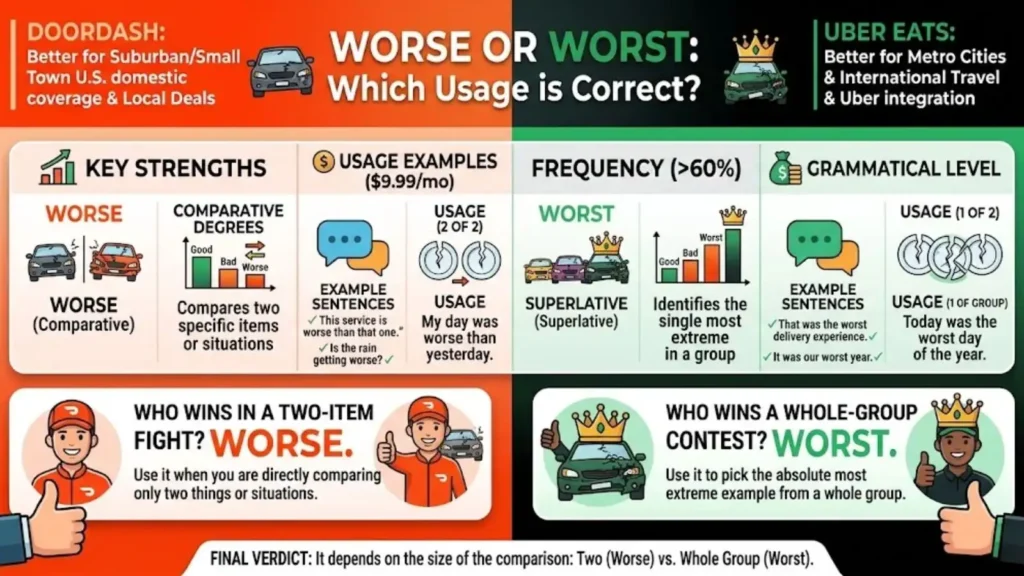
Worse is the comparative form of bad. It describes something that is less good, less acceptable, or more unpleasant than another thing.
Worse is commonly used when comparing two people, objects, situations, experiences, or conditions. It can also describe a change that makes an existing situation less favorable.
Examples of worse in sentences:
- My cold is getting worse.
- This restaurant is worse than the one we visited yesterday.
- His second essay was worse than his first essay.
- The weather became worse during the evening.
- The traffic is worse today than it was yesterday.
In each example, worse shows a comparison or a decline in quality or condition.
For instance, when you say, “The traffic is worse today,” you suggest that the traffic is more difficult or unpleasant than before.
What Does Worst Mean?
Worst is the superlative form of bad. It describes the least favorable option or the highest degree of something negative.
People generally use worst when identifying one item from a group of three or more. It can also describe the most unpleasant experience, the lowest quality, or the most serious point in a situation.
Examples of worst in sentences:
- This is the worst movie I have ever watched.
- Monday was the worst day of my week.
- That was the worst mistake in the entire report.
- She experienced the worst weather during her trip.
- He gave the worst performance of all the contestants.
In these sentences, worst identifies the lowest or least desirable option within a wider group or experience.
For example, “This is the worst movie I have ever watched” means that the speaker considers this movie worse than all the other movies they have watched.
Worse vs Worst: The Core Difference
The easiest way to remember the difference is to focus on comparison.
Worse compares. Worst ranks at the bottom.
Use worse when comparing two things or describing a negative change. Use worst when identifying the most negative option or the lowest point in a situation.
1. Use Worse for Comparisons
When two things are compared, worse is usually the correct choice.
Examples:
- My old phone works better than my new phone, but its battery life is worse.
- This test was worse than the previous one.
- The second plan is worse than the first plan.
- His English pronunciation is worse than mine.
Notice how each example compares one thing with another.
You can often recognize this pattern through words such as than. However, the word than is not always necessary.
For example, “My cough is getting worse” is correct because the sentence describes a decline in the person’s condition over time.
2. Use Worst for the Lowest Rank
When you want to identify the least favorable option in a group, use worst.
Examples:
- This is the worst restaurant in the area.
- She received the worst score in the class.
- That was the worst storm of the year.
- He made the worst decision of his career.
These sentences identify something as the least desirable or most unfavorable within a wider group.
A useful clue is the phrase “the worst.” The word the frequently appears before a superlative adjective, although other constructions are also possible.
For example, “Who performed worst?” is also grammatically correct because worst functions as an adverb.
Why Worse and Worst Are Different Grammar Forms
English adjectives can have different forms to express degrees of quality. These forms are called the positive, comparative, and superlative degrees.
The adjective bad follows an irregular pattern. Instead of adding -er and -est, it changes into different words.
| Degree of comparison | Word | Meaning |
|---|---|---|
| Positive | Bad | Something is not good. |
| Comparative | Worse | Less good than another thing or an earlier condition. |
| Superlative | Worst | The least good or most unfavorable. |
For example:
- Bad: The food is bad.
- Worse: The food is worse than yesterday’s meal.
- Worst: This is the worst meal I have ever eaten.
The word badder is not the standard comparative form of bad. Similarly, badest is not its standard superlative form.
Instead, English uses worse and worst. These irregular forms must be learned and practiced.
Is Worse Always Used for Two Things and Worst for Three or More?
This rule is helpful for beginners, but it needs a little explanation.
Traditionally, comparative forms such as worse are used to compare two things, while superlative forms such as worst identify the extreme within a group.
However, the number of items alone does not determine every correct choice. The intended meaning and sentence structure also matter.
For example:
- Of the two options, this one is worse.
- Of all five options, this one is the worst.
- The situation is getting worse.
- I experienced the worst day of my life.
The important distinction is that worse expresses a comparison or decline, while worst expresses the lowest rank or greatest degree of negativity.
Worse vs Worst: Comparison Table
The following table summarizes the main differences between these two words.
| Feature | Worse | Worst |
|---|---|---|
| Grammar form | Comparative | Superlative |
| Base adjective | Bad | Bad |
| Main purpose | Compares or describes decline | Identifies the lowest rank or most negative degree |
| Common pattern | Worse than | The worst |
| Example | This road is worse than that road. | This is the worst road in town. |
| Change over time | My condition is getting worse. | This is the worst my condition has been. |
Remember that worse and worst can also function as adverbs in certain sentences.
For example, “He performed worse today” compares his performance with another time. Meanwhile, “He performed worst of all” identifies his performance as the lowest in the group.
How to Use Worse and Worst in Real Life
Understanding grammar becomes easier when you see how words appear in everyday situations. Both forms are useful in conversations, education, blogging, and professional communication.
1. Everyday Conversations
People frequently use these words to discuss food, health, weather, travel, and personal experiences.
Examples:
- My back pain is worse after sitting for hours.
- This coffee tastes worse than the one I had this morning.
- That was the worst traffic jam I have ever experienced.
- Today is worse than yesterday because it has been raining all day.
- Missing the train was the worst part of my journey.
In everyday speech, worse often describes a negative change. On the other hand, worst often emphasizes an extreme experience.
2. Education and School Assignments
Students can use these words when comparing grades, explaining problems, or describing academic performance.
Examples:
- My second exam result was worse than my first result.
- This was the worst grade I received this semester.
- The student’s spelling became worse after he stopped practicing.
- She received the worst score among the three participants.
Teachers can also use these words to explain progress. For instance, “Your writing is worse than it was last month” compares two stages of performance.
However, “This is your worst assignment” identifies one assignment as the least successful within a group or set of experiences.
3. Blogging and Content Writing
Bloggers often use comparative and superlative words to describe products, experiences, mistakes, or problems.
Examples:
- This website loads worse on older mobile devices.
- The second version of the article performed worse than the original.
- These are the worst blogging mistakes beginners should avoid.
- This is the worst website design choice for mobile users.
Writers should choose the word that accurately communicates their meaning. Although strong words can make content more engaging, exaggerated claims may mislead readers if they are not supported by evidence.
4. SEO and Digital Marketing
In SEO and marketing content, worse and worst can help describe performance changes and common problems.
Examples:
- The website’s loading speed became worse after the update.
- This landing page performed worse than the previous version.
- These are the worst keyword research mistakes beginners make.
- The campaign had its worst results during the first week.
For professional marketing reports, avoid using worst unless the available data supports that conclusion. If a campaign performs poorly compared with only one previous campaign, worse may be more accurate.
Similarly, if a report identifies the lowest-performing campaign among a group, worst may be appropriate.
Common Mistakes to Avoid
Even experienced English speakers sometimes confuse worse and worst. The following mistakes are easy to correct once you understand the grammar rule.
Mistake 1: Using Worst Instead of Worse
Incorrect: My headache is getting worst.
Correct: My headache is getting worse.
Why? The sentence describes a negative change. Therefore, worse is the appropriate word.
Mistake 2: Using Worse Instead of Worst
Incorrect: This is the worse movie I have ever seen.
Correct: This is the worst movie I have ever seen.
Why? The speaker identifies the lowest-quality movie across all the movies they have seen.
Mistake 3: Writing Badder or Badest
Incorrect: This restaurant is badder than the other one.
Correct: This restaurant is worse than the other one.
Why? Bad has irregular comparative and superlative forms. Use worse and worst, not badder and badest, in standard English.
Mistake 4: Using Both Words in the Wrong Comparison
Incorrect: This is the worst than my old phone.
Correct: This phone is worse than my old phone.
Why? Use worse than when making a direct comparison. Do not combine worst with than in this construction.
Mistake 5: Assuming Worst Always Needs the Word The
Incorrect assumption: You must always write the worst.
Correct examples:
- This was the worst day of the week.
- Who performed worst in the competition?
Why? Superlatives often use the, especially before nouns. However, worst can also function as an adverb without the.
Easy Tips to Remember Worse vs Worst
If you frequently confuse these words, try these simple memory tips.
Tip 1: Remember the word “than.”
When comparing two things, the pattern worse than is common.
Example: “This book is worse than that one.”
Tip 2: Associate worst with the lowest rank.
Think of a competition in which one participant receives the lowest score. You could describe that result as the worst score.
Tip 3: Learn the complete pattern.
Practice saying the three forms together:
Bad → Worse → Worst
This sequence helps you remember the correct forms instead of creating incorrect words such as badder or badest.
Tip 4: Check what your sentence means.
Ask yourself whether you are comparing things or identifying the most negative option. This quick check can help you choose the right word.
Frequently Asked Questions
1. What is the main difference between worse and worst?
Worse is the comparative form of bad, while worst is the superlative form. Use worse to compare or describe a decline and worst to identify the lowest rank or most negative degree.
2. Is worse grammatically correct?
Yes. Worse is a standard English word. For example, “My cold is worse today” correctly describes a condition that has become more unpleasant or severe.
3. Is worst grammatically correct?
Yes. Worst is also a standard English word. For example, “That was the worst experience of my life” identifies an extremely unpleasant experience.
4. Should I use worse or worst with than?
Use worse than for a direct comparison.
Example: “This movie is worse than the previous one.”
The phrase worst than is incorrect in this construction.
5. Can I say “getting worse”?
Yes. “Getting worse” is a common and grammatically correct expression. It describes a situation that is becoming less favorable, more difficult, or more serious.
Example: “The weather is getting worse.”
6. Is it correct to say “my worst nightmare”?
Yes. My worst nightmare is a correct and common expression. It describes something extremely frightening or undesirable.
Example: “Losing all my work was my worst nightmare.”
7. What is the comparative and superlative form of bad?
The comparative form is worse, and the superlative form is worst.
The complete sequence is bad, worse, worst.
8. Can worse and worst be used as adverbs?
Yes. Both words can function as adverbs.
Examples:
- He performed worse than he did last time.
- Of all the players, he performed worst.
In the first sentence, worse compares performance. In the second, worst identifies the lowest performance within the group.
9. Is “worser” a correct English word?
Worser appears in some historical, dialectal, or nonstandard usage, but it is not the standard comparative form in modern English. In formal writing and everyday standard English, use worse.
Conclusion
Understanding worse vs worst can improve your English grammar and make your writing clearer. Although these words share a similar meaning, they serve different grammatical purposes.
Use worse when comparing two things or describing a negative change. For example, “My performance is worse than last week.” In contrast, use worst when identifying the lowest rank or most unfavorable option. For example, “That was the worst performance of the season.”
Remember the simple sequence: bad, worse, worst. Practice using these forms in everyday conversations, school assignments, emails, and blog posts. Moreover, check whether your sentence describes a comparison or an extreme before choosing the word.
With regular practice, you will find it easier to use both words correctly and communicate your ideas with confidence.

Hi, I’m Liam Harper, the voice behind Wordspry!
I’m here to make English grammar simple, clear, and easy to understand for learners of all levels. Through practical lessons and helpful guides, I aim to help you improve your writing and communication skills with confidence.