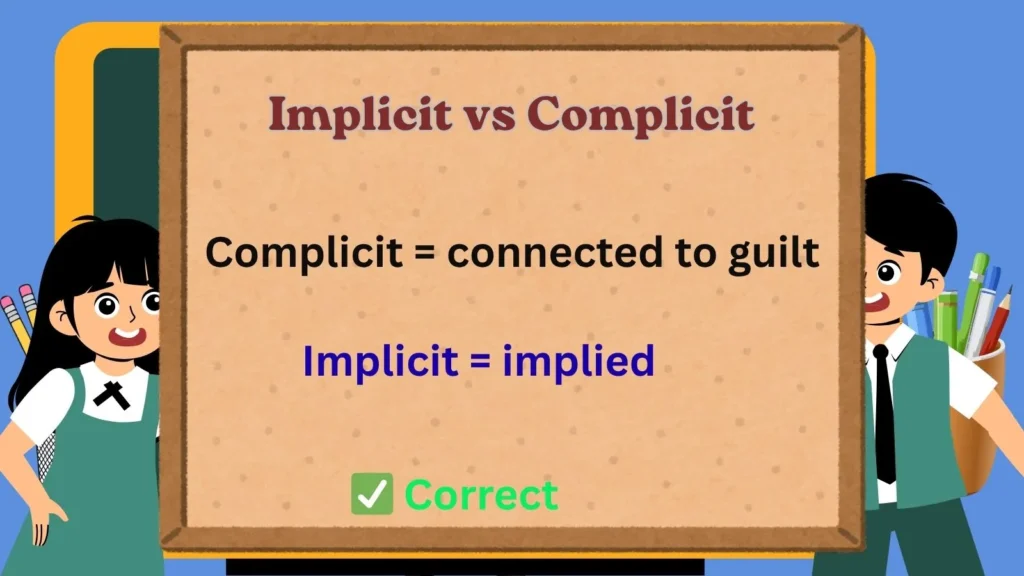
Implicit means something is understood without being directly stated, while complicit means being involved in wrongdoing or helping it happen.
These two words confuse many English learners because they sound alike and share similar endings. Imagine reading a news article where a company is called “complicit” in fraud. If you mistake it for “implicit,” the entire meaning changes. One word suggests hidden understanding, while the other points to guilt or involvement.
That’s why people often search for implicit vs complicit online. The pronunciation feels similar, but the meanings are completely different. In writing, mixing them up can cause awkward mistakes in emails, school papers, or professional communication.
Learn more about: Casi Algo Meaning: Full Guide to Love, Feelings, and Relationships
Table of Contents
- Quick Answer
- What Does “Implicit” Mean?
- What Does “Complicit” Mean?
- Key Difference Between Implicit and Complicit
- Origin and History
- Which One Should You Use?
- Common Mistakes
- Everyday Examples
- Usage Trends and Popularity
- Comparison Table
- Special Rules and Important Uses
- FAQs
- Conclusion
⚡ Implicit vs Complicit: Quick Answer
| Word | Meaning | Easy Memory Trick |
|---|---|---|
| Implicit | Suggested but not directly stated | “Implied silently” |
| Complicit | Involved in wrongdoing | “Companion in guilt” |
Example:
- Implicit: She gave implicit approval with a smile.
- Complicit: The manager was complicit in the scam.
What Does “Implicit” Mean?
The word implicit describes something understood without clear words. It often refers to hidden meaning, quiet agreement, or indirect communication.
Simple Definition
Something is implicit when it is suggested rather than openly expressed.
Correct Examples
✔ The teacher’s tone carried an implicit warning.
✔ There was implicit trust between the friends.
✔ His silence gave implicit permission.
Incorrect Examples
✘ He was implicit in the robbery.
(Incorrect because “implicit” does not mean involved in crime.)
Common Situations
People use “implicit” in:
- Conversations
- Literature
- Psychology
- Business communication
- Academic writing
Related Terms
- implied
- indirect
- unspoken
- understood
- suggested
What Does “Complicit” Mean?
The word complicit refers to someone involved in illegal, dishonest, or harmful behavior.
Simple Definition
A person is complicit when they help, support, or allow wrongdoing.
Correct Examples
✔ The employee was complicit in the fraud scheme.
✔ Several officials became complicit in corruption.
✔ Staying silent made him complicit in the lie.
Incorrect Examples
✘ She gave a complicit hint during class.
(Incorrect because “complicit” is about involvement in wrongdoing.)
Common Situations
People often use “complicit” in:
- News reports
- Legal discussions
- Politics
- Ethics debates
- Crime stories
Related Terms
- involved
- guilty
- responsible
- cooperating
- aiding
Key Difference Between Implicit and Complicit
The difference is simple once you focus on context.
- Implicit relates to hidden meaning.
- Complicit relates to participation in wrongdoing.
Easy Memory Trick
Implicit → “Implied”
Both words start with “imp.”
Complicit → “Complete involvement”
The “com” can remind you of cooperation or participation.
Origin and History
Implicit
“Implicit” comes from the Latin word implicitus, meaning “entwined” or “folded in.” Over time, it evolved to describe ideas hidden inside words or actions.
Complicit
“Complicit” comes from the Latin complicare, meaning “to fold together.” Later, English speakers used it for people connected to crimes or dishonest actions.
Although both words share Latin roots, modern English gives them very different meanings.
Which One Should You Use?
Use implicit when discussing:
- Hidden meaning
- Quiet understanding
- Unspoken agreement
- Indirect communication
Use complicit when discussing:
- Crime
- Dishonesty
- Ethical wrongdoing
- Participation in harmful acts
Quick Tip
Ask yourself:
“Am I talking about meaning or guilt?”
- Meaning → Implicit
- Guilt → Complicit
Common Mistakes
Here are mistakes many writers make.
| Wrong Sentence | Correct Sentence |
|---|---|
| He was implicit in the theft. | He was complicit in the theft. |
| Her complicit smile showed agreement. | Her implicit smile showed agreement. |
| The officer gave a complicit warning. | The officer gave an implicit warning. |
| They became implicit in corruption. | They became complicit in corruption. |
Why This Happens
The confusion usually comes from:
- Similar spelling
- Similar pronunciation
- Lack of context understanding
Everyday Examples
Emails
- “There was an implicit expectation to reply quickly.”
- “The team became complicit in hiding the mistake.”
Social Media
- “His post carried an implicit message about politics.”
- “Users accused the platform of being complicit.”
News
- “The report revealed complicit behavior among officials.”
- “The agreement contained implicit promises.”
Classroom
- “The teacher gave implicit instructions through gestures.”
- “Students who helped cheat were complicit.”
Daily Life
- “Their friendship relied on implicit trust.”
- “Ignoring the problem made everyone complicit.”
Usage Trends and Popularity
Implicit
“Implicit” appears more often in:
- Academic writing
- Psychology
- Education
- Communication studies
Complicit
“Complicit” is common in:
- Journalism
- Politics
- Crime reporting
- Ethics discussions
In modern media, “complicit” became especially popular during political debates and public scandals.
Comparison Table
| Feature | Implicit | Complicit |
|---|---|---|
| Meaning | Implied indirectly | Involved in wrongdoing |
| Tone | Neutral | Negative |
| Usage | Communication | Crime or ethics |
| Part of Speech | Adjective | Adjective |
| Common Pairings | implicit trust | complicit in fraud |
| Related Idea | Hidden meaning | Shared guilt |
Special Rules and Important Uses
“Complicit” Usually Needs “In”
Most sentences use:
- complicit in a crime
- complicit in corruption
✔ She was complicit in the scheme.
“Implicit” Often Describes Abstract Ideas
It commonly appears with:
- trust
- agreement
- understanding
- bias
- message
✔ There was implicit respect between them.
Important Note
“Implicit bias” is a very common phrase in psychology and education. It describes unconscious attitudes or assumptions.
FAQs
What is the difference between implicit and complicit?
Implicit means something is suggested indirectly. Complicit means involved in wrongdoing.
Is implicit positive or negative?
Usually neutral. It depends on the context.
Is complicit always negative?
Yes. It almost always relates to guilt, crime, or unethical behavior.
Can a person be implicit?
Not usually in modern English. People are more commonly described as “complicit.”
What is an example of implicit?
“She gave implicit approval by nodding.”
What is an example of complicit?
“The employee was complicit in the fraud.”
Why do people confuse implicit and complicit?
They sound similar and have related spelling patterns.
Conclusion
Understanding implicit vs complicit becomes much easier once you focus on the core meaning of each word. “Implicit” deals with ideas that are unspoken or indirectly understood. “Complicit,” on the other hand, involves taking part in wrongdoing or allowing harmful behavior to continue.
Even though the words sound alike, they belong in very different situations. One relates to communication and hidden meaning. The other relates to guilt and responsibility.
A simple memory trick can help:
- Implicit = implied
- Complicit = connected to guilt

Hi, I’m William Parker, the creator behind Wordspry.com
I enjoy breaking down complex grammar rules into clear and practical lessons that help learners write and speak English more effectively.