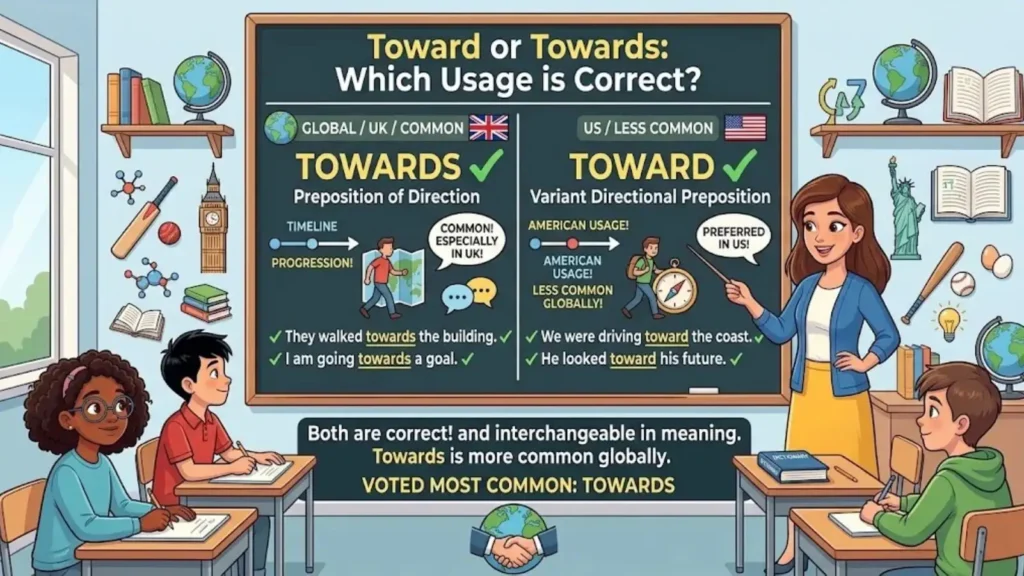
Toward and towards are both correct English words. They have the same meaning, and the main difference is regional preference: toward is more common in American English, while towards is more common in British English.
Have you ever stopped while writing an email because you could not decide between toward and towards? You are not alone. These two words look almost identical, and choosing one can feel like guessing between two spellings of the same word.
Core Meaning and Spelling Clarity: Toward or Towards
The simplest way to understand these words is to focus on their shared meaning. Both toward and towards describe movement, direction, progress, or an attitude directed at something.
Neither spelling is inherently more correct than the other. Your choice usually depends on your audience, your preferred variety of English, or the style guide you follow.
See also: Gumba vs Goomba: Which Spelling Is Correct and When Should You Use It?
What Does Toward Mean?
Toward is a preposition that indicates movement in the direction of a person, place, object, goal, or idea. It can also describe progress, responsibility, or feelings.
Example:
- The little boy ran toward his mother.
- Our team is working toward a shared goal.
- She has a positive attitude toward learning.
- The company contributed money toward the project.
In each sentence, toward connects an action, attitude, or contribution with its destination or purpose.
Think of it as an arrow pointing toward something. The arrow identifies a direction, but it does not necessarily mean the destination has been reached.
What Does Towards Mean?
Towards has the same meaning and grammatical function as toward. The additional s does not create a different meaning or change the direction of movement.
Examples:
- The little boy ran towards his mother.
- Our team is working towards a shared goal.
- She has a positive attitude towards learning.
- The company contributed money towards the project.
These sentences communicate the same ideas as their counterparts above.
Key takeaway:
Both words are correct. Choose the form that best matches your audience and maintain consistency throughout your writing.
Are Toward and Towards Different Parts of Speech?
No. Both words function as prepositions in standard usage.
A preposition often connects a noun or pronoun with another part of a sentence. It can express direction, relationship, purpose, or movement.
For instance, in “He walked toward the station,” the word toward explains the direction of his walk. The same grammatical role appears in “He walked towards the station.”
The spelling changes, but the grammar and meaning stay the same.
Why Do People Get Confused About Toward or Towards?
English can be surprisingly flexible. Sometimes two spellings are both correct, even when one looks more familiar to you.
The confusion surrounding toward or towards comes mainly from regional English preferences, school instruction, and exposure to different publications.
1. American and British English Use Different Preferences
American English generally favors toward, while British English generally favors towards. Both remain acceptable forms, so the distinction is about common usage rather than grammatical correctness.
Example:
- In American English: “We walked toward the beach.”
- In British English: “We walked towards the beach.”
Neither sentence is wrong. The difference simply reflects the writer’s preferred variety of English.
2. People Learn Different Forms at School
A student who learns British English might see towards in textbooks and examinations. Another student studying American English may regularly encounter toward.
Later, these students might read articles from different countries and notice both spellings. Without understanding regional preferences, they may assume one is incorrect.
In reality, both forms belong to standard English.
3. The Extra Letter Creates Doubt
Many learners associate correct spelling with a fixed set of rules. When they see a word written in two ways, they naturally wonder which version follows the rules.
However, English contains many accepted variations. The final s in towards is not an accidental addition, nor does it change the word’s meaning.
The best solution is to learn the regional preference instead of treating one form as a spelling error.
Toward or Towards in American and British English
If you are unsure which version to use, start by identifying your intended audience. This simple decision usually settles the question.
American English: Toward
American writers commonly use toward in books, articles, school assignments, and professional documents.
Example: The company is moving toward a greener future.
British English: Towards
British writers commonly use towards in everyday writing and formal publications.
Example: The company is moving towards a greener future.
These preferences are not strict geographical boundaries. British English speakers can use toward, and American English speakers can use towards. Both versions are understood and accepted.
What About Canadian, Australian, and Other English Varieties?
English usage extends far beyond the United States and the United Kingdom.
Canadian English often favors toward, while Australian and New Zealand English commonly follow the British preference for towards. However, usage can vary by publication, writer, and context.
If you are writing for an international audience, either form can work. Choose one spelling and use it consistently.
Side-by-Side Comparison Table: Toward vs Towards
Sometimes a quick comparison explains more than several paragraphs. The following table summarizes the essential differences.
| Feature | Toward | Towards |
|---|---|---|
| Correct spelling | Yes | Yes |
| Part of speech | Preposition | Preposition |
| Basic meaning | In the direction of | In the direction of |
| Physical movement | Correct | Correct |
| Attitude or feelings | Correct | Correct |
| Progress toward a goal | Correct | Correct |
| Contribution to a cost | Correct | Correct |
| Common regional preference | American English | British English |
| Suitable for formal writing | Yes | Yes |
| Meaning changes with spelling | No | No |
The most important point is that toward and towards are interchangeable in their ordinary uses. Your choice depends primarily on regional preference and editorial style.
Real-Life Meaning Explained: How to Use Toward or Towards
Both words can express several kinds of relationships. Understanding these uses will help you recognize them in conversations, books, emails, and examinations.
1. Physical Movement or Direction
This is the most familiar use. The word describes movement in the direction of a person, place, or object.
Examples:
- The dog ran toward its owner.
- The dog ran towards its owner.
- We drove toward the nearest hospital.
- We drove towards the nearest hospital.
Imagine standing at one end of a hallway while a friend approaches you. You could describe the movement using either spelling.
2. Attitudes, Feelings, and Behaviour
The words can also describe how someone feels or behaves in relation to another person or thing.
Examples:
- She has a positive attitude toward her studies.
- She has a positive attitude towards her studies.
- His behaviour toward his colleagues was respectful.
- His behaviour towards his colleagues was respectful.
This meaning appears frequently in school essays, workplace reviews, and discussions about relationships.
3. Progress and Goals
You can use toward or towards when discussing progress toward a desired result.
Examples:
- I am working toward my degree.
- I am working towards my degree.
- The team took another step toward success.
- The team took another step towards success.
The word describes the direction of your progress rather than guaranteeing the final result.
4. Money, Contributions, and Expenses
Both forms can indicate that money or effort is being used to help pay for or achieve something.
Examples:
- I saved $200 toward a new laptop.
- I saved $200 towards a new laptop.
- They donated money toward school repairs.
- They donated money towards school repairs.
This use is common in fundraising campaigns, budgets, financial reports, and everyday conversations.
5. Time and Position
The words can also refer to a point near a particular time or place.
Examples:
- We arrived toward the end of the afternoon.
- We arrived towards the end of the afternoon.
- Please sit toward the back of the room.
- Please sit towards the back of the room.
In these sentences, the word does not necessarily describe physical movement. Instead, it identifies an approximate position or time.
Common Mistakes When Using Toward or Towards
Although the spelling choice is simple, writers can still make mistakes by misunderstanding the words’ meanings or using them inconsistently.
Mistake 1: Calling Towards Incorrect in American English
Incorrect claim: “You must never use towards in American English.”
Correct explanation: Toward is more common in American English, but towards is also accepted.
Example:
- Less typical for American style: She walked towards the exit.
- Common American preference: She walked toward the exit.
Mistake 2: Assuming Toward Is Wrong in British English
Incorrect claim: “British writers must always add s to toward.”
Correct explanation: Towards is more common in British English, but toward is also valid.
Example:
- Common British preference: He moved towards the window.
- Also correct: He moved toward the window.
Do not confuse a regional preference with a compulsory grammar rule.
Mistake 3: Changing Spelling Without a Reason
Mixing both forms in one article can make your writing appear inconsistent.
For example:
We walked toward the museum. Later, we headed towards the station.
This passage is not grammatically incorrect. However, if both sentences belong to the same document, using one form throughout creates a more consistent style.
Better American version:
We walked toward the museum. Later, we headed toward the station.
Better British version:
We walked towards the museum. Later, we headed towards the station.
Consistency is especially useful in academic writing, business communication, and published blog posts.
Mistake 4: Thinking the Extra S Changes the Meaning
The final s does not make towards plural. It also does not indicate multiple directions or people.
Both words can appear before singular nouns, plural nouns, and abstract ideas.
Example:
- She turned toward the child.
- She turned towards the children.
- He worked toward peace.
- He worked towards peace.
The noun following the preposition determines its number, not the spelling of toward(s).
Memory Tricks: How to Remember Toward or Towards
A simple memory trick can help you choose the correct form quickly.
Trick 1: Remember the Regional Pattern
Associate the shorter form with American English and the longer form with British English.
- Toward = common American preference.
- Towards = common British preference.
This is a useful guide, not an absolute rule.
Trick 2: Think About Your Reader
Before writing, ask yourself one question: “Who will read this?”
If your audience is mainly American, choose toward. If your audience is mainly British, choose towards.
For international content, either is fine, provided you follow a consistent style.
Trick 3: Check Your Existing Document
If you have already written several paragraphs, search your document for both forms. Keep the version that matches your chosen style.
This small editing step can improve consistency without changing your meaning.
Professional Writing: Which Form Should You Choose?
A small spelling choice can help your writing feel more natural to its intended audience. Although toward and towards are both correct, professional writers should consider their publication’s conventions.
In Academic Writing
Students should follow the spelling conventions recommended by their teachers, institutions, or assignment guidelines.
For example, an American English essay might say:
Researchers are working toward a better understanding of climate change.
A British English essay could use:
Researchers are working towards a better understanding of climate change.
Both sentences are grammatically correct.
In Business Emails
Business writing benefits from consistency and clarity. Choose the spelling that matches your company’s preferred English variety.
American-style example:
Hi Team,
We are making steady progress toward our project goals. Thank you for your continued support and cooperation.
Best regards
For a British audience, you can replace toward with towards without changing the meaning.
Practical Examples: Toward or Towards in Sentences
The following examples show how both spellings work in everyday situations.
| Context | Using Toward | Using Towards |
|---|---|---|
| Walking | She walked toward the gate. | She walked towards the gate. |
| Education | He is working toward his diploma. | He is working towards his diploma. |
| Relationships | They showed kindness toward strangers. | They showed kindness towards strangers. |
| Business | We are moving toward a solution. | We are moving towards a solution. |
| Saving money | She put $50 toward the bill. | She put $50 towards the bill. |
| Time | We left toward evening. | We left towards evening. |
| Location | They sat toward the front. | They sat towards the front. |
Each pair communicates the same basic idea. The choice reflects regional preference, not a difference in grammar.
Mini Case Study: Editing a Blog Post
Imagine that a writer is preparing an article for an American audience.
The original draft contains these sentences:
- Our company is working towards cleaner energy.
- We are moving toward sustainable business practices.
- Every decision takes us towards our goal.
The writer reviews the article and chooses American English as the house style.
The revised version reads:
- Our company is working toward cleaner energy.
- We are moving toward sustainable business practices.
- Every decision takes us toward our goal.
The revision improves consistency without changing the message. A British publication could make the opposite choice and consistently use towards.
Quick Fix Guide: Toward or Towards?
Use this simple guide whenever you need to make a quick decision.
Writing for American readers?
Prefer toward.
Writing for British readers?
Prefer towards.
Writing for an international audience?
Either spelling works. Choose one and use it consistently.
Following a style guide?
Use the spelling required by your publisher, teacher, or organization.
FAQs About Toward or Towards
1. Is toward or towards correct?
Both toward and towards are correct English words. They have the same meaning and grammatical function. Toward is more common in American English, while towards is more common in British English.
2. Is toward American or British English?
Toward is generally associated with American English. American writers commonly use it to describe direction, progress, attitudes, and contributions. British writers can also use it, although towards is generally more common in the UK.
3. Is towards grammatically correct in American English?
Yes, towards is grammatically correct in American English. It is simply less common than toward in many American publications. If you are writing for a US audience, toward is usually the more natural default.
4. Should I write working toward or working towards?
Both working toward and working towards are correct. They mean making an effort to achieve something. Use working toward in American-style writing and working towards in British-style writing, unless your style guide specifies otherwise.
5. Do toward and towards have different meanings?
No. Toward and towards have the same basic meaning. Both can describe movement, attitudes, progress, approximate time or position, and contributions. Adding the final s does not change the meaning.
6. Can I use toward and towards in the same article?
You can, because both spellings are correct. However, it is generally better to choose one form and use it throughout the article. Consistent spelling makes your writing look more polished and professional.
7. Which spelling should English learners remember?
English learners should remember both forms and understand their regional preferences. Choose toward for most American English writing and towards for most British English writing. If your teacher or publication has a preferred style, follow that guidance.
Conclusion: Choose Toward or Towards With Confidence
The difference between toward and towards is simpler than it first appears. Both are correct English prepositions, and both express direction, progress, attitudes, position, or contributions.
The main distinction is regional preference. American English generally favors toward, while British English commonly uses towards. Neither spelling is universally better, and neither is inherently incorrect.
Once you understand this pattern, you can stop second-guessing yourself whenever these words appear. Instead, choose the form that suits your readers and concentrate on communicating your ideas clearly.
If you found this guide helpful, you might also enjoy our article on Forward or Forwards.

Hi, I’m Henry Collins, the educator behind Wordspry.com
I’m dedicated to helping English learners build confidence through easy grammar explanations, writing tips, and everyday language learning resources.