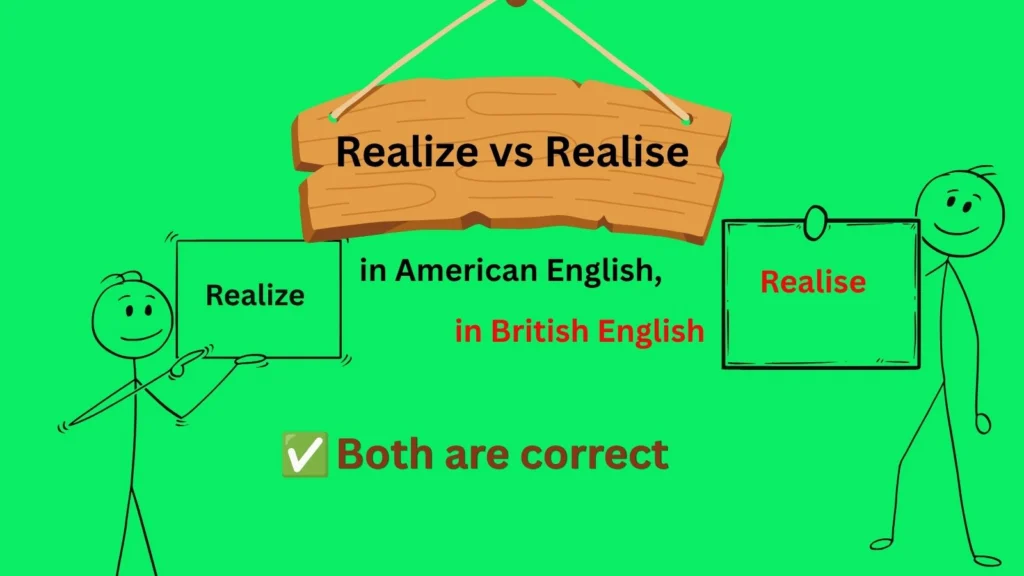
Realize and realise have the same meaning. The only difference is spelling. Realize is common in American English, while realise is common in British English.
Imagine you are writing an email to a client. You type, “I did not realize the meeting was today.” Later, your colleague changes it to “I did not realise the meeting was today.” Now you wonder which spelling is correct.
This question is very common. Many English learners and writers see both spellings and become confused. They want to know whether one is wrong or if both are acceptable.
The truth is simple. Realize and realise mean exactly the same thing. Both words mean to understand, become aware of, or recognize something. The difference comes from regional spelling rules.
People search for Realize vs Realise because they want to write correctly for school, work, websites, and social media. Understanding this spelling difference helps you communicate clearly and avoid mistakes.
See Related: Implicit vs Complicit: What’s the Real Difference?
Pronunciation
| Word | US Pronunciation | UK Pronunciation |
|---|---|---|
| Realize | ree-uh-lahyz | ree-uh-lahyz |
| Realise | ree-uh-lahyz | ree-uh-lahyz |
Both words sound exactly the same.
Difference Between Realize vs Realise
1. Spelling Style
Realize uses -ize.
Realise uses -ise.
Examples:
- I realize my mistake now.
- She will realize the truth soon.
- I realise my mistake now.
- She will realise the truth soon.
2. American vs British Usage
Americans usually write realize.
Many British writers use realise.
Examples:
- Americans realize the value of education.
- I realize this is important.
- British readers realise the value of education.
- I realise this is important.
3. Publishing Preference
American publishers prefer realize.
British publishers often prefer realise.
Examples:
- The US book uses realize.
- The magazine chose realize.
- The UK book uses realise.
- The newspaper chose realise.
4. School Teaching
US schools teach realize.
UK schools often teach realise.
Examples:
- Students learn realize in America.
- Teachers mark realize as correct.
- Students learn realise in Britain.
- Teachers mark realise as correct.
American style guides prefer realize.
5. Style Guides
British style guides may prefer realise.
Examples:
- The guide recommends realize.
- The editor changed it to realize.
- The guide recommends realise.
- The editor changed it to realise.
6. Website Audience
Audience location affects spelling choice.
Examples:
- A US website uses realize.
- American blogs write realize.
- A UK website uses realise.
- British blogs write realise.
7. Corporate Communication
Companies choose one style and stay consistent.
Examples:
- The US company uses realize.
- The report says realize.
- The UK company uses realise.
- The report says realise.
8. Search Preferences
People search using local spelling.
Examples:
- Americans search realize meaning.
- Americans type realize examples.
- Britons search realise meaning.
- Britons type realise examples.
9. Historical Preference
The spellings developed differently over time.
Examples:
- Many US texts use realize.
- Modern US writing prefers realize.
- Many UK texts use realise.
- Modern UK writing prefers realise.
10. Meaning
The meaning never changes.
Examples:
- I realize I was wrong.
- They realize the risk.
- I realise I was wrong.
- They realise the risk.
Nature and Behaviour of Realize vs Realise
Realize
Realize is a verb.
It means to understand something.
It is standard in American English.
Examples:
- I realize my error.
- We realize the importance of time.
Realise
Realise is also a verb.
It has the same meaning.
It is common in British English.
Examples:
- I realise my error.
- We realise the importance of time.
Why People Get Confused About Realize vs Realise
People get confused because both spellings are correct.
They sound the same.
They have the same meaning.
Many websites, books, and social media posts use different versions. This makes learners think one spelling is wrong.
The real difference is regional preference.
Comparison Table
| Feature | Realize | Realise |
|---|---|---|
| Meaning | Same | Same |
| Part of Speech | Verb | Verb |
| Pronunciation | Same | Same |
| American English | Preferred | Rare |
| British English | Accepted | Common |
| Formal Writing | Yes | Yes |
| Informal Writing | Yes | Yes |
| Correct Spelling | Yes | Yes |
Similarities
- Same meaning
- Same pronunciation
- Same grammar
- Same usage
The Origin of Realize
The word comes from the word real.
Its roots trace back through French and Latin languages.
The word entered English several centuries ago.
Over time, English spelling developed in different ways. American English favored -ize endings. British English often preferred -ise endings.
This created the two spellings we use today.
British vs American English
American English
Uses realize.
Examples:
- I realize the problem.
- They realize the need for change.
British English
Usually uses realise.
Examples:
- I realise the problem.
- They realise the need for change.
Both are correct in their regions.
Which One Should You Use?
Use realize if:
- You write for Americans.
- You follow American English rules.
- Your audience is mainly in the US.
Use realise if:
- You write for British readers.
- You follow UK spelling rules.
- Your audience is mainly in the UK.
For international audiences, either spelling works. Just stay consistent.
Common Mistakes
Mistake 1
❌ I realise the issue. (American document)
✅ I realize the issue.
Mistake 2
❌ I realize the issue. (British document using UK style)
✅ I realise the issue.
Mistake 3
❌ Using both spellings in one article.
✅ Use one spelling throughout.
Mistake 4
❌ Thinking one spelling is wrong.
✅ Both spellings are correct.
Everyday Usage Examples
Emails
- I realize the report is late.
- I realise the report is late.
Social Media
- I just realized my phone was at home.
- I just realised my phone was at home.
News
- Experts realize the danger.
- Experts realise the danger.
Formal Writing
- Researchers realize the impact.
- Researchers realise the impact.
Usage Trends
Realize dominates in the United States.
Realise remains popular in the United Kingdom and some Commonwealth countries.
Global websites often choose one version based on their audience.
The internet has made both spellings easy to see worldwide.
Metaphors and Similes
Metaphors
- Realizing the truth is opening a locked door.
- Realising a mistake is turning on a light.
Similes
- She realized the answer like a flash of lightning.
- He realised the truth like waking from a dream.
Connotative Meaning
Positive
- I realized my potential.
- She realised her dream.
Neutral
- I realized the meeting starts at noon.
- He realised the train was late.
Negative
- They realized the danger too late.
- She realised her mistake after the loss.
Idioms and Proverbs
See the Light
- After reading the report, he realized the problem.
- After reading the report, he realised the problem.
Wake Up and Smell the Coffee
- She finally realized what was happening.
- She finally realised what was happening.
Literature and Movies
Literature
Pride and Prejudice by Jane Austen (1813) uses British spelling traditions.
Many modern American novels use realize.
Movies
The movie The Pursuit of Happyness (2006, USA) contains themes where characters realize important truths.
The film The King’s Speech (2010, UK) reflects British language conventions.
Why This Difference Matters
This difference matters because spelling creates a professional impression.
Correct spelling shows attention to detail.
Writers, students, and businesses should match the spelling style of their audience.
Consistent spelling also improves readability.
Usefulness in Daily Life
Knowing the difference helps when:
- Writing emails
- Creating blog posts
- Completing school work
- Publishing books
- Managing websites
- Communicating internationally
It helps you choose the right spelling for your readers.
Situational Preference
When writing for an American audience, use realize because it matches standard US spelling rules. If your readers are in the United Kingdom, realise is usually the better choice. Businesses should follow the spelling style used in their region. Students should follow the rules required by their school or teacher. Bloggers and website owners should match the language of their target audience. For international communication, either spelling is acceptable. The most important rule is consistency. Choose one version and use it throughout your document. Mixing both spellings can look careless and may confuse readers.
Frequently Asked Questions.
Is realize correct?
Yes. It is the standard American spelling.
Is realise correct?
Yes. It is the common British spelling.
Do realize and realise mean the same thing?
Yes. Their meanings are identical.
Which spelling is older?
Both forms have existed for a long time.
Which spelling should international writers use?
Either works. Stay consistent.
Is realize more common online?
Yes. It appears more often because of American influence.
Can I use both in one document?
No. Choose one style and keep it throughout.
Conclusion
The debate over Realize vs Realise is actually very simple. Both spellings are correct, and both have the same meaning. They are pronounced the same way and function as the same verb. The only real difference is regional spelling preference.
American English strongly favors realize, while British English commonly uses realise. Neither spelling is better than the other. The right choice depends on your audience and the style guide you follow.
Understanding this difference helps students, writers, bloggers, businesses, and English learners communicate more effectively. It also prevents unnecessary corrections and confusion when reading international content.
If you write for Americans, choose realize. If you write for British readers, choose realise. For global communication, either spelling works perfectly well. Just remember one important rule: be consistent. Using one spelling style throughout your writing makes your work look professional, polished, and easy to read.

Hi, I’m Liam Harper, the voice behind Wordspry!
I’m here to make English grammar simple, clear, and easy to understand for learners of all levels. Through practical lessons and helpful guides, I aim to help you improve your writing and communication skills with confidence.