Inquiry vs Enquiry – Quick Answer
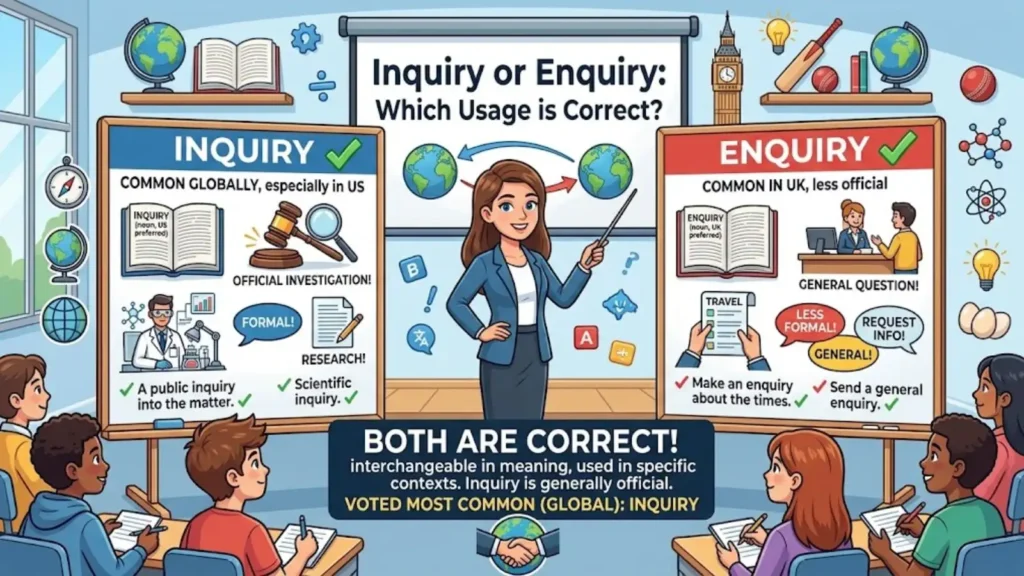
Inquiry and enquiry are both correct spellings. The best choice depends on your audience and the context.
- 🟢 ✓ Inquiry: Standard in American English; also used in British English, especially for formal investigations.
- 🟢 ✓ Enquiry: Common in British English, particularly for general questions or requests for information.
- 🔴 ✗ Inquery: Incorrect spelling.
- 🔴 ✗ Enquery: Incorrect spelling.
Examples
✓ Correct: I sent an inquiry about the job opening.
✓ Correct: I sent an enquiry about the job opening.
Both sentences are acceptable. The second spelling is more common in British English, while the first is standard in American English.
✗ Incorrect: I sent an inquery about the job opening.
Remember that the choice between inquiry and enquiry is usually about regional spelling and style, not a major difference in meaning.
RELATED: Hierarchical vs Hierarchal: Which Word Should You Use?
The Origin of Inquiry and Enquiry
The words inquiry and enquiry share the same historical roots. Both developed from the verb inquire or enquire, which means to ask about something or seek information.
These verbs came into English through Old French and ultimately trace back to Latin roots associated with seeking, asking, or investigating.
Over time, English developed two spelling forms:
- Inquiry became the preferred form in American English.
- Enquiry remained common in British English.
The difference reflects the way English spelling developed across regions. American English often favors certain forms that differ from traditional British usage.
For example:
✓ Inquiry: The police began an inquiry into the incident.
✓ Enquiry: She made an enquiry about the course fees.
Both words refer to seeking information. However, some British writers use inquiry for a formal investigation and enquiry for an ordinary question.
This distinction can help you choose the right word, but it is not a strict rule followed by every writer or organization.
British English vs American English Spelling
The main difference between inquiry vs enquiry is regional preference.
American English generally uses inquiry for both general questions and formal investigations. British English uses both spellings, sometimes with a distinction in meaning.
Comparison Table
| Feature | American English | British English |
|---|---|---|
| Preferred spelling | Inquiry | Enquiry for many general questions |
| Formal investigation | Inquiry | Inquiry is common |
| General request for information | Inquiry | Enquiry is common |
| Correct spelling | 🟢 ✓ Inquiry | 🟢 ✓ Inquiry and Enquiry |
| Incorrect spelling | 🔴 ✗ Inquery | 🔴 ✗ Enquery |
American English Examples
✓ Correct: I submitted an inquiry about my order.
✓ Correct: The government opened an inquiry into the incident.
American writers generally use inquiry in both sentences.
British English Examples
✓ Correct: I made an enquiry about the train times.
✓ Correct: The government launched an inquiry into the accident.
In these examples, enquiry refers to a general request for information, while inquiry refers to a formal investigation.
However, British English also accepts inquiry for ordinary questions. Always follow the spelling used by your organization or publication.
Which Spelling Should You Use?
The best spelling depends on your readers, your location, and the style guide you follow.
For American Readers
Use inquiry in most situations.
Examples:
- ✓ I have an inquiry about your services.
- ✓ The committee started an inquiry into the complaint.
- ✓ Please direct your inquiries to our office.
This spelling is standard in American business, education, and government writing.
For British Readers
Use enquiry for general questions if you follow traditional British usage.
Examples:
- ✓ I would like to make an enquiry about your prices.
- ✓ Please send your enquiries by email.
- ✓ The public inquiry examined the cause of the accident.
Both forms are correct in British English. The distinction between general questions and formal investigations is a useful guide.
For Canadian and Australian Readers
Both countries use British and American influences, so usage can vary by organization and context.
For a general request, enquiry may be appropriate in British-influenced writing. However, inquiry is also widely understood and used.
Follow the style guide of your employer, school, or publication.
For International Readers
If you write for a global audience, inquiry is a practical choice because it is standard in American English and widely understood elsewhere.
Most importantly, remain consistent throughout your document.
Common Mistakes with Inquiry vs Enquiry
Writers often confuse these words because they look similar and have nearly the same meaning.
Here are common mistakes and how to avoid them.
1. Using an Incorrect Spelling
🔴 ✗ Incorrect: I sent an inquery to the company.
🟢 ✓ Correct: I sent an inquiry to the company.
The standard spellings are inquiry and enquiry. Avoid adding an extra letter after the first syllable.
2. Mixing Regional Spellings Without a Reason
🔴 ✗ Inconsistent: I sent an enquiry yesterday. Today, I sent another inquiry about the same service.
🟢 ✓ Better: I sent an enquiry yesterday. Today, I sent another enquiry about the same service.
The first example is not necessarily grammatically wrong. However, the second maintains a consistent British spelling choice.
3. Assuming Enquiry Is Always Informal
🔴 ✗ Incorrect assumption: Enquiry is never suitable for formal writing.
🟢 ✓ Correct: Enquiry can appear in formal emails, business letters, and professional requests.
For example:
I am writing to make an enquiry about your admission requirements.
This is a polite and professional sentence.
4. Assuming Inquiry Is Only American
🔴 ✗ Incorrect assumption: British English never uses inquiry.
🟢 ✓ Correct: British English uses inquiry, especially in expressions such as public inquiry or official inquiry.
5. Confusing Inquiry With Question
An inquiry can be a question, but it can also involve a longer process of gathering facts.
For example:
I made an enquiry about the price.
This is a simple request for information.
The committee conducted an inquiry into the allegations.
This describes a formal investigation.
Understanding the context helps you choose the right word.
Inquiry vs Enquiry in Everyday Examples
Both spellings appear in daily communication. The following examples show how to use them naturally.
1. In Emails
When contacting a company, you can write:
American English:
Subject: Product Inquiry Dear Customer Service Team, I am writing to make an inquiry about your latest product.
British English:
Subject: Product Enquiry Dear Customer Service Team, I am writing to make an enquiry about your latest product.
Both versions are correct. Choose the one that matches your audience.
2. In News Reports
News organizations often use inquiry when discussing official investigations.
🟢 ✓ Correct: The court ordered an inquiry into the allegations.
🟢 ✓ Correct: Officials opened a public inquiry into the incident.
These examples are common in both American and British English.
3. On Social Media
People often use these words when asking about products, events, or services.
🟢 ✓ Correct: Please send us a product inquiry through our website.
🟢 ✓ Correct: DM us for any enquiries about our services.
The first example suits American usage. The second is common in British-influenced business communication.
4. In Formal Writing
Both words can appear in reports, letters, and academic documents.
🟢 ✓ Correct: The report answers several important inquiries about the policy.
🟢 ✓ Correct: We welcome enquiries from students interested in the program.
Use inquiry when it matches your regional style or refers to a formal investigation. Use enquiry when it matches your chosen British style.
Inquiry vs Enquiry – Google Trends and Usage Data
People search for inquiry vs enquiry to understand which spelling is correct and which one suits their audience.
Search interest can vary by country because English spelling preferences differ across regions. However, exact popularity rankings require current Google Trends data. Without checking a specific date range and comparison, it would be misleading to claim that one spelling receives a certain percentage of searches.
Here is a general guide to regional usage:
| Region | Common Preference | Typical Context |
|---|---|---|
| United States | Inquiry | Questions and investigations |
| United Kingdom | Enquiry and Inquiry | General questions and formal investigations |
| Canada | Both forms | Depends on the style guide |
| Australia | Both forms | British-influenced usage and organizational preferences |
| International English | Inquiry is a practical option | Global business and online content |
What Does Google Trends Show?
Google Trends can help you compare search interest for inquiry and enquiry in specific countries and time periods.
To explore the difference:
- Open Google Trends.
- Enter inquiry and enquiry as separate search terms.
- Select a country, such as the United States or United Kingdom.
- Choose a time range.
- Compare the relative search interest.
Remember that Google Trends reports relative interest, not exact search volume. Results can also change depending on the selected region, period, and search settings.
For writers, the practical lesson remains simple: choose the spelling that fits your audience rather than relying on popularity alone.
Inquiry vs Enquiry – Word Variations Comparison Table
The words below are related, but their grammatical forms and uses differ.
| Word | Part of Speech | Meaning | Example |
|---|---|---|---|
| Inquiry | Noun | A question or investigation | We received an inquiry. |
| Enquiry | Noun | A request for information | She made an enquiry. |
| Inquiries | Plural noun | More than one question or investigation | We answered three inquiries. |
| Enquiries | Plural noun | More than one request for information | The office handles enquiries. |
| Inquire | Verb | To ask or investigate | I want to inquire about fees. |
| Enquire | Verb | To ask for information | She called to enquire about the course. |
| Inquiring | Verb form | Asking or investigating | He is inquiring about the delay. |
| Enquiring | Verb form | Asking for information | They are enquiring about prices. |
The noun forms inquiry and enquiry are interchangeable in many contexts. Likewise, inquire and enquire are both accepted verb forms, although regional preferences differ.
FAQs About Inquiry vs Enquiry
1. Is inquiry or enquiry correct?
Both are correct. Inquiry is the standard spelling in American English. Enquiry is common in British English, especially for general requests for information.
2. What is the difference between inquiry and enquiry?
Both words usually mean a question or a process of seeking information. In some British usage, enquiry refers to a general question, while inquiry refers to a formal investigation.
3. Is enquiry British or American?
Enquiry is more closely associated with British English. American English generally prefers inquiry.
4. Is inquiry formal or informal?
It can be either. You can use inquiry for a simple request for information or a formal investigation.
5. Which spelling should I use in a business email?
Use inquiry for an American audience and enquiry if you follow a British style that prefers it for general requests. Both can be professional.
6. Is it inquiries or enquiries?
Both plural forms are correct. Use inquiries with inquiry and enquiries with enquiry.
7. Can I use inquiry and enquiry in the same article?
Yes, but it is better to follow one regional style unless the context calls for a specific term. Consistency makes your writing easier to read.
Conclusion
Understanding inquiry vs enquiry is simple once you know that both words are correct. They share almost the same meaning and usually refer to a request for information or an investigation.
The main difference is regional preference. Inquiry is standard in American English and is also used in British English, especially for formal investigations. Enquiry is common in British English, particularly when someone asks a general question.
For example, an American customer might send a product inquiry, while a British customer might make a product enquiry. Both sentences communicate the same idea.
When writing for a specific country, follow the spelling preferred by your readers or the style guide you use. If you publish content for an international audience, inquiry is a practical option because it is widely recognized.
Also, remember to avoid misspellings such as inquery and enquery. Finally, keep your spelling consistent across emails, articles, reports, and business documents.
With these simple rules, you can choose between inquiry and enquiry with confidence and make your English writing clearer and more professional.

Hi, I’m Liam Harper, the voice behind Wordspry!
I’m here to make English grammar simple, clear, and easy to understand for learners of all levels. Through practical lessons and helpful guides, I aim to help you improve your writing and communication skills with confidence.