Quick Answer
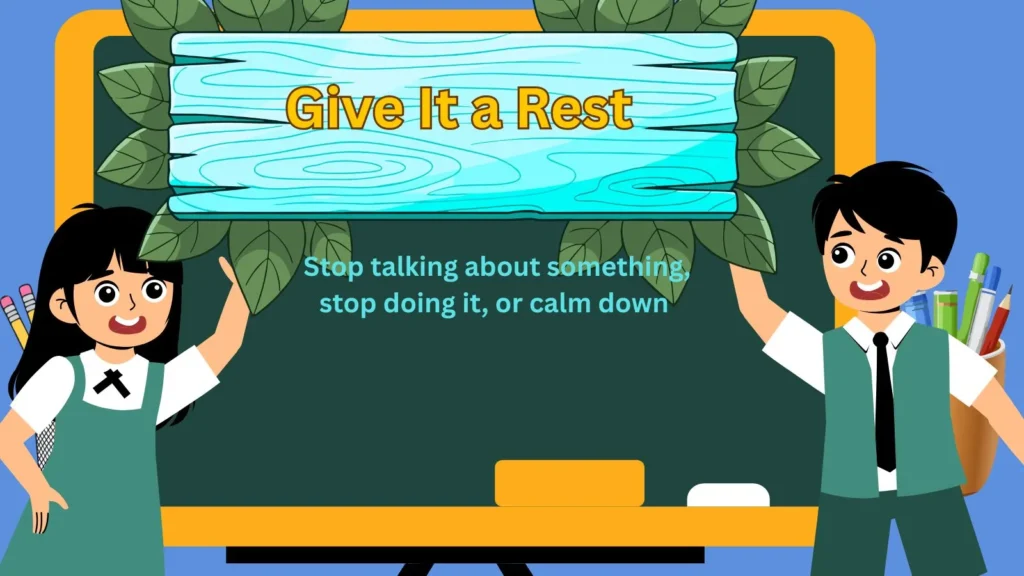
The expression “give it a rest” means stop talking about something, stop doing it, or calm down for a while. It is a common informal idiom used when someone becomes repetitive, annoying, or overly focused on one topic.
Example:
- “You’ve complained about the traffic all day — just gives it a rest.”
- “He kept making the same joke until his friends told him to stop.”
This phrase is widely used in both spoken and written English.
Meaning of the Phrase
This popular idiom tells a person to take a break from a topic, argument, habit, or action. People often use it during conversations when someone refuses to move on from an issue.
Unlike literal rest, the expression usually refers to mental or verbal repetition, not sleep or relaxation.
Simple Examples
- “Stop arguing and move on.”
- “She wouldn’t stop singing loudly.”
- “My brother kept teasing everyone at dinner.”
In each example, the speaker wants the other person to pause or change behavior.
Why People Get Confused
Many English learners misunderstand idioms because the words do not always match the real meaning. Someone reading this phrase literally may think it refers to physical rest or sleeping.
English also contains many tricky spelling patterns with double letters, including:
- Address
- Success
- Committee
Fast typing can create mistakes such as:
- “give rest”
- “give a rest”
- “give it rest”
The complete idiomatic form always includes all four words.
Origin and History
The word rest comes from the Latin root restare, meaning “to remain” or “stay back.” Over time, English speakers expanded the meaning beyond physical relaxation.
By the early 1900s, people began using the phrase informally to tell others to stop repeating something annoying. It became especially common in conversational British English before spreading worldwide.
Today, it appears in movies, television shows, online comments, and everyday speech.
British vs American English
The wording stays exactly the same across major English dialects.
| Dialect | Preferred Form |
|---|---|
| British English | Gives it a rest |
| American English | Gives it a rest |
| Canadian English | Gives it a rest |
| Australian English | Gives it a rest |
There are no spelling differences between regions.
When to Use This Expression
This idiom works best in informal communication. It sounds natural in daily conversations and relaxed writing.
Common Situations
- Text messages
- Friendly arguments
- Social media posts
- Casual emails
- Conversations with friends
Examples
- “We already discussed that yesterday.”
- “Please stop bringing up the same problem.”
- “The kids wouldn’t stop fighting.”
Avoid using the phrase in highly formal legal or academic documents because it may sound too conversational.
Common Mistakes
Writers and learners sometimes shorten or change the phrase incorrectly.
| ❌ Incorrect | ✅ Correct |
|---|---|
| Give rest | Give it a rest |
| Give it rest | Give it a rest |
| Give a rest | Give it a rest |
| Give some rest | Give it a rest |
Other Frequent Errors
- Leaving out the word it
- Using the phrase too formally
- Confusing it with sleeping
- Typing too quickly
Reading natural conversations can help you remember the correct structure.
Everyday Usage Examples
Here are some realistic situations where the idiom appears naturally.
Emails
- “We’ve talked about this issue enough for one day.”
Social Media
- “People online are still debating that old rumor.”
Workplace Conversations
- “The manager asked the team to stop arguing and focus on solutions.”
School Writing
- “Students often use idioms in dialogue exercises.”
These examples show how flexible the phrase can be in modern English.
Usage Comparison Table
| Situation | ❌ Wrong Example | ✅ Better Example |
|---|---|---|
| Casual speech | Give rest already | Give it a rest already |
| Friendly debate | Give a rest please | Give it a rest please |
| Online comments | Give some rest dude | Give it a rest, dude |
| Work discussion | Give it rest for now | Give it a rest for now |
| Family conversation | You should give rest | You should give it a rest |
The corrected versions sound more natural and grammatically complete.
FAQs
What does this expression mean?
It means to stop doing, saying, or repeating something for a while.
Is the phrase rude?
It can sound annoyed, but it is usually informal rather than harsh.
Can I use it in formal writing?
It is better suited for casual conversations and informal content.
Is the wording different in British English?
No. The expression remains the same in British and American English.
Why do people misunderstand it?
Idioms often have figurative meanings that differ from the literal words.
How can I remember the correct wording?
Think of it as telling someone to “take a break” from a topic or behavior.
Does it mean sleeping?
No. It usually refers to stopping an action or conversation temporarily.
Conclusion
This well-known English idiom is used when someone keeps repeating an action, argument, complaint, or topic for too long. It encourages a person to pause, calm down, or move on from something that has become annoying or excessive.
The expression is identical in British and American English, making it easy for learners to recognize worldwide. Most mistakes happen when writers remove words from the phrase or misunderstand its figurative meaning.
To remember it correctly, focus on the complete structure and practice using it in natural conversations, text messages, and dialogue writing. The more often you hear native speakers use the phrase, the easier it becomes to understand and apply confidently.

Hi, I’m Mason Clark, the writer behind Wordspry!
My goal is to make grammar learning easier with straightforward explanations, useful examples, and engaging English lessons that help you grow every day.