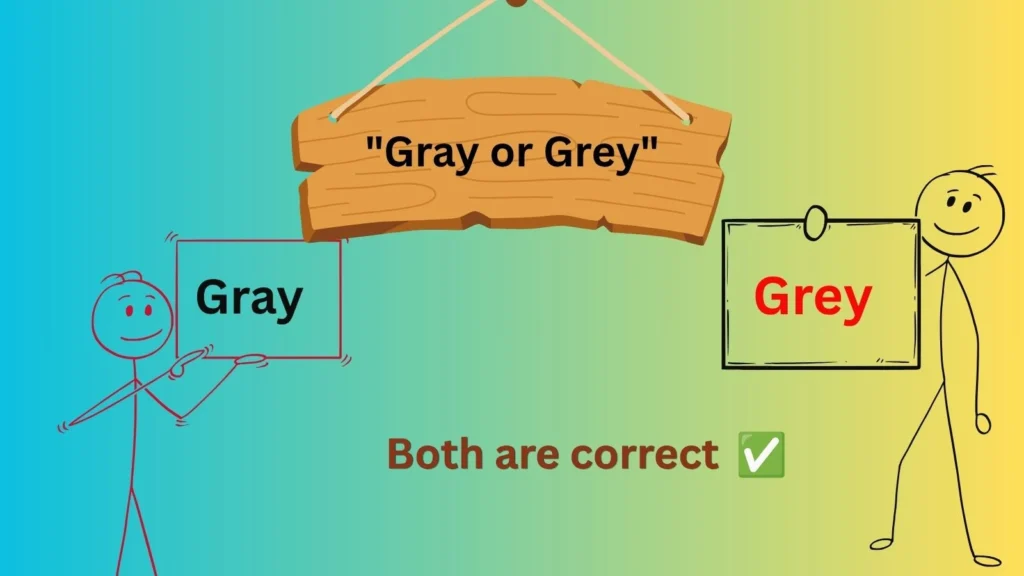
Have you ever paused while writing because you couldn’t decide whether to use gray or grey? You’re not alone. This tiny spelling difference confuses students, writers, bloggers, and even native English speakers every day. Since both words look almost identical and sound exactly the same, many people wonder if one spelling is wrong or if each has a different meaning.
Imagine you’re writing an email, publishing a blog post, or describing the color of a cloudy sky. You type the word, stop for a moment, and ask yourself, “Should I write gray or grey?” That small hesitation can interrupt your writing flow. Fortunately, the answer is much simpler than most people think.
The good news is that gray and grey mean exactly the same thing. The only real difference lies in the variety of English you are using. Knowing which spelling fits your audience helps your writing look polished, consistent, and professional.
Learn More About Us:Hierarchical vs Hierarchal: Which Word Should You Use?
Gray or Grey – The Core Difference
The difference between gray and grey is spelling, not meaning.
Both words describe the same color—the shade that sits between black and white. Neither spelling changes the pronunciation or definition.
Here’s the simple rule:
| Spelling | Used In | Correct? |
|---|---|---|
| Gray | American English | ✅ Yes |
| Grey | British English and most other English varieties | ✅ Yes |
In other words:
- If you’re writing for an American audience, use gray.
- If you’re writing for readers in the United Kingdom, Canada (often), Australia, or New Zealand, grey is generally preferred.
Both spellings appear in dictionaries because both are accepted forms of English.
Quick Examples
- The sky looks gray today. (American English)
- The sky looks grey today. (British English)
The meaning stays exactly the same.
Use Gray When…
Choose gray if you’re following American English spelling rules.
American publishers, newspapers, schools, universities, and businesses almost always use gray.
Common situations
Use gray when writing:
- American school assignments
- U.S. business emails
- American blogs
- Product descriptions for U.S. customers
- Social media aimed at American readers
Examples
- She wore a gray sweater to school.
- The painter chose a soft gray for the living room.
- His hair turned gray over the years.
- We bought a gray car last weekend.
- The clouds became gray before the storm.
Other common expressions
- gray skies
- gray matter
- gray hair
- gray wolf
- gray whale
If your document follows American spelling, keep using gray throughout the entire piece. Consistency always improves readability.
Use Grey When…
Choose grey when writing in British English.
Most writers in the United Kingdom naturally prefer grey, and many publications across Europe, Australia, and New Zealand follow the same spelling.
Common situations
Use grey for:
- British essays
- UK newspapers
- Australian websites
- British business communication
- International audiences using British English
Examples
- She painted the kitchen grey.
- His grey jacket matched his shoes.
- The morning sky looked grey and misty.
- The cat has beautiful grey fur.
- We chose a light grey sofa.
Common expressions
- grey skies
- grey hair
- grey area
- grey seal
- grey squirrel
Again, the meaning never changes. Only the regional spelling does.
Understanding the Grammar Rule
Unlike many confusing English word pairs, gray and grey are not different parts of speech.
They are simply spelling variants.
This means there is no grammar rule that changes how you use the word in a sentence.
Instead, the rule is based on the variety of English you’re writing.
Grammar Overview
| Feature | Gray | Grey |
|---|---|---|
| Part of speech | Adjective, noun, verb (rare) | Adjective, noun, verb (rare) |
| Pronunciation | Same | Same |
| Meaning | Color between black and white | Color between black and white |
| American English | ✅ Preferred | ❌ Rare |
| British English | ❌ Rare | ✅ Preferred |
As an adjective
Both spellings describe a noun.
Examples:
- A gray cat crossed the road.
- A grey cat crossed the road.
As a noun
The word can also name the color itself.
Examples:
- Gray goes well with blue.
- Grey looks elegant with white.
As a verb
Although uncommon, both spellings can describe becoming gray with age.
Examples:
- His beard began to gray.
- His beard began to grey.
The regional spelling rule still applies.
Why These Words Confuse People
People often believe gray and grey have different meanings because the spellings look different. In reality, our brains naturally assume that different spellings signal different definitions.
Several factors add to the confusion.
1. They sound identical
There is no pronunciation difference.
Whether someone says gray or grey, your ears hear exactly the same word.
2. The internet mixes both spellings
You might read an American article using gray and then visit a British website using grey only minutes later.
This constant switching makes both versions seem interchangeable.
3. Software changes the spelling
Many word processors automatically follow the language setting.
For example:
- Microsoft Word set to American English suggests gray.
- Microsoft Word set to British English suggests grey.
Writers often assume one spelling must be incorrect when their spell checker flags it.
4. Global audiences use both
Because websites attract readers from around the world, you’ll often see both spellings online.
Many international companies even choose one spelling based on their brand style rather than their location.
5. Our brains prefer consistency
Psychologists explain that readers notice inconsistencies more than differences.
Seeing gray and grey mixed in the same article feels distracting, even though both spellings are correct.
That is why professional editors recommend choosing one spelling and using it consistently throughout your writing.
Meaning and Definition
The words gray and grey share exactly the same meaning.
They refer to the neutral color between black and white.
As an adjective
They describe the appearance of something.
Examples:
- A gray jacket
- A grey sky
- Gray clouds
- Grey stones
As a noun
They refer to the color itself.
Examples:
- Gray is a timeless color.
- Grey matches almost everything.
As a verb
Although rare, the word can describe becoming gray with age.
Examples:
- His hair started to gray after fifty.
- Her beard slowly greyed with age.
Symbolic meanings
Besides describing a color, gray/grey often symbolizes:
- Balance
- Neutrality
- Wisdom
- Maturity
- Uncertainty
- Sophistication
For example:
- “The issue isn’t black and white. It’s a gray area.”
- “Her grey hair reflected years of experience.”
Whether you write gray or grey, readers will understand exactly the same meaning. The only choice you need to make is which English spelling standard matches your audience.
Side-by-Side Examples Table
Sometimes the easiest way to understand a spelling difference is to compare sentences. The examples below show how gray and grey work in real writing.
| Situation | American English | British English |
|---|---|---|
| Cloudy weather | The sky looks gray today. | The sky looks grey today. |
| Clothing | She bought a gray coat. | She bought a grey coat. |
| Hair color | His hair turned gray with age. | His hair turned grey with age. |
| Home décor | We painted the walls gray. | We painted the walls grey. |
| Animal | A gray wolf lives in this region. | A grey wolf lives in this region. |
Incorrect vs Correct Examples
The goal is not to decide which spelling is “right.” Instead, match the spelling to the variety of English you’re using.
| ❌ Less Appropriate | ✅ Better Choice |
|---|---|
| An American newspaper writes grey throughout an article. | An American newspaper consistently uses gray. |
| A British school essay switches between gray and grey. | A British school essay uses grey throughout. |
| A blog mixes both spellings randomly. | A blog follows one spelling style from start to finish. |
| A U.S. company brochure uses both versions. | A U.S. company brochure uses gray consistently. |
| A UK website changes spellings on every page. | A UK website sticks with grey across all pages. |
Key lesson: Consistency matters more than the spelling itself.
Memory Trick That Actually Works
Need an easy way to remember the difference? Try these simple tricks.
Trick 1: “A” for America
The word grAy contains the letter A.
Think:
- A = America
- Gray = American English
Trick 2: “E” for England
The word grEy contains the letter E.
Remember:
- E = England
- Grey = British English
A Visual Analogy
Imagine two paint buckets.
- One bucket has an A sticker for America. It contains gray paint.
- The other bucket has an E sticker for England. It contains grey paint.
Both buckets hold exactly the same color. Only the label changes.
That simple image helps many learners remember the correct spelling within seconds.
Common Grammar Mistakes
Although gray and grey share the same meaning, writers often make avoidable mistakes.
Mistake 1: Mixing spellings
❌ The house has gray walls and a grey roof.
✅ American English:
The house has gray walls and a gray roof.
✅ British English:
The house has grey walls and a grey roof.
Mistake 2: Thinking one spelling is wrong
❌ Only gray is correct.
✅ Both spellings are correct.
The preferred spelling depends on your audience.
Mistake 3: Ignoring your audience
Suppose you’re writing for an American company.
Instead of using grey, choose gray.
Likewise, use grey when writing for a British publication.
Mistake 4: Trusting spell check without checking language settings
Many writers panic when their word processor underlines one spelling.
Usually, the software simply follows its language setting.
Always check whether your document uses American or British English before changing the spelling.
Mistake 5: Switching styles midway
Professional writing looks polished because it stays consistent.
If your first paragraph uses gray, don’t suddenly change to grey later.
Everyday Conversation Examples
You’ll see these spellings everywhere in daily life.
At School
American English:
Our teacher asked us to color the elephant gray.
British English:
Our teacher asked us to colour the elephant grey.
At Work
American office:
Let’s use a gray background for the presentation.
British office:
Let’s use a grey background for the presentation.
Relationships
American English:
I love your new gray sweater.
British English:
I love your new grey jumper.
Social Media
American user:
Today’s gray skies match my mood.
British user:
Loving these peaceful grey autumn mornings.
Emails
American example:
Please order the gray office chairs.
British example:
Please order the grey office chairs.
Professional Writing Examples
Professional writers choose one spelling style and follow it carefully.
Blogs
American blog:
Soft gray walls make small rooms feel larger.
British blog:
Soft grey walls create a calm atmosphere.
News Headlines
American newspaper:
Gray clouds bring heavy rain.
British newspaper:
Grey skies expected across northern England.
Product Reviews
American retailer:
Available in black, white, and gray.
British retailer:
Available in black, white, and grey.
Academic Writing
Universities usually follow a style guide.
If you’re writing in the United States, use gray consistently.
If you’re studying in the United Kingdom, use grey throughout your paper.
Following the required style guide makes your work appear more professional and credible.
Quick Editing Checklist
Before publishing your writing, ask yourself these questions.
✅ Who is my audience?
✅ Am I writing in American or British English?
Did I use gray or grey consistently?✅
✅ Did I accidentally switch spellings halfway through?
Does my spelling match the rest of the document?✅
✅ Does my spell checker use the correct language setting?
If you answer “yes” to all these questions, your spelling is probably consistent and professional.
Popular Idioms and Expressions
Many common expressions include gray or grey. The spelling simply changes with regional English.
| American English | British English | Meaning |
|---|---|---|
| gray area | grey area | Something unclear or uncertain |
| gray matter | grey matter | The brain or intelligence |
| gray hair | grey hair | A sign of aging or experience |
| gray skies | grey skies | Cloudy weather or a gloomy mood |
Example Sentences
- The new policy falls into a gray area, so we’ll need legal advice.
- The situation remains a grey area under current regulations.
- His gray hair reflects decades of experience.
- Her grey hair gives her a distinguished appearance.
No matter which spelling you choose, these expressions carry the same meaning. Just remember to match the spelling to your chosen variety of English and use it consistently throughout your writing.
Mini Case Study: How One Simple Spelling Choice Improved a Blog
Emma, a lifestyle blogger in London, wrote an article about choosing the perfect wall color for a living room. Throughout the post, she alternated between gray and grey without noticing.
A reader commented that the inconsistent spelling looked distracting. Emma checked her article and realized she had copied product descriptions from American websites while writing in British English.
She updated every instance to grey, matching her audience and the rest of her content.
The result?
- The article looked more polished.
- Readers focused on the advice instead of the spelling.
- Her brand appeared more professional and consistent.
The lesson is simple: Consistency builds trust.
How Teachers Explain It
Many teachers use a staircase analogy because it is easy to remember.
Imagine two staircases leading to the same room.
- The first staircase is labeled America.
- The second staircase is labeled England.
Both staircases take you to the exact same destination—the color between black and white.
The only difference is the path you choose.
Another classroom tip is to write:
- GrAy → A = America
- GrEy → E = England
Students often remember this trick after seeing it just once.
Practical Tips for Students
Learning the correct spelling becomes much easier with regular practice.
Here are a few habits that work well:
- Decide whether you’re writing in American or British English before you begin.
- Keep a list of common spelling differences, such as color/colour, favorite/favourite, and gray/grey.
- Read books, newspapers, and blogs from your target English variety.
- Use your word processor’s language setting to match your assignment.
- Proofread your work for consistency before submitting it.
- Practice writing five sentences using gray and another five using grey.
- Create flashcards with the memory trick: A = America, E = England.
Small, repeated practice sessions help the spelling become automatic.
Why Correct Usage Matters
At first glance, choosing between gray and grey may seem like a tiny detail. However, consistent spelling has a bigger impact than many people realize.
Correct usage helps you:
- Communicate clearly with your audience.
- Show attention to detail.
- Build credibility as a writer.
- Meet academic or workplace style guidelines.
- Create a professional impression.
- Maintain consistency across articles, reports, and websites.
Readers rarely notice consistent spelling, but they often notice inconsistency. Choosing one style and sticking with it makes your writing smoother and easier to read.
Whether you’re writing an essay, a business email, a blog post, or a social media caption, using the appropriate regional spelling reflects confidence and professionalism.
Final Quick Reference Table
| Question | Answer |
|---|---|
| Do gray and grey mean different things? | No. They have the same meaning. |
| Which spelling does American English prefer? | Gray |
| Which spelling does British English prefer? | Grey |
| Are both spellings correct? | Yes. |
| Do they sound different? | No. They have the same pronunciation. |
| Which spelling should I choose? | Use the version that matches your audience and remain consistent. |
| Can I mix both spellings in one article? | It’s best not to. Choose one style and use it throughout. |
Conclusion
Choosing between gray or grey is much easier once you understand the rule. Both spellings refer to the same color, and neither is more correct than the other. The only difference is regional preference. Gray is the standard spelling in American English, while grey is preferred in British English and many other English-speaking countries.
The most important rule is consistency. Decide which variety of English fits your audience before you start writing, then use that spelling throughout your document. This simple habit makes your writing look cleaner, more professional, and easier to read.
Now that you know the difference, you can use gray or grey with confidence, whether you’re writing an essay, publishing a blog, sending an email, or creating content for readers around the world.
Frequently Asked Questions (FAQs)
1. Is gray or grey the correct spelling?
Both are correct. Gray is the preferred spelling in American English, while grey is preferred in British English.
2. Do gray and grey have different meanings?
No. Both words describe the color between black and white and have exactly the same meaning.
3. Which spelling should I use in the United States?
If you’re writing for an American audience, use gray.
4. Which spelling is common in the United Kingdom?
British English generally uses grey.
5. Can I use both spellings in the same article?
You can, but it is not recommended. Choose one spelling style and use it consistently.
6. Why does my spell checker mark one spelling as incorrect?
Most spell checkers follow your language settings. If your document uses American English, it will usually suggest gray. If it uses British English, it will suggest grey.
7. Which spelling is better for SEO?
Neither spelling is better by itself. Choose the version that matches your target audience. If your website targets American readers, use gray consistently. If it targets British readers, use grey consistently.
8. How can I remember the difference easily?
Use this simple memory trick:
- GrAy → A = America
- GrEy → E = England

Hi, I’m Henry Collins, the educator behind Wordspry.com
I’m dedicated to helping English learners build confidence through easy grammar explanations, writing tips, and everyday language learning resources.