Have you ever wondered whether you should write adviser or advisor? You’re not alone. Many students, writers, business owners, and professionals search for this answer because both spellings appear in books, websites, and official documents.
The confusion comes from the fact that both words have the same meaning and pronunciation. However, their usage depends on tradition, region, style guides, and sometimes even an organization’s preference. Choosing the wrong spelling won’t usually change the meaning of your sentence, but using the preferred form for your audience can make your writing look more professional.
You’ll learn the difference between adviser or advisor, discover which spelling is more common, understand the grammar behind both words, and see plenty of real-life examples. By the end, you’ll know exactly when to use each spelling with confidence.
RELATED: Casi Algo Meaning: Full Guide to Love, Feelings, and Relationships
What Does Adviser or Advisor Mean?
Both adviser and advisor refer to a person who gives advice, guidance, or recommendations.
In simple words, an adviser or advisor is someone who helps others make better decisions.
Examples
- My financial advisor helped me plan for retirement.
- The school adviser guided students during course selection.
- She works as a legal advisor for a large company.
- Our academic adviser answered all our questions.
Both spellings carry the same meaning. The difference lies mainly in style and preference rather than grammar.
Core Difference Between Adviser and Advisor
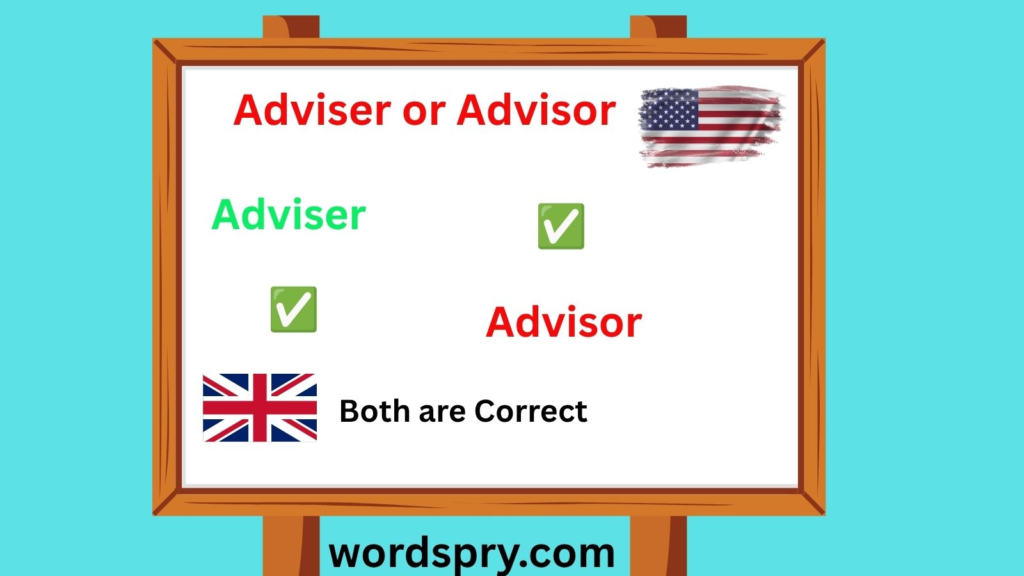
The biggest surprise is that both spellings are correct.
Although many people think one is wrong, English dictionaries recognize both forms.
Here’s the main difference:
- Adviser is the traditional spelling.
- Advisor is a newer spelling that has become very popular, especially in North America and business settings.
Neither spelling changes the meaning of the word.
Think of it this way:
Both words are like two roads leading to the same destination. They arrive at exactly the same meaning.
Why Both Spellings Exist
Most English nouns ending in -er come directly from verbs.
Examples include:
- teach → teacher
- write → writer
- drive → driver
Since the verb is advise, many language experts preferred adviser because it follows the normal English pattern.
However, over time, advisor became common through government agencies, universities, financial firms, and corporate branding.
Today, dictionaries accept both spellings.
Why One Form Seems More Correct Than the Other
People often ask which spelling is “correct.”
The answer depends on context.
Use Adviser when:
- Following traditional English spelling
- Writing academic papers
- Following style guides that prefer -er
- Writing in formal British English
Use Advisor when:
- Referring to official job titles
- Writing for many American businesses
- Following company branding
- Matching the spelling used by an organization
For example:
✅ Academic Adviser
✅ Financial Advisor
Both are perfectly acceptable because they match common usage.
Adviser vs Advisor Comparison Table
| Feature | Adviser | Advisor |
|---|---|---|
| Meaning | Person who gives advice | Person who gives advice |
| Pronunciation | Same | Same |
| Grammar | Correct | Correct |
| Traditional spelling | Yes | No |
| Common in British English | More common | Less common |
| Common in American business | Less common | Very common |
| Used in job titles | Sometimes | Frequently |
| Dictionary accepted | Yes | Yes |
Real-Life Usage of Adviser or Advisor
Understanding real-life usage makes the choice much easier.
In Education
Many schools and universities use academic adviser.
Example:
“My academic adviser helped me choose my major.”
However, some universities officially use Academic Advisor instead.
Always follow the institution’s preferred spelling.
In Business
Many companies prefer financial advisor or investment advisor because these titles have become standard in the financial industry.
Example:
“Our financial advisor explained different investment options.”
In Government
Government departments often choose their own preferred spelling.
Examples include:
- Policy Adviser
- Senior Advisor
- Economic Adviser
Official titles should always be copied exactly.
In Blogging
If you’re writing a blog, consistency matters more than the specific spelling.
Choose either:
- adviser
or
- advisor
Then use the same spelling throughout your article.
Grammar Rules Explained Simply
Here are easy grammar rules beginners can remember.
Rule 1
Both spellings are nouns.
Correct:
- She is my adviser.
- He became our advisor.
Rule 2
Never confuse them with the verb advise.
Correct:
- I advise students every day.
Incorrect:
- I advisor students.
Rule 3
Use whichever spelling matches your audience.
British audience:
- adviser
American corporate audience:
- advisor
Examples in Sentences
Adviser
- The career adviser reviewed my resume.
- Every student met with an adviser.
- Our legal adviser attended the meeting.
Advisor
- The company hired a marketing advisor.
- She spoke with her financial advisor.
- The president appointed a senior advisor.
Common Mistakes to Avoid
1. Thinking one spelling is wrong
Many learners believe advisor is incorrect.
It isn’t.
Both spellings are accepted.
2. Mixing both spellings in one article
Avoid this:
“Our adviser met the new advisor.”
Choose one spelling unless you’re referring to official titles.
3. Confusing advise with adviser
Remember:
- advise = verb
- adviser/advisor = noun
Example:
✔ I advise clients.
✔ I am an adviser.
4. Ignoring official job titles
If someone’s business card says Senior Advisor, don’t change it to Senior Adviser.
Respect official titles.
5. Assuming British and American English always agree
Language evolves over time.
Many American organizations now strongly prefer advisor, while many British publications still lean toward adviser.
Tips to Remember the Difference
Here are a few easy memory tricks.
- Both spellings are correct.
- Adviser is the older spelling.
- Advisor is common in modern business.
- Match the spelling used by your employer or school.
- Stay consistent throughout your writing.
Related Words
These related terms help readers understand the topic better:
- advice
- advise
- financial adviser
- financial advisor
- academic adviser
- legal advisor
- career adviser
- business advisor
- grammar guide
- English spelling
- British English
- American English
- correct spelling
- writing tips
- English grammar
FAQs
Is adviser or advisor correct?
Yes. Both spellings are correct and accepted by major English dictionaries.
Which spelling is more common?
Advisor is more common in American business, while adviser remains popular in British English and many traditional publications.
Is advisor an American spelling?
Yes. Although both spellings exist worldwide, advisor is especially common in the United States.
Is adviser used in the UK?
Yes. Many British publications, schools, and organizations still prefer adviser.
Should I use adviser or advisor in SEO writing?
You can use either spelling consistently. If appropriate, naturally mentioning both forms helps reach readers searching for different spellings.
Which spelling do dictionaries recommend?
Major dictionaries list both adviser and advisor as correct spellings with the same meaning.
Is there any difference in pronunciation?
No.
Both words are pronounced exactly the same way.
Can I switch between adviser and advisor?
It’s better not to. Pick one spelling and use it consistently unless you’re referring to official job titles that use a specific form.
Conclusion
The debate over adviser or advisor is less about right versus wrong and more about style and preference. Both spellings mean a person who gives advice, and both are accepted in modern English. Adviser is the traditional form and remains common in British English, while advisor is widely used in American businesses, government agencies, and professional job titles.
The best approach is to consider your audience, follow any official naming conventions, and stay consistent throughout your writing. Whether you’re creating blog posts, academic papers, business documents, or marketing content, understanding this small spelling difference will make your writing clearer and more professional. Once you know the context, choosing between adviser and advisor becomes simple.

Hi, I’m William Parker, the creator behind Wordspry.com
I enjoy breaking down complex grammar rules into clear and practical lessons that help learners write and speak English more effectively.