Have you ever typed demur when you meant demure and wondered why your sentence suddenly sounded like a courtroom drama? You are not alone! These two English words look almost identical, but they have different meanings. One describes a person’s quiet, modest behavior, while the other means to object or express disagreement.
Imagine writing, “She looked demur at the party.” You probably mean that she looked shy or reserved. However, the word demur does not describe someone’s appearance or personality. It means to raise an objection. One tiny letter can turn a simple description into an entirely different message!
So, what is the difference between demur and demure? Are they interchangeable, or does each word belong in a different sentence? And why do so many English learners mix them up?
Table of Contents
- What Do Demur and Demure Mean?
- Background and Origin of Demur and Demure
- Contexts Where Demur and Demure Are Used
- Usage Across Different Platforms
- Common Misconceptions
- Common Mistakes
- Similar Words and Alternatives
- How to Respond to Demur and Demure
- Demur and Demure Across Languages and Cultures
- Difference Between Demur, Demure, and Similar Words
- Demur and Demure in Online Conversations
- Popularity and Trends Over Time
- Trusted References
- FAQs
- Conclusion
What Do Demur and Demure Mean?
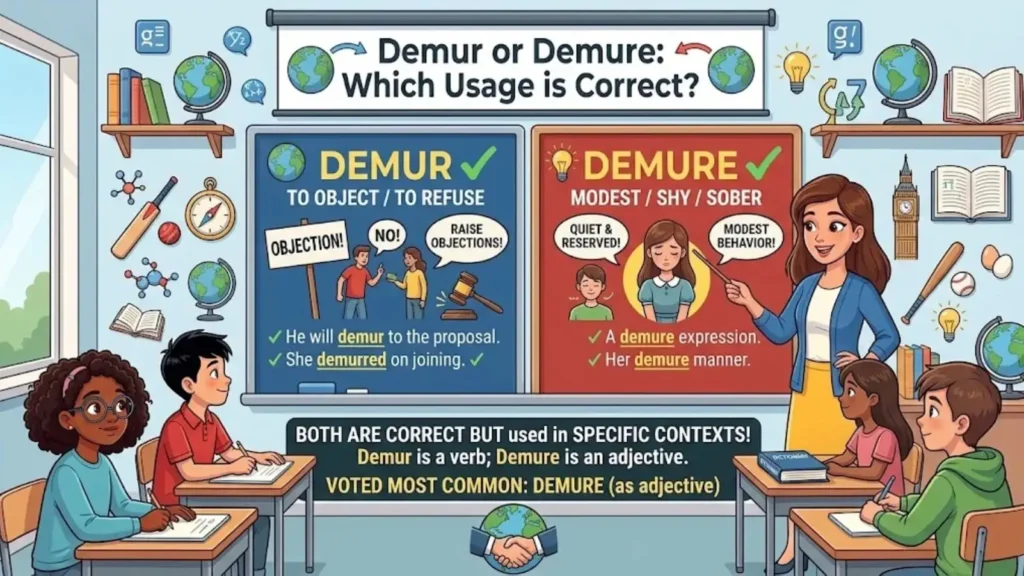
Demur means to object, disagree, or express reluctance. Demure means modest, reserved, shy, or quiet in behavior or appearance. Although the words look similar, they serve different grammatical purposes. Demur is mainly a verb, while demure is an adjective.
Here is the easiest way to remember them:
| Word | Part of speech | Meaning | Example |
|---|---|---|---|
| Demur | Verb | To object or hesitate | He demurred at the proposed changes. |
| Demur | Noun | An objection or expression of disagreement | She accepted the offer without demur. |
| Demure | Adjective | Modest, shy, or reserved | She wore a demure blue dress. |
| Demurely | Adverb | In a modest or reserved manner | He smiled demurely. |
Notice the difference? One word describes an action or objection. The other describes a quality or manner.
Demur Meaning and Examples
The word demur often appears in formal discussions, business meetings, legal writing, and situations where someone disagrees politely.
For example:
- Workplace: Maya demurred when her manager suggested working on Sunday.
- School: The student demurred because she disagreed with the proposed rule.
- Business: Several investors demurred at the company’s new plan.
- Everyday life: I wanted to accept the invitation, but I demurred at first.
You can also use demur as a noun, although this use is less common in everyday conversation.
Example: “He accepted the invitation without demur.”
This means he accepted without objecting or expressing hesitation.
Demure Meaning and Examples
The adjective demure describes someone or something that appears modest, quiet, reserved, or shy. It can describe a person’s behavior, expression, clothing, or style.
Examples include:
- Appearance: She wore a demure dress to the formal dinner.
- Expression: He gave a demure smile when everyone praised him.
- Personality: The new student seemed demure during her first class.
- Behavior: She remained demure while accepting the award.
However, demure does not necessarily mean weak, unhappy, or unfriendly. A reserved person can still be confident and capable.
A Quick Texting Example
Imagine this conversation between two friends:
Friend 1: “Are you going to challenge the teacher’s decision?”
Boy 2: “I might demur if the explanation doesn’t make sense.”
Friend 1: “And what about your sister? She’s so quiet!”
Friend 2: “She’s naturally demure around new people.”
Both words fit their sentences, but switching them would change the meaning.
Background and Origin of Demur and Demure
Although demur and demure look like close relatives, their histories and meanings developed differently. Their similar spelling explains why writers sometimes confuse them.
Where Did Demur Come From?
The verb demur entered English through Middle English and Anglo-French. Its earlier sense involved lingering or delaying, and its meaning developed toward hesitation and objection. The word traces back to Latin demorari, meaning to delay or linger.
Over time, demur became associated with expressing disagreement or reluctance.
For example, someone might demur when asked to accept an unfair decision. Rather than immediately agreeing, the person raises an objection.
Today, the word often appears in formal writing, legal contexts, news reports, and professional discussions.
Where Did Demure Come From?
The history of demure is more complicated. Dictionaries trace it to Middle English and Anglo-French forms associated with seriousness, dignity, and modest behavior. Its precise origin remains uncertain.
By the late seventeenth century, demure had developed the familiar sense of being reserved, shy, or modest.
Writers began using it to describe people, expressions, and clothing that appeared restrained or understated.
For example, “a demure smile” describes a modest or reserved expression rather than an act of disagreement.
Why Do People Confuse Them?
There are three main reasons:
- Similar spelling: Both words begin with the same five letters.
- Related historical forms: Their histories have some linguistic connections, even though their modern meanings differ.
- Different grammatical roles: People sometimes focus on spelling instead of checking how a word functions in a sentence.
The solution is simple: learn each word through a short example rather than memorizing the spelling alone.
Contexts Where Demur and Demure Are Used
These words appear in different situations because they communicate different ideas.
In Serious Conversations
Demur works well when someone raises a concern or politely disagrees.
Example: “The committee demurred at the suggestion because it exceeded the budget.”
By contrast, demure describes a reserved manner.
Example: “Her demure expression remained unchanged throughout the discussion.”
Between Friends
Friends can use demur when discussing an invitation, decision, or suggestion, although the word may sound formal or humorous.
Example: “I must demur. There is absolutely no way I’m waking up at five!”
Demure can describe someone’s quiet or modest behavior.
Example: “You looked surprisingly demure in that family photograph.”
The humor comes from the contrast between a formal word and an ordinary situation.
In Business and Professional Writing
Demur suits formal discussions about proposals, contracts, and decisions.
Example: “The client demurred at the revised payment terms.”
Demure may appear in descriptions of clothing, presentation, or behavior.
Example: “The designer introduced a demure collection for the spring season.”
Neither word is inherently inappropriate for professional communication. The important factor is whether its meaning fits the sentence.
In Online Conversations and Social Media
People may use demure in captions about fashion, makeup, personal style, or a deliberately modest appearance.
Example: “Keeping the outfit simple and demure today.”
People may use demur in a serious post or as a playful, formal-sounding way to disagree.
Example: “I must demur: pineapple belongs on pizza.”
Neither word is a standard texting acronym. They are ordinary English vocabulary words that can appear in digital conversations.
In Dating and Personal Relationships
Demure can describe someone who appears shy or reserved during a first meeting.
Example: “He seemed demure at dinner but became talkative later.”
Demur can describe hesitation or disagreement about a suggestion.
Example: “She demurred when he suggested changing their plans.”
Remember that being demure does not automatically mean someone is interested in romance. Quiet behavior alone cannot reveal a person’s feelings.
Usage Across Different Platforms
Unlike internet acronyms such as LOL or SMH, demur and demure do not have special meanings tied to particular platforms. Their meaning stays the same across digital and offline communication.
| Platform | Example | Typical use |
|---|---|---|
| “I must demur 😂” | Playful disagreement | |
| Messenger | “She looked demure in that photo.” | Describing appearance |
| Discord | “I demur on that point.” | Discussion or debate |
| TikTok | “A demure look for tonight.” | Fashion or personal style |
| “A simple, demure outfit.” | Style captions | |
| Twitter/X | “I respectfully demur.” | Expressing disagreement |
| Snapchat | “Looking demure today!” | Casual photo captions |
| Slack | “I would demur at that proposal.” | Formal workplace discussion |
| Microsoft Teams | “The team demurred at the suggestion.” | Reporting disagreement |
These examples illustrate possible uses, not verified platform-specific trends. Always choose the word based on the intended meaning.
Common Misconceptions About Demur and Demure
Several misunderstandings make these words harder to use correctly.
Misconception 1: Demur and Demure Mean the Same Thing
They do not. Demur means to object or hesitate, while demure means modest or reserved.
Incorrect: “She looked demur in her new dress.”
Correct: “She looked demure in her new dress.”
Misconception 2: Demure Always Means Shy
Not exactly. A person described as demure may appear modest, quiet, reserved, or restrained. The word does not prove that the person feels shy internally.
For example, a confident public speaker might wear a demure outfit without being shy at all.
Misconception 3: Demur Always Means Refusing Something
Demur can express disagreement, hesitation, or reluctance. It does not always mean a complete refusal.
Example: “He demurred at first but eventually accepted the invitation.”
He expressed hesitation rather than rejecting the invitation permanently.
Misconception 4: Demure Is Only Used for Women
Traditional dictionary definitions often emphasize women and girls, but the word can describe anyone’s behavior or appearance.
Example: “The actor gave a demure smile during the interview.”
However, context matters because the word may sound old-fashioned or carry traditional ideas about modest behavior.
Misconception 5: Both Words Are Internet Slang
Neither word originated as modern internet slang. Both have long histories in English. Social media may give demure a fresh context, but that does not change its standard dictionary meaning.
Common Mistakes When Using Demur and Demure
Even experienced writers can mix up these words. Here are the mistakes worth avoiding.
1. Using Demur to Describe Appearance
Incorrect: “She wore a demur outfit.”
Correct: “She wore a demure outfit.”
Use demure when describing clothing, expressions, or reserved behavior.
2. Using Demure to Express Disagreement
Incorrect: “I demure with your opinion.”
Correct: “I demur at that suggestion.”
You can also write, “I disagree with your opinion,” which sounds more natural in everyday conversation.
3. Ignoring the Part of Speech
Remember this simple distinction:
- Demur: Usually a verb meaning to object.
- Demure: An adjective describing a reserved or modest quality.
Checking the word’s grammatical role can prevent most errors.
4. Overusing Demur in Casual Conversations
Although demur is a valid English word, it sounds formal in many everyday situations.
Instead of saying, “I demur at your dinner proposal,” you could say, “I’d rather eat somewhere else.”
Choose the wording that suits your audience.
5. Assuming Demure Describes Someone’s Entire Personality
Calling someone demure describes a particular quality or impression. It does not mean the person is always quiet or reserved.
A person may act demure at a formal event and joke freely with friends later.
Similar Words and Alternatives
Several English words share meanings with demur or demure. However, they are not always interchangeable.
| Word | Meaning | When to use it |
|---|---|---|
| Object | Express disagreement | Everyday and formal objections |
| Disagree | Have a different opinion | General conversations |
| Hesitate | Pause before acting | Uncertainty or reluctance |
| Resist | Oppose or refuse to accept something | Stronger opposition |
| Modest | Not boastful or showy | Personality or behavior |
| Reserved | Quiet or restrained | Personality or social behavior |
| Shy | Nervous around others | Social discomfort |
| Coy | Playfully shy or indirect | Flirtatious or teasing behavior |
| Unassuming | Not seeking attention | Humble personality |
| Subdued | Quiet or restrained in intensity | Mood, behavior, or appearance |
For example, you might object to a proposal, hesitate before accepting an invitation, or appear demure at a formal event.
The closest alternative depends on the sentence, not just the dictionary definition.
How to Respond to Demur and Demure
If someone uses either word in conversation, your response should match the context.
Funny Response
Friend: “I must demur. Your playlist is questionable.”
You: “Objection noted, Your Honor! The playlist stays.”
Friendly Response
Friend: “She looked demure in that picture.”
You: “Yes, she looked elegant and reserved.”
Serious Response
Colleague: “I demur at the proposed deadline.”
You: “Could you explain which part of the timeline concerns you?”
Flirty Response
Person: “You look rather demure tonight.”
You: “That’s a fancy way of saying I look good!”
Use a playful reply only when the situation and relationship make it appropriate.
Emoji Response
Emojis can help communicate tone in casual messages:
- 😊 — A warm or modest expression.
- 🤔 — Hesitation or disagreement.
- 😂 — Playful disagreement.
- 👗 — Clothing or personal style.
Remember that emojis do not change a word’s meaning. They simply help communicate the intended tone.
Demur and Demure in Different Languages and Cultures
English speakers sometimes use these words when discussing modesty, disagreement, or social behavior across cultures. However, translations vary because languages express these ideas differently.
| Language | Possible equivalent of demure | Possible equivalent of demur |
|---|---|---|
| Spanish | Modesto/a, reservado/a | Objetar, discrepar |
| Arabic | متحفظ (reserved), محتشم (modest) | يعترض (to object) |
| Hindi | विनम्र, संकोची | आपत्ति करना |
| Urdu | باحیا، متواضع، کم گو | اعتراض کرنا |
| Tagalog | Mahinhin, mahiyain | Tumutol |
| Tamil | அடக்கமான, கூச்சமான | எதிர்ப்பு தெரிவி |
| Malayalam | വിനയമുള്ള, ലജ്ജാശീലമുള്ള | എതിർക്കുക |
| Marathi | नम्र, लाजाळू | आक्षेप घेणे |
These are approximate equivalents, not exact matches for every context. The best translation depends on whether demure describes modest behavior or demur expresses an objection.
Cultural expectations also affect how people interpret modesty, shyness, and disagreement. A quiet manner may be viewed positively in one setting but interpreted differently in another.
Most importantly, English speakers do not need to translate these words into internet abbreviations. They can use the standard English words directly when appropriate.
Difference Between Demur, Demure, and Similar Words
The easiest way to distinguish these words is to focus on what each one communicates.
| Word | Grammatical role | Main idea | Example |
|---|---|---|---|
| Demur | Verb | Objecting | She demurred at the request. |
| Demure | Adjective | Modest or reserved | She gave a demure smile. |
| Demeanor | Noun | A person’s outward behavior | His calm demeanor impressed the team. |
| Defer | Verb | Yielding to another person’s judgment or authority | I will defer to your expertise. |
| Disagree | Verb | Holding a different opinion | I disagree with that conclusion. |
| Modest | Adjective | Not showy or boastful | She chose a modest outfit. |
Demur vs. Demure
Demur describes what someone does when they object. Demure describes how someone or something appears.
- “He demurred at the offer.” He expressed hesitation or disagreement.
- “He wore a demure outfit.” His clothing appeared modest or understated.
Demure vs. Demeanor
These words look similar, but they serve different purposes.
- Demure is an adjective: “She looked demure.”
- Demeanor is a noun: “Her calm demeanor impressed everyone.”
A person’s demeanor can be confident, nervous, friendly, or reserved. Demure specifically suggests modesty or restraint.
Demur vs. Disagree
Both can communicate opposition, but demur often sounds more formal.
- “I disagree with the decision.” This sounds direct and natural.
- “I demur at the decision.” This sounds more formal or literary.
Choose the word that fits the tone of your writing.
Demur and Demure in Online Conversations and Social Media
Although these words are not internet acronyms, they can appear in online discussions, captions, comments, and memes.
In Memes
A meme might use demur to make a disagreement sound excessively formal.
Example: “I must demur. That is not how we make grilled cheese.”
The humor comes from using sophisticated language for an ordinary disagreement.
On Reddit and Discord
Users might write demur in debates, discussions, or humorous replies.
Example: “I respectfully demur on that interpretation.”
The word can sound serious, playful, or deliberately formal depending on the conversation.
In Group Chats
Both words can add variety to everyday messages, although simpler alternatives often sound more natural.
Example: “I demur. We are absolutely not ordering pizza for the third night in a row.”
The key takeaway is that the words retain their standard meanings online. The surrounding conversation determines their tone.
Popularity and Trends Over Time
| Period | Language development |
|---|---|
| Middle English period | Earlier forms of demur expressed lingering or delay. |
| Late Middle Ages | Demure developed associations with seriousness, dignity, and modesty. |
| Late 17th century | The familiar reserved or shy sense of demure became established. |
| 20th century | Both words continued to appear in literature, formal writing, and general English. |
| 2020s | Social media provides new contexts for words such as demure, especially in fashion and humor. |
This is a broad historical overview, not a measured search-trend timeline. Without reliable, comparable search-volume data, it would be misleading to assign exact popularity levels to individual periods.
FAQs
1. What is the difference between demur and demure?
Demur means to object, disagree, or express reluctance. Demure means modest, shy, quiet, or reserved. The first usually functions as a verb, while the second functions as an adjective.
See also: Gumba vs Goomba: Which Spelling Is Correct and When Should You Use It?
2. Is demur a real word?
Yes. Demur is a standard English word used in formal conversations, business discussions, literature, and legal contexts. It can also function as a noun meaning an objection or expression of disagreement.
3. What does demure mean in texting?
In texting, demure usually retains its standard meaning of modest, reserved, or understated. Someone might use it to describe an outfit, expression, or manner. Its tone can be sincere, playful, or sarcastic.
4. Is demure a compliment?
It can be. Calling someone demure may suggest that they look elegant, modest, or reserved. However, the meaning depends on context, and some people may find the word old-fashioned or overly focused on traditional expectations of modesty.
5. Can you use demur in a sentence?
Yes. For example: “The manager demurred at the suggestion because it would increase costs.” Here, demurred means that the manager expressed an objection or hesitation.
6. How do you remember demur vs. demure?
Remember this simple distinction: demur means to object, while demure describes a modest or reserved appearance. If you are describing someone’s clothing or expression, choose demure. If you are describing disagreement, choose demur.
Conclusion
Understanding demur vs. demure becomes easy once you remember their different meanings. Demur means to object, disagree, or express hesitation, while demure describes someone or something that appears modest, quiet, or reserved. Although their spellings look almost identical, they perform different jobs in a sentence.
Use demur when someone questions a suggestion or politely raises an objection. Choose demure when describing a reserved smile, understated outfit, or modest manner. If you are unsure, check whether your sentence describes an action or a quality. That small trick can prevent many common writing mistakes.
Both words can make your vocabulary more precise, especially in formal writing and thoughtful conversations. You can even use them humorously in social media captions or group chats.

Hi, I’m Liam Harper, the voice behind Wordspry!
I’m here to make English grammar simple, clear, and easy to understand for learners of all levels. Through practical lessons and helpful guides, I aim to help you improve your writing and communication skills with confidence.