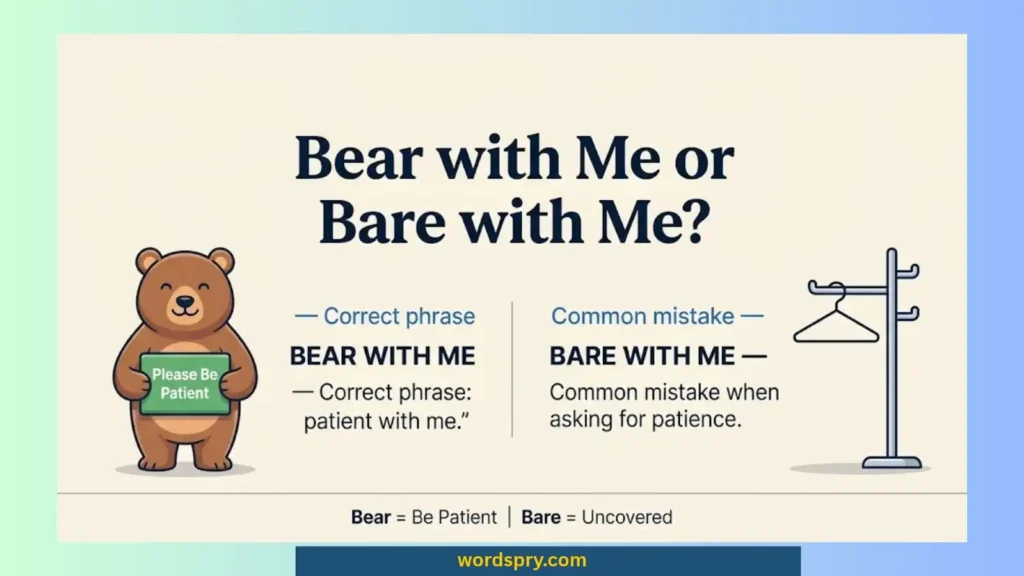
Bear with Me or Bare with Me – Quick Answer
Correct Phrase “Bear with me” 🟢
The word bear means to tolerate, endure, or deal with something. Therefore, “bear with me” asks someone to wait or remain patient.
Correct:✅
- Please bear with me while I check the details.
- Bear with me for a moment, please.
- Thank you for bearing with me during this delay.
Incorrect for this meaning:🔴
– Please bare with me while I check the details.❌
The word bare means uncovered or exposed. It does not express a request for patience.
Easy Memory Trick
Remember this simple rule:
- Bear with me = Please be patient.
- Bare = Uncovered or exposed.
For example, you can have bare feet, but you should ask someone to bear with you when you need more time.
RELATED: No Cuts No Buts No Coconuts: Meaning, Origin and Examples
The Origin of Bear with Me or Bare with Me
The phrase “bear with me” comes from the older meaning of bear. The word has long been used to mean carrying, supporting, or enduring something.
Over time, English speakers began using bear to describe dealing with a difficult situation or showing patience. The phrase “bear with me” developed as a polite way to ask someone to tolerate a delay, problem, or interruption.
For example:
Please bear with me while I explain this process.
Here, the speaker asks the listener to remain patient during the explanation.
The word bare has a different history. It refers to something that is uncovered, exposed, or without the usual covering.
For example:
He walked across the grass with bare feet.
The two words sound alike in modern English. This makes them easy to confuse when speaking or writing.
However, their meanings remain different. Bear relates to patience in this phrase, while bare relates to being uncovered.
British English vs American English Spelling
The phrase “bear with me” is correct in both British and American English. There is no spelling difference between these varieties.
Writers in the United States, United Kingdom, Canada, Australia, and other English-speaking regions use the same phrase when asking someone to be patient.
| Language variety | Correct phrase | Example |
|---|---|---|
| American English | Bear with me🟢 ✓ | Please bear with me while I check. |
| British English | Bear with me🟢 ✓ | Please bear with me while I check. |
| Canadian English | Bear with me🟢 ✓ | Bear with me for a moment. |
| Australian English | Bear with me🟢 ✓ | Thanks for bearing with me. |
| Global English | Bear with me🟢 ✓ | Please bear with me during the delay. |
Why Do People Confuse the Words?
The main reason is pronunciation. Bear and bare are homophones, which means they sound alike but have different meanings.
Example:
- Bear: Please bear with me.
- Bare: The tree had bare branches.
Because the words sound the same, spelling mistakes can happen when people write quickly or rely on sound alone.
The solution is to remember the meaning of each word rather than its pronunciation.
Which Spelling Should You Use?
You should use “bear with me” whenever you want someone to wait, remain patient, or allow you time to finish something.
This rule applies to everyday conversations, business writing, formal communication, and online messages.
For American Writers
Use bear with me in emails, meetings, customer service messages, and daily conversations.
Example:
Please bear with me while I review your request.✅
For British and Commonwealth Writers
The same phrase is correct in British, Australian, Canadian, and other Commonwealth English contexts.
Example:
Thank you for bearing with me while we resolve the issue.
For International Writers
If you write for a global audience, bear with me is the standard choice.
It sounds polite and is widely understood. You can also use alternatives such as:
- Please be patient with me.
- Give me a moment, please.
- Thank you for waiting.
- Please allow me a little more time.
Choose the phrase that best fits your tone and situation.
Common Mistakes with Bear with Me or Bare with Me
Even experienced writers can mix up these words. Here are some common errors and their corrections.
Mistake 1: Writing “Bare with Me” When Asking for Patience
🔴 ✗ Incorrec
Bare with me while I finish this report.
🟢 ✓ Correct
Bear with me while I finish this report.
The speaker needs more time, so bear is the correct word.
Mistake 2: Using “Bear” When You Mean Uncovered
🔴 ✗ Incorrect:
She walked outside with bear feet.
🟢 ✓ Correct:
She walked outside with bare feet.
Here, bare means the feet are not covered by shoes or socks.
Mistake 3: Assuming Both Phrases Mean the Same Thing
The phrases have different meanings.
- Bear with me: Please be patient with me.
- Bare: Uncovered or exposed.
Although “bare with me” can be interpreted literally in a different context, it is not the standard phrase for asking someone to wait.
Mistake 4: Forgetting the Correct Form of the Phrase
You can change the phrase to fit your sentence.
Correct examples include:✅
- Please bear with me.
- Thank you for bearing with me.
- I appreciate you bearing with me.
The word bearing keeps the same meaning of tolerating or showing patience.
Mistake 5: Using the Phrase in Every Situation
“Bear with me” is polite, but it may sound repetitive if you use it too often.
Instead, you can write:
Thank you for your patience while I look into this matter.
Bear with Me or Bare with Me in Everyday Examples
The phrase “bear with me” is common in daily life. It helps speakers ask for patience without sounding rude.
1. In Emails
When writing a professional email, you may need more time to find information or complete a task.
Example:
Hello Sarah, Please bear with me while I review the documents. I will send you an update soon. Best regards, Alex
This message sounds polite and professional.
2. In News and Public Announcements
News presenters and public speakers may use the phrase when there is a delay or interruption.
Example:
Please bear with us while we restore the live broadcast.
The phrase asks the audience to remain patient while the problem is fixed.
3. On Social Media
People use the phrase when explaining delays or asking followers to wait.
Example:
Bear with me while I finish editing this video. I will share it soon!
It is friendly and easy to understand.
4. In Formal Writing
In professional communication, the phrase can help explain a delay.
Example:
We kindly ask you to bear with us while we complete the necessary checks.
This sentence is suitable for a business notice or customer service message.
5. In Everyday Conversation
You might use the phrase when explaining something or looking for an item.
Examples:
- Bear with me while I find my keys.
- Please bear with me; I am still learning.
- Thanks for bearing with me while I explain.
These examples show how the phrase works in natural English.
Bear with Me or Bare with Me – Google Trends and Usage Data
People search for “bear with me or bare with me” because the words sound alike and are easy to confuse.
The phrase often appears in searches about English grammar, spelling, writing tips, and word meanings. Students, English learners, office workers, bloggers, and professional writers may all need a quick answer.
Search interest can vary across countries and over time. The United States, United Kingdom, Canada, and Australia are among the places where both words are used in everyday English. People learning English in other countries may also search for this phrase.
However, it is important to separate general language use from measured search data. Google Trends can show relative search interest by location and time, but it does not automatically provide exact search volumes or prove which phrase is used most often in every country.
The language rule itself is clear: “bear with me” is the standard phrase for asking someone to be patient. “Bare with me” is usually a spelling mistake when used with that meaning.
Comparison Table: Bear with Me vs Bare with Me
| Feature | Bear with me | Bare with me |
|---|---|---|
| Correct for asking patience? | Yes | No |
| Main meaning | Please be patient with me | Suggests being uncovered with me |
| Key word | Bear | Bare |
| Word meaning | Tolerate or endure | Uncovered or exposed |
| Example | Please bear with me while I check. | The phrase is not correct for this meaning. |
| Best use | Delays, requests, explanations | Describing something uncovered |
The table makes the difference clear. If you want someone to wait or remain patient, choose bear with me.
FAQs About Bear with Me or Bare with Me
Question No 1. Is it bear with me or bare with me?
Bear with me is correct when asking someone to be patient. For example, “Please bear with me while I finish this task.”
Question No 2. What does “bear with me” mean?
It means “please be patient with me.” You can use it when you need extra time, want to explain something, or need someone to wait.
Question No 3. Why do people write “bare with me”?
People often write it because bear and bare sound the same. They may know the spoken phrase but choose the wrong spelling.
Question No 4. Is “bear with me” formal or informal?
It works in both formal and informal situations. You can use it with friends, coworkers, customers, or readers.
Question No 5. Can I say “thanks for bearing with me”?
Yes. This is a correct and polite expression.
Example:
Thank you for bearing with me while we fix the problem.🟢 ✓ Correct
Conclusion
Understanding the difference between bear with me or bare with me helps you write clear and correct English. The phrase bear with me is the right choice when asking someone to be patient, wait, or allow you more time. In contrast, bare means uncovered or exposed. Although these words sound the same, their meanings are different. Use bear with me in professional emails, formal writing, and everyday conversations. Remember this simple rule: bear means tolerate, while bare means uncovered. With these easy grammar tips and correct usage examples, you can avoid common spelling mistakes and communicate with confidence.

Hi, I’m Mason Clark, the writer behind Wordspry!
My goal is to make grammar learning easier with straightforward explanations, useful examples, and engaging English lessons that help you grow every day.