Have you ever stopped while writing and wondered whether to use lieing or lying? You are not alone. Many English learners and native speakers find this word confusing because its spelling changes when the verb lie takes the ending -ing.
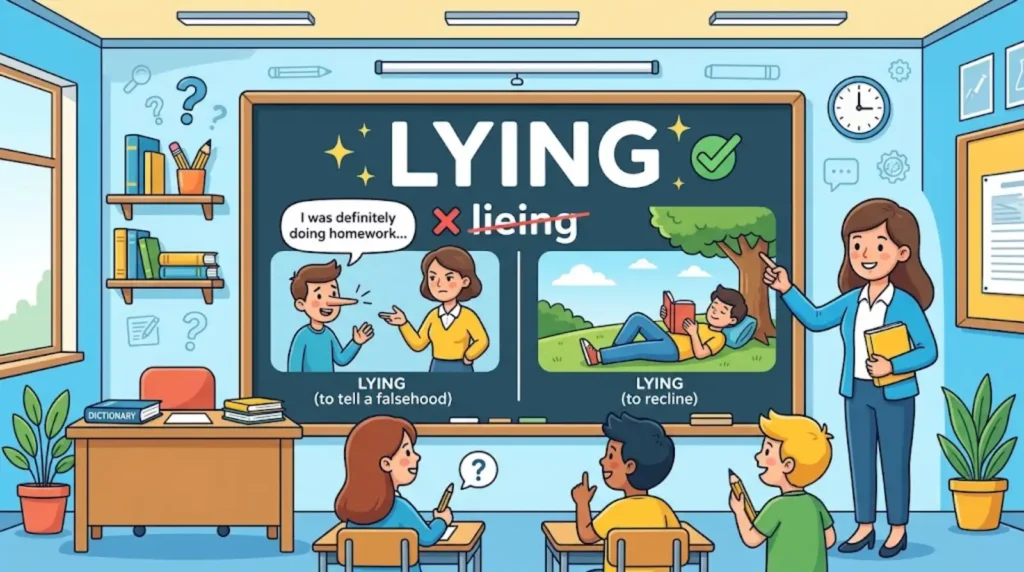
The correct spelling is lying, not lieing. For example, you should write, “He is lying on the sofa,” rather than “He is lieing on the sofa.” The letter e is dropped before adding -ing.
However, there is another reason people search for this spelling. The word lying has more than one meaning. It can describe a person who says something untrue, or it can describe someone resting in a flat position. Both meanings use the same spelling.
You will learn the difference between lieing or lying, understand the basic spelling rule, and explore common mistakes. You will also find examples from everyday conversations, emails, social media, and formal writing. By the end, you will know how to use lying with confidence.
Related: Hierarchical vs Hierarchal: Which Word Should You Use?
Lieing or Lying – Quick Answer
Lying is the correct spelling. Lieing is a common spelling mistake.
When you add -ing to the verb lie, you remove the final e and add -ing. This gives you lying.
Examples:
- Correct: She is lying on the bed.
- Incorrect: She is lieing on the bed.
- Correct: He is lying about what happened.
- Incorrect: He is lieing about what happened.
The word lying has two common meanings:
- Telling an untruth: “He is lying about his age.”
- Resting in a flat position: “The book is lying on the table.”
Both meanings use the same spelling.
Easy Rule to Remember
When a verb ends in a silent e, you usually drop the e before adding -ing.
For example:
- Lie → Lying
- Make → Making
- Write → Writing
- Take → Taking
Therefore, always write lying, never lieing, in standard English.
The Origin of Lieing or Lying
To understand why lying is correct, it helps to look at the history and grammar of the word lie.
The English verb lie has old Germanic roots. Over time, it developed into the modern English word used for resting in a flat position. Another verb, lie, means to say something that is not true. These verbs have different histories, but both use the spelling lying when they take the -ing ending.
The spelling rule explains why the letter e disappears. In English, many verbs ending in a silent e drop that letter before adding -ing.
For example:
- Hope becomes hoping.
- Dance becomes dancing.
- Smile becomes smiling.
- Lie becomes lying.
The final e is removed to form the correct present participle.
The spelling lieing may look logical because it keeps the original letters. However, English spelling rules do not normally keep the final silent e in this pattern.
As a result, lying is the accepted spelling in modern British and American English.
British English vs American English Spelling
The good news is that there is no spelling difference between British and American English for this word.
Both varieties use lying. The incorrect form lieing is not standard in either variety.
| Word or form | American English | British English |
|---|---|---|
| Present participle | Lying | Lying |
| Past tense of lie (rest) | Lay | Lay |
| Past participle of lie (rest) | Lain | Lain |
| Present participle of lie (tell an untruth) | Lying | Lying |
| Incorrect spelling | Lieing | Lieing |
Examples in American English
- The dog is lying under the table.
- He is lying to his parents.
- She was lying when she gave that answer.
Examples in British English
- The cat is lying on the sofa.
- He is lying about his plans.
- The papers were lying on the floor.
As you can see, the spelling remains the same in both countries.
Why Do People Write Lieing?
People often write lieing because they try to keep the full word lie before adding -ing. However, the correct spelling rule requires dropping the final e.
Remember this pattern:
Lie + ing = Lying
This rule applies to both British and American English.
Which Spelling Should You Use?
If you are writing for a school, workplace, website, or social media platform, always use lying.
Your audience does not change the spelling. Instead, the meaning of the sentence tells you how to use the word.
For American Readers
Use lying in all standard writing.
Example:
The child is lying on the couch.
For British and Commonwealth Readers
Use the same spelling.
Example:
He was lying about the reason for his absence.
For a Global Audience
If you write for readers around the world, choose lying. It is understood in standard English everywhere.
For bloggers, students, teachers, and professional writers, using the correct spelling also helps make your writing clear and trustworthy.
You should also remember that lying can describe both a physical position and an untrue statement. The context tells readers which meaning you intend.
For example:
- “She is lying on the grass.” This describes her position.
- “She is lying to her friend.” This means she is not telling the truth.
Both sentences are correct.
Common Mistakes with Lieing or Lying
Many writers make spelling mistakes because English verbs do not all follow the same pattern. Here are some common errors and ways to avoid them.
1. Writing Lieing Instead of Lying
Incorrect:
He is lieing about his homework.
Correct:
He is lying about his homework.
The final e in lie is dropped before adding -ing.
2. Confusing Lying with Laying
The words lying and laying have different meanings.
Lying means resting or being in a flat position.
The baby is lying in the crib.
Laying means putting or placing something somewhere.
She is laying the blanket on the bed.
A simple way to remember the difference is that laying usually involves placing an object, while lying describes a position.
3. Confusing Lying with Lay
The past tense of lie, when it means to rest, is lay.
Examples:
- Present: I lie on the sofa.
- Past: Yesterday, I lay on the sofa.
- Present participle: I am lying on the sofa.
This pattern can be confusing because lay is also a present-tense verb meaning to place something.
I lay the book on the desk.
Here, lay means to put something down.
4. Using Lying Without Enough Context
The word lying can have two meanings. Sometimes, the reader may need more information to understand the sentence.
For example:
He was lying in the room.
This usually describes his position, but more context may help.
Compare it with:
He was lying about what happened in the room.
The second sentence clearly refers to telling an untruth.
5. Assuming British and American English Use Different Spellings
Incorrect assumption: British English uses lieing, while American English uses lying.
Correct: Both use lying.
There is no regional spelling difference for this word.
Lieing or Lying in Everyday Examples
Seeing the word in real-life situations can help you remember the correct spelling.
In Emails
Correct:
Hi Sam, I think there may be a mistake in the report. Some papers are lying on the wrong desk.
Another example:
I want to be honest with you. I was lying when I said I had finished the work.
Both examples use the correct spelling.
In News Writing
News reports may use lying to describe a person’s position or a false statement.
Examples:
- The injured man was lying on the road when help arrived.
- The official denied lying about the new policy.
The meaning depends on the sentence.
On Social Media
People often use lying in casual posts and comments.
Examples:
- “I’m not lying; that movie was amazing!”
- “My cat is lying on my laptop again.”
- “Stop lying about what happened.”
Although the tone may be informal, the spelling remains the same.
In Formal Writing
In academic and professional writing, use lying according to its meaning.
Examples:
- The patient was lying in bed during the examination.
- The witness admitted to lying about the event.
- The documents were lying on the conference table.
Always choose words that make the meaning clear.
Lieing or Lying – Comparison Table
The following table compares common forms and related words.
| Word | Correct or Incorrect? | Meaning | Example |
|---|---|---|---|
| Lying | Correct | Resting in a flat position | She is lying on the grass. |
| Lying | Correct | Saying something untrue | He is lying to his parents. |
| Lieing | Incorrect | Nonstandard spelling | She is lieing on the bed. |
| Lie | Correct | Rest or tell an untruth | I need to lie down. |
| Lay | Correct | Past tense of lie (rest) | I lay down yesterday. |
| Lain | Correct | Past participle of lie (rest) | I have lain here for an hour. |
| Laying | Correct | Putting or placing something | She is laying the book down. |
This comparison shows that lying is the correct form when adding -ing to lie.
Lieing or Lying – Google Trends and Usage Data
People search for lieing or lying because the spelling rule is not always easy to remember. The word lie ends in ie, so adding -ing may seem as though it should produce lieing. However, standard English uses lying.
Search interest for this spelling question may come from students, English learners, teachers, bloggers, and people checking their writing. The word also appears in many everyday situations, including school assignments, online discussions, emails, and news reports.
Interest can vary by country and over time. Google Trends can help compare search interest across locations such as the United States, United Kingdom, Canada, and Australia. However, without checking a specific Trends report, it would not be accurate to claim that one country has the highest search volume.
It is also important to understand that search popularity does not determine correct spelling. The standard form remains lying in both British and American English.
For writers and website owners, answering this question clearly can help readers understand the spelling rule and avoid a common mistake.
FAQs About Lieing or Lying
1. Is it lieing or lying?
Lying is correct. Lieing is a misspelling. Drop the final e from lie before adding -ing.
2. Why is lying spelled without an e?
English usually drops a silent final e before adding -ing. Therefore, lie becomes lying, just as write becomes writing.
3. Is lying correct in British English?
Yes. Lying is the correct spelling in British English, American English, and other standard forms of English.
4. What is the difference between lying and laying?
Lying means resting in a flat position or saying something untrue. Laying means putting or placing something somewhere.
Examples:
- The dog is lying on the floor.
- The girl is laying her book on the desk.
5. What is the past tense of lie?
When lie means to rest or recline, its past tense is lay.
Example:
I lay on the sofa last night.
When lie means to tell an untruth, its past tense is lied.
Example:
He lied about his age.
6. Can lying mean telling a false statement?
Yes. Lying can mean deliberately saying something that is not true.
Example:
She is lying about where she went.
It can also describe a person or object resting in a flat position.
7. How can I remember the correct spelling of lying?
Remember the simple spelling pattern:
Lie → Lying
Remove the final e before adding -ing. If you are unsure, remember that lieing is not the standard spelling.
Conclusion
The difference between lieing or lying is easy to understand once you learn the spelling rule. Lying is the correct form, while lieing is a common spelling mistake. When you add -ing to the verb lie, you remove the final e.
Remember that lying has two common meanings. It can describe someone resting in a flat position, or it can mean telling something that is not true. For example, “The dog is lying on the floor” describes a position, while “He is lying about his mistake” describes an untrue statement.
The spelling does not change between British and American English. Therefore, students, teachers, bloggers, and professional writers should always use lying in standard writing.
You should also learn the difference between lying, laying, lay, and lied. These words have different meanings and uses, even though they are closely related.
In short, keep one simple rule in mind: lie becomes lying. With this rule and a little practice, you can avoid this common spelling error and write with greater confidence.

Hi, I’m William Parker, the creator behind Wordspry.com
I enjoy breaking down complex grammar rules into clear and practical lessons that help learners write and speak English more effectively.