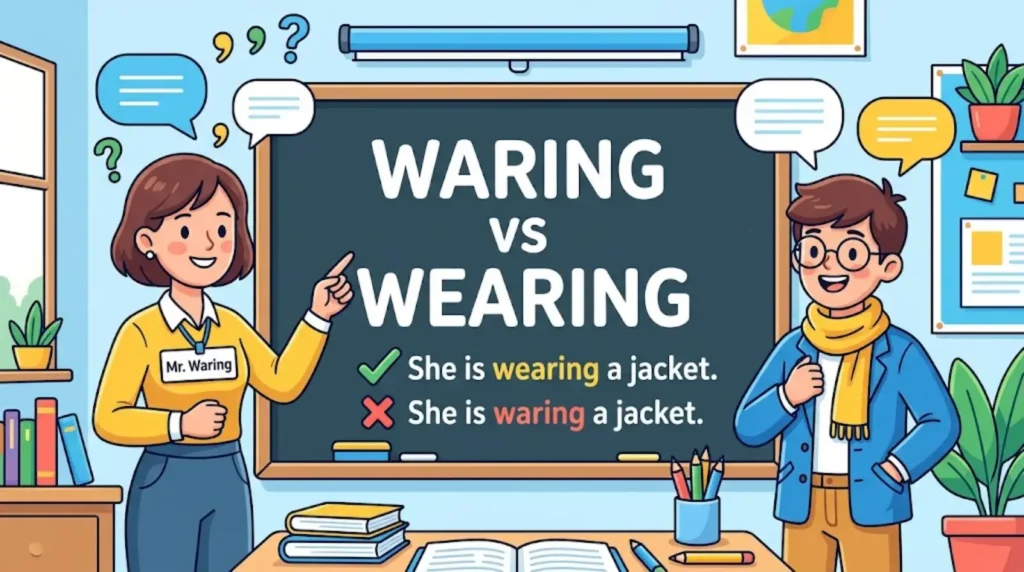
Meaning and Definition
The words Waring and wearing have different functions in ordinary writing. Understanding each one separately makes the distinction easier to remember.
Waring vs Wearing: The Core Difference
The main difference between Waring and wearing involves their meaning and grammatical function. Wearing is a common English word that means having clothes, shoes, jewelry, or another item on your body. It can also describe using or damaging something through repeated use.
By contrast, Waring is not the standard spelling of the everyday word wearing. You may encounter Waring as a person’s surname, a brand name, or another proper noun. In those contexts, the spelling depends on the specific name.
Quick Answer
- Wearing: The correct word when someone has clothes or accessories on their body.
- Waring: Usually a proper name or surname, not the standard spelling of the verb wear.
Comparison Table
| Feature | Waring | Wearing |
|---|---|---|
| Common English word | No, not in this everyday sense | Yes |
| Main meaning | Usually a proper name | Having clothes or items on |
| Part of speech | Usually a proper noun | Verb form or participle |
| Everyday usage | Limited | Very common |
| Example | Mr. Waring teaches English. | She is wearing a blue jacket. |
Remember: If you’re describing someone’s clothes, choose wearing. If you’re writing a person’s actual name, preserve the spelling Waring.
Use Waring When…
Use Waring when you refer to a person, family name, organization, or another proper noun that genuinely uses this spelling. Capitalization matters because proper names identify particular people or entities.
Unlike wearing, Waring does not normally describe putting clothes on your body. Therefore, avoid using it as a substitute for the everyday verb form.
1. When Referring to a Surname
Waring can appear as a family name in biographies, historical records, school documents, and professional correspondence.
Examples:
- Mr. Waring will lead tomorrow’s meeting.
- The Waring family moved to another town.
- Dr. Waring published a paper about language learning.
- I received an email from Sarah Waring.
- The historian discussed Waring’s contribution to the project.
In each sentence, Waring identifies a person or family. It does not describe clothing.
2. When Writing a Proper Name
Some businesses, institutions, products, and places may include Waring in their official names. When you refer to such an entity, use the spelling that the entity officially adopts.
Examples:
- The report mentioned a company named Waring.
- We checked the Waring product manual.
- Her research cited a person named Waring.
- The archive contains several documents about the Waring family.
Always verify the name when accuracy matters. A spelling that looks unusual may still be correct when it belongs to a real person or established name.
3. When Quoting or Recording a Name
Names require special care in formal writing. If a student records a teacher’s name as Waring, the student should not change it to Wearing merely because the latter word looks familiar.
For example:
- Correct: Professor Waring reviewed my essay.
- Incorrect: Professor Wearing reviewed my essay, if the professor’s actual surname is Waring.
However, the reverse also matters. If someone’s surname is Wearing, do not change it to Waring. Proper names follow the person’s established spelling.
Use Wearing When…
Use wearing when you need the present participle of the verb wear. The word commonly describes clothes, shoes, jewelry, glasses, uniforms, and other things that someone has on their body.
It also appears in expressions about using or gradually damaging an object. Because wearing has several related uses, understanding the sentence helps you choose it correctly.
1. When Describing Clothes
This is the most common use of wearing. It tells readers what someone has on.
Examples:
- She is wearing a red dress.
- He was wearing black shoes at the wedding.
- My brother is wearing his school uniform.
- The woman wearing glasses is our new teacher.
- They were wearing warm coats during the winter trip.
Notice that wearing often follows a form of the verb be, such as am, is, are, was, or were.
For instance, “She is wearing a jacket” describes what she has on now. Meanwhile, “She wore a jacket yesterday” describes a past event.
2. When Describing Accessories
The word also applies to objects people put on or carry on their bodies as accessories.
Examples:
- He is wearing a silver watch.
- My aunt was wearing pearl earrings.
- She looks confident wearing those sunglasses.
- The athlete is wearing a protective helmet.
- Are you wearing your new shoes today?
These sentences all require wearing, not waring. The spelling remains the same whether the item is clothing, jewelry, or protective equipment.
3. When Describing Damage Through Use
The verb wear can also describe something that becomes damaged or thinner through regular use. Its -ing form is wearing.
Examples:
- The old carpet is wearing thin.
- These shoes are wearing out quickly.
- Constant friction is wearing down the surface.
- The paint is wearing away near the door.
- The repeated washing is wearing out the fabric.
In these examples, wearing does not mean that someone has an item on their body. Instead, it describes gradual damage or loss caused by use.
4. When Describing Emotional or Physical Strain
The word appears in expressions that describe something gradually exhausting a person.
Examples:
- The long journey is wearing me out.
- Constant arguments are wearing him down.
- The stressful schedule is wearing on the whole team.
- Lack of sleep is wearing her out.
These expressions communicate fatigue, pressure, or exhaustion. Once again, wearing is the correct spelling.
Understanding the Grammar Rule
The easiest way to understand Waring vs Wearing is to examine the verb wear and its different forms.
“English often creates the -ing form of a verb by adding -ing to its base form. However, some verbs require a spelling change before they accept this ending.”
The verb wear follows a straightforward pattern: it becomes wearing.
Forms of the Verb Wear
| Verb Form | Example |
|---|---|
| Base form | I wear comfortable shoes. |
| Third-person singular | She wears comfortable shoes. |
| Simple past | She wore comfortable shoes yesterday. |
| Past participle | She has worn those shoes before. |
| Present participle | She is wearing comfortable shoes. |
Notice that the forms wore and worn differ from the base form. Therefore, English learners sometimes struggle to remember the correct form when they write quickly.
Nevertheless, wearing always keeps the letter sequence wear before the -ing ending.
How to Use Wearing in Different Tenses
| Tense or Structure | Example |
|---|---|
| Present continuous | I am wearing a blue shirt. |
| Past continuous | I was wearing a blue shirt. |
| Present perfect continuous | I have been wearing this shirt all day. |
| Descriptive phrase | The boy wearing a blue shirt is my cousin. |
| Gerund | Wearing a helmet protects your head. |
The final example shows that wearing can also function as a gerund. A gerund uses an -ing verb form as a noun-like element in a sentence.
For example, “Wearing comfortable shoes makes walking easier” uses wearing comfortable shoes as the subject.
A Simple Grammar Rule
When you want to describe clothes or accessories someone has on, use wearing.
When you mean a person whose name is Waring, use Waring.
These words do not represent two competing spellings of the same everyday verb. Instead, they serve different purposes, so the sentence’s meaning determines your choice.
Why These Words Confuse People
The confusion between Waring and wearing often starts with their similar appearance. Both words contain familiar letters, and a fast typist may overlook the extra letter e in wearing.
However, several other factors can contribute to this mistake.
1. Fast Typing Creates Spelling Errors
People often type messages quickly, especially on phones. As a result, they may leave out a letter or choose a nearby spelling without noticing.
For example:
- Incorrect: She is waring a coat.
- Correct: She is wearing a coat.
A quick proofreading check usually catches this error.
2. Familiar Names Influence Word Choice
Readers may have encountered Waring as a surname. Consequently, their brains may recognize the letter pattern and accept it even when the sentence requires wearing.
This happens because people often rely on visual familiarity when they read or type.
3. English Contains Irregular Verb Forms
The verb wear changes form in several ways: wear, wears, wore, and worn. Therefore, learners may feel uncertain about how to create its -ing form.
Fortunately, the rule is simple. Add -ing directly to wear to create wearing.
4. Spell Checkers Do Not Catch Every Error
A spell checker may recognize a surname or proper noun without knowing whether it fits the sentence. Therefore, it may not flag Waring when a writer accidentally uses it instead of wearing.
Context matters just as much as spelling.
5. Readers Focus on Meaning
When someone reads “She is waring a dress,” they may understand the intended meaning immediately. Because the sentence still makes sense, the reader may overlook the missing letter.
Nevertheless, understanding a sentence does not make every spelling choice correct. Careful editing helps you catch mistakes that meaning alone cannot reveal.
What Does Waring Mean?
Waring usually appears as a proper noun, especially a surname. It does not serve as the standard present participle of wear.
Examples:
- Mr. Waring teaches mathematics.
- The article mentions the Waring family.
- We contacted a researcher named Waring.
In each case, the word identifies a particular person or name. Its meaning depends on the individual or entity it refers to.
What Does Wearing Mean?
Wearing is the present participle of wear. It can also function as a gerund or adjective-like modifier, depending on the sentence.
Verb form:
- She is wearing a green jacket.
As a gerund:
- Wearing a helmet improves safety.
As part of a descriptive phrase:
- The student wearing glasses answered the question.
In addition, wearing appears in phrasal expressions such as wearing out, wearing down, and wearing away.
Quick Definition Table
| Word | Definition | Example |
|---|---|---|
| Waring | Usually a proper name or surname | Ms. Waring called this morning. |
| Wearing | Having clothes or accessories on | He is wearing a hat. |
| Wearing out | Becoming damaged through use | My old shoes are wearing out. |
| Wearing down | Gradually reducing strength or resistance | The pressure is wearing him down. |
The main takeaway is straightforward: wearing belongs to everyday grammar, while Waring usually identifies a name. Choose the form that matches the meaning you want to express.
Side-by-Side Examples Table
Comparing sentences makes the difference between Waring vs Wearing easier to understand. Although both words look similar, only wearing works as the usual verb form for describing clothes or accessories.
Incorrect vs Correct Examples
| Incorrect Sentence | Correct Sentence | Explanation |
|---|---|---|
| She is waring a red dress. | She is wearing a red dress. | Use wearing for clothes. |
| He was waring black shoes. | He was wearing black shoes. | The verb requires the full spelling. |
| I am waring my school uniform. | I am wearing my school uniform. | Wearing describes what someone has on. |
| They are waring matching jackets. | They are wearing matching jackets. | Add the missing e. |
| The child is waring a helmet. | The child is wearing a helmet. | Use wearing for protective equipment. |
| Mr. Wearing teaches English. | Mr. Waring teaches English. | Use the person’s actual surname. |
The last example needs special attention. Waring can be a correct surname, while Wearing can also be someone’s surname. Always check the person’s actual name rather than assuming one spelling must be correct.
More Examples in Context
- Incorrect: My sister is waring a beautiful necklace.
- Correct: My sister is wearing a beautiful necklace.
- Incorrect: Who is waring the blue uniform?
- Correct: Who is wearing the blue uniform?
- Incorrect: These gloves are waring out.
- Correct: These gloves are wearing out.
- Incorrect: I met Professor Wearing yesterday.
- Correct: I met Professor Waring yesterday, if Waring is the professor’s actual surname.
These examples show why context matters. In ordinary sentences about clothing or damage, wearing is the correct choice. For names, follow the person’s established spelling.
Memory Trick That Actually Works
If you regularly confuse Waring and wearing, try a simple visual trick. You do not need to memorize complicated grammar rules to remember the difference.
Trick 1: Remember the Word Wear
The word wear appears inside wearing.
Think of familiar things you wear:
- Clothes
- Shoes
- Hats
- Watches
- Glasses
Whenever your sentence describes something on your body, remember the word wear. Then add -ing to form wearing.
For example:
- I wear a jacket.
- I am wearing a jacket.
The spelling stays connected to the base verb.
Trick 2: Connect Wearing With Dressing
Imagine standing in front of a mirror before leaving home. You put on a shirt, choose your shoes, and adjust your watch.
Ask yourself, “What am I wearing?”
Because you’re describing clothes and accessories, the correct answer contains the complete word wearing.
By contrast, imagine reading a school report that mentions Mr. Waring. In that sentence, Waring identifies a person rather than describing clothing.
Trick 3: Use a Simple Sentence Test
Before typing the word, ask:
Am I describing what someone has on, or naming a person?
| Your Meaning | Correct Choice |
|---|---|
| Someone has a coat on. | Wearing |
| Someone has shoes on. | Wearing |
| A person has the surname Waring. | Waring |
| Something is gradually becoming damaged. | Wearing |
This test works because it focuses on meaning instead of appearance.
Common Grammar Mistakes
Even confident English writers sometimes make small spelling mistakes. Fortunately, you can avoid most errors involving Waring vs Wearing by learning a few simple rules.
Mistake 1: Leaving Out the Letter E
Incorrect: She is waring a blue sweater.
Correct: She is wearing a blue sweater.
The verb wear contains the letter sequence w-e-a-r. Keep that spelling when adding -ing.
Mistake 2: Using Waring as a Verb
Incorrect: He is waring a new pair of sneakers.
Correct: He is wearing a new pair of sneakers.
Waring does not serve as the standard present participle of wear. Therefore, use wearing when describing clothing.
Mistake 3: Confusing Past and Present Forms
Incorrect: Yesterday, she was wore a red coat.
Correct: Yesterday, she was wearing a red coat.
The past continuous tense uses was or were followed by an -ing form. Therefore, the correct construction is was wearing.
You can also write, “Yesterday, she wore a red coat.” Both sentences work, but they use different grammatical structures.
Mistake 4: Forgetting the Verb After Is or Are
Incorrect: They are wear matching uniforms.
Correct: They are wearing matching uniforms.
When you describe an action happening now, use the present continuous structure:
Subject + am/is/are + verb-ing
Examples:
- I am wearing a jacket.
- She is wearing a jacket.
- They are wearing jackets.
Mistake 5: Changing a Person’s Name
Incorrect: The invitation lists Mr. Wearing, even though his surname is Waring.
Correct: The invitation lists Mr. Waring.
Proper names require accurate spelling. Therefore, never change someone’s surname simply because another word looks more familiar.
Mistake 6: Trusting Spell Check Completely
A spell checker may accept Waring because it recognizes the word as a name. However, the software may not understand your intended meaning.
For example, it might overlook “She is waring a coat.”
Read the entire sentence rather than relying only on automatic corrections. Context helps you identify the right word.
Everyday Conversation Examples
The difference becomes easier to remember when you see both words in realistic situations.
At School
Students often describe uniforms, sports equipment, and classroom activities.
Examples:
- “Why are you wearing your sports uniform today?”
- “The student wearing the red shirt won the race.”
- “Our history teacher, Mr. Waring, assigned a new project.”
- “Everyone is wearing a name badge for the school event.”
In these examples, wearing describes clothes, while Waring identifies a teacher.
At Work
Professional conversations frequently mention clothing, uniforms, and colleagues.
Examples:
- “The employees are wearing their safety equipment.”
- “Who is wearing the blue company jacket?”
- “Please contact Ms. Waring about the meeting.”
- “The staff members were wearing matching shirts during the conference.”
The context makes each word’s function clear.
In Relationships
Everyday conversations with friends and family often include comments about outfits.
Examples:
- “I love the dress you’re wearing.”
- “Are you wearing the watch I gave you?”
- “Your brother is wearing my favorite hoodie.”
- “I spoke with your friend, Daniel Waring, yesterday.”
These examples show how naturally wearing appears in ordinary conversation.
On Social Media
Social media captions often use short, direct sentences. However, quick typing can create spelling mistakes.
Examples:
- “Loving the jacket I’m wearing today!”
- “What do you think of the shoes she’s wearing?”
- “Everyone is wearing their favorite color.”
- “A special thanks to designer Alex Waring.”
Before publishing a caption, check that you have used the correct word. A quick review helps your post look polished.
In Emails
Professional emails require clarity, particularly when you discuss dress codes or identify colleagues.
Example 1: Workplace dress code
“Please remember that everyone must be wearing appropriate safety equipment during the inspection.”
Example 2: Identifying a colleague
“Please send the report to Ms. Waring before Friday.”
Example 3: Event instructions
“Guests will be wearing formal clothing at the awards ceremony.”
A correct word choice helps readers understand your message without unnecessary distractions.
Professional Writing Examples
Professional writing benefits from precise spelling and grammar. Whether you’re publishing a blog or preparing an academic paper, choose words that communicate your intended meaning clearly.
1. Blogs
Bloggers often describe outfits, fashion trends, and personal experiences.
Example:
“Choosing the right shoes can improve comfort throughout the day. However, the shoes you’re wearing should also suit the activity.”
A fashion blog might also mention a designer named Waring. In that case, the writer should preserve the designer’s correct name.
2. News Headlines
News writers need concise and accurate language.
Examples:
- “Athletes Wearing Protective Gear Compete in Regional Event”
- “Students Wearing School Uniforms Join Community Parade”
- “Local Historian Dr. Waring Publishes New Research”
Notice how the first two headlines describe clothing, while the third identifies a person.
3. Product Reviews
Product reviews often explain how clothing fits, feels, or performs.
Examples:
- “The jacket I’m wearing feels comfortable in cold weather.”
- “These shoes are wearing out faster than expected.”
- “The fabric is wearing thin after repeated washing.”
- “The review quotes a designer named Waring.”
The word wearing can describe both having an item on and the gradual damage that occurs through use.
4. Academic Writing
Students should use standard spelling and grammar in essays, reports, and research papers.
Examples:
- “Participants were wearing protective clothing during the experiment.”
- “The student wearing a blue jacket completed the task.”
- “Professor Waring reviewed the submitted research.”
Academic writing also requires careful proofreading. Even a small spelling error can distract readers from an otherwise strong argument.
Search Intent and SEO Relevance
People who search for Waring vs Wearing usually want a quick explanation of the difference. They may have spotted an unfamiliar spelling online or need to correct a sentence before submitting an assignment.
Common search questions include:
- Is waring a real word?
- Is waring or wearing correct?
- How do you spell wearing clothes?
- What does Waring mean?
- Why does my spell checker accept waring?
A useful grammar article should answer these questions directly before exploring more advanced details.
Why Search Intent Matters
Readers generally want practical guidance rather than a complicated linguistic explanation. Therefore, clear definitions, short examples, and comparison tables can help them find the answer quickly.
For an educational blog, this structure also supports readability. Readers can scan the headings, locate the relevant rule, and apply it to their own writing.
SEO Tips for Grammar Bloggers
If you’re publishing an article about this keyword, consider these practices:
- Include the main keyword naturally in the title and introduction.
- Explain the difference near the beginning.
- Add examples that demonstrate correct and incorrect usage.
- Use related terms such as wearing clothes, spelling mistakes, and English grammar where relevant.
- Include frequently asked questions that address genuine reader concerns.
- Avoid repeating the keyword unnaturally in every paragraph.
Search optimization should support helpful writing rather than replace it. A clear, accurate explanation gives readers more value than unnecessary keyword repetition.
Quick Editing Checklist
Before submitting an essay, sending an email, or publishing a blog post, review your use of Waring and wearing.
Ask yourself these questions:
- Am I describing clothes, shoes, jewelry, or accessories?
- Did I spell the verb form wearing correctly?
- Does the sentence use the correct verb structure, such as is wearing or was wearing?
- Am I referring to a person whose actual surname is Waring?
- Did I check the sentence’s meaning instead of trusting spell check alone?
- Did I proofread the complete sentence?
If you’re describing clothing, choose wearing. If you’re referring to a person named Waring, preserve the correct name.
Popular Expressions and Phrases Using Wearing
The word wearing appears in several common expressions. Learning these phrases will help you understand its meaning in different contexts.
1. Wearing Out
Meaning: Becoming damaged or exhausted through repeated use.
Examples:
- My favorite sneakers are wearing out.
- The constant noise is wearing me out.
- Years of use are wearing out the carpet.
2. Wearing Down
Meaning: Gradually reducing someone’s strength, energy, or resistance.
Examples:
- The long working hours are wearing him down.
- Repeated delays are wearing down the team’s patience.
- The pressure eventually wore down their resistance.
3. Wearing Away
Meaning: Gradually removing or destroying a surface through repeated action.
Examples:
- The river is wearing away the riverbank.
- Constant friction is wearing away the paint.
- Wind and rain are wearing away the rock.
4. Wearing Thin
Meaning: Becoming physically thin or losing patience.
Examples:
- The old carpet is wearing thin.
- My patience is wearing thin after several delays.
- Their excuses are wearing thin.
5. Wear Your Heart on Your Sleeve
Meaning: To show your emotions openly.
Example:
“She wears her heart on her sleeve, so everyone knows when she’s upset.”
This idiom uses wear rather than wearing, but it helps demonstrate how the verb appears in figurative expressions.
Important: These expressions use forms of the verb wear. They do not use Waring as a substitute. Learning them can strengthen your vocabulary and improve your understanding of everyday English.
A Real-Life Case Study: Waring vs Wearing
Imagine a student named Ali is writing an English assignment about school uniforms. He wants to explain what students should wear during the school day.
Ali writes:
“Every student is waring a clean uniform.”
His teacher marks the word waring and asks him to check the spelling. Ali looks at the sentence again but does not understand his mistake.
The correct sentence is:
“Every student is wearing a clean uniform.”
Why? Because Ali is describing what students have on their bodies. The verb wear becomes wearing when it takes the -ing ending.
Now imagine Ali is writing about a person named Mr. Waring. In that case, the spelling could be correct:
“Mr. Waring teaches English at our school.”
This example shows why context matters. Use wearing when describing clothes or something being worn. Use Waring when it is the correct spelling of a name or another proper noun.
How Teachers Explain Waring vs Wearing
Teachers often explain this spelling difference by connecting each word to its purpose.
Think of wearing as an action word. It tells readers what someone has on or what something is experiencing.
For example:
- Sara is wearing a blue dress.
- He is wearing glasses.
- The old shoes are wearing out.
Now think of Waring as a name tag. It may identify a person, family, place, or organization.
For example:
- Mr. Waring arrived early.
- The Waring family lives nearby.
A simple classroom trick is to ask one question: Am I describing an action, or am I writing a name?
If you are describing an action involving clothes, accessories, or wear and tear, wearing is usually the word you need. If you are referring to someone whose name is Waring, keep the capital letter when appropriate.
Practical Tips for Students
Students can remember the difference between Waring and wearing with a few simple habits.
1. Look at the sentence meaning.
Read the whole sentence before choosing a spelling. Meaning often reveals the correct word.
2. Remember the base verb.
The base verb is wear. Adding -ing gives you wearing.
3. Check for a name.
If the sentence refers to a person named Waring, the spelling may be correct. Proper names should follow the person’s actual spelling.
4. Read your sentence aloud.
Reading aloud can help you notice when a word does not fit the meaning, although it may not reveal every spelling error.
5. Use a spellchecker carefully.
A spellchecker may accept both words because Waring can be a proper noun. Always check the context.
6. Practise with short sentences.
Write three sentences using wearing and one sentence using Waring as a name. This helps you understand how each word works.
7. Proofread before submitting.
Check school assignments, emails, essays, and social media posts for missing letters or typing errors.
Why Correct Usage Matters
Choosing between Waring and wearing may seem like a small detail, but spelling affects how clearly people understand your writing.
Using waring instead of wearing in a sentence about clothes can distract readers. It may also make an otherwise strong assignment or professional message appear less carefully edited.
Correct spelling is especially important in schoolwork, blog posts, product descriptions, business emails, and formal documents. Readers expect words to communicate the intended meaning without unnecessary confusion.
However, context remains essential. Changing a person’s surname from Waring to wearing could create a different and incorrect name. That is why writers should check both spelling and meaning rather than relying only on automated corrections.
The best approach is simple: understand what the sentence means, identify whether the word describes an action or names someone, and then choose the spelling that fits.
Waring vs Wearing: Quick Reference Table
| Feature | Waring | Wearing |
|---|---|---|
| Standard use | Usually a proper name or surname | Standard form of the verb wear |
| Meaning | Depends on the name or proper noun | Having clothes or accessories on; experiencing wear or strain |
| Part of speech | Proper noun when used as a name | Verb form; also used as a participial adjective |
| Capitalization | Capitalized when used as a proper name | Usually lowercase unless it starts a sentence |
| Example | Mr. Waring called yesterday. | She is wearing a jacket. |
| Common mistake | Using it instead of wearing | Misspelling it as waring |
| Easy reminder | Think of a name | Think of the action wear + ing |
Frequently Asked Questions
1. Is Waring or Wearing correct?
Both spellings can be correct in different contexts. Wearing is the standard form of the verb wear, while Waring may be a surname or another proper noun.
2. Is Waring a real word?
Waring is used as a proper name, including as a surname. It is not the standard spelling of the present participle of wear.
3. Why is wearing spelled with an e?
The base verb is wear. When you add -ing, the result is wearing. The letter e is part of the original spelling and remains in the word.
4. Is “I am waring a jacket” correct?
No. The correct sentence is “I am wearing a jacket.” Wearing describes the clothes you have on.
5. Can Waring be a person’s name?
Yes. Waring can be a surname. If you are referring to someone with that name, use the correct spelling of their name.
6. What is the easiest way to remember Waring vs Wearing?
Remember that wearing comes from the verb wear. If you are talking about clothes, glasses, shoes, or wear and tear, you probably need wearing.
7. Does a spellchecker always catch the mistake?
No. A spellchecker may accept Waring because it can be a proper noun. Review the sentence’s meaning to make sure the spelling fits.
If you found this guide helpful, you might also enjoy our related grammar articles for more easy English explanations and real-world examples.
Conclusion
The difference between Waring and wearing is simple once you understand their uses. Wearing is the standard spelling when describing clothes, accessories, or something experiencing wear and tear. For example, “She is wearing a red coat” is correct. Waring, on the other hand, may be correct when it is a person’s surname or another proper noun. The main mistake happens when writers leave out the letter e in wearing. To avoid this error, read the sentence carefully, check its meaning, and decide whether you are describing an action or referring to a name. A spellchecker can help, but context is still important. With a little practice, you can confidently choose the right spelling in school assignments, emails, blog posts, and everyday conversations.

Hi, I’m Liam Harper, the voice behind Wordspry!
I’m here to make English grammar simple, clear, and easy to understand for learners of all levels. Through practical lessons and helpful guides, I aim to help you improve your writing and communication skills with confidence.