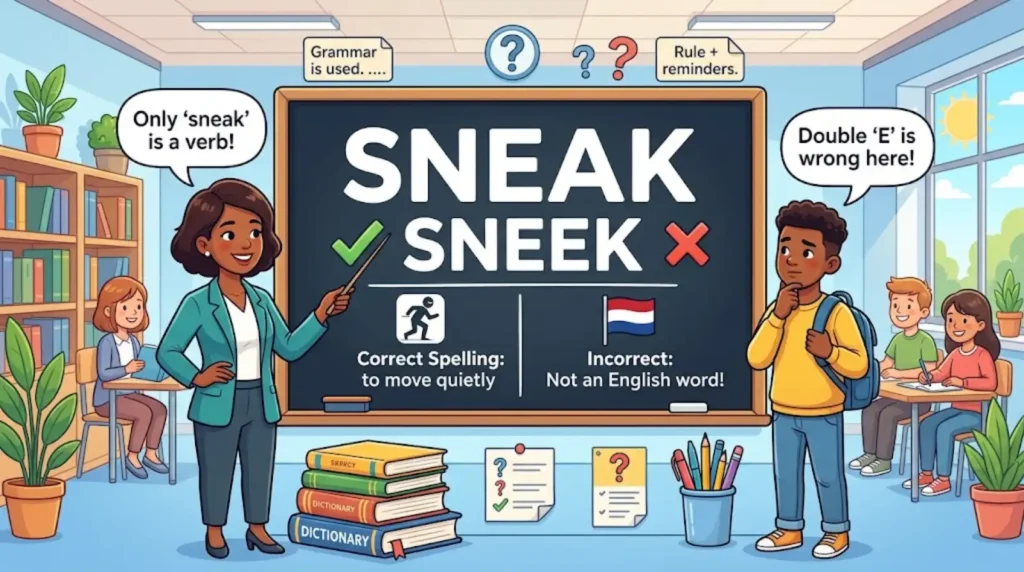
When comparing Sneek vs Sneak, the correct spelling in standard English is sneak. It means to move quietly, secretly, or without being noticed. Sneek is generally a misspelling of sneak, although it may appear as a proper name, brand, username, or creative spelling.
For example, imagine you want to enter a room without waking anyone. You might say, “I tried to sneak into the kitchen quietly.” In this sentence, sneak is the correct word.
People often search for Sneek vs Sneak because both spellings sound similar. However, English spelling can be confusing, especially when words have unexpected letter combinations. A small spelling mistake can also make an otherwise clear sentence look unprofessional.
Table of Contents
- Sneek vs Sneak: Quick Answer
- Definitions and Examples
- Origin and History
- British English vs American English
- Which One Should You Use?
- Common Spelling Mistakes
- Everyday Examples
- Usage Trends and Popularity
- Comparison Table
- Special Rules and Important Uses
- Frequently Asked Questions
- Conclusion
Sneek vs Sneak: Quick Answer
Sneak is the correct spelling of the common English word. It means to move quietly, act secretly, or do something without attracting attention. Sneek is not a standard spelling of this word.
Examples:
- Correct: The cat tried to sneak into the bedroom.
- Incorrect: The cat tried to sneek into the bedroom.
Remember this simple rule: use sneak in normal English writing, including schoolwork, emails, articles, and social media posts. Use Sneek only when it is an intentional proper name, brand name, username, or other specially chosen spelling.
Definitions and Examples
What Does “Sneak” Mean?
The word sneak can function as a verb or a noun. As a verb, it describes moving quietly or doing something secretly to avoid attention. As a noun, it can describe a person who behaves in a secretive or underhanded way.
Examples:
- Verb: The children tried to sneak past their sleeping parents.
- Verb: I sneaked a cookie before dinner.
- Noun: Nobody trusted the sneak who kept reporting everyone’s mistakes.
- Expression: We watched a sneak preview of the new movie.
The word also appears in common expressions such as sneak out, sneak in, sneak a peek, and sneak up on someone.
What Does “Sneek” Mean?
Sneek is not the standard spelling of the English word sneak. People may type it because they confuse the vowel combination ea with ee.
However, the spelling may be intentional in a name, business, brand, or online username. In those situations, its meaning depends on the person or organization using it.
Examples:
- Incorrect: I tried to sneek into the classroom.
- Correct: I tried to sneak into the classroom.
- Possible proper name: Sneek is the name of a business or online account.
The important distinction is context. When describing secret movement, choose sneak. When reproducing an official name, preserve its original spelling.
Origin and History
The word sneak has a long history in English. Historical sources trace it to older forms associated with creeping or crawling. It entered recorded English usage around the late sixteenth century.
Over time, its meaning expanded beyond quiet physical movement. Today, someone can sneak into a room, sneak a look at a message, or sneak an extra snack.
The spelling sneak reflects the established form of the word. By contrast, sneek does not represent a standard alternative spelling in ordinary English usage.
Here is how the word appears in common expressions:
- Sneak in: Enter without attracting attention.
- Sneak out: Leave quietly or secretly.
- Sneak peek: A brief or early look at something.
- Sneak attack: An unexpected attack.
These expressions show why using the correct spelling matters in everyday communication.
British English vs American English
The spelling sneak is standard in both British and American English. There is no regional spelling difference between these varieties.
| Usage | British English | American English |
|---|---|---|
| Standard spelling | Sneak | Sneak |
| Present tense | Sneak | Sneak |
| Past tense | Sneaked or snuck | Sneaked or snuck |
| Present participle | Sneaking | Sneaking |
| Incorrect standard spelling | Sneek | Sneek |
One interesting difference concerns the past tense. Both sneaked and snuck are accepted, although snuck is especially common in American English.
For example:
- British English: She sneaked out of the house.
- American English: She snuck out of the house.
Both sentences are correct. The choice depends on style, audience, and personal preference—not on whether you use sneek or sneak.
Which One Should You Use?
Choose sneak whenever you need the ordinary English word. This rule applies to academic writing, professional communication, creative writing, and casual conversations.
Use these practical tips:
- For school assignments: Write sneak when describing secret movement.
- For emails: Use sneak in sentences such as “I will sneak away for lunch.”
- For blog posts: Spell expressions such as sneak peek correctly.
- For social media: Use sneak unless you intentionally mean a particular name or username.
- For brand names: Follow the official spelling, even when it differs from standard English.
When proofreading, look for the letter combination ea. If you are describing someone moving quietly, sneak is the spelling you need.
Common Spelling Mistakes
The confusion between sneek and sneak often happens because English vowel combinations can represent similar sounds. Both spellings may suggest the same pronunciation to a learner, but only one is standard for this word.
Here are common mistakes to avoid.
| Incorrect sentence | Correct sentence |
|---|---|
| He tried to sneek inside. | He tried to sneak inside. |
| I will sneek a look later. | I will sneak a look later. |
| The cat can sneek past us. | The cat can sneak past us. |
| She wants to sneek out early. | She wants to sneak out early. |
| We got a sneek peek. | We got a sneak peek. |
Is “Sneek Peek” Correct?
No. In standard English, the correct expression is sneak peek.
A sneak peek is an early or brief look at something before its full release or public presentation.
Example:
- Incorrect: Here is a sneek peek of our new website.
- Correct: Here is a sneak peek of our new website.
This expression is especially common in advertising, entertainment, blogging, and social media.
Everyday Examples
Seeing the word in different situations makes the spelling easier to remember.
1. Emails
Correct: “I’ll sneak out during my lunch break to collect the package.”
This sentence describes leaving quietly or briefly.
2. Social Media
Correct: “Here’s a sneak peek at my upcoming travel vlog!”
The phrase tells readers they can see a preview before the full video appears.
3. News
Correct: “The studio offered fans a sneak peek at its upcoming film.”
This sentence describes an early preview for an audience.
4. Classroom
Correct: “The student tried to sneak a look at the answer sheet.”
The verb describes an attempt to look without being noticed.
5. Daily Life
Correct: “Our dog tried to sneak onto the sofa while we were away.”
The sentence describes an animal moving somewhere without attracting attention.
Across all five examples, sneak is the correct standard spelling.
Usage Trends and Popularity
The spelling sneak is the established form used in dictionaries, books, news articles, and everyday English. Sneek sometimes appears online, but it is generally a spelling error when intended to mean secret or quiet movement.
The standard spelling is also common in familiar expressions, including sneak peek, sneak attack, and sneak out.
Why might people still search for “Sneek vs Sneak”?
- Similar pronunciation: Both spellings may appear to represent the same sound.
- English spelling patterns: Learners sometimes confuse ea and ee.
- Typing mistakes: Fast typing can lead to incorrect spellings.
- Online names: Some brands and usernames use unusual spellings intentionally.
Although online searches can help reveal what people find confusing, they do not automatically prove which spelling is more popular. The practical rule remains straightforward: use sneak in standard English writing.
Comparison Table
This table summarizes the essential differences between sneek and sneak.
| Feature | Sneek | Sneak |
|---|---|---|
| Standard English spelling | No | Yes |
| Meaning as a common verb | Not standard | To move or act secretly |
| Accepted in ordinary writing | No | Yes |
| Suitable for schoolwork | No | Yes |
| Used in the phrase “___ peek” | Incorrect | Correct |
| May appear as a proper name | Yes | Yes |
| Best choice for general writing | No | Yes |
The key takeaway is simple: sneak is the correct spelling for the ordinary English word. Do not use sneek as a substitute.
Special Rules and Important Uses
Although sneek is not the standard spelling, understanding the word’s different forms will help you write more confidently.
Sneak, Sneaked, and Snuck
The verb sneak has several commonly used forms.
| Verb form | Example |
|---|---|
| Base form: sneak | I sneak into the kitchen quietly. |
| Third-person singular: sneaks | She sneaks downstairs at night. |
| Past tense: sneaked | He sneaked out after dinner. |
| Past tense: snuck | He snuck out after dinner. |
| Present participle: sneaking | They are sneaking into the garden. |
Both sneaked and snuck are accepted past-tense forms. However, snuck is especially common in American English.
Sneak Peek vs. Sneak Peak
Another common spelling confusion involves peek and peak.
- Sneak peek: A secret or early look at something.
- Peak: The highest point of something, such as a mountain.
Correct: “The company shared a sneak peek of its new product.”
Incorrect: “The company shared a sneak peak of its new product.”
Remember that peek relates to looking, while peak relates to a high point.
Frequently Asked Questions
1. Is “sneek” a real word?
Sneek is not the standard spelling of the common English verb sneak. However, it can appear as a proper name, brand, or username. Use sneak when writing about secret or quiet movement.
2. Which is correct: Sneek or Sneak?
Sneak is correct in standard English. For example, “The cat tried to sneak into the bedroom” uses the accepted spelling.
3. How do you spell “sneak peek”?
The correct spelling is sneak peek. It means an early or brief look at something. The expression is frequently used for movie previews, product launches, and upcoming blog posts.
4. Is “sneak” used in British and American English?
Yes. Both British and American English use sneak as the standard spelling. The past-tense forms sneaked and snuck are also used, although their popularity varies by region and writing style.
5. Why do people spell sneak as sneek?
People may confuse the spellings because the letters ea and ee can represent similar sounds in English. Typing habits and unfamiliarity with the correct spelling can also contribute to this mistake.
6. What is the past tense of sneak?
Both sneaked and snuck are accepted past-tense forms. For example, “She sneaked out early” and “She snuck out early” are both correct.
7. Can “Sneek” be used as a name?
Yes. A person or business can intentionally use Sneek as a name or brand spelling. However, that does not make it a standard alternative spelling of the English word sneak.
Conclusion
When comparing Sneek vs Sneak, remember that sneak is the correct spelling in standard English. It means to move quietly, do something secretly, or avoid attracting attention.
The spelling sneek is generally incorrect when used with this meaning. Nevertheless, it may be appropriate when reproducing a specific brand name, username, or other proper name.
Keep these simple rules in mind:
- Write sneak when describing secret movement or actions.
- Use sneak peek when referring to an early preview.
- Remember that both sneaked and snuck are accepted past-tense forms.
- Preserve Sneek when it is the intentional spelling of a name.
The next time you hesitate between these spellings, choose sneak for ordinary English writing. A quick spelling check can help you avoid mistakes and make your writing clearer.

Hi, I’m Victoria Lane, the voice behind Wordspry!
I’m passionate about helping students and readers master English grammar, vocabulary, and writing through simple, friendly, and easy-to-follow content.