Quick answer: “drier” is usually the comparative form of “dry,” while “dryer” usually means a machine or device that dries something. However, drier can also be used as a noun for a drying machine, so the two words can overlap in some situations.
English has plenty of words that look almost identical but do very different jobs. Drier or dryer is a perfect example. One small letter can change the meaning of your sentence, especially when you are talking about weather, clothes, hair, or appliances.
Imagine saying, “This room is dryer than yesterday.” You probably mean that the room has less moisture. In that case, drier is the natural choice. But if you say, “Put the clothes in the dryer,” you are talking about a machine.
The confusion becomes even greater because dictionaries list drier as another spelling of dryer when the word means a machine.
Understanding the difference helps you write more clearly at school, at work, online, and in everyday conversations. Once you learn one simple rule, choosing between drier and dryer becomes much easier.
RELATED: Passtime or Pastime: Which Spelling Is Correct?
Core Meaning and Spelling Clarity
The easiest way to understand these words is to separate their main jobs.
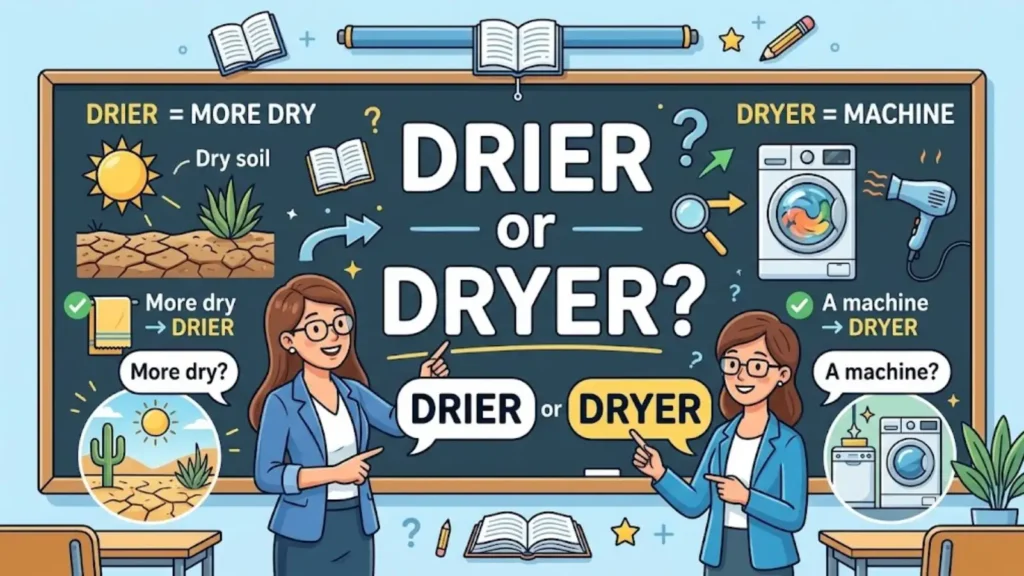
Drier most commonly means more dry. It is the comparative form of the adjective dry. Cambridge Dictionary lists drier as the comparative form of dry.
For example:
- The desert is drier than the forest.
- My skin feels drier in winter.
- Today is drier than yesterday.
- This towel is drier than that one.
In each sentence, you are comparing two conditions.
On the other hand, dryer commonly refers to a machine or device used for drying. Oxford defines dryer as a machine for drying something and gives examples such as hairdryer and dryer.
For example:
- I put my clothes in the dryer.
- She bought a new hair dryer.
- The restaurant uses a hand dryer.
- The farmer uses a grain dryer.
A Simple Rule
Think of the words this way:
Drier = more dry
Dryer = something that dries
This distinction will solve most everyday questions.
However, there is an important detail. Drier can also be a noun meaning a drying machine. Major dictionaries recognize this usage.
So, “dryer” is generally the clearer choice when you mean an appliance, while “drier” is especially common when you mean “more dry.”
Why People Get Confused
The confusion comes from the fact that both words are pronounced almost exactly the same.
You can hear the same basic sound in:
- drier
- dryer
That makes spelling especially tricky.
The words also come from the same base word: dry.
When we want the comparative form, we normally change dry to drier:
- dry → drier
- dry → driest
For example:
The air is dry.
Then:
The air is drier today.
But when we create a noun for something that performs the action, dryer is commonly used:
The machine dries the clothes.
So:
I need a new dryer.
The spelling difference looks tiny, but the grammatical role is different.
Why “Dryer” Looks Natural for a Machine
Many English nouns use -er to describe a person or thing that performs an action.
Consider:
- teach → teacher
- clean → cleaner
- wash → washer
- print → printer
- dry → dryer
Therefore, dryer can naturally describe something that dries.
This pattern makes the spelling easy to remember.
Real-Life Meaning Explained
The best way to learn drier or dryer is to see the words in situations you actually experience.
Talking About Weather
Use drier when comparing moisture or rainfall.
Correct:
This summer is drier than last summer.
Here, drier means the summer has less moisture or rain.
Incorrect for this meaning:
This summer is dryer than last summer.
Although readers may understand the sentence, drier is the standard comparative spelling.
Talking About Clothes
Use dryer when referring to an appliance.
Correct:
The clothes are in the dryer.
Here, dryer means the machine.
Talking About Hair
You can use dryer for the appliance:
I need to buy a new hair dryer.
You can use drier for the condition of hair:
My hair feels drier after swimming.
Notice how the meaning changes.
Talking About Skin
When comparing the condition of skin, use drier:
My hands are drier during the winter.
You are comparing how dry your hands are.
You would use dryer only if you mean a device:
I used the hand dryer after washing my hands.
Drier vs Dryer: Side-by-Side Comparison
| Word | Main meaning | Part of speech | Example |
|---|---|---|---|
| drier | More dry | Adjective | The weather is drier today. |
| dryer | A machine that dries | Noun | Put the clothes in the dryer. |
| drier | A machine that dries | Noun | The drier is running. |
| dry | Not wet | Adjective | The towel is dry. |
| drying | Becoming or making something dry | Verb/adjective | The clothes are drying. |
| driest | Most dry | Adjective | July is the driest month. |
The table shows why context matters.
In most writing, drier = more dry and dryer = drying machine is the safest distinction.
Is “Drier” Ever Correct for a Machine?
Yes.
This is one of the details that often surprises English learners.
Dictionaries recognize drier as another spelling of dryer when it refers to a machine or device that dries something. Cambridge specifically lists drier as another spelling of dryer for this noun meaning.
Oxford also lists drier as an alternative noun spelling for a machine used for drying.
For example:
The hair drier is broken.
This sentence is grammatically acceptable.
However, hair dryer is the more familiar spelling for many modern readers, particularly in American English.
Similarly:
tumble dryer
is extremely common in British English. Oxford lists tumble dryer and tumble drier as British English forms.
Therefore, you should not automatically call drier wrong.
The meaning and context matter.
Drier or Dryer in American and British English
There is some variation between English varieties.
In both American and British English, drier is used as the comparative form of dry.
For appliances, dryer is widely recognized in both varieties. Cambridge lists dryer as a machine that dries things and also notes drier as another spelling.
British English commonly uses phrases such as:
- tumble dryer
- hairdryer
- hand dryer
You may also encounter:
- tumble drier
- hair drier
- hand drier
American English strongly favors dryer for the appliance.
Which Spelling Should You Choose?
If you are writing for a general or American audience, this simple approach works well:
Use “drier” for comparisons.
Use “dryer” for machines.
This keeps your writing clear even though drier can technically be used as a noun.
Common Mistakes
Small spelling mistakes can make a sentence sound awkward or change its intended meaning.
Mistake 1: Using “dryer” for a comparison
❌ The climate is dryer this year.
✅ The climate is drier this year.
Why?
Because you are comparing the climate with an earlier period.
Mistake 2: Using “drier” when “dryer” is clearer
❌ Put your clothes in the drier.
✅ Put your clothes in the dryer.
The first sentence is not necessarily impossible, because drier can be a noun. However, dryer is clearer and more familiar for an appliance.
Mistake 3: Confusing “dry” and “drier”
❌ Today is dry than yesterday.
✅ Today is drier than yesterday.
The word than often signals a comparison.
Whenever you see a comparison, ask yourself:
Am I saying “more dry”?
If yes, drier is probably the word you need.
Mistake 4: Writing “dryest”
❌ This is the dryest month.
✅ This is the driest month.
The standard forms are:
- dry
- drier
- driest
Cambridge lists drier and driest as the comparative and superlative forms of dry.
Memory Tricks
Still mixing them up? Try these simple tricks.
Trick 1: Think “More Dry”
If you can replace the word with more dry, use drier.
The air is drier.
Think:
The air is more dry.
The sentence may sound less natural with more dry, but the meaning is clear.
Trick 2: Think “Machine”
If you are talking about an appliance, remember:
Dryer = machine
A dryer does the drying.
This is similar to:
- wash → washer
- clean → cleaner
- dry → dryer
Trick 3: Look for “Than”
If the sentence contains than, check whether you need a comparison.
This towel is drier than that one.
The weather is drier than last week.
The word than is a useful warning sign.
Professional Writing Importance
Correct word choice matters because readers should not have to decode your meaning.
Imagine writing a product description:
“This dryer leaves your clothes drier in less time.”
Here, both words are correct.
The first dryer means the appliance.
The second drier means the clothes become more dry.
That single sentence is a perfect example of why context matters.
Professional writers, teachers, editors, and marketers need to make these distinctions naturally. Clear spelling also makes instructions easier to follow.
For example:
Place the wet towels in the dryer until they are completely dry.
This is clearer than using drier for the appliance.
Good writing is not only about avoiding errors. It is also about choosing the word that communicates your idea fastest.
Practical Examples
Here are some everyday examples to make the difference stick.
Weather
Correct:
The weather is drier this week.
Meaning: There is less moisture or rain.
Clothes
Correct:
The dryer stopped working.
Meaning: The drying machine stopped.
Hair
Correct:
My hair is drier than usual.
Meaning: Your hair has less moisture.
Correct:
I bought a new hair dryer.
Meaning: You bought a device for drying hair.
Towels
Correct:
This towel is drier than the other one.
The towels are being compared.
Bathroom
Correct:
The hand dryer is beside the sink.
The sentence refers to a machine.
Climate
Correct:
The northern region has a drier climate.
The climate is being described comparatively.
Mini Case Study: One Sentence, Two Meanings
Consider this sentence:
The dryer made my clothes drier.
At first glance, the two words look almost identical.
But they perform different jobs.
Dryer is the machine.
Drier describes the result.
The machine makes the clothes more dry.
This is probably the easiest sentence to remember the distinction.
Another example:
The new dryer works well, but my clothes still seem drier in the summer.
Here, dryer identifies the appliance, while drier compares the condition of the clothes.
Quick Fix Guide
When you are unsure between drier or dryer, ask three questions.
Question 1: Am I comparing dryness?
If yes, use drier.
This room is drier than the kitchen.
Question 2: Am I talking about a machine?
If yes, dryer is usually the clearest choice.
The dryer needs repair.
Question 3: Could “more dry” replace the word?
If yes, choose drier.
The soil is drier now.
Think:
The soil is more dry now.
The meaning becomes obvious.
Drier or Dryer: A Quick Cheat Sheet
| If you mean… | Use |
|---|---|
| More dry | drier |
| Most dry | driest |
| Clothes machine | dryer |
| Hair appliance | dryer |
| Hand-drying machine | dryer |
| A drying machine in British English | dryer or drier |
| Comparing weather | drier |
| Comparing skin or hair | drier |
| Comparing soil | drier |
When in doubt, remember:
Drier describes a condition. Dryer usually names a device.
Frequently Asked Questions About Drier or Dryer
1. Is “drier” or “dryer” correct?
Both are correct, but they usually have different primary uses. Drier is normally the comparative form of dry, meaning “more dry.” Dryer commonly means a machine or device that dries something. Dictionaries also recognize drier as an alternative noun spelling for a drying machine.
2. Is it “drier than” or “dryer than”?
The standard comparative form is drier than.
For example:
Today is drier than yesterday.
Here, you are comparing two levels of dryness.
3. Is a washing machine called a dryer?
No. A washing machine washes clothes. A dryer dries clothes.
Some machines combine both functions and are called washer-dryers. Oxford lists washer-dryer as a machine that washes and dries clothes.
4. Is “hair drier” correct?
Yes. Hair drier is an accepted spelling. However, hair dryer is also correct and is often the more familiar form. Oxford lists dryer and drier as alternatives for drying machines.
5. Is “drier” the comparative form of “dry”?
Yes. Drier is the standard comparative form of dry.
For example:
The desert is drier than the forest.
The superlative form is driest.
6. Is “dryer” always a machine?
Not necessarily in every dictionary or specialized context, but dryer commonly refers to a machine or device that dries something. Cambridge and Oxford both give this meaning.
7. Should I use “drier” or “dryer” in American English?
For American English, the safest everyday distinction is drier for “more dry” and dryer for a drying machine.
For example:
The climate is drier.
The clothes are in the dryer.
This approach is simple, natural, and easy for readers to understand.
Conclusion
The difference between drier or dryer becomes simple once you focus on meaning.
Use drier when you mean more dry:
The air is drier today.
Use dryer when you mean a machine or device that dries something:
Put the clothes in the dryer.
There is one important exception: drier is also an accepted spelling for a drying machine, especially in some British English usage. Major dictionaries recognize both spellings.
Still, if you want the clearest everyday rule, remember:
Drier = more dry.
Dryer = drying machine.
Once this distinction becomes familiar, you will have much less trouble choosing the right word in emails, school assignments, blog posts, product descriptions, and everyday conversations.
If you found this guide helpful, you might also enjoy our article on Dry vs Dried: What Is the Difference?

Hi, I’m Henry Collins, the educator behind Wordspry.com
I’m dedicated to helping English learners build confidence through easy grammar explanations, writing tips, and everyday language learning resources.