Ever typed “blankie or blanky” into Google because your spelling suddenly decided to take a nap? You are not alone. Both forms look natural, both sound almost identical, and both can describe that beloved little blanket a child refuses to leave behind.
So, is it blankie or blanky? Is one spelling correct while the other is a typo? Or are both legitimate words with slightly different uses?
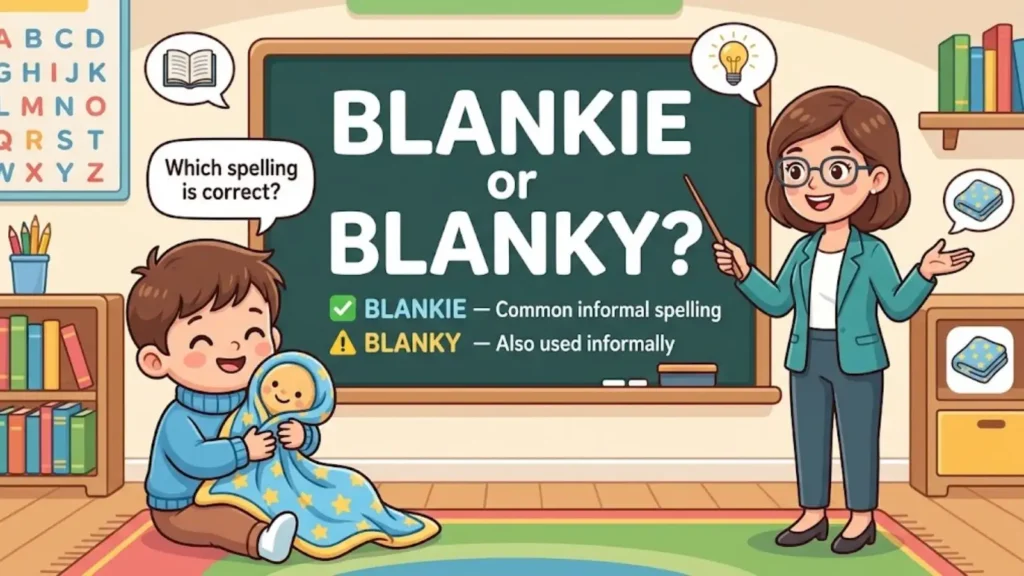
The short answer is simple: blankie is the safer and more widely recognized choice in American English, especially when you mean a child’s comfort blanket. However, blanky is also used and appears as a recognized informal or baby-talk form in some dictionaries. Cambridge lists blankie as an informal noun, mainly US, and Wiktionary records blanky as an alternative form.
In this guide, you’ll learn the meaning, spelling, pronunciation, origin, usage, differences, examples, and common mistakes involving blankie or blanky.
See also: Hierarchical vs Hierarchal: Which Word Should You Use?
Table of Contents
- What Does Blankie or Blanky Mean?
- Background and Origin of Blankie
- Contexts Where Blankie or Blanky Is Used
- Usage Across Different Platforms
- Common Misconceptions About Blankie or Blanky
- Common Mistakes When Using Blankie or Blanky
- Similar Words and Alternatives
- How to Use Blankie or Blanky in a Sentence
- Blankie or Blanky in Different Languages and Cultures
- Difference Between Blankie, Blanky, and Blanket
- Blankie or Blanky in Online Conversations
- Popularity and Usage Over Time
- Trusted References
- Frequently Asked Questions
- Conclusion
What Does Blankie or Blanky Mean?
Blankie is an informal word for a blanket, especially a small blanket that a young child uses for comfort, security, or emotional reassurance.
Blanky can carry essentially the same meaning. Collins, for example, defines blanky as baby talk for a comfort blanket, while Wiktionary lists it as an alternative form of blankie.
There is no major difference in meaning when both words refer to a child’s comfort blanket.
| Word | Meaning | Usage |
|---|---|---|
| Blankie | A child’s comfort blanket | Informal, mainly US |
| Blanky | A comfort blanket | Informal, baby talk or variant |
| Blanket | A covering used for warmth | Standard English |
| Comfort blanket | An object that provides comfort | Neutral |
Example
Mom: “Did you pack your blankie?”
Child: “Yep! I can’t sleep without it.”
Here, blankie sounds warm, affectionate, and child-friendly.
Cambridge gives blankie the pronunciation /ˈblæŋ.ki/ and describes it as a blanket, especially one a young child uses to feel safe and happy.
Background and Origin of Blankie
The word blankie comes from the ordinary English word blanket.
It developed as an affectionate, informal form of blanket, using the -ie ending. Wiktionary specifically gives its etymology as blanket + -ie.
This type of word formation appears often in casual English. Speakers sometimes change familiar words to make them sound softer, smaller, or more affectionate.
For example:
- dog → doggie
- cat → kitty
- sweet → sweetie
- blanket → blankie
Merriam-Webster records the first known use of blankie as 1899, showing that the word has been around much longer than modern internet slang.
What About Blanky?
Blanky follows a similar pattern. Instead of -ie, it uses -y to create an affectionate form.
Wiktionary records blanky as an alternative form of blankie, while Collins lists it as baby talk meaning a comfort blanket.
So, neither word came from TikTok, Reddit, or gaming culture. They are older informal English forms.
Contexts Where Blankie or Blanky Is Commonly Used
Unlike internet acronyms, blankie or blanky is not mainly social-media slang. People usually use these words in family conversations, children’s speech, stories, and casual writing.
In Family Conversations
Parents often use blankie when talking to young children.
Example:
“Where’s your blankie? It’s almost bedtime.”
The word feels softer than the neutral word blanket.
Between Friends
Adults may use blankie jokingly when talking about a favorite blanket.
Example:
“I’m staying home tonight with my snacks and my blankie.”
That usage adds humor and a cozy feeling.
Online Gaming
You may occasionally see blankie or blanky in gaming chats, but it isn’t a standard gaming abbreviation.
Someone might jokingly say:
“I’m grabbing my blankie before this horror game.”
The humor comes from treating the blanket as a comfort object.
Social Media
On TikTok, Instagram, Reddit, or X, people may use blankie when discussing childhood memories, cozy lifestyles, pets, or bedtime routines.
Example:
“My cat stole my blankie again.”
That sounds casual and playful.
Dating Apps
The word can also appear in playful conversations.
Example:
“Movie night, snacks, and a blankie? Sounds perfect.”
Here, blankie creates a cozy rather than formal tone.
Usage Across Different Platforms
| Platform | Example | Notes |
|---|---|---|
| “Where’s your blankie?” | Casual family chat | |
| Messenger | “I need my blankie tonight 😂” | Playful |
| Discord | “Time for my blankie and horror games.” | Humorous |
| TikTok | “POV: You still have your childhood blankie.” | Nostalgic |
| “Cozy night with my blankie.” | Casual | |
| Twitter/X | “My blankie has officially become my personality.” | Humorous |
| Snapchat | “Don’t forget your blankie!” | Friendly |
| Slack | “I need coffee and my blankie.” | Joking; not professional wording |
| Teams | “I need my blankie after this meeting.” | Informal humor |
The important point is that blankie isn’t an internet acronym. Its meaning stays closely connected to a blanket or comfort object.
Common Misconceptions About Blankie or Blanky
Misconception 1: Blanky Is Always Wrong
Not necessarily.
Blanky is used as an informal comfort-blanket term, and Collins recognizes it as baby talk. Wiktionary also lists it as an alternative form of blankie.
Misconception 2: Blankie Means Any Blanket
Technically, blankie can refer to a blanket, but the word often carries a stronger association with children, comfort, and security.
Misconception 3: Blankie Is Internet Slang
No. The word existed long before TikTok, Instagram, and modern texting culture.
Misconception 4: Blankie Is a Formal Word
It isn’t. Cambridge labels blankie as informal and mainly US.
Common Mistakes When Using Blankie or Blanky
Avoid these common problems:
1. Using blankie in formal writing
For professional or academic writing, choose blanket or comfort blanket.
2. Assuming blanky is automatically a spelling mistake
Context matters. Some dictionaries recognize blanky as an informal form.
3. Treating blankie and blanket as completely interchangeable
They can refer to the same physical object, but their tone differs.
4. Assuming only babies can use the word
Adults can use blankie humorously or affectionately.
5. Overthinking the spelling
If you need the safest informal choice for American readers, blankie is usually the better option.
Similar Words and Alternatives
| Word | Meaning | When to Use It |
|---|---|---|
| Blankie | Child’s comfort blanket | Informal |
| Blanky | Comfort blanket | Baby talk or informal use |
| Blanket | General covering | Standard English |
| Comfort blanket | Blanket used for comfort | Neutral |
| Security blanket | Object providing emotional comfort | More descriptive |
| Throw | Small decorative blanket | Home decor |
The best alternative depends on the context.
For example, a child might ask for a blankie, while a home-decor article might discuss a throw.
How to Use Blankie or Blanky in a Sentence
Here are some natural examples:
- “She won’t sleep without her blankie.”
- “Where did you put the baby’s blankie?”
- “He carried his blanky everywhere.”
- “My childhood blankie is still in my closet.”
- “The toddler hugged her blankie during the storm.”
- “I need my blankie and a cup of hot chocolate.”
- “Don’t forget your blanky before bedtime.”
Which One Sounds More Natural?
For a broad American English audience, blankie usually sounds like the safer choice.
For example:
“The baby grabbed her blankie.”
sounds completely natural.
Blankie or Blanky in Different Languages and Cultures
The exact word changes across languages, but the idea of a comfort blanket is widely understood.
| Language | Common idea |
|---|---|
| Spanish | Manta or mantita |
| Arabic | بطانية / blanket-related forms vary by dialect |
| Hindi | कंबल (kambal) |
| Urdu | کمبل (kambal) |
| Tagalog | Kumot |
| Tamil | போர்வை |
| Malayalam | പുതപ്പ് |
| Marathi | कांबळे |
Unlike internet acronyms, blankie isn’t normally translated as an English slang abbreviation. Speakers generally use the ordinary word for blanket in their language, sometimes with an affectionate diminutive.
Difference Between Blankie, Blanky, and Blanket
The easiest way to remember the difference is tone.
| Feature | Blankie | Blanky | Blanket |
|---|---|---|---|
| Meaning | Comfort blanket | Comfort blanket | General blanket |
| Tone | Affectionate | Childlike | Neutral |
| Formal? | No | No | Yes |
| Child-focused | Often | Often | Not necessarily |
| American usage | Common | Less standard | Very common |
| Best default | Yes | Acceptable | Yes for formal writing |
So, if you’re writing a children’s story, blankie works beautifully.
If you’re writing a formal report, use blanket.
Blankie or Blanky in Online Conversations and Social Media
People may use blankie online when talking about:
- Childhood memories
- Cozy nights
- Parenting
- Babies and toddlers
- Pets
- Sleep routines
- Nostalgia
- Comfort objects
- Funny personal habits
For example:
“My dog stole my blankie, so apparently I don’t own blankets anymore.”
That sentence uses blankie for humor.
On social media, the word often creates a warm, cozy, nostalgic feeling rather than a technical meaning.
Popularity and Usage Over Time
Unlike modern slang terms, blankie has a long history.
| Period | General usage |
|---|---|
| Late 1800s | Informal affectionate use develops |
| 1900s | Used in family and children’s language |
| 2000s | Appears in books, media, and everyday speech |
| 2010s | Common in parenting and online discussions |
| 2020s | Continues in casual, nostalgic, and social-media language |
The important takeaway is that blankie is not a newly invented internet word. Dictionary evidence connects it to older informal English. Merriam-Webster records its first known use as 1899.
Trusted References
For reliable definitions and word history, useful sources include:
- Cambridge Dictionary — defines blankie and identifies its informal US usage.
- Merriam-Webster — useful for word history and dictionary definitions.
- Collins Dictionary — recognizes blanky as baby talk for a comfort blanket.
- Wiktionary: blankie — records blankie and its alternative forms.
- Wiktionary: blanky — records blanky as an alternative form of blankie.
Frequently Asked Questions
Is blankie or blanky correct?
Blankie is the safer default spelling, especially in American English. However, blanky is also used as an informal term for a comfort blanket and appears in dictionary sources.
Learn More: Gumba vs Goomba: Which Spelling Is Correct and When Should You Use It?
Is blanky a real word?
Yes. Blanky is used as an informal or baby-talk word for a comfort blanket. Collins lists it with that meaning.
What does blankie mean?
Blankie means a blanket, especially a small blanket that a child uses for comfort or security. Cambridge labels it informal and mainly US.
Is blankie a formal word?
No. Blankie is informal. In formal writing, use blanket or comfort blanket instead.
What is the plural of blankie?
The plural of blankie is blankies.
Example:
“The children brought their blankies on the trip.”
How do you pronounce blankie?
Cambridge gives the pronunciation /ˈblæŋ.ki/.
Is blanky a misspelling of blankie?
Not necessarily. Although blankie is the safer default, blanky has recognized informal usage.
Is blankie the same as blanket?
They have closely related meanings, but the tone differs. Blanket is the standard neutral word, while blankie sounds informal, affectionate, and often child-focused.
Is blanky the same as blankie?
When both refer to a comfort blanket, they have essentially the same meaning. The main difference is spelling and usage preference.
Can adults use the word blankie?
Absolutely. Adults may use blankie affectionately, jokingly, or when discussing a childhood comfort object.
Conclusion
So, blankie or blanky?
The easiest answer is: choose blankie as your default informal spelling.
Blankie means a blanket, especially a small or favorite blanket that a child uses for comfort. Cambridge recognizes it as an informal word, mainly in US English.
Blanky isn’t simply nonsense, either. It can refer to the same kind of comfort blanket and appears in dictionary sources as an informal or baby-talk form.
Remember this simple rule:
Blankie = safest informal choice
Blanky = recognized informal variant
Blanket = standard neutral choice
So if your sentence involves a toddler hugging a beloved blanket like it’s the last treasure on Earth, blankie is probably the word you’re looking for.

Hi, I’m William Parker, the creator behind Wordspry.com
I enjoy breaking down complex grammar rules into clear and practical lessons that help learners write and speak English more effectively.