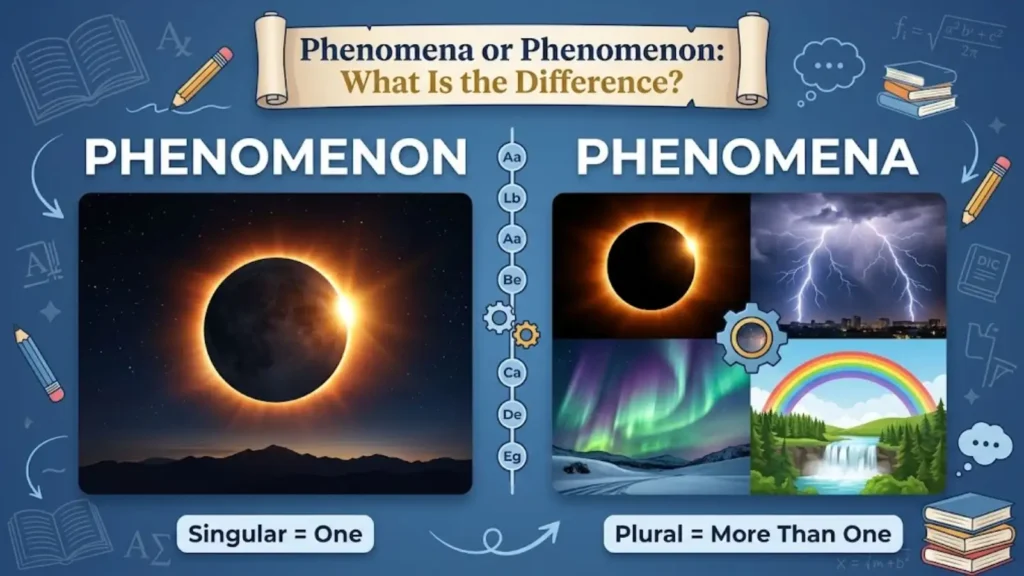
Have you ever wondered whether to write phenomena or phenomenon? These two words are closely related, so it is easy to confuse them. However, they are not interchangeable because they have different grammatical roles. The main difference is simple: phenomenon is singular, while phenomena is plural.
If you are describing one unusual event, fact, or occurrence, use phenomenon. When you are talking about two or more such events or occurrences, use phenomena. Understanding this difference can make your writing more accurate and professional.
This guide explains phenomena vs. phenomenon in simple English. You will learn their meanings, origins, correct usage, examples, common mistakes, synonyms, antonyms, and everyday applications.
RELATED: No Cuts No Buts No Coconuts: Meaning, Origin and Examples
Phenomena or Phenomenon: Quick Answer
Phenomenon is the singular form of the word. It refers to one event, fact, situation, or occurrence that can be observed or studied.
Phenomena is the plural form. It refers to two or more events, facts, situations, or occurrences.
Examples:
- ✅ A solar eclipse is a fascinating phenomenon.
- ✅ Natural phenomena can be difficult to predict.
- ❌ A solar eclipse is a fascinating phenomena.
- ❌ Several natural phenomenon occur every year.
The easiest rule to remember is:
One = phenomenon
More than one = phenomena
What Does Phenomenon Mean?
The noun phenomenon refers to something that can be observed, experienced, or studied. It can describe a natural event, social development, unusual occurrence, or noticeable fact.
Example:
A rainbow is a natural phenomenon.
Here, phenomenon refers to one observable event or occurrence.
The word is commonly used in science, education, psychology, technology, and everyday discussions. It does not necessarily mean something strange or mysterious.
For example:
Climate change is a complex global phenomenon.
In this sentence, phenomenon describes a broad and observable development.
See also:
What Does Phenomena Mean?
Phenomena is the plural form of phenomenon. It refers to multiple observable events, occurrences, or developments.
For example:
Scientists study different natural phenomena.
Because the sentence discusses multiple events, phenomena is correct.
Other examples include:
- Weather phenomena can affect travel.
- Social phenomena often change over time.
- Scientists investigate unusual phenomena.
- These phenomena occur in different regions.
Therefore, if you can replace the word with events, occurrences, or developments, and you mean more than one, phenomena may be the appropriate choice.
Phenomenon vs. Phenomena: Main Difference
The key difference is number.
| Word | Number | Meaning | Example |
|---|---|---|---|
| Phenomenon | Singular | One observable event or occurrence | A tornado is a natural phenomenon. |
| Phenomena | Plural | Two or more observable events or occurrences | Tornadoes are natural phenomena. |
This distinction is similar to other singular and plural forms borrowed from Greek.
Example:
Phenomenon → Phenomena
The spelling changes because the word comes from Greek.
The Origin of Phenomenon and Phenomena
Both phenomenon and phenomena come from Greek. The Greek word phainomenon referred to something that appears or becomes visible.
The singular English form developed as phenomenon, while the Greek plural form became phenomena.
Because English adopted many words from Greek and Latin, some words retain traditional plural forms instead of simply adding -s.
Example:
- phenomenon → phenomena
- criterion → criteria
- bacterium → bacteria
- datum → data
These forms can seem unusual at first. However, they become easier to remember with regular practice.
When Should You Use Phenomenon?
Use phenomenon when you are talking about one event, occurrence, or observable fact.
Examples:
- A solar eclipse is a rare phenomenon.
- The northern lights are a beautiful natural phenomenon.
- This psychological effect is an interesting phenomenon.
- The rapid growth of online shopping is a modern phenomenon.
- Scientists are studying this unusual phenomenon.
Notice that each sentence focuses on one event, development, or concept.
When Should You Use Phenomena?
Use phenomena when you are talking about multiple events, occurrences, or developments.
Examples:
- Scientists study various natural phenomena.
- Weather phenomena can be difficult to predict.
- Researchers observed several unusual phenomena.
- Social phenomena can influence communities.
- Space contains many fascinating phenomena.
Here, the plural form is necessary because the sentences refer to more than one occurrence.
Common Mistakes
Many writers make mistakes because phenomena looks like a singular word. However, it is plural.
Mistake 1: Using Phenomena for One Event
❌ A rainbow is a natural phenomena.
✅ A rainbow is a natural phenomenon.
The sentence describes one observable event, so phenomenon is correct.
Mistake 2: Using Phenomenon for Multiple Events
❌ Scientists study several natural phenomenon.
✅ Scientists study several natural phenomena.
The word several clearly indicates more than one, so the plural form is required.
Mistake 3: Adding “-s” to Phenomenon
❌ The researchers studied many phenomenons.
✅ The researchers studied many phenomena.
Although “phenomenons” may appear in informal writing, phenomena is the standard plural form.
How to Remember the Difference
A simple memory trick can help.
Think:
Phenomenon = one
Phenomena = many
You can also look at the endings:
- -on → singular
- -a → plural
For example:
One phenomenon
Two phenomena
This pattern is especially useful when writing academic, scientific, or educational content.
Phenomena or Phenomenon in Everyday English
Although these words are common in academic writing, they also appear in everyday English.
Examples With Phenomenon
The popularity of this app is a cultural phenomenon.
A rainbow is an impressive natural phenomenon.
Viral videos have become a modern phenomenon.
Examples With Phenomena
Scientists regularly observe unusual weather phenomena.
Social media has created new cultural phenomena.
These natural phenomena attract visitors from around the world.
The correct form depends entirely on whether you mean one or multiple occurrences.
Synonyms of Phenomenon
The best synonym depends on the context.
Common synonyms include:
- event
- occurrence
- incident
- development
- situation
- experience
- fact
- effect
- process
For example:
A solar eclipse is a natural phenomenon.
You could describe it as a natural event, although phenomenon may sound more scientific.
In another context:
The rise of artificial intelligence is a social phenomenon.
Possible alternatives include development or trend, depending on the exact meaning.
Antonyms of Phenomenon
There is no single perfect antonym for phenomenon because its meaning changes according to context.
However, possible contrasting ideas include:
- non-event
- absence
- invisibility
- nothingness
- nonoccurrence
These are not direct opposites in every sentence. Therefore, choose an alternative based on the meaning you want to express.
Phenomenon in Science
The word phenomenon is especially common in science because scientists study things that can be observed, measured, or explained.
Examples include:
- earthquakes
- eclipses
- gravity
- photosynthesis
- magnetic effects
- volcanic eruptions
- weather patterns
For example:
An earthquake is a geological phenomenon.
When discussing several types of events, use the plural:
Scientists study geological phenomena around the world.
Phenomena in Academic Writing
Phenomena is frequently used in academic and research writing. It allows writers to discuss multiple events, behaviors, or developments.
For example:
Researchers examined social phenomena affecting young adults.
Here, phenomena refers to multiple social events or behaviors.
Academic writers should still make sure that the surrounding sentence clearly supports the plural form.
Comparison With Similar Words
English contains several words with traditional Greek or Latin plurals.
| Singular | Plural |
|---|---|
| phenomenon | phenomena |
| criterion | criteria |
| bacterium | bacteria |
| medium | media |
| datum | data |
These words can be confusing because their plural forms do not follow the most common English pattern of adding -s or -es.
Learning them as pairs can make your writing much easier.
Which Spelling Should You Use?
Use phenomenon when referring to one event, occurrence, fact, or observable development.
Use phenomena when referring to two or more such events or occurrences.
For example:
This is an unusual phenomenon.
But:
These are unusual phenomena.
The choice is not based on British or American spelling. Both forms are standard in English, and the difference is mainly grammatical.
Frequently Asked Questions
Q1.Is phenomena singular or plural?
Phenomena is plural. Its singular form is phenomenon.
Q2.What is the singular of phenomena?
The singular form of phenomena is phenomenon.
Q3.What is the plural of phenomenon?
The standard plural is phenomena.
Q4.Can I say “a phenomena”?
No. Use “a phenomenon” because the article “a” refers to one thing.
Q5.Can I say “many phenomenon”?
No. Use “many phenomena” because “many” refers to more than one.
Q6.Is “phenomenons” correct?
In standard English, phenomena is the preferred plural form of phenomenon.
Q7.What is an example of a phenomenon?
A solar eclipse is an example of a natural phenomenon because it is an observable event.
Q8.What is an example of phenomena?
Eclipses, earthquakes, and volcanic eruptions are examples of natural phenomena.
Conclusion
The difference between phenomena and phenomenon is simple once you understand their grammatical numbers. Phenomenon is the singular form, while phenomena is the plural form.
Use phenomenon when discussing one event, occurrence, development, or observable fact. Use phenomena when discussing two or more.
For example, you can say, “A solar eclipse is a natural phenomenon.” However, if you are discussing several observable events, say, “Scientists study different natural phenomena.”
Remember the basic rule: one phenomenon, many phenomena. This simple pattern will help you avoid common grammar mistakes and improve your academic, professional, and everyday English writing.

Hi, I’m Mason Clark, the writer behind Wordspry!
My goal is to make grammar learning easier with straightforward explanations, useful examples, and engaging English lessons that help you grow every day.