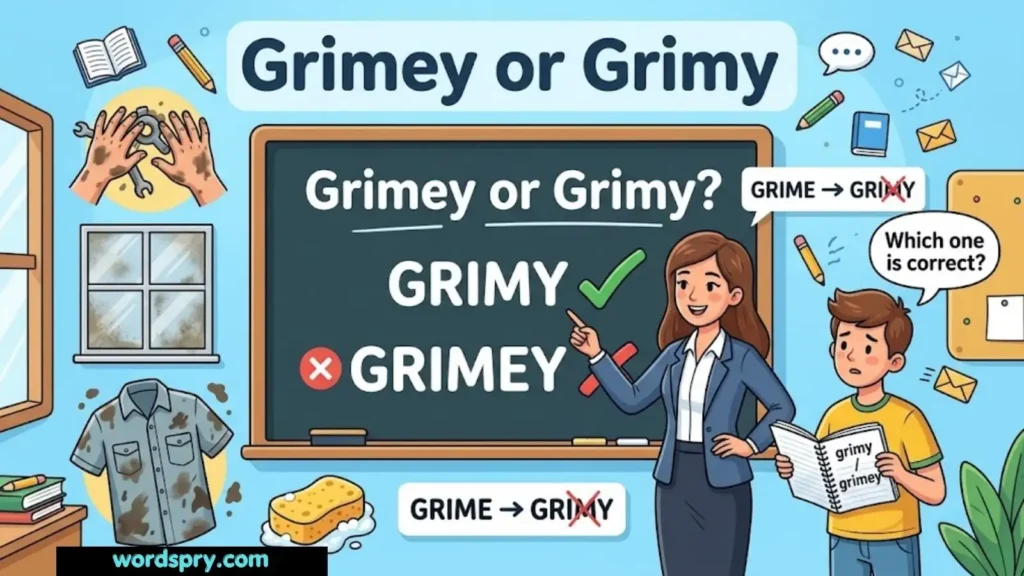
Grimy is the standard and preferred spelling when you mean dirty, covered with grime, or marked by built-up dirt. Grimey does appear occasionally as an alternative or informal spelling, but grimy is the safer choice for standard English.
The confusion is easy to understand. The noun grime ends in an e, so many writers naturally assume that adding -y should produce grimey. However, English spelling does not always work that neatly. The established adjective is grimy, pronounced “GRY-mee.” Cambridge and Collins both define grimy as meaning dirty or covered with grime.
Imagine a mechanic finishing work on an old car. His hands are covered with oil and dirt. You would naturally say, “His hands are grimy.” Writing “grimey” would look unusual in formal English.
Knowing the difference matters because spelling affects clarity and credibility. Whether you are writing a school assignment, work email, blog post, or everyday message, choosing grimy keeps your writing polished and standard.
Core Meaning and Spelling Clarity
Here is the simple answer: grimy is the standard spelling.
The word is an adjective formed from grime, meaning dirt or filth that has collected on a surface. Dictionaries define grimy as dirty or covered with grime.
What does “grimy” mean?
Grimy describes something that has noticeable dirt, grease, soot, or accumulated filth on it.
For example:
- The kitchen floor was grimy.
- His hands became grimy after fixing the engine.
- The old windows looked grimy.
- The children came home with grimy faces.
- The subway station had a grimy appearance.
The word often suggests built-up dirt, rather than one small mark or stain.
A clean shirt with one tiny spot is simply stained. A shirt covered in old dirt and grease may be described as grimy.
Grimy vs. grime
The connection becomes easier when you separate the two words:
| Word | Part of speech | Meaning |
|---|---|---|
| grime | Noun | Dirt or filth that collects on something |
| grimy | Adjective | Covered with or full of grime |
| griminess | Noun | The quality or condition of being grimy |
| grimily | Adverb | In a grimy manner |
The adjective grimy comes from grime + -y. Its history goes back to the early 1600s.
Why Do People Get Confused?
The spelling mistake has a very understandable cause.
Look at the noun:
grime
Now add the adjective ending:
grime + y
It seems logical to write:
grimey
But standard English uses:
grimy
That small missing e causes a surprising amount of confusion.
The pronunciation makes it trickier
Both grimy and grimey, when pronounced naturally, can sound like “GRY-mee.”
Cambridge gives the pronunciation as approximately /ˈɡraɪ.mi/ in both British and American English.
So, when someone hears the word, they cannot easily determine its spelling.
This is similar to other English words where pronunciation does not provide a perfect spelling guide.
The original word creates a spelling trap
People see grime and mentally carry the final e into the adjective.
It happens quickly:
grime → grimey
However, the standard form drops the final e:
grime → grimy
This is why the spelling can feel strange even to experienced English learners.
Real-Life Meaning Explained
A dictionary definition is useful, but everyday examples make grimy much easier to understand.
Think about places or objects that collect dirt over time.
Grimy hands
Someone repairing a bicycle may finish with grimy hands.
The hands are not merely dusty. They may have grease, oil, soil, and dark residue covering them.
Example:
After changing the tire, Jake had grimy hands.
A grimy window
A window can become grimy when dust, pollution, fingerprints, and moisture build up.
Example:
The shop owner cleaned the grimy windows before opening.
A grimy kitchen
A kitchen may look grimy when grease and dirt have accumulated around the stove, counters, or walls.
Example:
We spent Saturday cleaning the grimy kitchen.
A grimy street
The word can also describe a place or environment.
Example:
The movie showed a grimy alley behind the nightclub.
Here, grimy creates a stronger visual impression than simply saying dirty.
Grimy vs. Grimey: Side-by-Side Comparison
The quickest way to remember the difference is to compare the two forms directly.
| Feature | Grimy | Grimey |
|---|---|---|
| Standard spelling | ✅ Yes | ⚠️ Not the usual standard form |
| Meaning “covered with grime” | ✅ Yes | ✅ Can appear as a variant |
| Common in dictionaries | ✅ Yes | Less common |
| Formal writing | ✅ Recommended | ❌ Avoid |
| Academic writing | ✅ Recommended | ❌ Avoid |
| Professional writing | ✅ Recommended | ❌ Avoid |
| Informal usage | ✅ Yes | Sometimes |
| Pronunciation | “GRY-mee” | Usually “GRY-mee” |
| Best choice | Use this | Usually avoid |
The important point is that grimey is not simply meaningless. Wiktionary records it as an alternative spelling of grimy.
Therefore, the most accurate explanation is not “grimey never exists.”
Instead:
Grimy is the established standard spelling. Grimey may occur as an alternative or informal spelling.
That distinction is useful when explaining the word accurately.
Common Mistakes With Grimy
Even simple adjectives can create spelling problems when their base words look different.
Mistake 1: Adding the “e”
Incorrect for standard English:
The mechanic had grimey hands.
Correct:
The mechanic had grimy hands.
Mistake 2: Assuming the spelling follows the noun
A writer may reason:
shine → shiny
grime → grimey
But English spelling is not always perfectly predictable.
The established adjective is grimy, not grimey.
Mistake 3: Treating grimey as the preferred formal spelling
You might encounter grimey online or in informal writing. However, that does not make it the best choice for every situation.
If you are writing a school paper, resume, business email, article, or formal report, choose grimy.
Mistake 4: Using “grimy” when you mean “messy”
The two ideas overlap, but they are not identical.
Messy usually means disorganized or untidy.
Grimy focuses more strongly on dirt or accumulated filth.
Compare:
My bedroom is messy.
The room may contain books, clothes, and papers everywhere.
But:
My bedroom floor is grimy.
This suggests actual dirt has built up on the floor.
Grimy vs. Dirty: What Is the Difference?
This is another useful distinction.
Dirty is a broad word. It can describe almost anything that is not clean.
Grimy is more specific and visual.
Think of it this way:
Dirty = not clean.
Grimy = dirty with noticeable, often built-up grime.
For example:
My shoes are dirty.
This could mean they have some mud on them.
But:
My shoes are grimy.
This suggests a more stubborn layer of dirt.
Cambridge lists dirty, filthy, grubby, grungy, mucky, soiled, and other related words alongside grimy.
Memory Tricks
A good memory trick can save you from making the same spelling mistake again.
Trick 1: Drop the E
Remember:
grime → grimy
The e disappears before -y.
You can write it as:
GRIME − E + Y = GRIMY
That simple pattern is easy to remember.
Trick 2: Think “grime is messy, grimy is descriptive”
The noun is:
grime
The adjective is:
grimy
If you are describing something covered in grime, remember the shorter form.
Trick 3: “Grimy” looks like “dirty”
Both words are short adjectives that end naturally without the extra e.
When you need the adjective, picture:
dirty → grimy
Not:
dirty → grimey
Professional Writing Importance
Spelling may seem like a small detail, but small details can shape how readers judge writing.
Imagine two sentences in a business report:
The factory equipment was grimey and poorly maintained.
The factory equipment was grimy and poorly maintained.
The second sentence looks more polished because grimy is the established standard form.
This matters particularly in:
- School assignments
- College essays
- Business reports
- Professional emails
- Resumes
- Blog articles
- Website content
- Formal documents
- Editing and proofreading
Informal spelling can sometimes be intentional. However, professional writing usually benefits from standard vocabulary and spelling.
Practical Examples
Seeing the word in different situations makes its meaning easier to remember.
Example 1: Mechanic
After working beneath the truck, the mechanic’s hands were grimy.
The word works because grease and dirt have accumulated on his hands.
Example 2: Child
The little boy returned from playing outside with a grimy face.
Here, the face has become visibly dirty.
Example 3: Window
Sunlight could barely pass through the grimy window.
The adjective suggests dirt has built up on the glass.
Example 4: Kitchen
The restaurant owner replaced the old, grimy kitchen tiles.
The tiles have accumulated dirt and grease.
Example 5: Workplace
The workers cleaned the grimy machinery before the inspection.
The machinery had visible dirt or residue.
Example 6: Informal writing
You may sometimes see:
That alley looked really grimey.
Although this form occurs, grimy remains the safer standard choice.
Mini Case Study: Which Word Should You Choose?
Imagine you are writing a school essay about city pollution.
You want to describe an old building covered in dirt.
You have two options:
The building had a grimey exterior.
or:
The building had a grimy exterior.
For standard academic writing, choose the second sentence.
Why?
Because grimy is the established standard spelling for the adjective meaning dirty or covered with grime.
Now imagine you are writing dialogue for a fictional character.
The character might deliberately use informal or unconventional spelling.
In that creative situation, grimey could appear as a stylistic choice. Context matters.
Quick Fix Guide
When you are unsure, use this simple checklist.
Need an adjective meaning dirty?
→ Choose grimy.
Writing a school assignment?
→ Choose grimy.
Writing a professional email?
→ Choose grimy.
Writing a blog or article?
→ Choose grimy.
Writing formal academic content?
→ Choose grimy.
Saw “grimey” online?
→ It may be an informal or alternative spelling, but do not assume it is the preferred standard form.
Quick correction
❌ grimey
✅ grimy
Sentence correction
❌ The mechanic’s clothes were grimey after work.
✅ The mechanic’s clothes were grimy after work.
❌ The old windows looked grimey.
✅ The old windows looked grimy.
❌ Her hands became grimey while gardening.
✅ Her hands became grimy while gardening.
Pronunciation of Grimy
The word grimy is pronounced approximately:
GRY-mee
Its pronunciation is the same in standard British and American English, although individual accents naturally vary. Cambridge lists the pronunciation as /ˈɡraɪ.mi/.
Break it into two parts:
grime + y
Say:
GRY + mee
The pronunciation is one reason the spelling can cause trouble. When people hear “GRY-mee,” they may naturally imagine grimey.
However, remember:
Pronunciation: GRY-mee
Spelling: GRIMY
Word Origin and History
The word has an interesting history.
Grimy comes from grime + -y and dates to the early seventeenth century. Etymological sources trace grime to older Germanic and Middle English forms connected with dirt, soot, smearing, or rubbing.
The noun grime itself refers to dirt that collects on a surface. Collins also identifies grimy as a derived form of grime.
So the modern relationship is straightforward:
grime → grimy
The spelling has been established for centuries, which explains why grimy is the form preferred in standard English.
Grimy in Different Contexts
The word can describe more than someone’s hands or clothing.
Objects
a grimy phone screen
a grimy car seat
a grimy kitchen sink
Places
a grimy alley
a grimy subway station
a grimy industrial area
People
a grimy mechanic
a grimy child
grimy workers after a long shift
Surfaces
a grimy wall
a grimy floor
a grimy window
In each case, the basic idea remains the same: visible or accumulated dirt.
FAQs About Grimey or Grimy
1. Is “grimy” or “grimey” correct?
Grimy is the standard spelling. It means dirty or covered with grime. Grimey can appear as an alternative or informal spelling, but grimy is the better choice for standard English.
2. Is “grimey” a real word?
Grimey does appear in English as an alternative spelling of grimy. However, it is not the usual standard spelling. For formal and professional writing, use grimy.
3. What does grimy mean?
Grimy means dirty, especially when dirt, grease, soot, or other residue has accumulated on something. For example, “The mechanic washed his grimy hands.”
4. Why do people spell grimy as grimey?
People often spell it grimey because the noun grime ends in an e. The pronunciation also sounds like “grime-y,” which makes the extra letter seem logical. However, the standard spelling is grimy.
5. How do you pronounce grimy?
Grimy is pronounced approximately GRY-mee. Cambridge lists it as /ˈɡraɪ.mi/ in both British and American English.
6. What is the difference between grimy and dirty?
Dirty is a general word for something that is not clean. Grimy is more specific and often suggests accumulated, greasy, dusty, or ingrained dirt.
For example, a shirt can be dirty because of one stain, while a work shirt covered in old grease may look grimy.
7. Is grimy appropriate for formal writing?
Yes. Grimy is appropriate in standard, academic, professional, and everyday English. If you are unsure between grimy and grimey, choose grimy for formal writing.
Conclusion
When choosing between grimey or grimy, remember one simple rule: grimy is the standard spelling.
The word describes something that is dirty or covered with accumulated grime. You can describe grimy hands, grimy windows, grimy floors, grimy clothes, or a grimy street.
The confusion happens because the noun grime contains an e, and the pronunciation sounds like “grime-y.” Nevertheless, standard English uses grimy, without the extra e. Dictionaries such as Cambridge and Collins recognize grimy as the standard adjective.
You may still encounter grimey, especially in informal or alternative usage. It is therefore useful to recognize the spelling rather than assume every appearance is a simple typo. Still, when your goal is clear, polished English, grimy is the safest choice.
So the next time you hesitate, remember:
Grime → Grimy
Not:
Grime → Grimey
That small spelling choice can make your writing look cleaner, more confident, and more professional.
Internal linking suggestion: If you found this guide helpful, you might also enjoy our article on Dirty vs. Grimy: What Is the Difference?

Hi, I’m Victoria Lane, the voice behind Wordspry!
I’m passionate about helping students and readers master English grammar, vocabulary, and writing through simple, friendly, and easy-to-follow content.