Have you ever paused while writing a sentence like, “She was ___ the new painting”? You may wonder whether the correct spelling is eying or eyeing. Both forms look almost identical, but the extra e can make the choice feel surprisingly tricky.
So, is eying wrong? Is eyeing the only correct spelling? Or can you use both without worrying about a grammar mistake?
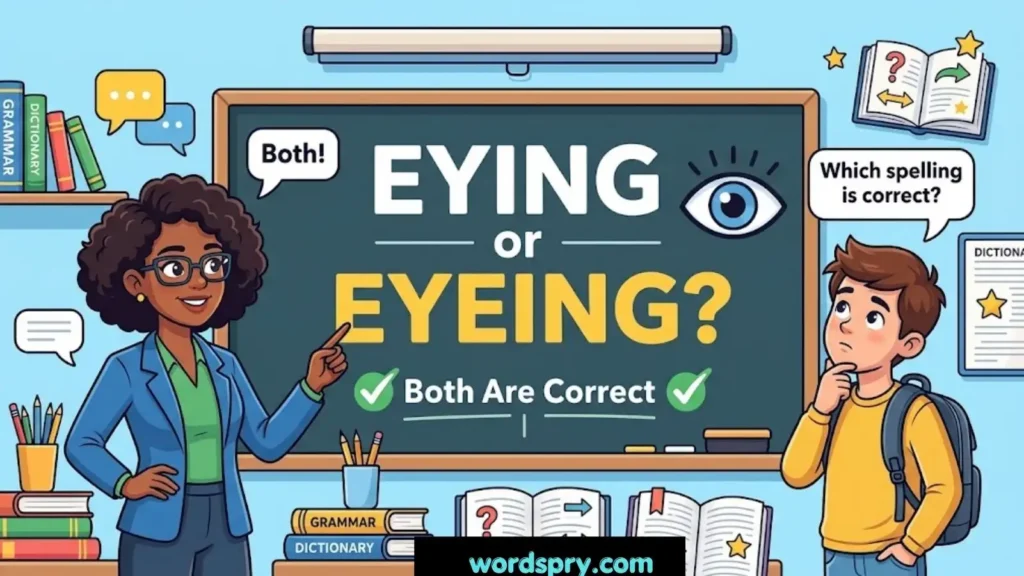
The good news is that both eying and eyeing are accepted spellings of the present participle of the verb eye. However, eyeing is generally the more familiar form, while eying is also recognized by major dictionaries. Merriam-Webster lists “eyeing or eying,” while Oxford lists both forms as the -ing form of eye.
In this guide, you will learn the difference between eying and eyeing, their meanings, pronunciation, usage, examples, common mistakes, and which spelling works best in modern American English.
RELATED: Hierarchical vs Hierarchal: Which Word Should You Use?
Quick Answer
Eying and eyeing are both correct spellings. They are forms of the verb eye, meaning to look at, watch, observe, study, or consider something carefully. Eyeing is the more familiar spelling, while eying is also accepted, especially in American English.
Table of Contents
- Meaning at a Glance
- What Does Eying or Eyeing Mean?
- Why Do People Search for Eying or Eyeing?
- The Deeper Meaning of Eying or Eyeing
- Background and Origin
- Contexts Where Eying or Eyeing Is Used
- Usage Across Different Platforms
- Examples in Everyday Life
- When Should You Use Eying or Eyeing?
- When Should You Avoid Using It?
- Common Misconceptions
- Common Mistakes
- Similar Words and Alternatives
- How to Use Eying or Eyeing in a Sentence
- Eying or Eyeing in Different Languages and Cultures
- Eying or Eyeing in Online Conversations
- Popularity and Trends Over Time
- Featured Snippet Summary
- Trusted References
- Frequently Asked Questions
- Conclusion
Meaning at a Glance
| Aspect | Explanation |
|---|---|
| Literal Meaning | Looking at, watching, or observing something carefully |
| Symbolic Meaning | Paying attention to something that attracts interest |
| Emotional Meaning | Showing curiosity, desire, suspicion, admiration, or interest |
| Common Usage | Describing someone watching, considering, or wanting something |
| Tone | Neutral, curious, suspicious, admiring, or informal depending on context |
| Related Topics | Looking, watching, observing, considering, attention, interest |
What Does Eying or Eyeing Mean?
Eying and eyeing are present participles of the verb eye.
The verb eye means to look at someone or something carefully. It can also mean to watch something closely or consider a possibility. Merriam-Webster defines eye as fixing the eyes on something, contemplating it, or watching and studying it closely.
For example:
Maria was eyeing the chocolate cake on the table.
This sentence suggests that Maria was looking at the cake with interest. Perhaps she wanted a slice. Perhaps she was simply deciding whether to eat it.
The word can also describe careful observation:
The manager was eyeing the changing sales numbers.
Here, eyeing means watching or studying the numbers.
So, eying and eyeing have the same meaning. The difference lies in spelling rather than definition.
Eyeing vs. Eying
| Spelling | Correct? | Meaning | Usage |
|---|---|---|---|
| eyeing | Yes | Looking at or considering carefully | Very common |
| eying | Yes | Looking at or considering carefully | Accepted variant |
Cambridge lists eying as the present participle of eye and notes the US usage. Cambridge also lists eyeing and identifies eying as an American variant.
Why Do People Search for Eying or Eyeing?
People often search for eying or eyeing because English spelling can become confusing when a word ends in e and receives an -ing ending.
Normally, English drops a final silent e before adding -ing:
- make → making
- write → writing
- hope → hoping
- use → using
That pattern may make eying look more logical.
However, English spelling does not always follow one simple rule. In the case of eye, dictionaries recognize both eyeing and eying.
People may encounter the word in:
- Social media posts
- News articles
- Business writing
- Art reviews
- Books
- Movies
- Sports coverage
- Marketing content
- Online discussions
- Everyday conversations
For example:
The company is eyeing a larger market.
Here, eyeing means considering or targeting the market.
The Deeper Meaning of Eying or Eyeing
Although the basic meaning involves looking, eyeing can communicate more than simple vision.
The surrounding context can suggest curiosity, desire, suspicion, admiration, or careful consideration.
Creativity
An artist may be eyeing a particular object before deciding how to include it in a painting.
Identity
A person might eye clothing, artwork, or symbols that reflect their personality.
Storytelling
Writers often use the word to show what a character notices without directly explaining the character’s thoughts.
Personal Growth
Someone may be eyeing a new opportunity because they are considering a change in their life.
Hidden Meanings
The word can hint at an unspoken intention.
For example:
He was eyeing the empty chair.
This could simply mean he was looking at it. However, the reader might infer that he wanted to sit there.
That small difference makes eyeing useful in visual storytelling.
Background & Origin
The word eye has a very old history. Merriam-Webster traces the noun eye to Middle English and Old English ēage, with related forms appearing in other Germanic and Indo-European languages. The verb eye dates to the 15th century in the sense of looking at something.
Oxford also traces eye to Old English ēage and notes its relationship to words in languages such as Dutch and German.
The spelling eyeing can look unusual because it preserves the original word eye while adding -ing. At the same time, eying follows the more familiar spelling pattern of removing the final e before adding -ing.
Modern dictionaries recognize both forms.
Therefore, this is not a case of one spelling being completely wrong. Instead, it is a case where English allows two accepted variants.
Contexts Where Eying or Eyeing Is Used
Art & Painting
Artists and viewers may use eyeing to describe close observation of artwork.
Visitors were eyeing the colorful abstract painting.
The word can suggest curiosity or admiration.
Photography
Photographers may describe someone eyeing a subject before taking a photograph.
The photographer was eyeing the perfect angle.
Here, the word suggests careful visual judgment.
Literature
Authors use eyeing to reveal a character’s thoughts or intentions.
She stood quietly, eyeing the locked door.
The sentence creates tension without explaining everything.
Movies & Documentaries
Scripts and narration can use the word to describe characters watching people, objects, or situations.
The detective kept eyeing the suspect.
The word immediately creates a sense of suspicion.
Personal Development
People can use eyeing when discussing future goals.
He is eyeing a promotion next year.
Here, the meaning shifts from literally looking to considering or pursuing something.
Business & Branding
Business writers frequently use eyeing when discussing future plans.
The company is eyeing international expansion.
Merriam-Webster specifically recognizes eye in the sense of contemplating or considering something.
Education
Teachers may use the word when describing observation.
The students were eyeing the science experiment with curiosity.
Social Media
Social media users may write:
Eyeing that new camera 👀
The phrase usually means wanting, considering, or showing interest in the camera.
Usage Across Different Platforms
| Platform | Typical Usage | Example |
|---|---|---|
| Showing interest in products or places | “Eyeing this outfit 👀” | |
| TikTok | Expressing desire or curiosity | “POV: You’re eyeing the last slice.” |
| Considering ideas or products | “Eyeing these bedroom designs.” | |
| Everyday observation | “I’ve been eyeing that restaurant.” | |
| Business opportunities | “The company is eyeing new markets.” | |
| YouTube | Reviews and commentary | “I’m eyeing this new camera.” |
| Blogs | Describing attention or plans | “The brand is eyeing international growth.” |
Examples in Everyday Life
The word appears naturally in many situations.
Daily Conversation
I’m eyeing that jacket in the window.
Artwork
She stood in the gallery, eyeing each painting carefully.
Classroom Discussion
The students were eyeing the unusual object on the desk.
Business Presentation
Our company is eyeing expansion into new markets.
Social Media Caption
Still eyeing that dream vacation.
Speech
We should keep eyeing new opportunities instead of waiting for them.
Blog Title
The New Trends Designers Are Eyeing This Year
These examples show that the word can describe both literal observation and figurative consideration.
When Should You Use Eying or Eyeing?
You can use either spelling when the context calls for the present participle of eye.
However, eyeing is often the safer choice for general readers because it is highly recognizable and appears as the standard -ing form in many dictionaries.
Use it when you mean:
- Looking carefully
- Watching closely
- Observing someone
- Considering an option
- Showing interest
- Wanting something
- Targeting a goal
- Studying a situation
For example:
The investor is eyeing several technology companies.
This does not mean the investor is literally staring at them. It means the investor is considering them.
When Should You Avoid Using It?
Avoid eyeing when your meaning requires a more precise or formal verb.
For example, legal and scientific writing may benefit from words such as:
- examining
- observing
- evaluating
- reviewing
- assessing
- monitoring
Instead of:
The researchers were eyeing the results.
A scientific paper might say:
The researchers were analyzing the results.
Likewise, a contract should use precise language rather than a conversational word like eyeing.
This does not make eyeing incorrect. It simply means that word choice should match the purpose and audience.
Common Misconceptions About Eying or Eyeing
Misconception 1: Eying Is Always Wrong
This is incorrect.
Major dictionaries recognize eying as a valid form. Merriam-Webster lists eyeing or eying, while Cambridge identifies eying as a US form.
Misconception 2: Eyeing Means Only Staring
Not necessarily.
It can mean looking carefully, watching closely, considering something, or showing interest.
Misconception 3: Eyeing Is an Idiom
No.
Eyeing is a verb form, specifically the present participle of eye.
Misconception 4: The Two Spellings Have Different Meanings
They do not.
Eying and eyeing carry the same basic meaning.
Misconception 5: Eyeing Always Suggests Suspicion
Not at all.
Someone can eye something with curiosity, admiration, desire, caution, or suspicion.
Common Mistakes When Using Eying or Eyeing
1. Assuming Eying Is a Typo
It is not automatically a typo. Dictionaries recognize it as a variant.
2. Treating the Word as Only Literal
Eyeing can mean considering something.
The company is eyeing a new market.
3. Using It Without Context
A sentence like:
She was eyeing it.
may leave readers wondering what it is and why she was looking at it.
4. Overusing It in Branding
Creative language can attract attention, but repeated use can make marketing copy feel predictable.
5. Confusing It With “Eyed”
Eyed and eyeing are different grammatical forms.
- He eyed the painting. → past tense
- He is eyeing the painting. → present participle
Similar Phrases & Alternatives
| Phrase | Meaning | Best Used When |
|---|---|---|
| Looking at | Directing your eyes toward something | Everyday speech |
| Watching | Looking at something over a period of time | Events or movement |
| Observing | Paying careful attention | Formal or academic writing |
| Examining | Studying something closely | Detailed inspection |
| Inspecting | Checking something carefully | Objects, systems, or places |
| Studying | Looking closely to understand something | Learning or analysis |
| Considering | Thinking seriously about an option | Decisions and plans |
| Monitoring | Watching something regularly | Business, science, or safety |
| Admiring | Looking with appreciation | Art, beauty, or achievement |
How to Use Eying or Eyeing in a Sentence
Professional Writing
The company is eyeing opportunities in the renewable energy sector.
Creative Writing
She stood beneath the gallery lights, eyeing the mysterious portrait.
Social Media Caption
Eyeing this beautiful little café for my next weekend trip.
Inspirational Quote
Keep eyeing new possibilities, even when the path looks uncertain.
Everyday Conversation
I’ve been eyeing that pair of shoes for weeks.
Eying or Eyeing in Different Languages & Cultures
The exact spelling eying/eyeing belongs to English, but the idea of carefully looking, observing, or showing interest exists across many languages.
| Language | Interpretation |
|---|---|
| Spanish | Mirando or observando, depending on context |
| French | Regardant or observant |
| Arabic | A phrase meaning looking at, watching, or observing |
| Hindi | A phrase meaning looking at or watching carefully |
| Urdu | A phrase meaning دیکھنا or غور سے دیکھنا, depending on context |
| Tamil | A phrase expressing looking at or observing |
| Malayalam | A phrase expressing watching or looking carefully |
| Marathi | A phrase expressing observing or looking closely |
The cultural idea remains similar, but the emotional meaning depends on context. A person can look with admiration in one situation and suspicion in another.
Eying or Eyeing in Online Conversations & Social Media
Online communication has made eyeing especially useful because it can express interest quickly.
A user might post:
Eyeing that new laptop 👀
The message can mean:
“I am interested in buying that laptop.”
Another person might write:
Been eyeing this place for months.
That could mean the person has wanted to visit the place for a long time.
On platforms such as Instagram, TikTok, Pinterest, Reddit, and YouTube, eyeing can therefore carry a casual sense of desire or curiosity.
The 👀 emoji often strengthens this meaning by suggesting interest, curiosity, or anticipation.
Popularity & Trends Over Time
| Period | Trend |
|---|---|
| Before 2010 | Both spellings appeared in dictionaries and general writing, with eyeing widely recognizable. |
| 2010–2015 | Online publishing increased exposure to both forms. |
| 2016–2020 | Social media helped expand casual uses such as “eyeing this.” |
| 2021–Present | Eyeing remains common in everyday and professional writing, while eying remains an accepted variant. |
It is important not to confuse online frequency with correctness. A less common spelling can still be grammatically valid.
Featured Snippet Summary
Eying and eyeing are both correct spellings of the present participle of “eye.” Both mean looking at, watching, studying, or considering something carefully. Eyeing is the more familiar spelling, while eying is an accepted variant, particularly in American English. Major dictionaries, including Merriam-Webster, Cambridge, and Oxford, recognize these forms.
Trusted References
For reliable information about eying and eyeing, consult established dictionaries:
- Merriam-Webster – Eye
- Cambridge Dictionary – Eyeing
- Oxford Advanced Learner’s Dictionary – Eye
- Dictionary.com – Eye
Merriam-Webster explicitly gives eyeing or eying as the verb’s present-participle forms. Oxford also lists both eyeing and eying, while Cambridge identifies eying as a US variant.
Frequently Asked Questions (FAQs)
Is eying correct or should I use eyeing?
Eying is correct, and eyeing is also correct. Both are accepted forms of the verb eye. However, eyeing is often the more familiar choice for general readers.
Is eying an American spelling?
Eying is especially recognized as a US variant. Cambridge marks eying as US usage, while eyeing is also widely used.
What does eyeing mean?
Eyeing means looking at, watching, studying, or considering someone or something carefully. It can also suggest interest or desire.
Is eyeing a verb?
Yes. Eyeing is the present participle of the verb eye. It can appear with helping verbs such as is, was, and has been.
She is eyeing the new dress.
Is eyeing an idiom?
No. Eyeing is not an idiom. It is a grammatical form of the verb eye.
Is eyeing a metaphor?
Not by itself. However, eyeing can appear in figurative expressions.
For example:
The company is eyeing a new market.
The company obviously cannot literally stare at a market. Here, eyeing means considering or targeting it.
Why does eyeing have two e’s?
The spelling eyeing keeps the original word eye before adding -ing. English spelling allows this form, while eying follows the common pattern of dropping a final e. Major dictionaries recognize both forms.
Which is better: eying or eyeing?
For most general writing, eyeing is a familiar and clear choice. However, eying is also correct, so choosing it does not automatically create a spelling error.
Conclusion
The choice between eying and eyeing looks more complicated than it really is. Both spellings are correct forms of the verb eye, and both describe looking at, watching, studying, or considering something carefully.
Eyeing may feel more natural to many readers because the spelling clearly preserves the word eye. At the same time, eying is not a mistake. Major dictionaries recognize it as a valid variant, with Cambridge specifically marking it as a US form.
The word also has a useful figurative side. Someone can be eyeing a painting, eyeing a new opportunity, eyeing a promotion, or eyeing a slice of cake. The meaning changes slightly with context, but the central idea remains attention and interest.
So, if you encounter eying, do not immediately reach for the red pen. And if you prefer eyeing, you are making an equally valid choice.
Sometimes English gives us two doors into the same room—and this is one of those cases.

Hi, I’m Mason Clark, the writer behind Wordspry!
My goal is to make grammar learning easier with straightforward explanations, useful examples, and engaging English lessons that help you grow every day.