Imagine you’ve just adopted an adorable kitten from a shelter or found a stray in your neighborhood. Friends immediately ask, “Is it a boy or a girl?” You pause because you’re not quite sure. Many people assume they can tell by looking at a cat’s face, color, or personality, but those clues often lead to wrong guesses.
Learning how to tell if a cat is male or female is easier than you might think once you know what to look for. Whether you’re naming a new pet, scheduling veterinary care, or simply satisfying your curiosity, identifying a cat’s sex is an important skill.
In this guide, you’ll learn the easiest visual signs, the differences between male and female kittens and adult cats, common myths, and when it’s best to ask a veterinarian for help. By the end, you’ll be able to identify a cat’s sex with much more confidence.
Quick Answer
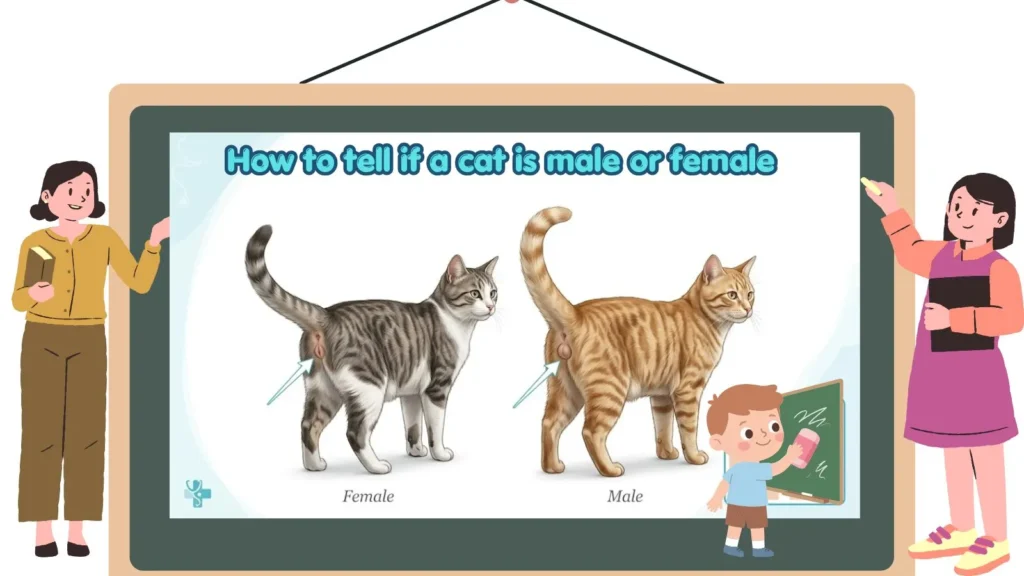
The easiest way to tell if a cat is male or female is by examining the area under its tail. Male cats have a larger gap between the anus and genital opening, and adult males usually have visible testicles. Female cats have the anus and vulva much closer together, with the vulva appearing as a vertical slit.
Table of Contents
- Meaning at a Glance
- How to Tell if a Cat Is Male or Female
- Why People Want to Know a Cat’s Sex
- Male vs Female Cat Anatomy
- Differences in Kittens
- Differences in Adult Cats
- Color Clues That Can Help
- Personality Differences
- Common Myths
- Step-by-Step Guide
- When to Ask a Veterinarian
- Comparison Tables
- FAQs
- Conclusion
Meaning at a Glance
| Aspect | Explanation |
|---|---|
| Main Purpose | Identify whether a cat is male or female |
| Best Method | Examine the area beneath the tail |
| Most Reliable Sign | Distance between anus and genital opening |
| Helpful Age | Easier after 6–8 weeks |
| Accuracy | Very high when anatomical features are visible |
| Related Topics | Cat anatomy, kitten care, pet ownership, veterinary care |
How to Tell if a Cat Is Male or Female
The most reliable method is to gently lift the cat’s tail.
Male Cat
A male cat typically has:
- A round genital opening
- Noticeable space between the anus and penis
- Testicles (if not neutered)
- The openings resemble a colon (:)
Female Cat
A female cat usually has:
- A vertical slit (vulva)
- Very little distance between the anus and vulva
- No testicles
- The openings resemble a lowercase “i”
Simple Example
If you rescue two kittens from the same litter, the one with two closely spaced openings is likely female, while the kitten with a larger gap is likely male.
Why Do People Search for How to Tell if a Cat Is Male or Female?
People commonly search this topic because they want to:
- Choose an appropriate name
- Schedule spaying or neutering
- Understand reproductive behavior
- Care for newborn kittens
- Adopt the right pet for their family
- Confirm information provided by shelters or breeders
Many new pet owners also discover that guessing based on appearance alone often leads to mistakes.
Understanding Male and Female Cat Anatomy
Male Anatomy
Male cats have:
- Anus
- Scrotum (contains testicles)
- Penis opening
The anus and penis are separated by approximately 1 inch (2–3 cm) in adult cats.
Female Anatomy
Female cats have:
- Anus
- Vulva
The vulva sits directly below the anus with very little space in between.
Male vs Female Kittens
Sexing kittens can be difficult because their reproductive organs are still developing.
Male Kitten Signs
- Greater distance between openings
- Tiny scrotal sac may appear after several weeks
- Round genital opening
Female Kitten Signs
- Short distance between openings
- Vertical slit beneath anus
- No scrotal bulge
If the kittens are younger than four weeks, even experienced owners sometimes struggle.
Adult Male vs Adult Female Cats
| Feature | Male | Female |
|---|---|---|
| Distance Between Openings | Larger | Smaller |
| Testicles | Usually visible (unless neutered) | None |
| Genital Shape | Circular | Vertical slit |
| Cheeks | Often broader | Usually slimmer |
| Body Size | Often larger | Often smaller |
Can Fur Color Reveal a Cat’s Sex?
Sometimes—but not always.
Orange Cats
Around 75–80% of orange cats are male because the orange coat color is linked to the X chromosome.
Calico Cats
Almost all calico cats are female.
Tortoiseshell Cats
Nearly every tortoiseshell cat is female.
However, coat color should never replace a physical examination.
Personality Differences
While every cat has a unique personality, some owners notice general trends.
Male cats may:
- Be more social
- Roam farther if unneutered
- Spray to mark territory
Female cats may:
- Be slightly more independent
- Become vocal during heat cycles
- Show nesting behavior before giving birth
These behaviors vary widely and are strongly influenced by spaying, neutering, and environment.
Step-by-Step Guide
Step 1
Wait until the cat feels calm.
Step 2
Gently lift the tail.
Step 3
Locate the anus.
Step 4
Look directly below it.
Step 5
Compare the distance and shape.
- Large gap + round opening = Male
- Small gap + vertical slit = Female
If you’re still unsure, ask your veterinarian.
When Should You Ask a Veterinarian?
Consult a veterinarian if:
- The kitten is very young.
- The anatomy isn’t clear.
- The cat has been neutered early.
- You suspect an abnormality.
- You’re preparing for spaying or neutering.
Veterinarians can usually identify a cat’s sex within seconds.
Common Misconceptions
| Myth | Reality |
|---|---|
| Male cats are always bigger. | Size varies by breed and nutrition. |
| Female cats are always calmer. | Personality depends on many factors. |
| Orange cats are always male. | Most are male, but females exist. |
| You can tell by the face. | Facial appearance isn’t reliable. |
Common Mistakes
Many beginners accidentally:
- Check the wrong body area.
- Assume color guarantees sex.
- Forget that neutered males may lack visible testicles.
- Guess based on personality.
- Examine frightened kittens too quickly.
Taking your time usually improves accuracy.
Similar Topics
| Topic | Meaning | Best Used When |
|---|---|---|
| Male vs Female Kitten | Sex identification in young cats | New litters |
| Cat Anatomy | Body structure | Learning pet care |
| Spaying vs Neutering | Reproductive surgery | Veterinary planning |
| Calico Cats | Coat genetics | Color identification |
| Tortoiseshell Cats | Coat patterns | Genetics discussions |
| Cat Development | Growth stages | Kitten care |
Example Sentences
Everyday Conversation
“I finally learned how to tell if a cat is male or female before adopting my kitten.”
Veterinary Visit
“The vet showed us how to identify the kitten’s sex correctly.”
Pet Blog
“This guide explains how to tell if a cat is male or female using simple anatomical differences.”
Social Media
“We thought our kitten was a girl for two months—turns out he’s a boy!”
Educational Content
“Knowing the difference helps owners plan appropriate veterinary care.”
Around the World
| Language | Common Interpretation |
|---|---|
| Spanish | Determining a cat’s biological sex |
| French | Identifying male or female anatomy |
| Arabic | Distinguishing male and female cats |
| Hindi | नर और मादा बिल्ली की पहचान |
| Urdu | نر اور مادہ بلی کی پہچان |
| Tamil | ஆண் மற்றும் பெண் பூனையை அடையாளம் காணுதல் |
| Malayalam | ആൺ, പെൺ പൂച്ചയെ തിരിച്ചറിയൽ |
| Marathi | नर आणि मादी मांजर ओळखणे |
Although the language changes, the anatomical differences remain the same worldwide.
Online Discussions
People often discuss this topic on:
- Reddit pet communities
- Facebook cat groups
- YouTube pet care videos
- Veterinary blogs
- Animal rescue forums
- Adoption websites
Most conversations include photos asking for help identifying a kitten’s sex.
Popularity Over Time
| Period | Trend |
|---|---|
| Before 2010 | Mostly veterinary books and pet guides |
| 2010–2015 | Growing interest through pet blogs |
| 2016–2020 | Increased searches with social media pet adoption |
| 2021–Present | High search volume due to online pet ownership resources |
Featured Snippet Summary
To tell if a cat is male or female, gently lift the tail and examine the area beneath it. Male cats have a larger space between the anus and genital opening and often visible testicles. Female cats have a vertical slit located close to the anus, making identification straightforward in most adult cats.
Trusted References
For accurate information, consult reputable veterinary and educational sources such as:
- Cambridge Dictionary (general terminology)
- Merriam-Webster (definitions)
- Oxford Learner’s Dictionaries (English usage)
- American Veterinary Medical Association (AVMA)
- Cornell University College of Veterinary Medicine
- ASPCA
- International Cat Care
Frequently Asked Questions
How can I tell if a kitten is male or female?
Look under the tail. Male kittens have a larger gap between the anus and genital opening, while females have a vertical slit close to the anus.
At what age can you tell a kitten’s sex?
An experienced person may identify the sex at birth, but it becomes much easier after 6–8 weeks.
Are orange cats always male?
No. Most orange cats are male, but female orange cats also exist.
Are calico cats always female?
Almost all calico cats are female because of their unique genetics.
Can a neutered male still be identified?
Yes. Although the testicles are removed, the greater distance between the anus and penis opening remains.
Can behavior identify a cat’s sex?
Not reliably. Personality varies greatly among individual cats.
Should I ask a veterinarian if I’m unsure?
Yes. A veterinarian can accurately identify a cat’s sex during a routine examination.
Conclusion
Learning how to tell if a cat is male or female is an essential skill for every cat owner. The most reliable method is to examine the area beneath the tail, paying attention to the distance between the anus and genital opening and the shape of the genital area. While coat color and behavior may provide helpful clues, they should never replace a physical examination.
Knowing your cat’s sex helps you choose an appropriate name, plan for spaying or neutering, understand reproductive behavior, and provide better overall care. Identifying kittens may take a little practice, but the process becomes much easier as they grow.
If you’re ever uncertain, don’t hesitate to ask a veterinarian. A quick professional examination can remove any doubt and ensure your feline friend receives the right care. The better you understand your cat, the stronger the bond you’ll build for years to come.

Hi, I’m Victoria Lane, the voice behind Wordspry!
I’m passionate about helping students and readers master English grammar, vocabulary, and writing through simple, friendly, and easy-to-follow content.