Have you ever paused while writing and wondered whether “too early” or “to early” is correct? You are not alone. This is one of the most common grammar mistakes in English because the words to and too sound exactly the same. Many students, writers, bloggers, and even native speakers mix them up.
The good news is that the rule is very simple. Once you understand the difference, you will never confuse these words again.
You’ll learn the correct spelling, why people make this mistake, where the words came from, and how to use them in everyday writing. We’ll also compare British and American English, look at real-life examples, answer common questions, and explain which version you should use depending on your audience.
If you’ve searched for “too early or to early,” this article gives you a quick answer first and then explains everything in simple English.
RELATED: FALSE FLAG: Meaning, Origin, Usage, and Common Writing Mistakes
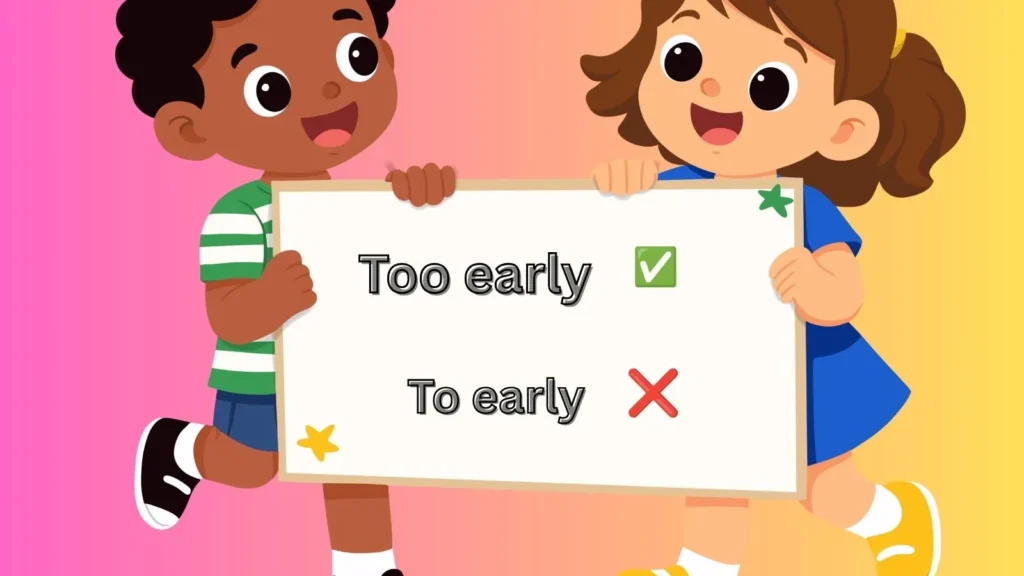
Too Early or To Early – Quick Answer
The correct phrase is:
✅ too early.
❌ To early is incorrect.
The word too means more than needed, excessively, or also. In the phrase too early, it means earlier than expected or desired.
Examples
✅ I woke up too early today.
It’s too early to make a decision.✅
✅ We arrived too early for the meeting.
❌ I woke up to early today.
❌ It is to early to leave.
Quick Rule
| Phrase | Correct? | Meaning |
|---|---|---|
| Too early | ✅ Yes | Earlier than expected or desired |
| To early | ❌ No | Grammar mistake |
The Origin of “Too Early”
Understanding where these words come from makes the rule easier to remember.
The word too
The word too comes from Old English tō, which later developed another spelling to show a different meaning. Today, too usually means:
- More than enough
- Excessively
- Also
Examples:
- It’s too cold outside.
- You’re driving too fast.
- I want to come too.
The word to
The word to is a preposition or part of an infinitive verb.
Examples:
- Go to school.
- I want to learn.
- Give it to Sarah.
Why the confusion exists
Both words sound exactly alike. They are homophones, meaning they share the same pronunciation but have different meanings and spellings.
When writing quickly, many people accidentally type to early instead of too early.
British English vs American English Spelling
Unlike words such as colour/color or travelling/traveling, there is no spelling difference between British and American English for too early.
Both countries use exactly the same phrase.
Examples
American English
- It’s too early to celebrate.
British English
- It’s too early to celebrate.
Both are correct.
Comparison Table
| Feature | American English | British English |
|---|---|---|
| Too early | ✅ Correct | ✅ Correct |
| To early | ❌ Incorrect | ❌ Incorrect |
| Meaning | Earlier than expected | Earlier than expected |
| Grammar rule | Same | Same |
Which Spelling Should You Use?
The answer depends on grammar—not your location.
If your audience is in the United States
Use:
✅ too early
If your audience is in the United Kingdom
Use:
✅ too early
If your audience is worldwide
Use:
✅ too early
There is no regional variation. Every major English dictionary accepts only too early.
Common Mistakes with Too Early or To Early
Many writers confuse to and too because they sound the same.
Here are the most common mistakes.
| Incorrect | Correct |
|---|---|
| To early to leave | Too early to leave |
| I arrived to early | I arrived too early |
| It’s to early now | It’s too early now |
| We came to early | We came too early |
| You called to early | You called too early |
Easy Memory Trick
If you can replace the word with excessively, use too.
Example:
It is too early.
↓
It is excessively early.
The sentence still makes sense.
That tells you too is correct.
Too Early or To Early in Everyday Examples
In emails
✅ Sorry, I sent the report too early.
In news articles
✅ Experts say it is too early to predict the election result.
On social media
✅ Why am I awake too early again?
In school writing
✅ It is too early to reach a final conclusion.
In business writing
✅ It is too early to announce the new product.
In conversations
Person A: Should we leave?
Person B: No, it’s too early.
Too Early or To Early – Google Trends & Usage Data
Search engines show that many people type “to early” because they are unsure about the spelling.
However, grammar resources, dictionaries, schools, and style guides consistently recommend only too early.
Usage by country
| Country | Common Correct Form |
|---|---|
| United States | Too early |
| Canada | Too early |
| United Kingdom | Too early |
| Australia | Too early |
| New Zealand | Too early |
| Ireland | Too early |
People usually search for to early because they want to check whether it is correct. After learning the rule, they switch to too early.
Comparison Table
| Variation | Correct? | Meaning | Example |
|---|---|---|---|
| Too early | ✅ Yes | Earlier than desired | We arrived too early. |
| To early | ❌ No | Grammar error | We arrived to early. |
| Very early | ✅ Yes | Quite early | We arrived very early. |
| So early | ✅ Yes | Earlier than expected | Why are you here so early? |
| Early | ✅ Yes | Before the usual time | I arrived early. |
Tips to Remember the Difference
- Too has an extra “o.”
- Think of the extra letter as meaning extra.
- If something is more than enough, use too.
- If you are talking about movement or an infinitive verb, use to.
- Read your sentence aloud before publishing.
FAQs
Is “to early” ever correct?
No. It is always a grammar mistake.
Why do people write “to early”?
Because to and too sound exactly the same.
Is “too early” correct in American English?
Yes. It is the correct form in American English.
Is “too early” correct in British English?
Yes. British English uses too early as well.
How do I remember the difference?
Remember that too has an extra o, which represents extra.
Can “too” mean “also”?
Yes.
Example:
“I want to come too.”
Is “too early to tell” correct?
Yes. It is a very common English expression.
Example:
“It’s too early to tell whether the project will succeed.”
Conclusion
The answer to “too early or to early” is simple: too early is always the correct phrase, while to early is always incorrect. The confusion happens because to and too sound alike, but they have different jobs in English. Too means more than enough or excessively, making it the only correct choice when talking about something happening earlier than expected. Meanwhile, to works as a preposition or as part of an infinitive verb, so it cannot replace too in this phrase.
The best way to avoid this mistake is to remember the extra o in too. Think of it as meaning extra, just like arriving too early means arriving earlier than needed. This rule never changes in American English, British English, Canadian English, Australian English, or any other standard variety of English. By following this simple guideline, you can write with confidence in emails, school assignments, professional documents, and everyday conversations.

Hi, I’m Mason Clark, the writer behind Wordspry!
My goal is to make grammar learning easier with straightforward explanations, useful examples, and engaging English lessons that help you grow every day.