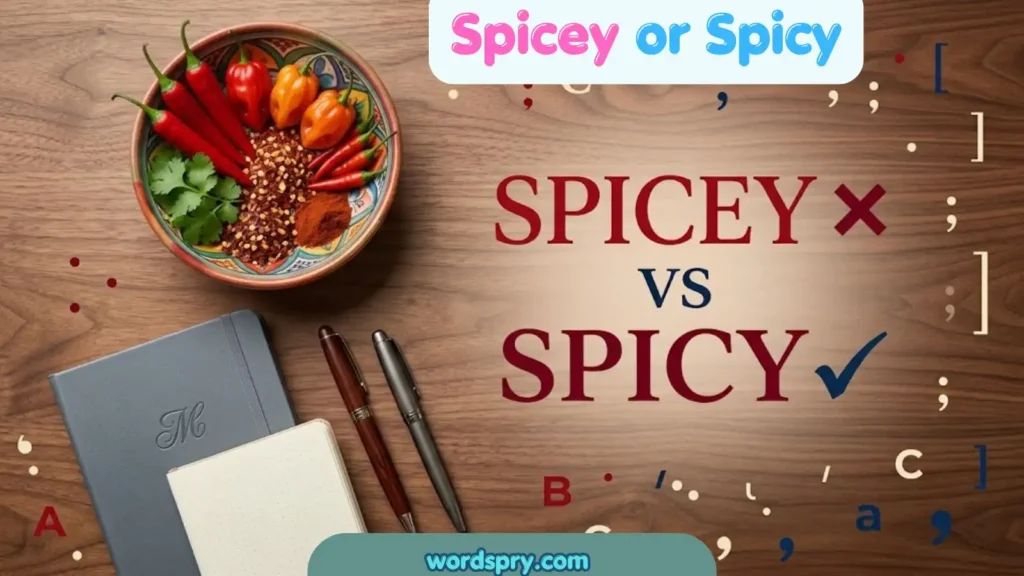
Have you ever typed spicey and wondered if the spelling looks right? You are not alone. The words spicey or spicy often confuse writers because the noun spice keeps its final “e,” while the adjective does not. This small spelling difference causes many mistakes in emails, recipes, blog posts, social media captions, and school writing.
The good news is simple: spicy is the standard spelling you should use. Merriam-Webster lists spicey as a variant spelling, while major learner dictionaries use spicy as the main form.
The word spicy usually describes food with a strong, hot, or pungent flavor. It can also describe something exciting, bold, or slightly shocking. For example, you can have a spicy curry, a spicy debate, or a spicy story.
You will learn the difference between spicey and spicy, discover where the word came from, and see whether British and American English use different spellings. You will also find practical examples, common mistakes, usage advice, and answers to frequently asked questions.
RELATED: Gumba vs Goomba: Which Spelling Is Correct and When Should You Use It?
Spicey or Spicy – Quick Answer
The correct spelling in standard modern English is spicy.
Spicey appears in dictionaries as a variant spelling, but spicy is the normal and preferred form for everyday, professional, academic, and published writing. Merriam-Webster specifically defines spicey as a “variant spelling of spicy.”
Correct Examples
- ✅ This curry is very spicy.
- ✅ I love spicy chicken wings.
- ✅ The sauce has a spicy flavor.
- ✅ That was a spicy comment.
Incorrect or Nonpreferred Examples
- ❌ This curry is very spicey.
- ❌ I love spicey chicken wings.
- ❌ The sauce has a spicey flavor.
Therefore, if you are unsure which spelling to choose, remember:
Spice → Spicy
Do not add the “e” again.
Spicy Meaning
Spicy is an adjective. It commonly means containing spices or having a strong, hot, pungent flavor. Cambridge and Oxford both give this food-related meaning.
It can also have a broader meaning. For example, spicy may describe something exciting, surprising, provocative, or slightly shocking.
See also: No Cuts No Buts No Coconuts: Meaning, Origin and Examples
The Origin of Spicey or Spicy
The story begins with the noun spice.
The word spice has a long history in English and ultimately traces through French and Latin language history. The adjective spicy developed from spice + -y. Collins dates the word to the mid-1500s and gives its formation as spice + -y.
Merriam-Webster records the first known use of spicy in 1543.
The suffix -y often creates adjectives that mean “having,” “containing,” or “characterized by” something.
Example:
- spice → spicy
- juice → juicy
- ice → icy
- shine → shiny
- noise → noisy
This pattern helps explain why spicy became the standard spelling.
Why Does “Spicey” Look Correct?
The confusion is understandable.
A writer sees:
spice + y = spicey
At first glance, that seems logical. However, English spelling does not always work by simply attaching letters. The final silent e is removed in spicy.
So the correct process is:
SPICE → remove E → SPIC + Y → SPICY
The spelling spicey has appeared historically and continues to occur today. Merriam-Webster recognizes it as a variant, and Scrabble’s dictionary also lists it as playable with the meaning “spicy.”
However, that does not mean spicey is the best choice for normal writing.
British English vs American English Spelling
Unlike color/colour or favorite/favourite, this spelling does not create a major American-British difference.
Both American and British English use:
spicy
Cambridge gives the same spelling for both varieties, although pronunciation details can vary slightly.
Collins also provides British and American entries for spicy, with the same spelling.
| English Variety | Preferred Spelling | Example |
|---|---|---|
| American English | spicy | This salsa is spicy. |
| British English | spicy | This curry is spicy. |
| Canadian English | spicy | I enjoy spicy food. |
| Australian English | spicy | The noodles are spicy. |
| Global English | spicy | She ordered a spicy meal. |
So, you do not need to change the spelling based on your audience.
A Small Pronunciation Difference
The spelling stays the same, but pronunciation can vary slightly between British and American English. Cambridge lists the word with UK and US pronunciation information.
The common pronunciation is close to:
SPY-see
The comparative and superlative forms are:
- spicy
- spicier
- spiciest
Which Spelling Should You Use?
The easiest advice is to use spicy almost every time.
For a US Audience
Use spicy in:
- school assignments
- business emails
- recipes
- websites
- product descriptions
- news articles
- social media posts
For a UK or Commonwealth Audience
Use spicy as well.
There is no need to write spicey simply because your readers are British, Australian, or Canadian.
For Global English
Spicy is the safest choice.
If your website attracts readers from several countries, consistent standard spelling makes your content easier to read and edit.
What About “Spicey”?
You may encounter spicey in usernames, informal posts, older texts, branding, or casual writing. Some dictionaries record it as a variant.
Still, if you are writing something that needs to look polished, choose spicy.
Common Mistakes with Spicey or Spicy
Several mistakes appear because writers try to preserve the spelling of spice.
Mistake 1: Keeping the Final “e”
❌ The chicken is spicey.
✅ The chicken is spicy.
The final e does not stay.
Mistake 2: Using “Spicey” in Professional Writing
❌ Our restaurant offers many spicey dishes.
✅ Our restaurant offers many spicy dishes.
Professional content should normally use the standard spelling.
Mistake 3: Confusing Spicy With Spice
Spice and spicy have different grammatical roles.
- Spice = noun
- Spicy = adjective
Examples:
- Add some spice to the soup.
- The soup is spicy.
Mistake 4: Misspelling the Comparative
❌ This curry is spiceyer than the last one.
✅ This curry is spicier than the last one.
Mistake 5: Misspelling the Superlative
❌ This is the spiceyest sauce.
✅ This is the spiciest sauce.
Remember the correct forms:
spicy → spicier → spiciest
Spicey or Spicy – Comparison Table
| Variation | Status | Best Use | Example |
|---|---|---|---|
| spicy | Standard | All normal writing | The soup is spicy. |
| spicey | Variant/nonpreferred | Avoid in standard writing | The soup is spicey. |
| spicier | Standard | Comparative | This sauce is spicier. |
| spiciest | Standard | Superlative | This is the spiciest dish. |
| spicily | Standard | Adverb | The dish was spicily seasoned. |
| spiciness | Standard | Noun | I enjoy the spiciness. |
The key difference is simple: spicy is the form you should normally choose.
Spicey or Spicy in Everyday Examples
The word spicy appears in many types of writing. It is not limited to food.
In Emails
You might use it when discussing food, products, or marketing.
The customer requested a less spicy version of the dish.
Or:
Please confirm whether the new sauce is spicy enough.
In News Writing
Journalists may use spicy literally or figuratively.
The restaurant launched a new spicy chicken sandwich.
It can also describe a heated situation:
The debate became spicy after the final question.
On Social Media
Social media often uses spicy in a playful way.
Examples:
- “That is a spicy opinion!”
- “Things are getting spicy in the comments.”
- “This recipe looks seriously spicy.”
In these examples, spicy can mean bold, dramatic, or controversial.
In Formal Writing
Formal writing usually uses the literal meaning.
The study examined consumer preferences for spicy foods.
However, figurative uses can work in less formal articles, reviews, and commentary.
In Recipes
Recipes frequently use spicy to describe flavor.
- spicy curry
- spicy noodles
- spicy salsa
- spicy chicken
- spicy soup
- spicy sauce
Oxford lists examples such as spicy sauce, spicy sausage, and spicy soup.
Spicey or Spicy – Google Trends & Usage Data
Google Trends can help show how search interest changes over time and across regions. However, it is important to understand what the tool measures.
Google Trends reports relative search interest, not a simple count of every word used in speech or writing. Its trend system also separates normal search activity from unusual spikes.
For spicey or spicy, the practical pattern is clear: spicy is the standard form used across major English varieties, while spicey appears mainly as a variant, spelling question, typo, or informal usage.
Search interest can also change with context. For example, searches involving spicy recipes, spicy food, sauces, restaurant dishes, and cooking can rise because people often use the word literally.
The figurative meaning has also become common online. Cambridge and Oxford both recognize uses of spicy for exciting or slightly shocking stories and situations.
Usage by Country
| Country/Region | Common Standard Form | Typical Context |
|---|---|---|
| United States | spicy | Food, recipes, social media |
| United Kingdom | spicy | Food, news, informal speech |
| Canada | spicy | Food and general writing |
| Australia | spicy | Food and casual communication |
| India | spicy | Food, recipes, cooking content |
| Global English | spicy | Food and figurative use |
Rather than treating spicey as a separate English word, it is better to view it as a variant spelling that people may encounter.
How to Remember Spicey or Spicy
Here is an easy memory trick:
Spice loses the “e” before becoming spicy.
Think of the pattern:
- ice → icy
- juice → juicy
- spice → spicy
- shine → shiny
So when you hesitate, ask yourself:
Would I write “icey” instead of “icy”?
Probably not.
That reminder can help you remember spicy.
FAQs About Spicey or Spicy
1. Is it spicey or spicy?
Spicy is the standard spelling. Use it in normal English writing. Merriam-Webster lists spicey as a variant spelling of spicy.
2. Is “spicey” a real word?
It is a recorded variant spelling. Merriam-Webster lists spicey as a variant, and other dictionaries may show it as an alternative form. However, spicy is the preferred form for standard modern writing.
3. Is spicy the same in British and American English?
Yes. Both British and American English use spicy. The spelling does not change between these varieties.
4. Why is spicy spelled without an e?
The adjective developed from spice + -y. The final silent e is dropped, producing spicy. Collins identifies the word origin as spice + -y.
5. What does spicy mean?
Spicy usually means containing spices or having a strong, hot, or pungent flavor. It can also mean exciting, bold, or slightly shocking in informal contexts.
6. What is the comparative form of spicy?
The comparative form is spicier.
Example:
This curry is spicier than the soup.
7. What is the superlative form of spicy?
The superlative form is spiciest.
Example:
That was the spiciest meal I have ever eaten.
Conclusion
When choosing between spicey or spicy, the safest answer is clear: use spicy. It is the standard spelling in modern English and works for American, British, Canadian, Australian, and global audiences. Cambridge, Oxford, Collins, and Merriam-Webster all support spicy as the main form, while Merriam-Webster records spicey as a variant.
The confusion happens because the noun spice ends with an “e.” When it becomes the adjective spicy, that final “e” disappears. Therefore, write spice → spicy, not spice → spicey.
Use spicy when describing hot or strongly seasoned food. You can also use it for bold opinions, exciting stories, dramatic situations, and playful online comments. Its comparative form is spicier, while its superlative form is spiciest.
So, whether you are writing a recipe, email, article, school assignment, or social media post, remember one simple rule: spicy is the professional choice.

Hi, I’m Victoria Lane, the voice behind Wordspry!
I’m passionate about helping students and readers master English grammar, vocabulary, and writing through simple, friendly, and easy-to-follow content.