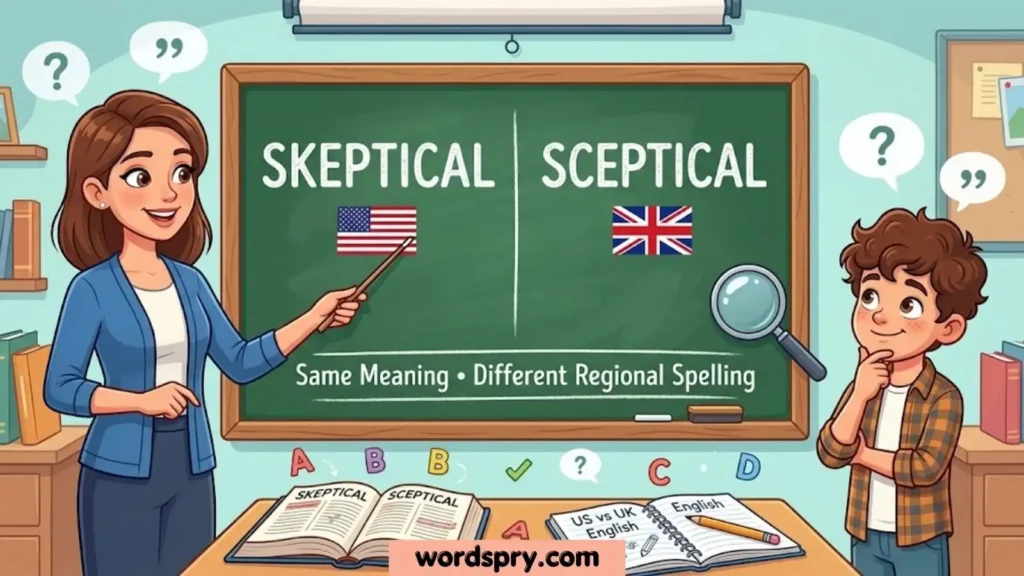
Both “skeptical” and “sceptical” are correct; the main difference is regional spelling.
If you have ever wondered whether to write skeptical vs sceptical, you are not alone. The two words look almost identical, sound the same in most varieties of English, and carry exactly the same basic meaning. The difference comes mainly from English spelling conventions.
Skeptical is the usual spelling in American English, while sceptical is the standard British English form. Major dictionaries, including Cambridge, Oxford, Collins, and Merriam-Webster, recognize this regional distinction.
Imagine reading a British newspaper that says, “The public remains sceptical.” An American newspaper might write, “The public remains skeptical.” Neither writer has made a spelling mistake.
This distinction matters when you write essays, reports, emails, blog posts, academic papers, or professional documents. Choosing one spelling and using it consistently makes your writing look polished and intentional.
So, if you are unsure which form to use, think about your audience first. American readers generally expect skeptical, while British readers generally expect sceptical.
Core Meaning and Spelling Clarity
The first thing to understand is simple: skeptical and sceptical mean the same thing.
Both adjectives describe someone who has doubts about whether something is true, useful, reliable, or likely to happen. Cambridge defines skeptical as doubting that something is true or useful, and notes that British English usually uses sceptical.
For example:
- I am skeptical about his story.
- I am sceptical about his story.
- She was skeptical of the company’s promises.
- She was sceptical of the company’s promises.
The meaning does not change when the k becomes c.
The Main Spelling Difference
| American English | British English |
|---|---|
| skeptical | sceptical |
| skeptic | sceptic |
| skepticism | scepticism |
| skeptically | sceptically |
Merriam-Webster identifies sceptic, sceptical, and scepticism as chiefly British spellings of skeptic, skeptical, and skepticism.
Therefore, the difference is primarily regional spelling, not meaning.
Why People Get Confused
At first glance, the difference seems tiny. Yet that tiny letter can create plenty of uncertainty.
English contains many words that change spelling between American and British varieties. Think about:
- color / colour
- center / centre
- organize / organise
- traveled / travelled
- favorite / favourite
Skeptical vs sceptical follows a similar regional pattern.
The “K” and “C” Problem
American English commonly favors skeptical, with a k.
British English commonly favors sceptical, with a c.
That difference can look like a completely different word to learners. It is not.
Oxford lists sceptical as the British English spelling and skeptical as the North American spelling.
Different Spelling, Same Pronunciation
In normal English speech, both forms are pronounced essentially the same way:
SKep-ti-kəl
The spelling changes, but the pronunciation and meaning remain stable.
That makes this pair especially confusing for people learning English through conversation. You may hear the word long before you see it written.
Real-Life Meaning Explained
What does being skeptical or sceptical actually look like?
Imagine your friend says, “I can teach you fluent Spanish in three days.”
You might reply, “Really? I’m skeptical.”
You are not necessarily calling your friend a liar. You simply want stronger evidence before accepting the claim.
That distinction is important.
Being skeptical does not always mean being negative. A skeptical person may simply want proof, evidence, or a reasonable explanation.
Skeptical Does Not Mean “Always Negative”
Consider these situations:
Situation 1:
A company promises that its new product will double your productivity.
A skeptical customer may ask for research before buying it.
Situation 2:
Someone claims they won the lottery but provides no evidence.
A skeptical friend may question the story.
Situation 3:
A scientist hears an unusual claim.
Instead of accepting it immediately, the scientist may look for reliable evidence.
In each case, doubt encourages careful thinking.
Merriam-Webster describes skeptical as relating to or marked by skepticism and lists related ideas such as doubting, questioning, cautious, and wary.
Skeptical vs Sceptical: Side-by-Side Comparison
Here is the difference at a glance.
| Feature | Skeptical | Sceptical |
|---|---|---|
| Meaning | Doubting or questioning something | Doubting or questioning something |
| Standard usage | American English | British English |
| Pronunciation | Essentially the same | Essentially the same |
| Part of speech | Adjective | Adjective |
| Related noun | skeptic | sceptic |
| Related noun | skepticism | scepticism |
| Common in US writing | Yes | Less common |
| Common in UK writing | Less common | Yes |
| Correct spelling | Yes | Yes |
The easiest rule is this:
Use “skeptical” for American English and “sceptical” for British English.
Collins similarly identifies sceptical as mainly British and gives skeptical as the American form.
When Should You Use “Skeptical”?
Use skeptical when following American English spelling conventions.
This is especially appropriate for:
- American school assignments
- US business writing
- American websites
- US newspapers
- American academic publications
- Content aimed at US readers
Examples
- The investors were skeptical about the proposal.
- I remain skeptical about his explanation.
- She gave me a skeptical look.
- Many customers are skeptical of online reviews.
- The researchers were skeptical about the initial results.
Notice that the meaning stays focused on doubt or questioning.
When Should You Use “Sceptical”?
Use sceptical when following British English spelling conventions.
It commonly appears in:
- British school writing
- UK newspapers
- British academic writing
- UK government documents
- British websites
- Publications following British spelling
Oxford gives examples such as being sceptical about someone’s chances or sceptical of a claim.
Examples
- The committee remained sceptical about the proposal.
- She was sceptical of his explanation.
- The audience looked sceptical.
- Many voters are sceptical about the promise.
- He took a sceptical view of the plan.
Again, nothing changes except the spelling convention.
Common Mistakes
The biggest mistake is not choosing one spelling over the other.
The real problem is mixing spelling systems without a reason.
Mistake 1: Mixing American and British Forms
Consider this sentence:
The skeptical customer questioned the company’s scepticism.
This mixture may look inconsistent if the document follows one spelling system.
For American English, write:
The skeptical customer questioned the company’s skepticism.
For British English, write:
The sceptical customer questioned the company’s scepticism.
Consistency creates a cleaner impression.
Mistake 2: Thinking “Sceptical” Is Incorrect
Some American readers may see sceptical and assume it is misspelled.
It is not.
Merriam-Webster explicitly recognizes sceptical as a chiefly British spelling.
Mistake 3: Thinking “Skeptical” Is Incorrect in Britain
The reverse assumption also causes trouble.
Skeptical is not a meaningless or incorrect spelling. It is the standard American form and is widely understood internationally.
Mistake 4: Confusing Skepticism With Cynicism
These words overlap, but they are not perfect synonyms.
A skeptical person asks:
“What evidence supports this claim?”
A cynical person may begin with a stronger assumption of bad motives or dishonesty.
Healthy skepticism can encourage investigation rather than automatic rejection.
Incorrect vs Correct Examples
Here are some practical examples.
Example 1: American English
Incorrect for consistent US style:
The team was sceptical about the results.
Better:
The team was skeptical about the results.
Example 2: British English
Incorrect for consistent UK style:
The team was skeptical about the results.
Better:
The team was sceptical about the results.
Remember, “incorrect” here means inconsistent with the selected regional style, not that the spelling itself is universally wrong.
Example 3: Mixed Vocabulary
Inconsistent:
She was skeptical about the proposal but expressed scepticism about its funding.
American style:
She was skeptical about the proposal but expressed skepticism about its funding.
British style:
She was sceptical about the proposal but expressed scepticism about its funding.
Memory Tricks
Spelling rules become easier when you connect them with something familiar.
Trick 1: K for American
Remember:
SkeptiKAl → American
The K can remind you of the spelling commonly used in the United States.
Trick 2: C for British
Remember:
Sceptical → British
The C form is strongly associated with British English.
Trick 3: Think in Families
Don’t memorize just one word.
Learn the whole family together:
American:
- skeptic
- skeptical
- skepticism
- skeptically
British:
- sceptic
- sceptical
- scepticism
- sceptically
Once you remember the pattern, the spelling becomes much easier.
Professional Writing Importance
A single letter rarely changes the meaning of a sentence. However, consistency can affect how professional your writing looks.
Imagine a company publishing a report in British English. The document uses colour, organisation, and centre throughout. Suddenly, it uses skeptical.
Readers will understand it, but the spelling may feel inconsistent.
The same applies to American English.
Pick One Style and Stick With It
Before writing a long document, decide which English variety you need.
For example:
US audience → skeptical
UK audience → sceptical
International audience → choose one accepted style and apply it consistently.
This approach works especially well for:
- SEO articles
- academic assignments
- business reports
- marketing copy
- newsletters
- school essays
- professional emails
Consistency makes your writing easier to edit and easier to trust.
Practical Examples in Everyday English
The word appears in many ordinary situations.
At Work
My manager was skeptical about the projected sales figures.
British version:
My manager was sceptical about the projected sales figures.
At School
The teacher was skeptical of the student’s unusual explanation.
British version:
The teacher was sceptical of the student’s unusual explanation.
In Conversation
I’m skeptical that he’ll finish the project today.
British version:
I’m sceptical that he’ll finish the project today.
In News Writing
Voters remain skeptical about the proposed changes.
British version:
Voters remain sceptical about the proposed changes.
In Science
Researchers were skeptical about the claim until more evidence appeared.
British version:
Researchers were sceptical about the claim until more evidence appeared.
A Mini Case Study: Choosing the Right Spelling
Suppose you are writing an article for an American technology website.
Your draft contains:
Some users remain sceptical about the company’s latest AI feature.
The meaning is perfectly clear. However, the publication uses American English throughout.
You should change it to:
Some users remain skeptical about the company’s latest AI feature.
Now imagine the same sentence appears in a British publication.
There, this version fits the publication’s style:
Some users remain sceptical about the company’s latest AI feature.
The lesson is simple: the audience determines the preferred spelling.
Quick Fix Guide
When you’re stuck between skeptical vs sceptical, use this quick checklist.
- 🇺🇸 Writing for Americans? Use skeptical.
- 🇬🇧 Writing for British readers? Use sceptical.
- 📚 Following a style guide? Follow its spelling rules.
- 🌍 Writing internationally? Pick one standard and remain consistent.
- ✍️ Writing an academic paper? Check your institution’s preferred English variety.
- 💼 Writing professionally? Match the organization’s established style.
- 🔎 Editing SEO content? Keep the spelling consistent with the target audience.
You do not need to worry about the meaning changing.
It doesn’t.
Skeptical vs Sceptical and Related Words
Understanding the word family can prevent future spelling mistakes.
| American English | British English | Meaning |
|---|---|---|
| skeptic | sceptic | A person who doubts or questions |
| skeptical | sceptical | Showing doubt |
| skepticism | scepticism | A questioning attitude |
| skeptically | sceptically | In a doubtful or questioning way |
Merriam-Webster traces skeptic through Latin and Greek roots connected with ideas of examining, considering, or looking closely. Its first known English use as a noun dates to the late sixteenth century.
The underlying idea is therefore closely connected with questioning and investigation, rather than simply refusing to believe everything.
Is Being Skeptical a Bad Thing?
Not necessarily.
Healthy skepticism can protect people from false claims, exaggerated promises, scams, and weak evidence.
For example, imagine receiving an email that says:
“Congratulations! You have won $5 million. Send your bank details to claim your prize.”
A skeptical reader might pause and investigate before responding.
That doubt can be useful.
However, extreme skepticism can become unhelpful when someone rejects every claim without considering evidence.
A balanced approach works best:
Question → investigate → examine evidence → form a conclusion.
That is very different from simply saying “no” to everything.
FAQs About Skeptical vs Sceptical
1. Is “skeptical” or “sceptical” correct?
Both are correct. Skeptical is the usual American English spelling, while sceptical is the usual British English spelling.
2. Is sceptical British or American?
Sceptical is mainly the British spelling. American English normally uses skeptical. Collins and Cambridge both identify this regional difference.
3. Does skeptical mean doubtful?
Yes. Someone who is skeptical has doubts about whether something is true, useful, or likely to happen.
4. Does sceptical mean the same as skeptical?
Yes. Sceptical and skeptical have the same basic meaning. The primary difference is the regional spelling convention.
5. Which spelling should I use in American English?
Use skeptical. The related forms are skeptic, skepticism, and skeptically.
6. Which spelling should I use in British English?
Use sceptical. The related forms are sceptic, scepticism, and sceptically.
7. Is skeptical a negative word?
Not always. Being skeptical simply means questioning or doubting something. Healthy skepticism can encourage people to examine evidence before accepting a claim.
Conclusion
The choice between skeptical vs sceptical becomes easy once you understand the regional difference. Both words describe doubt, questioning, or a lack of complete belief. Neither spelling changes the core meaning.
Use skeptical when following American English conventions. Use sceptical when following British English conventions. Dictionaries such as Cambridge, Oxford, Collins, and Merriam-Webster support this distinction.
The most important rule is consistency. If your article uses American spelling, keep the k form throughout the word family. If your writing follows British spelling, choose the c form.
Once you connect K with American English and C with British English, the choice becomes almost automatic.
So next time you hesitate, don’t ask which spelling is “really” correct. Ask a better question: Which English variety am I writing for?
That small decision can make your writing clearer, more polished, and more professional.

Hi, I’m William Parker, the creator behind Wordspry.com
I enjoy breaking down complex grammar rules into clear and practical lessons that help learners write and speak English more effectively.