Have you ever typed “offered” and suddenly wondered whether it should have two r’s? You are not alone. Many English learners hesitate between offered or offerred, especially because words such as referred and preferred contain double r’s.
So, is offerred an acceptable spelling? Why does offered use only one r when the verb offer already ends in r? And what spelling should you use in an email, essay, article, or professional document?
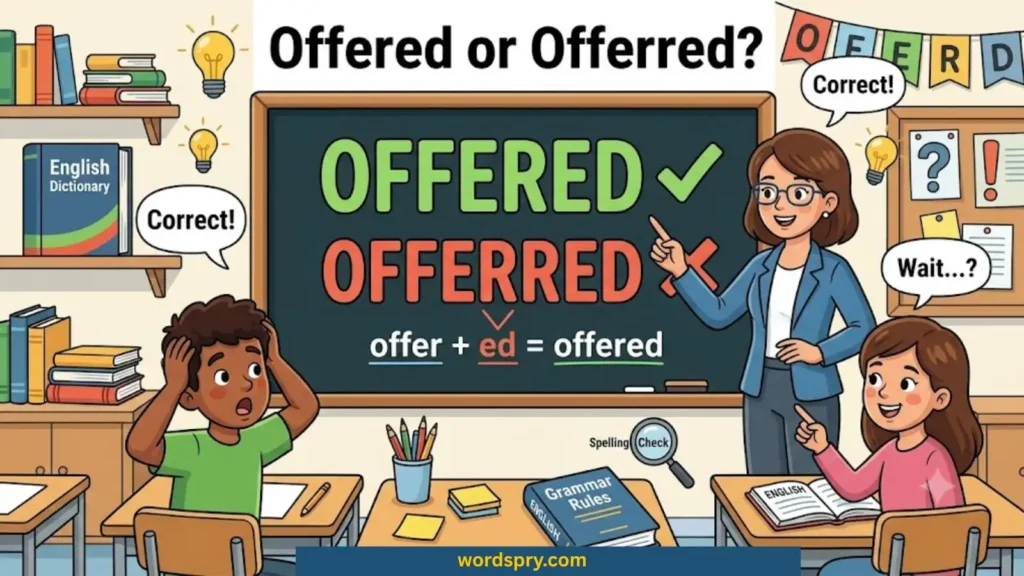
The answer is simple: offered is the correct spelling. Offerred is a misspelling.
This guide explains why the correct form is offered, how English spelling rules create it, and how to use it naturally in sentences. You will also see examples, comparisons, common mistakes, related words, and answers to frequently asked questions. By the end, you will know exactly when to write offered and why offerred should stay out of your writing.
Quick Answer
Offered is the correct spelling. Offerred is incorrect. Offered is the past tense and past participle of the verb offer, meaning to present, provide, suggest, or make something available. The word takes -ed, producing offered, not offerred.
Table of Contents
- Meaning at a Glance
- What Does Offered Mean?
- Why Do People Search for Offered or Offerred?
- Why Is Offerred Incorrect?
- Background and Origin of Offer
- Contexts Where Offered Is Used
- Usage Across Different Platforms
- Examples in Everyday Life
- When Should You Use Offered?
- When Should You Avoid It?
- Common Misconceptions
- Common Mistakes
- Similar Words and Alternatives
- How to Use Offered in a Sentence
- Offered in Different Languages and Cultures
- Offered in Online Conversations
- Spelling Trends Over Time
- Featured Snippet Summary
- Trusted References
- Frequently Asked Questions
- Conclusion
Meaning at a Glance
| Aspect | Explanation |
|---|---|
| Correct Spelling | Offered |
| Incorrect Spelling | Offerred |
| Base Verb | Offer |
| Past Tense | Offered |
| Past Participle | Offered |
| Basic Meaning | Presented, provided, suggested, or made available |
| Common Use | Everyday, professional, academic, and business writing |
| Main Spelling Issue | Adding an unnecessary second r |
What Does Offered Mean?
Offered is the past tense and past participle of offer.
The verb offer can mean several things depending on context. You can offer someone help, offer a suggestion, offer a product for sale, or offer someone an opportunity.
Example:
The teacher offered extra help after class.
Here, offered means provided or made available.
You can also use it when someone presents something for consideration:
She offered a different explanation for the problem.
In this sentence, offered means presented or suggested.
The word can therefore express ideas such as:
- provided
- presented
- suggested
- proposed
- volunteered
- made available
- gave someone an opportunity
The spelling remains the same in all these meanings: offered.
Offered vs. Offerred
| Word | Correct? | Explanation |
|---|---|---|
| Offered | ✅ Yes | Standard English spelling |
| Offerred | ❌ No | Incorrectly adds an extra r |
Why Do People Search for Offered or Offerred?
The confusion usually comes from English spelling patterns.
Many learners notice that some verbs ending in r double the final consonant before adding -ed:
- refer → referred
- prefer → preferred
- occur → occurred
That pattern can make offerred look reasonable.
However, English spelling does not simply double every final consonant. Different rules apply depending on the word’s ending, pronunciation, and syllable structure.
Because offer already ends with r, learners may instinctively add another r before -ed. That creates the common misspelling offerred.
The correct form is much simpler:
offer + ed = offered
Why Is Offerred Incorrect?
Offerred is incorrect because standard English does not require a second r when forming the past tense of offer.
The correct spelling follows this pattern:
offer → offered
Compare it with these examples:
- open → opened
- answer → answered
- cover → covered
- discover → discovered
- offer → offered
The spelling does not become offerr-ed.
Why Does Referred Have Two Rs?
This is where much of the confusion comes from.
The verb refer becomes referred, while offer becomes offered.
| Base Verb | Past Tense |
|---|---|
| offer | offered |
| refer | referred |
| prefer | preferred |
| occur | occurred |
| transfer | transferred |
English spelling can look inconsistent because different historical and grammatical patterns influence individual words.
The important point is practical: memorize “offered” as the standard form.
Background and Origin of Offer
The word offer has a long history in English. It ultimately traces back through Old French to Latin offerre, meaning roughly “to present” or “to bring before.”
The word developed into English with meanings connected to presenting something for acceptance, consideration, or use.
Over time, offer became a very flexible English verb.
Today, people can offer:
- help
- advice
- money
- food
- opportunities
- services
- explanations
- suggestions
- support
- discounts
The spelling offered developed as the regular past-tense form of offer.
Unlike a phrase whose meaning depends on symbolism or artistic interpretation, offered has a straightforward grammatical function. Its main issue involves spelling and verb formation.
Contexts Where Offered Is Used
Everyday Conversations
People often use offered when describing help, food, advice, or assistance.
Example:
My neighbor offered to carry the boxes.
Business and Professional Writing
Businesses frequently use offered when describing services, products, benefits, or opportunities.
Example:
The company offered employees flexible working hours.
Education
Teachers and schools can use the word when discussing support, courses, or opportunities.
Example:
The university offered several new online courses.
Literature
Writers use offered to describe actions, suggestions, emotions, or opportunities.
Example:
He offered her a quiet smile.
News and Journalism
News reports often use the word when describing proposals, assistance, or official statements.
Example:
The government offered financial assistance to affected families.
Marketing and Advertising
Brands commonly use offered to describe products, discounts, and services.
Example:
The store offered customers a 20% discount.
Social Media
Users may write offered when talking about experiences, advice, support, or opportunities.
Example:
She offered some great advice during the discussion.
Academic Writing
Researchers can use offered when describing explanations, interpretations, or evidence.
Example:
The study offered a possible explanation for the results.
Usage Across Different Platforms
| Platform | Typical Usage | Example |
|---|---|---|
| Captions and personal posts | “They offered us an unforgettable experience.” | |
| TikTok | Stories and comments | “He offered a simple solution.” |
| Guides and ideas | “The article offered useful decorating tips.” | |
| Conversations and posts | “A friend offered to help.” | |
| Professional updates | “The company offered me a new position.” | |
| YouTube | Video descriptions | “The course offered practical lessons.” |
| Blogs | Explanations and articles | “The guide offered several useful examples.” |
Examples in Everyday Life
Here are several natural examples:
- She offered me a cup of coffee.
- The teacher offered extra practice exercises.
- He offered to drive us home.
- The store offered a special discount.
- The manager offered a reasonable solution.
- They offered their support during the difficult time.
- The website offered free educational resources.
- The company offered her a full-time position.
Notice that none of these sentences needs offerred.
When Should You Use Offered?
Use offered whenever you describe something that someone presented, provided, suggested, proposed, or made available in the past.
It works naturally in:
- everyday conversations
- emails
- business writing
- academic papers
- creative writing
- social media posts
- news articles
- educational content
- presentations
- formal reports
For example:
The organization offered free training to new employees.
Here, offered clearly describes something the organization made available in the past.
When Should You Avoid Using It?
You do not need to avoid offered in formal writing. It is a standard English word.
However, you should avoid using it when the situation requires the present tense.
For example:
❌ The company offered free shipping every day.
If the company still provides free shipping, this may need present tense.
✅ The company offers free shipping every day.
Use offered for a past action and offers for a current or habitual action.
Common Misconceptions About Offered
Misconception 1: Offerred Is an Alternative Spelling
It is not. Offerred is a misspelling in standard modern English.
Misconception 2: Every Word Ending in R Doubles the R
English does not work that way.
Compare:
- offer → offered
- refer → referred
- prefer → preferred
The spelling rules depend on the individual word and its structure.
Misconception 3: Offered and Offerred Have Different Meanings
They do not.
Offered is the correct form. Offerred does not represent a separate meaning or grammatical form.
Misconception 4: Offerred Looks More Formal
Extra letters do not make a word more formal.
In professional writing, offered is the correct and polished choice.
Common Mistakes When Using Offered
1. Adding an Extra R
❌ The company offerred me a job.
✅ The company offered me a job.
2. Confusing Offered With Offers
❌ The company offered free delivery every week.
✅ The company offers free delivery every week.
Use offers when the action remains current or happens regularly.
3. Confusing Offered With Offering
Offering is the present participle or gerund form.
The company is offering a discount.
Offered describes a completed past action or functions as a past participle.
The company offered a discount last month.
4. Using Offered When Suggested Fits Better
These words can overlap, but context matters.
She offered a solution.
This means she presented a solution for consideration.
She suggested a solution.
This directly emphasizes the idea or recommendation.
Similar Words and Alternatives
| Word | Meaning | Best Used When |
|---|---|---|
| Offered | Presented or made available | Describing a past action |
| Suggested | Put forward an idea | Giving a recommendation |
| Proposed | Formally suggested | Discussing plans or ideas |
| Provided | Supplied something | Talking about resources or services |
| Presented | Showed or introduced | Formal or professional contexts |
| Gave | Supplied or handed something over | General situations |
| Supplied | Provided something needed | Products, materials, or resources |
| Volunteered | Willingly offered help | Offering assistance or service |
How to Use Offered in a Sentence
Professional Writing
The company offered employees additional training opportunities.
Creative Writing
He offered her a reassuring smile.
Social Media Caption
They offered us more kindness than we expected.
Inspirational Quote
Sometimes the opportunity you need comes from the help someone offered.
Everyday Conversation
My brother offered to pick me up after work.
Academic Writing
The research offered a new perspective on the issue.
Offered in Different Languages and Cultures
The exact spelling issue exists specifically within English, but the underlying concept of offering appears across many languages and cultures.
| Language | Common Equivalent or Interpretation |
|---|---|
| Spanish | ofreció / ofrecido |
| French | a offert / offert |
| Arabic | قَدَّمَ / عَرَضَ, depending on context |
| Hindi | पेश किया / प्रस्ताव दिया |
| Urdu | پیش کیا / پیشکش کی |
| Tamil | வழங்கினார் / அளித்தார், depending on context |
| Malayalam | വാഗ്ദാനം ചെയ്തു / നൽകി, depending on context |
| Marathi | देऊ केले / ऑफर केले, depending on context |
The exact translation changes according to meaning. For example, offered help, offered a price, and offered an opportunity may require different words in another language.
This difference matters because translation involves meaning, not simply replacing one word with another.
Offered in Online Conversations and Social Media
The word offered appears frequently online because people constantly describe things that others provided, suggested, or made available.
You might see phrases such as:
- “She offered some great advice.”
- “They offered free resources.”
- “The company offered me a position.”
- “He offered to help.”
- “The video offered a new perspective.”
On social platforms, users sometimes type quickly and rely on spell-check. That can help catch offerred, but automated correction should not replace understanding the spelling rule.
For bloggers, students, and professionals, using offered correctly creates cleaner and more credible writing.
Spelling Trends Over Time
The spelling of offer has historical roots, but the modern form offered is well established in standard English.
| Period | General Development |
|---|---|
| Earlier English | Offer developed through French and Latin influences. |
| Before 2010 | Offered remained the standard spelling. |
| 2010–2015 | Online writing increased searches for spelling differences. |
| 2016–2020 | Spell-check tools made common errors easier to identify. |
| 2021–Present | Search engines and AI writing tools continue highlighting spelling questions such as offered or offerred. |
The appearance of offerred online does not make it correct. Search frequency and spelling accuracy are two different things.
Summary
Offered is the correct spelling of the past tense and past participle of offer. Offerred is incorrect. The verb offer means to present, provide, suggest, or make something available. Always write offered, with one r before -ed.
Trusted References
For reliable information about English spelling, definitions, pronunciation, and verb forms, consult established dictionary resources such as:
- Cambridge Dictionary
- Merriam-Webster
- Oxford Learner’s Dictionaries
- Dictionary.com
These resources provide authoritative definitions and usage information for offer and related forms.
Frequently Asked Questions
Q1.Is offered or offerred correct?
Offered is correct. Offerred is a misspelling and should not appear in standard English writing.
Q2.Why does offered have only one r?
The past tense of offer forms normally with -ed:
offer + ed = offered
English does not double the final r in this word.
Q3.Is offerred a word?
Offerred is not the standard spelling of the past tense of offer. Writers should use offered instead.
Q4.What is the past tense of offer?
The past tense is offered.
She offered me some advice.
Q5.What is the past participle of offer?
The past participle is also offered.
They have offered several solutions.
Q6.Why is referred spelled with two Rs but offered with one?
English spelling patterns differ between words. Refer becomes referred, while offer becomes offered. You cannot apply the spelling pattern of referred automatically to offer.
Q7.Is offered a verb?
Yes. Offered is the past-tense and past-participle form of the verb offer.
Q8.What does offered mean?
Depending on context, offered can mean presented, provided, suggested, proposed, volunteered, or made available.
Conclusion
When choosing between offered or offerred, there is no need to overthink the answer. Offered is the correct spelling, while offerred is a common but incorrect spelling.
The confusion often comes from words such as referred and preferred, which contain a doubled r. However, English spelling does not use one simple rule for every verb ending in r. The correct form of offer is simply offered.
The word itself has many useful meanings. Someone can offer help, advice, money, support, an opportunity, a suggestion, or a service. You can use it comfortably in casual conversations, academic writing, business communication, creative work, and online content.
So the next time your fingers hesitate between the two spellings, remember the simple pattern:
offer → offered

Hi, I’m Victoria Lane, the voice behind Wordspry!
I’m passionate about helping students and readers master English grammar, vocabulary, and writing through simple, friendly, and easy-to-follow content.