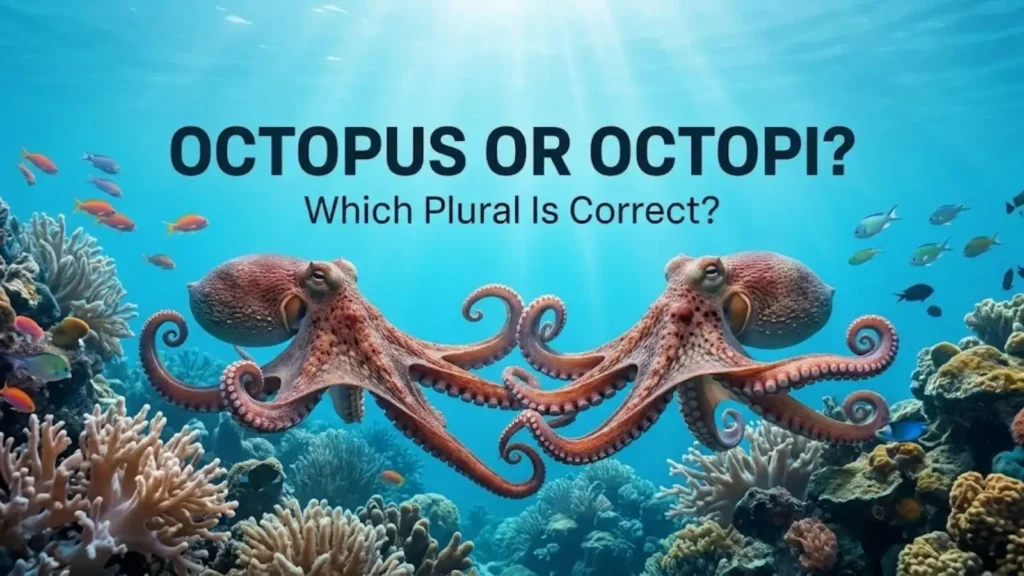
Octopus or Octopi – Quick Answer
Both octopuses and octopi are accepted English plurals of octopus. However, octopuses is a straightforward choice because it follows the regular English plural rule. Octopi is also widely recognized, although its formation applies a Latin-style plural ending to a word of Greek origin.
- ✅ Octopus: The singular form, referring to one animal.
- ✅ Octopuses: A standard English plural for two or more animals.
- ✅ Octopi: An accepted and commonly used alternative plural.
- ⚠️ Octopodes: A less common plural based on Greek word formation.
Examples
- ✅ One octopus was hiding beneath the rock.
- ✅ Three octopuses were swimming near the reef.
- ✅ Several octopi appeared in the aquarium exhibit.
- ✅ The scientific discussion mentioned multiple octopodes.
All four examples are grammatically possible in appropriate contexts, although octopodes is uncommon in ordinary conversation.
| Word or Form | Correctness | Meaning or Usage |
|---|---|---|
| Octopus | Correct | Singular: one animal |
| Octopuses | Correct | Standard English plural |
| Octopi | Accepted | Common alternative plural |
| Octopodes | Accepted but uncommon | Plural based on Greek formation |
The key point is simple:
you do not need to avoid octopi, but octopuses is an excellent default for clear, everyday English.
Meaning and Definition of Octopus or Octopi
What Does Octopus Mean?
An octopus is a marine animal belonging to the class Cephalopoda. It has eight arms, a soft body, and no internal skeleton like that of a typical vertebrate. Octopuses are known for their intelligence, camouflage abilities, and capacity to move through narrow spaces.
The word octopus is a singular countable noun. Use it when referring to one individual animal.
Examples:
- The octopus changed color to blend into its surroundings.
- The singular noun identifies one animal.
- A small octopus crawled beneath the coral.
- The article a signals that the noun is singular.
- The aquarium introduced a new octopus to its marine exhibit.
- The sentence refers to one newly introduced animal.
What Does Octopuses Mean?
Octopuses is the regular English plural of octopus. It refers to two or more individual animals and is suitable for everyday writing, educational materials, and general scientific communication.
English commonly forms plurals by adding -s or -es. In this case, adding -es creates the plural octopuses.
Examples:
- Several octopuses live among the rocks.
- The plural noun refers to multiple animals.
- The researchers observed two octopuses during the study.
- The word correctly follows the number two.
- Young octopuses often hide in small crevices.
- The plural describes animals in general.
What Does Octopi Mean?
Octopi is an alternative plural of octopus. It is widely used in English and is especially familiar to readers who expect certain nouns ending in -us to form plurals ending in -i.
However, the word octopus comes from Greek, not Latin. Therefore, octopi applies a Latin-style plural pattern rather than directly following the original Greek formation.
Examples:
- The divers spotted several octopi near the reef.
- The plural refers to multiple animals.
- The documentary showed octopi hunting for crabs.
- The word functions as the plural subject.
- Visitors watched the octopi move around their enclosure.
- The noun refers to more than one animal.
Although octopi is acceptable, writers who want a simple, widely understood English plural can choose octopuses.
What Does Octopodes Mean?
Octopodes is another plural form, based on Greek word formation. It is much less common than octopuses and octopi, so most readers will encounter it less often.
Examples:
- The linguistics discussion mentioned octopodes as a possible plural.
- The word appears in a discussion about language.
- The author compared octopodes with other Greek-derived forms.
- It illustrates a grammatical comparison.
- The specialist used octopodes in a discussion of word origins.
- The plural appears in a specialized linguistic context.
For most readers, this form is interesting to know but unnecessary in everyday writing.
The Origin and History of Octopus or Octopi
The word octopus comes from Greek. It is formed from elements associated with oktō, meaning “eight,” and pous, meaning “foot.” This origin reflects the animal’s eight arms, which are often called tentacles in everyday conversation, although zoologists distinguish arms from true tentacles in cephalopods.
The Greek origin helps explain why the plural question is more complicated than it first appears. In Greek, the corresponding plural formation is associated with octopodes. However, English has its own plural rules, and borrowed words do not always retain the original language’s grammar.
The form octopuses follows the familiar English pattern of adding -es. Meanwhile, octopi developed through the use of a Latin-style plural ending, even though octopus is Greek in origin. This explains why some people question whether octopi is the best choice.
English regularly adopts words from Greek, Latin, French, and other languages. Over time, these words often develop plural forms that fit English usage. Consequently, a word’s original language does not always determine the only acceptable plural in modern English.
See also: Casi Algo Meaning: Full Guide to Love, Feelings, and Relationships
Main Differences Between Octopus and Octopi
The main difference between octopus, octopuses, and octopi is grammatical number and plural formation.
- Octopus is singular.
- Octopuses is a standard English plural.
- Octopi is an accepted alternative plural.
- Octopodes is a less common Greek-based plural.
| Feature | Octopus | Octopuses | Octopi |
|---|---|---|---|
| Grammatical number | Singular | Plural | Plural |
| Meaning | One animal | Multiple animals | Multiple animals |
| Formation | Base noun | English plural ending | Latin-style plural ending |
| Everyday usage | Very common | Very common | Common |
| Best use | One animal | Clear general writing | Accepted alternative |
Singular and Plural Agreement
The form you choose must agree with the rest of the sentence.
- ✅ The octopus is resting in its den.
- ✅ The octopuses are resting in their dens.
- ✅ The octopi are resting in their dens.
- ❌ The octopuses is resting in its den.
The final example contains an agreement error because octopuses is plural, while is is singular.
Is Octopi More Correct Because of Latin?
No. The ending -i is associated with certain Latin plural forms, such as cactus/cacti. However, octopus comes from Greek, so treating octopi as the only correct plural is misleading.
British English vs American English
There is no major British-versus-American spelling difference between octopuses and octopi. Both forms are used in English, and the choice is not governed by a strict regional spelling rule.
In both British and American writing, octopuses is a clear, standard option. Octopi is also familiar and accepted. Individual publications may prefer one form, especially in scientific or educational content.
| Writing Context | Recommended Form | Reason |
|---|---|---|
| British English | Octopuses | Standard English plural |
| American English | Octopuses | Standard English plural |
| Informal writing | Octopuses or octopi | Both are understandable |
| Linguistic discussion | Octopodes may appear | Useful when discussing Greek formation |
| School assignments | Usually octopuses | Clear and easy to explain |
For formal work, follow your teacher’s instructions, publisher’s style guide, or organization’s editorial rules. The most important point is to use the plural consistently and correctly.
Which Form Should You Use?
School and University Assignments
Use octopuses unless your teacher or assignment specifically requests another form. It follows a familiar English plural rule and avoids unnecessary discussion about Latin and Greek endings.
Example: “The researchers observed three octopuses near the seabed.”
Professional and Academic Writing
In scientific writing, octopuses is a practical choice because it is clear and widely understood. If you are writing a linguistic article about plural forms, you can discuss octopi and octopodes as well.
Always follow the publication’s preferred style when one is provided.
Everyday Conversation
In conversation, both octopuses and octopi are understandable. You can use either, although octopuses follows the regular English pattern.
Social Media and Informal Writing
Both forms work in ordinary posts and captions. Choose the one that sounds natural to you, and avoid correcting someone simply for using octopi.
Common Mistakes to Avoid
1. Treating Octopi as the Only Correct Plural
❌ The only correct plural is octopi.
✅ Both octopuses and octopi are accepted plurals.
Why? English uses both forms. The regular plural octopuses is not incorrect simply because another form exists.
2. Using Octopus for Multiple Animals
❌ Three octopus were swimming near the reef.
✅ Three octopuses were swimming near the reef.
Why? In standard English, a countable noun needs a plural form when referring to more than one animal.
3. Using a Singular Verb With a Plural Noun
❌ The octopi is hiding under the rock.
✅ The octopi are hiding under the rock.
Why? Octopi is plural, so it normally takes the plural verb are.
4. Assuming Octopi Comes Directly From Greek
❌ Octopi is the original Greek plural of octopus.
✅ Octopi is an English plural formed using a Latin-style ending; octopodes reflects Greek plural formation.
Why? The word octopus has Greek roots, but octopi follows a Latin-style pattern.
5. Calling Octopodes the Only Correct Greek-Based Form in English
❌ Octopuses is incorrect because octopodes is the Greek-based plural.
✅ Octopuses is a standard English plural, while octopodes is a less common alternative.
Why? Modern English accepts plural forms that follow English patterns, even when a word originally came from another language.
Octopus or Octopi in Everyday English
Everyday Conversation
- “We saw two octopuses at the aquarium.”
- “The documentary showed several octopi hunting for food.”
Both sentences are correct. Each plural refers to multiple animals.
School and Education
- “The class learned how octopuses protect themselves.”
- “The teacher explained why some writers use octopi.”
The first sentence uses a standard plural, while the second discusses an alternative form.
Blogging and Content Writing
- “Octopuses use camouflage to blend into their surroundings.”
- “Is octopi correct? Yes, it is an accepted plural.”
These examples work well in educational and wildlife content because they are direct and easy to understand.
Science and Nature Writing
- “Researchers observed several octopuses during the survey.”
- “The report described the behavior of octopi in different habitats.”
Both forms can appear in science-related writing. Nevertheless, use octopuses when you want a straightforward, broadly accepted plural.
Quick Tips to Remember the Correct Form
- One animal: Write octopus.
- More than one: Use octopuses as your everyday default.
- Remember the alternative: Octopi is also accepted.
- Know the origin: The word comes from Greek, so octopi is not a direct Greek plural.
- Keep agreement correct: Write “the octopuses are,” not “the octopuses is.”
The easiest rule is to remember that octopus is singular and octopuses is a standard plural. You can use octopi when it suits your writing, but you do not need it to make your grammar correct.
FAQs About Octopus or Octopi
1. Is octopus or octopi correct?
Octopus is singular, while octopi is an accepted plural. However, octopuses is also correct and is a straightforward choice in everyday English.
2. What is the correct plural of octopus?
The standard English plural is octopuses. Octopi is another accepted form, and octopodes is a less common alternative based on Greek formation.
3. Why do people say octopi?
People use octopi because English speakers have applied a familiar Latin-style plural ending to the word. Although the word comes from Greek, octopi has become an established plural in English.
4. Is octopuses grammatically correct?
Yes. Octopuses follows a regular English plural pattern and is widely accepted. You can use it in formal writing, schoolwork, and everyday conversation.
5. Is octopi a real word?
Yes. Octopi is an established English plural of octopus. It is not the only correct plural, however, and octopuses is equally acceptable.
6. Is octopodes correct?
Yes, octopodes is a recognized but uncommon plural associated with Greek word formation. Most readers will be more familiar with octopuses or octopi.
7. Do British and American English use different plurals?
There is no strict regional distinction that makes one plural British and another American. Both British and American writers use octopuses and octopi.
8. Should I use octopuses in formal writing?
Yes. Octopuses is a clear and reliable choice for formal writing. If a publication has a style guide, follow its preferred form.
9. What is the difference between octopus and octopuses?
Octopus refers to one animal, while octopuses refers to two or more. The verb in the sentence should agree with the noun’s number.
10. Is octopi more correct than octopuses?
No. Neither plural is universally more correct than the other. Octopuses follows standard English plural formation, while octopi is an accepted alternative.
Conclusion
When deciding between octopus or octopi, remember that octopus is singular, while octopuses and octopi are accepted plurals. Although octopi is familiar to many English speakers, it uses a Latin-style ending for a word that comes from Greek. Meanwhile, octopuses follows a regular English plural pattern and is a clear choice for everyday and formal writing.
You may also encounter octopodes, a less common plural based on Greek formation. However, you rarely need it outside discussions of language or word history.
For school assignments, educational websites, and professional writing, choose octopuses unless a style guide specifies otherwise. Most importantly, use the correct singular or plural form and make sure your verbs agree. With this simple rule, you can write about these remarkable marine animals with confidence.

Hi, I’m Mason Clark, the writer behind Wordspry!
My goal is to make grammar learning easier with straightforward explanations, useful examples, and engaging English lessons that help you grow every day.