Have you ever stopped while writing a sentence and wondered whether you should use led or lead? You are not alone. These two words look very similar, but they do not always have the same meaning, tense, or pronunciation.
The confusion usually appears when someone wants to describe an action that happened in the past. For example, should you write, “She led the team” or “She lead the team”? The correct answer is led because it is the past tense of lead.
However, lead is still correct in many other situations. It can describe a present or future action, a position of advantage, or the chemical element. It can also have different pronunciations depending on its meaning.
Led or Lead – Quick Answer
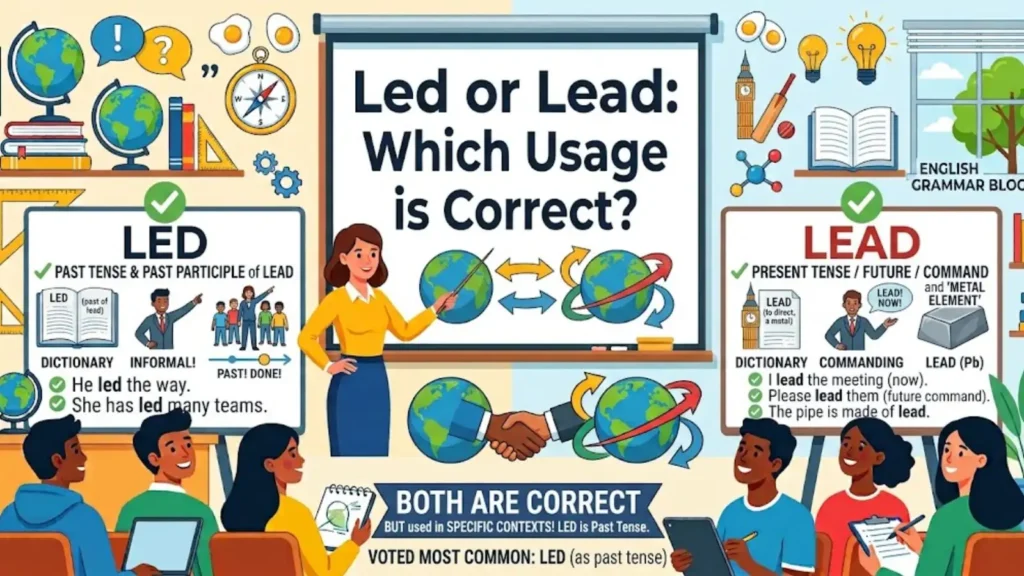
Lead is the present form of the verb meaning to guide, direct, or be in charge.
Led is the past tense and past participle of lead.
Examples
- I lead the team every Monday.
- She led the team yesterday.
- They will lead the project next year.
- He has led the company for five years.
A simple rule is:
Present = lead
Past = led
There is another important use of lead. It can refer to the heavy metal with the chemical symbol Pb.
- The old pipes contained lead.
- Scientists tested the water for lead.
This meaning of lead is pronounced like “led.”
When lead means “guide,” however, it is pronounced like “leed.” Cambridge gives the pronunciation /liːd/ for the verb and /led/ for the metal.
Quick Comparison
| Word | Meaning | Pronunciation | Example |
|---|---|---|---|
| lead | Guide or direct | “leed” | I will lead the group. |
| led | Past form of lead | “led” | She led the group. |
| lead | Heavy metal | “led” | The paint contained lead. |
The Origin of Led or Lead
The word lead has a long history in English. The verb meaning “to guide” comes from Old English lædan, which meant to guide, accompany, or show the way. It is connected to older Germanic words related to traveling or going.
Over time, the verb developed several meanings. It came to mean guiding people, being in front, directing an activity, and being in a position of leadership.
For example:
- The guide leads visitors through the museum.
- The captain leads the team.
- She led the group through the forest.
The past form led developed from this same verb. It is an irregular verb form, so lead does not become “leaded” when talking about the normal past action of guiding someone.
There is also a separate word lead, meaning the heavy metal. Its history is different from the verb. The metal word comes from Old English lead and has Germanic roots.
This creates an unusual situation. Modern English has:
- lead = guide
- led = guided in the past
- lead = a metal
The spelling of lead stays the same in its two main meanings, but the pronunciation changes.
Interestingly, the journalism term lede developed as an alternative spelling for lead in the newspaper sense. It was used to help distinguish that meaning from other meanings of lead.
British English vs American English Spelling
There is no major British-American spelling difference between lead and led.
Both British English and American English use:
- lead for the present form of the verb
- led for the past form
- lead for the metal
The difference is therefore not about whether you are writing for the United States or the United Kingdom. It is mainly about meaning, tense, and pronunciation.
Comparison Table
| Usage | British English | American English |
|---|---|---|
| Present verb | lead | lead |
| Past verb | led | led |
| Past participle | led | led |
| Metal | lead | lead |
| Lead = guide pronunciation | “leed” | “leed” |
| Lead = metal pronunciation | “led” | “led” |
For example, both varieties use:
She leads the department.
And:
She led the department last year.
So, unlike spelling pairs such as colour/color or centre/center, you do not need to change lead or led based on your audience.
Which Spelling Should You Use?
The correct spelling depends on the meaning and time of the action, not your country.
Use “Lead” for the Present
Use lead when the action is happening now or describes something that regularly happens.
Examples:
- I lead the team.
- She leads the department.
- They lead the discussion every Friday.
- Good teachers lead by example.
Use “Lead” for the Future
Use lead after words such as will, can, may, or to.
Examples:
- She will lead the meeting.
- He can lead the project.
- They may lead the campaign.
- We want to lead the discussion.
Use “Led” for the Past
Use led when the action has already happened.
Examples:
- She led the meeting yesterday.
- He led the team last year.
- The guide led us to the village.
- The coach led the players to victory.
Use “Lead” for the Metal
Use lead when you mean the chemical element.
Examples:
- The old paint contained lead.
- The workers found lead in the pipes.
- The laboratory tested the sample for lead.
Easy Memory Trick
Remember this sentence:
Today I lead. Yesterday I led.
This simple pattern can help you choose the correct word quickly.
Common Mistakes with Led or Lead
Many mistakes happen because lead and led look so similar.
Mistake 1: Using Lead for the Past
❌ She lead the team last year.
✅ She led the team last year.
The action happened last year, so you need the past form led.
Mistake 2: Using Led for the Present
❌ He led the team every Monday.
If you mean that he currently does this every Monday, write:
✅ He leads the team every Monday.
However, led can be correct if you are describing a past routine:
✅ He led the team every Monday last year.
The time reference changes the answer.
Mistake 3: Writing “Leaded”
❌ She leaded the group.
For the normal verb meaning “guide,” the past form is not leaded.
✅ She led the group.
However, leaded can appear in special technical contexts related to covering something with lead or adding lead to something. It is not the normal past tense of the verb lead.
Mistake 4: Confusing Pronunciation
The spelling can be misleading because lead has two common pronunciations.
Lead = guide
I will lead the team.
This sounds like “leed.”
Lead = metal
The pipe contains lead.
This sounds like “led.”
Led = past tense
She led the team.
This also sounds like “led.”
Therefore, led and the metal lead sound the same, but they have different spellings and meanings.
Led or Lead in Everyday Examples
Knowing the rule is useful, but seeing the words in real situations makes the difference easier to remember.
In Emails
Present or future:
I will lead the meeting tomorrow.
Past:
Sarah led the meeting yesterday.
In Business Writing
Mr. Brown will lead the new project.
Ms. Brown led the project successfully last year.
In News Writing
News reports often describe completed events using led.
The coach led the team to an important victory.
For journalism, lead can also be a noun meaning the opening or introductory part of a news story. The alternative spelling lede is also used in journalism.
On Social Media
Proud of our team! Sarah led us to a great result.
Or:
Excited to lead this amazing project!
In Academic Writing
The study led to several important findings.
Strong evidence may lead to a different conclusion.
In Everyday Conversation
Can you lead the way?
He led us home.
She will lead the group.
The old building contains lead.
These examples show why context is so important.
Led or Lead – Google Trends & Usage Data
People search for led or lead because the two words are closely related but have different grammatical functions. The most common question is whether lead or led should be used when describing something that happened in the past.
Search interest can vary by country, language background, education level, and context. For example, learners may search for “lead or led past tense,” “led or lead the team,” or “is lead the past tense of lead?”
It is important not to confuse general search popularity with correct usage. Google Trends data can change over time and can also vary significantly depending on the selected country and date range.
The grammar rule itself is stable:
- lead = present/base verb
- led = past and past participle
- lead = metal
- lead = several noun meanings, including an advantage or position in front
The word lead also has many meanings beyond this spelling question. As a noun, it can refer to a position at the front, a clue, or other forms of advantage. This broader range helps explain why lead appears in many different contexts.
For professional writing, it is better to focus on the sentence’s meaning rather than search popularity.
Led or Lead: Comparison Table
| Feature | Led | Lead |
|---|---|---|
| Main grammar role | Past tense | Base/present verb |
| Meaning | Guided or directed in the past | Guide or direct |
| Pronunciation | “led” | “leed” when meaning guide |
| Can describe past action? | Yes | No, not as the normal past form |
| Can describe present action? | No | Yes |
| Can describe future action? | No by itself | Yes |
| Can mean metal? | No | Yes |
| Example | She led the team. | She will lead the team. |
FAQs About Led or Lead
1. Is “led” the past tense of “lead”?
Yes. Led is the past tense and past participle of lead when lead means to guide, direct, or be in charge.
Example:
She led the team yesterday.
2. Is it “lead” or “led” for the past tense?
Use led.
Correct:
He led the meeting last week.
Incorrect:
He lead the meeting last week.
3. Is “lead” ever pronounced like “led”?
Yes. When lead means the metal, it is pronounced like led.
Example:
The pipes contain lead.
Cambridge lists the metal pronunciation as /led/.
4. Is “lead” pronounced “leed”?
Yes, when lead is the verb meaning to guide or direct.
Example:
I will lead the group.
It is pronounced /liːd/.
5. What is the past participle of lead?
The past participle is led.
Examples:
She has led the team for five years.
They have led several successful projects.
6. Is “leaded” the past tense of lead?
No, not when lead means guide or direct.
The normal past tense is:
lead → led
So write:
He led the team.
7. Do British and American English use led differently?
No. Both British and American English use led as the past tense of lead. The main difference is meaning and pronunciation, not regional spelling.
Conclusion
Understanding led or lead is easier once you focus on the tense and meaning of the sentence. Lead is the base form of the verb when it means to guide, direct, or be in charge. Led is its past tense and past participle.
For example, you can say, “I lead the team today,” but you should say, “I led the team yesterday.” The word lead also has another important meaning: the heavy metal. In that case, it is pronounced like led.
There is no major difference between British and American spelling. Both varieties use lead and led in the same way. Therefore, your choice should depend on the sentence, not your location.
The easiest memory trick is simple: Today I lead; yesterday I led. If you are talking about the metal, use lead. With this rule and a little practice, you can avoid one of the most common English word-choice mistakes.

Hi, I’m Henry Collins, the educator behind Wordspry.com
I’m dedicated to helping English learners build confidence through easy grammar explanations, writing tips, and everyday language learning resources.