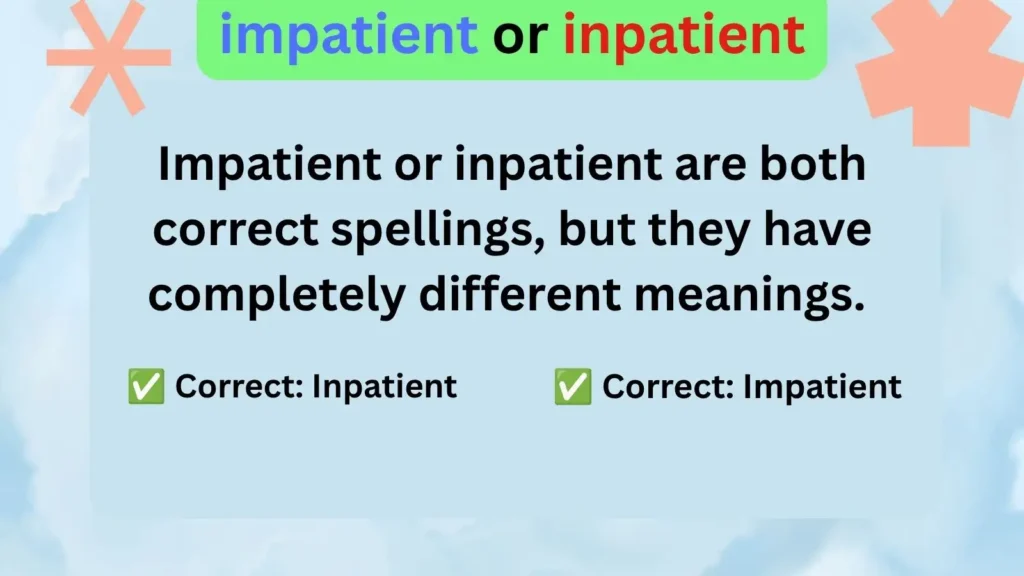
Impatient or inpatient are both correct spellings, but they have completely different meanings. One describes a person who cannot wait calmly, while the other describes a person receiving medical care in a hospital.
This small spelling difference can cause a big change in meaning. For example, saying “The patient is impatient” means the person does not want to wait. Saying “The patient is an inpatient” means the person stays in a hospital or another medical facility for treatment.
People often confuse these words because they look and sound very similar. Both contain patient, and the prefix im- or in- can be easy to overlook while reading or typing. However, English grammar gives each word a separate job.
Understanding the difference can improve your English writing, vocabulary, and communication. It can also help you avoid an embarrassing spelling mistake, especially in medical, academic, or professional writing.
In this guide, we will explain the correct spelling, word meaning, pronunciation, grammar rules, common mistakes, and everyday usage of impatient or inpatient. You will also see simple examples that make the difference easy to remember.
By the end, you will know exactly when to use impatient and when to use inpatient.
Quick Answer
✅ Correct: Impatient
Impatient describes someone who does not want to wait or who becomes annoyed because something takes too long.
Example:
Sarah became impatient after waiting for an hour.
✅ Correct: Inpatient
Inpatient describes a person who stays in a hospital or medical facility while receiving treatment.
Example:
The hospital admitted him as an inpatient.
❌ Is either word incorrect?
No. Both words are correct. The important difference is their meaning.
| Word | Meaning | Example |
|---|---|---|
| Impatient | Unable or unwilling to wait calmly | The children were impatient for lunch. |
| Inpatient | A person receiving treatment while staying in a medical facility | The hospital treated her as an inpatient. |
Simple rule
Think of the words this way:
Impatient = cannot wait
Inpatient = stays in a medical facility
That simple distinction will help you choose the correct word.
What Does Impatient Mean?
Impatient is an adjective that describes someone who becomes annoyed, restless, or frustrated when they have to wait.
It can also describe someone who wants something to happen immediately.
For example:
I became impatient while waiting for the bus.
The speaker does not enjoy waiting.
You can also use impatient when someone wants to do something without delay:
The students were impatient to start the trip.
Here, the students are eager and unwilling to wait.
Everyday meaning
In everyday English, impatient usually means not willing to wait calmly.
Common situations include waiting for:
- A bus
- A meal
- A phone call
- A reply
- A doctor
- A delivery
- A meeting
- A decision
For example:
Mark grew impatient when his food did not arrive.
Academic meaning
In academic writing, impatient can describe a person, group, or attitude that shows a lack of patience.
The researchers became impatient with the repeated delays.
Professional meaning
In the workplace, people often use impatient to describe a customer, manager, client, or employee who wants quick results.
The client became impatient after several delays.
Real-life examples
- My brother gets impatient in long lines.
- The customer sounded impatient on the phone.
- She was impatient to hear the final decision.
- The children became impatient during the long journey.
Interesting fact
The word impatient does not always mean angry. Sometimes it simply means eager for something to happen.
For example:
I am impatient to see my new house.
This sentence can express strong eagerness rather than anger.
What Does Inpatient Mean?
Inpatient is mainly a medical term. It refers to a person who stays in a hospital or other healthcare facility while receiving treatment.
For example:
The doctor admitted the patient as an inpatient.
The person will remain in the facility instead of receiving treatment and leaving immediately.
The word can also describe medical care itself.
She needs inpatient treatment.
This means she needs treatment that requires her to stay at a healthcare facility.
Inpatient vs outpatient
One of the easiest ways to understand inpatient is to compare it with outpatient.
An inpatient stays in a healthcare facility for treatment.
An outpatient receives medical care but does not stay overnight or remain admitted as an inpatient.
For example:
The hospital admitted James as an inpatient.
Maria visited the clinic as an outpatient.
This difference appears often in medical records, hospital websites, insurance documents, and healthcare discussions.
Professional meaning
Healthcare professionals commonly use inpatient when discussing:
- Hospital admissions
- Medical treatment
- Hospital wards
- Patient care
- Healthcare services
- Insurance claims
- Medical records
For example:
The hospital has expanded its inpatient services.
Real-life examples
- The doctor recommended inpatient care.
- The hospital has 200 inpatient beds.
- The nurse checked on every inpatient.
- His condition required inpatient treatment.
Why “Impatient” and “Inpatient” Cause Confusion
The confusion comes from their similar appearance.
Both words contain patient:
- im + patient = impatient
- in + patient = inpatient
The prefixes look small, but they change the meaning.
Impatient
The prefix im- creates a word related to a lack of patience.
Impatient = lacking patience or unwilling to wait
Inpatient
The prefix in- helps form a medical term referring to someone who remains inside a healthcare facility for treatment.
Inpatient = a person receiving care while staying in a medical facility
Pronunciation confusion
The two words also sound similar.
However, their stress patterns help distinguish them.
Impatient: im-PAY-shunt
Inpatient: IN-pay-shunt
When speaking quickly, the difference can become difficult to notice. This explains why some people type the wrong word after hearing it.
Simple memory trick
Use this trick:
Impatient has “im” for “I’m not waiting!”
I’m not waiting! → impatient
For inpatient, remember:
Inpatient = in a hospital
The word in can remind you that the person stays in a medical facility.
Origin and Etymology
The two words developed from different linguistic ideas.
Origin of “impatient”
Impatient comes from Latin impatīēns, which relates to a lack of patience or an inability to endure something calmly.
The word passed through French before becoming part of English vocabulary.
The base word patient has an important connection with the idea of enduring or tolerating something. Its history ultimately goes back to Latin pati, meaning “to suffer” or “to endure.”
Over time, English developed impatient to describe someone who cannot tolerate waiting or delay.
Today, the word has both emotional and practical uses.
Origin of “inpatient”
Inpatient developed in English from in- and patient.
In medical language, it came to describe a person who remains in a healthcare institution while receiving treatment.
Modern healthcare uses the term widely in hospitals, medical reports, insurance systems, and patient-care discussions.
The related word outpatient creates a useful contrast:
- Inpatient → stays in the facility
- Outpatient → receives treatment without being admitted to stay
Therefore, although both words contain patient, their prefixes give them very different meanings.
Pronunciation Guide
Correct pronunciation can help prevent confusion.
Impatient
A common pronunciation is:
im-PAY-shunt
The stress usually falls on the second syllable.
impatient → im-PAY-shunt
Inpatient
A common pronunciation is:
IN-pay-shunt
The first part receives stronger stress.
inpatient → IN-pay-shunt
Are US and UK pronunciations different?
American and British English generally pronounce both words in very similar ways. Minor differences in accent may occur, but the meanings remain the same.
Common pronunciation mistake
Some learners pronounce both words exactly alike. This can cause confusion when speaking about medical care.
Practice saying:
I am impatient.
Then:
He is an inpatient.
Focus on the opening sound.
Easy pronunciation trick
Remember:
im-PAY-shunt = cannot wait
IN-pay-shunt = medical patient staying inside
This connection can make both pronunciation and meaning easier to remember.
How the Words Are Used in Modern English
Both words remain common, but they appear in different contexts.
Daily conversation
People commonly use impatient in everyday conversations.
Why are you so impatient?
I am getting impatient.
The word often describes emotions and behavior.
Academic writing
Academic writers may use impatient when describing attitudes or reactions.
Participants became impatient during the lengthy process.
Inpatient appears more often in healthcare research.
The study examined inpatient recovery times.
Business writing
Impatient can describe customers or managers.
The customer became impatient after receiving no response.
Inpatient may appear in business documents connected with healthcare.
The company provides services for inpatient care.
Professional communication
Medical professionals frequently use inpatient.
The patient requires inpatient treatment.
General professionals may use impatient when describing behavior.
The manager appeared impatient during the meeting.
Digital communication
Both words can appear online.
Social media users often write:
I am so impatient for the new update!
Medical websites may say:
Our hospital offers comprehensive inpatient services.
Context makes the intended meaning clear.
Common Collocations
A collocation is a group of words that commonly appear together.
| Word | Common Collocation | Example |
|---|---|---|
| Impatient | impatient person | He is an impatient person. |
| Impatient | impatient customer | The impatient customer asked for help. |
| Impatient | impatient with | She became impatient with the delay. |
| Impatient | impatient to | They were impatient to begin. |
| Impatient | grow impatient | We grew impatient after two hours. |
| Inpatient | inpatient care | The patient needs inpatient care. |
| Inpatient | inpatient treatment | Doctors recommended inpatient treatment. |
| Inpatient | inpatient services | The hospital provides inpatient services. |
| Inpatient | inpatient unit | He was moved to the inpatient unit. |
| Inpatient | inpatient admission | The doctor approved the inpatient admission. |
Learning these phrases can improve your English vocabulary and natural word usage.
Difference Between Similar Words
The easiest way to understand impatient or inpatient is to compare related words.
| Word | Meaning | Example |
|---|---|---|
| Impatient | Not willing to wait calmly | She became impatient. |
| Patient | Able to wait calmly | He remained patient. |
| Inpatient | Person staying in a healthcare facility for treatment | The hospital admitted the inpatient. |
| Outpatient | Person receiving treatment without being admitted to stay | She visited as an outpatient. |
| Eager | Very excited or interested in doing something | They were eager to begin. |
| Restless | Unable to relax or stay still | The child became restless. |
Impatient vs patient
These words are opposites in one common sense.
She is patient and can wait calmly.
She is impatient and wants an immediate answer.
Inpatient vs outpatient
These terms belong mainly to healthcare.
The hospital admitted him as an inpatient.
The clinic treated her as an outpatient.
Remember that inpatient does not mean “the opposite of impatient.” They belong to different areas of meaning.
Grammar Rules
Impatient as an adjective
Impatient is an adjective.
It describes a person, attitude, or reaction.
He is impatient.
She gave an impatient sigh.
The impatient customer complained.
You can also use it after linking verbs such as become, seem, feel, and grow.
I feel impatient.
They became impatient.
Inpatient as a noun
Inpatient can function as a noun.
The hospital admitted three inpatients.
Here, inpatients means three people receiving treatment while staying in the facility.
Inpatient as an adjective
It can also function as an adjective.
The hospital provides inpatient care.
She needs inpatient treatment.
Singular and plural
The plural noun form is:
inpatient → inpatients
For example:
The ward has ten inpatients.
Impatient does not normally have a plural form because it is an adjective.
You would not write:
❌ impatients
Instead, say:
impatient people
Articles
When inpatient acts as a singular countable noun, you can use an article.
He is an inpatient.
She became an inpatient yesterday.
When it works as an adjective, the article belongs to the noun that follows.
He needs inpatient treatment.
Real Sentence Examples
Daily life
I became impatient while waiting for the train.
The children were impatient to open their gifts.
She gets impatient when people arrive late.
School
The students became impatient during the long presentation.
He was impatient to receive his exam results.
Workplace
The manager became impatient after several delays.
The client sounded impatient during the phone call.
Healthcare
The doctor recommended inpatient treatment.
The hospital admitted him as an inpatient.
The nurse checked on every inpatient.
Positive examples
The team was impatient to begin the new project.
Here, impatient means eager.
The patient received excellent inpatient care.
Negative examples
Do not become impatient while you wait.
The doctor said that inpatient care was not necessary.
These examples show how context controls the meaning.
Common Spelling Mistakes
Writers often make mistakes because impatient and inpatient look almost identical.
Mistake 1: Using “inpatient” for lack of patience
❌ I became inpatient while waiting for my order.
✅ I became impatient while waiting for my order.
The sentence describes frustration with waiting, so impatient is correct.
Mistake 2: Using “impatient” for hospital care
❌ The doctor recommended impatient treatment.
✅ The doctor recommended inpatient treatment.
The sentence describes medical care that requires a patient to stay in a healthcare facility.
Mistake 3: Confusing pronunciation
Because the words sound similar, people sometimes choose the wrong spelling.
Always consider the context before choosing the word.
Mistake 4: Keyboard errors
Fast typing can turn impatient into inpatient or vice versa.
This mistake becomes especially important in medical writing because the meaning can change significantly.
Memory trick
Use two simple questions:
Am I talking about waiting?
Use impatient.
Am I talking about hospital care?
Use inpatient.
That rule solves most usage problems.
Why People Search “Impatient or Inpatient”
People search for impatient or inpatient because the two words look and sound very similar.
Their search intent usually falls into several categories.
Educational intent
Students want to know which spelling fits a sentence.
Grammar correction
Writers may notice a red underline in a document and wonder which word they need.
Writing improvement
Bloggers, employees, and students want to avoid incorrect word usage.
Student searches
English learners often search for the difference between similar words while building vocabulary.
Content writer searches
Professional writers may check the distinction before publishing an article, email, report, or medical-related document.
The main lesson is simple: both spellings are correct, but they do different jobs.
Real-Life Case Study
Imagine that a hospital employee writes a report about a patient’s treatment.
The employee writes:
“The doctor recommended impatient treatment.”
At first glance, the sentence may look acceptable. However, it contains the wrong word.
The correct sentence is:
“The doctor recommended inpatient treatment.”
Why?
Because the writer means treatment that requires the patient to stay in a healthcare facility.
Now consider a different sentence:
“The customer became inpatient after waiting for two hours.”
This sentence should use:
“The customer became impatient after waiting for two hours.”
The first mistake changes a medical term into a description of someone’s behavior. The second mistake makes a normal emotional reaction sound like a healthcare term.
In casual writing, readers may understand the intended meaning from context. However, professional and medical writing requires greater accuracy.
A single letter can change the meaning of an entire sentence. That is why careful word choice matters.
Expert Insight
A useful language-learning habit is to study confusing words in pairs.
Instead of memorizing impatient alone, learn it beside inpatient.
Then connect each word with a strong idea:
Impatient → waiting
Inpatient → hospital
This method creates a mental link between spelling and meaning.
When proofreading, do not check spelling only. Check whether the word makes sense in the sentence.
For example:
“The customer was inpatient.”
The spelling may look familiar, but the context should make you stop. A customer waiting for service is probably impatient, not inpatient.
As an English teacher might say:
“When two words look alike, let the meaning choose the spelling.”
That simple principle can help with many confusing English words.
Impatient or Inpatient: Final Comparison
| Feature | Impatient | Inpatient |
|---|---|---|
| Correct spelling? | Yes | Yes |
| Main meaning | Unable or unwilling to wait | Person receiving care while staying in a medical facility |
| Part of speech | Adjective | Noun and adjective |
| Related word | Patient | Outpatient |
| Common field | Everyday English | Healthcare |
| Example | She is impatient. | He is an inpatient. |
| Main clue | Waiting | Hospital care |
The words share patient, but their meanings are completely different.
FAQs About Impatient or Inpatient
1. Is “inpatient” a real word?
Yes. Inpatient is a standard English word, especially common in healthcare. It can refer to a person who stays in a medical facility for treatment or describe care provided to such patients.
2. What does “impatient” mean?
Impatient means unwilling or unable to wait calmly. It can also mean eager for something to happen quickly.
She was impatient to hear the results.
3. What does “inpatient” mean?
Inpatient usually refers to someone who stays in a hospital or other healthcare facility while receiving treatment.
The hospital admitted him as an inpatient.
4. Is “impatient” the opposite of “patient”?
In one common sense, yes. A patient person can wait calmly, while an impatient person becomes restless or frustrated while waiting.
5. Is “inpatient” the opposite of “outpatient”?
In healthcare, they describe different types of care. An inpatient stays in a healthcare facility, while an outpatient receives treatment without being admitted to stay.
6. Are “impatient” and “inpatient” pronounced differently?
Yes. They are very similar, but the opening sounds and stress patterns differ. Impatient is commonly pronounced im-PAY-shunt, while inpatient is commonly pronounced IN-pay-shunt.
7. Is “inpatient” a noun or adjective?
It can be both.
As a noun:
The hospital admitted two inpatients.
As an adjective:
She needs inpatient care.
8. Can “impatient” have a positive meaning?
Sometimes. It can express strong eagerness rather than anger.
I am impatient to see the finished project.
Here, the speaker strongly wants to see it.
9. What is an easy way to remember the difference?
Remember:
Impatient = cannot wait.
Inpatient = stays in a medical facility.
10. Which spelling should I use?
Use impatient when you mean someone who does not want to wait or who feels eager for something to happen. Use inpatient for medical care or a person who stays in a healthcare facility.
Conclusion
The difference between impatient or inpatient is simple once you connect each word with its meaning. Both spellings are correct, but you cannot use them interchangeably.
Use impatient when you describe someone who does not want to wait, becomes restless, or wants something to happen quickly. For example, “The customer became impatient after waiting for an hour.” The word can also describe strong eagerness, so it does not always express anger.
Use inpatient when you discuss healthcare. An inpatient is a person who stays in a hospital or medical facility while receiving treatment. The word can also describe services, care, treatment, or units connected with this type of medical stay.
The best memory trick is easy: impatient is about waiting, while inpatient is about medical care. When you are proofreading, always consider the meaning before choosing the spelling.
Whether you are writing an email, school assignment, blog post, business document, or medical text, using the right word makes your communication clearer and more professional.
Remember: If you cannot wait, you are impatient. If you stay in for medical care, you are an inpatient.

Hi, I’m Victoria Lane, the voice behind Wordspry!
I’m passionate about helping students and readers master English grammar, vocabulary, and writing through simple, friendly, and easy-to-follow content.