The word nostalgic appears in conversations about childhood, old songs, family traditions, movies, photographs, and memories. But what exactly does it mean, and how should you use it in a sentence? If you are unsure about the meaning, spelling, or usage of nostalgic, this guide makes it simple. We will explain its definition, origin, British and American usage, common mistakes, and practical examples. One important spelling note comes first: nostalgic is spelled with one “s”. Unlike words such as address or success, it does not contain a double s. Understanding that difference can help you avoid unnecessary spelling mistakes.
Nostalgic – Quick Answer
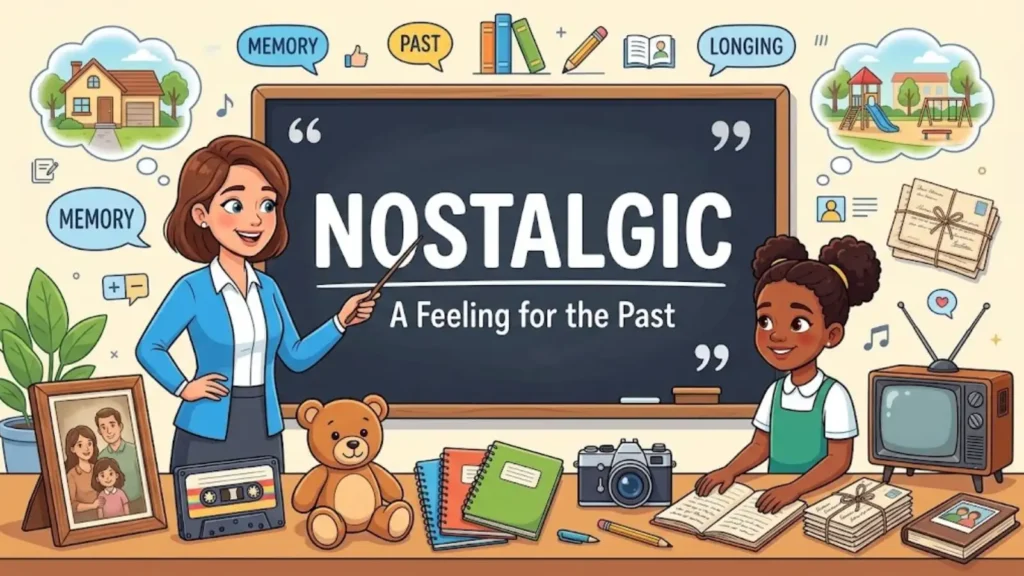
Nostalgic is an adjective that describes a warm, emotional feeling about something from the past. It often combines happiness with a little sadness because the moment cannot be experienced in exactly the same way again.
For example, you might feel nostalgic when you hear a childhood song, see an old school photograph, or visit your hometown. You can say, “That song makes me nostalgic for my childhood.”
RELATED: No Cuts No Buts No Coconuts: Meaning, Origin and Examples
Meaning of Nostalgic
The word nostalgic means feeling or showing a sentimental longing for an earlier time, place, person, or experience. It usually describes an emotional response to memories, rather than ownership, control, or a particular skill.
For example, someone may feel nostalgic about an old house, school, friendship, television show, or family tradition. The feeling can be pleasant but slightly sad because the past has changed.
Examples:
- I feel nostalgic when I see my old school.
- She became nostalgic while looking through family photos.
- That movie has a nostalgic atmosphere.
Why People Misspell Nostalgic
People sometimes misspell nostalgic because English contains many familiar words with double letters. Words such as address, success, and necessary can make writers expect similar patterns in other words.
However, nostalgic does not follow that pattern. Its correct spelling is n-o-s-t-a-l-g-i-c. Common typing mistakes can happen when people write quickly, rely on sound, or add an unnecessary second s. Spell-checkers may catch some errors, but remembering the word structure is more reliable.
Origin of Nostalgic
The history of nostalgic goes back to the word nostalgia. The term was coined in 1688 by Swiss physician Johannes Hofer. It was formed from Greek nostos, meaning “homecoming,” and algos, meaning “pain” or “distress.”
Originally, nostalgia referred to severe homesickness and was treated as a medical condition. Over time, its meaning changed. By the modern period, it commonly referred to sentimental feelings about the past. The adjective nostalgic developed from nostalgia with the suffix -ic.
British vs American English
There is no spelling difference between British and American English for nostalgic. Both varieties use the same spelling and the same basic meaning. Cambridge lists nostalgic as an adjective meaning that someone feels happy and slightly sad when thinking about things from the past.
| English Variety | Correct Spelling | Example |
|---|---|---|
| British English | nostalgic | I feel nostalgic about school. |
| American English | nostalgic | I feel nostalgic about school. |
| Both | nostalgic | She felt nostalgic for home. |
When to Use Nostalgic
You can use nostalgic in both formal and informal writing. It works well in essays, school assignments, emails, work reports, legal documents, and casual conversations when you need to describe an emotional connection to the past.
In formal writing, you might write, “The building has a nostalgic character.” Everyday speech, you could say, “I’m feeling nostalgic today.” In a legal document, the word may appear when describing a person’s emotional or historical connection to an event, property, or period.
Common Mistakes With Nostalgic
The most common spelling mistake is adding an unnecessary second “s.” The correct form is nostalgic, not nostalssgic or another invented double-letter variation.
| Incorrect | Correct |
|---|---|
| nostalssgic | nostalgic |
| nostalggic | nostalgic |
| nostaligic | nostalgic |
| nostalgick | nostalgic |
Another mistake comes from typing too quickly and accidentally changing the order of letters. Remember the basic pattern: nostalgic.
Everyday Examples of Nostalgic
The word nostalgic appears naturally in many types of communication. Someone might use it in an email after discussing an old workplace, while a social media user might describe a childhood photograph as nostalgic.
Examples:
- Email: “Looking through our old project photos made me feel nostalgic.”
- Social media: “This picture makes me so nostalgic for summer.”
- Professional writing: “The restaurant uses a nostalgic design inspired by the 1950s.”
- School assignment: “The author creates a nostalgic view of childhood.”
- Casual speech: “That old game makes me nostalgic.”
Usage Comparison Table
The following examples show how nostalgic works with objects, skills, historical or legal contexts, and everyday speech.
| Context | Correct Sentence | Incorrect Sentence |
|---|---|---|
| Object | This old camera makes me nostalgic. | This old camera makes me nostalgia. |
| Skill/activity | I feel nostalgic when I play that old game. | I feel nostalgia when I play that old game. |
| Legal/historical | The property has a nostalgic connection to the family. | The property has a nostalgicly connection to the family. |
| Daily speech | I’m feeling nostalgic about my childhood. | I’m feeling nostalgiac about my childhood. |
| School writing | The poem has a nostalgic tone. | The poem has a nostalgiac tone. |
Nostalgic vs. Nostalgia
Although these words are closely related, they have different grammatical jobs. Nostalgia is a noun that names the feeling, while nostalgic is an adjective that describes someone or something connected with that feeling.
For example, “The photograph brought back nostalgia” uses the noun. “The photograph has a nostalgic quality” uses the adjective. This simple distinction makes your writing clearer and prevents unnecessary grammatical mistakes.
How to Remember the Spelling of Nostalgic
A simple way to remember nostalgic is to connect it with its base word, nostalgia. The adjective simply adds -ic:
nostalgia → nostalgic
Also remember that the word begins with nost-, not nostalss- or another double-letter pattern. If you can spell nostalgia, adding -ic makes the adjective easier to remember.
FAQs About Nostalgic
What does nostalgic mean?
Nostalgic means feeling happy and slightly sad when thinking about something from the past. It often describes memories of childhood, family, places, music, or important experiences.
Is nostalgic a noun or adjective?
Nostalgic is an adjective. It describes a person, feeling, object, memory, atmosphere, or experience connected with the past.
How do you spell nostalgic?
The correct spelling is nostalgic. It contains one “s”, not a double “s.”
Is nostalgic the same as nostalgia?
No. Nostalgia is the feeling itself, while nostalgic describes something or someone experiencing or expressing that feeling.
Can nostalgic describe a person?
Yes. For example: “My father became nostalgic while looking at his childhood photographs.”
Is nostalgic spelled differently in British English?
No. Nostalgic has the same spelling in British and American English.
What is the origin of nostalgic?
Nostalgic comes from nostalgia, a word coined in 1688 from Greek nostos (“homecoming”) and algos (“pain” or “distress”).
Conclusion
Nostalgic describes a sentimental feeling connected with the past, often combining happiness with a touch of sadness. Its history is especially interesting because nostalgia originally described homesickness before developing its modern meaning.
For spelling, remember one key point: nostalgic has one “s.” Do not apply the double-s pattern from words such as address or success. When you remember nostalgia + -ic = nostalgic, the spelling becomes much easier.

Hi, I’m Henry Collins, the educator behind Wordspry.com
I’m dedicated to helping English learners build confidence through easy grammar explanations, writing tips, and everyday language learning resources.