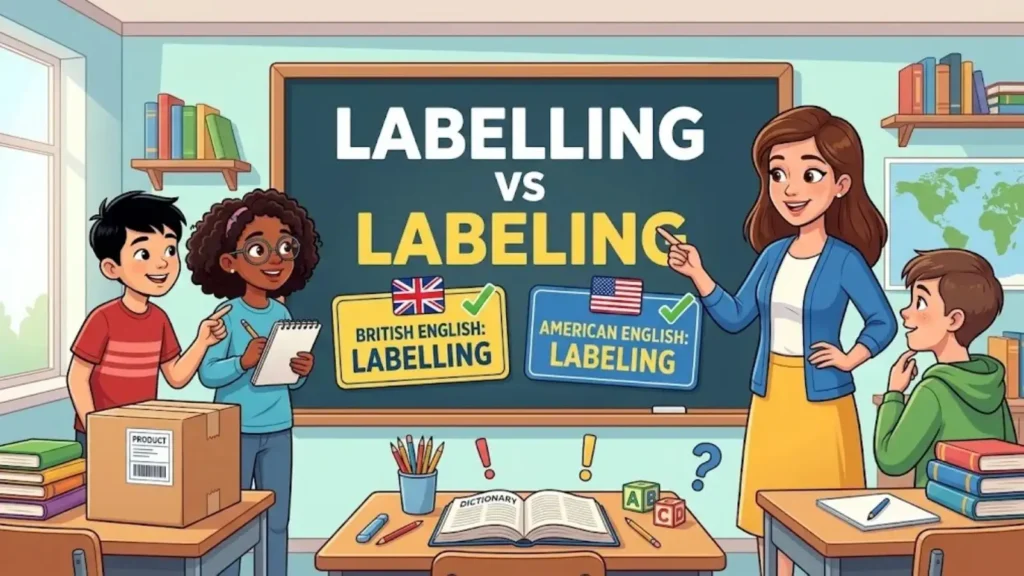
Labelling and labeling are both correct spellings. The main difference is regional: labelling is standard in British English, while labeling is standard in American English.
Have you ever written a word, looked at it twice, and wondered whether your spelling checker was right? That happens often with words that follow different British and American spelling rules. The debate over labelling vs labeling is a perfect example.
Imagine preparing product labels for an online store. You write, “Labelling Instructions” on a document, but your American colleague changes it to “Labeling Instructions.” Did you make a mistake? Not necessarily. Both spellings are accepted, but your colleague may be following a different regional standard.
Understanding this difference helps you write more confidently in school assignments, business emails, blog posts, and professional documents. It also prevents unnecessary corrections when communicating with readers from different countries.
The good news is that you do not need to memorize two completely different words. Both forms come from the verb label and have the same meaning. You only need to understand where each spelling is preferred and how to use it consistently.
Labelling vs Labeling: Core Meaning and Spelling Clarity
The easiest way to understand this spelling difference is to focus on the final consonant.
Both words describe the act of putting a label on something or identifying something with a label. Neither spelling changes the meaning, pronunciation, or grammatical function of the word.
What Does Labelling Mean?
Labelling is the British English spelling of the word. It is commonly used in the United Kingdom and in other places that follow British spelling conventions, including many contexts in Australia and New Zealand.
For example:
- The company is labelling its products before shipping.
- Food labelling rules help consumers understand ingredients.
- Proper labelling makes laboratory samples easier to identify.
- The teacher is labelling the parts of a diagram.
In each example, labelling describes an action involving labels or identification.
What Does Labeling Mean?
Labeling is the American English spelling. Writers in the United States generally use this form in education, business, product packaging, scientific writing, and everyday communication.
For example:
- The company is labeling its products before shipping.
- Food labeling rules help consumers understand ingredients.
- Proper labeling makes laboratory samples easier to identify.
- The teacher is labeling the parts of a diagram.
Notice that the meaning remains exactly the same. Only the spelling changes.
Why Does One Letter Make a Difference?
The difference comes from regional spelling conventions for verbs ending in a single vowel followed by a consonant.
In British English, the final consonant is commonly doubled before adding -ing when the relevant spelling rule applies. American English often keeps the consonant single in words such as labeling.
Therefore, the distinction is not about correctness in general. It is about following the spelling conventions expected by your audience.
Why Do People Get Confused About Labelling vs Labeling?
One extra letter can make a familiar word look incorrect, especially when you regularly read different types of English.
The confusion usually comes from three sources: regional spelling rules, automatic spellcheckers, and mixed-language content on the internet.
British and American Spelling Rules
British and American English often treat the final letter l differently when adding endings such as -ing and -ed.
For example:
| British English | American English |
|---|---|
| Labelling | Labeling |
| Labelled | Labeled |
| Travelling | Traveling |
| Cancelled | Canceled |
| Modelling | Modeling |
These differences are established spelling conventions, not signs that one country uses better English than another. Cambridge Dictionary identifies labelling as the UK form and labeling as the US form.
Spellcheckers Can Make the Confusion Worse
Imagine writing a report in British English. Your document contains the phrase “product labelling,” but your American English spellchecker underlines it.
You might assume you made a spelling mistake. However, the software may simply be using American English as its default language.
The reverse can happen when American writers use British English settings.
The solution: Set your spellchecker to the English variety you intend to use. This helps you catch genuine errors without unnecessarily changing correct regional spellings.
Online Articles Often Mix English Varieties
Blogs, international websites, and online stores sometimes combine British and American spellings.
For example, a page might use labelling in one paragraph and canceled in another. Both words are valid individually, but the combination may look inconsistent.
Choose one spelling style and follow it throughout the page. This simple habit makes your writing easier to read and more professional.
Labelling vs Labeling: Real-Life Meaning Explained
Both spellings describe the same everyday actions. Understanding the context makes the word even easier to remember.
1. Product Packaging
Think about a bottle of shampoo at your local supermarket. Its label might list the ingredients, directions, and expiry information.
- British English: The manufacturer is labelling every bottle.
- American English: The manufacturer is labeling every bottle.
The action is identical. Only the regional spelling changes.
2. School and Education
Teachers often label diagrams to help students understand complicated ideas.
For example, a science teacher might label the parts of a flower, while a geography teacher labels countries on a map.
- British English: The students are labelling the diagram.
- American English: The students are labeling the diagram.
Both sentences describe students adding names or identifying information.
3. Business and Shipping
Imagine an online shop preparing hundreds of parcels for delivery. Workers must label each package with the correct address.
- British English: The staff are labelling the parcels.
- American English: The staff are labeling the packages.
In both cases, clear labels help prevent delivery mistakes.
4. Science and Healthcare
Accurate labels matter when workers handle laboratory samples, medicines, or research materials.
A missing or incorrect label can cause serious confusion. Therefore, proper labelling or labeling helps people identify materials correctly.
The spelling depends on the document’s English variety, but the importance of accuracy remains the same.
Labelling vs Labeling: Side-by-Side Comparison Table
A comparison table is one of the quickest ways to remember the difference.
| Feature | Labelling | Labeling |
|---|---|---|
| Preferred spelling | British English | American English |
| Meaning | Adding a label or identifying something | Same meaning |
| Pronunciation | Same | Same |
| Grammatical role | Present participle or gerund | Present participle or gerund |
| Past tense | Labelled | Labeled |
| Common noun form | Labelling | Labeling |
| Example | Product labelling is important. | Product labeling is important. |
| Suitable for formal writing | Yes, in British English | Yes, in American English |
The key point is straightforward: labelling is the usual British form, while labeling is the usual American form.
Which Form Should You Choose?
Use these simple guidelines:
- Writing for a US audience? Choose labeling.
- Writing for a UK audience? Choose labelling.
- Writing for an international business? Follow its preferred style guide.
- Writing for school or university? Follow your teacher’s or institution’s spelling rules.
- Editing an existing article? Keep its established English variety consistent.
If your readers come from several countries, consistency matters more than choosing one form for everyone.
Common Mistakes When Using Labelling and Labeling
Most mistakes happen when writers confuse regional spelling with incorrect spelling. Fortunately, the distinction is easy to fix.
Mistake 1: Calling Labelling Incorrect
Incorrect claim: “Labelling is always a spelling mistake.”
Correct explanation: Labelling is standard British English, while labeling is standard American English.
For example:
- British: The factory is labelling the containers.
- American: The factory is labeling the containers.
Neither sentence is inherently wrong.
Mistake 2: Mixing British and American Spellings
Consider this sentence:
Inconsistent example
The company is labelling products while traveling across the country.
This sentence mixes the usual British spelling labelling with the usual American spelling traveling.
A more consistent British version would be:
The company is labelling products while travelling across the country.
An American version would be:
The company is labeling products while traveling across the country.
Mixing forms is not always a grammatical error, but it can weaken consistency in edited writing.
Mistake 3: Misspelling the Base Word
The original word is label, not lable.
Incorrect examples include:
- Lableing
- Lableling
- Labelingg
Correct forms include:
- Labeling
- Labelling
- Labeled
- Labelled
Remember the base word first. Then apply the spelling convention used in your document.
Mistake 4: Assuming the Meaning Changes
Some writers think the extra l changes the word’s meaning or pronunciation.
It does not. Both spellings refer to the same action, whether that means adding information to a package or identifying something by name.
The difference is regional, not semantic.
Easy Memory Tricks for Labelling vs Labeling
You do not need to memorize a complicated grammar rule to choose the right spelling. A few simple reminders can do the job.
Trick 1: Connect Labeling With the United States
Remember this pairing:
- US = Labeling
- UK = Labelling
The American form has one l before -ing. The British form doubles that letter.
Trick 2: Learn the Whole Word Family
Instead of memorizing only one word, learn its related forms together.
| American English | British English |
|---|---|
| Labeling | Labelling |
| Labeled | Labelled |
| Labeler | Labeller |
This pattern helps you recognize related words when writing reports, product descriptions, or educational articles.
Trick 3: Think About Your Readers First
Before you begin writing, ask yourself one question: Who will read this?
If your audience mainly lives in the United States, choose American English. If your readers are mainly in the United Kingdom, choose British English.
For an international website, you can select a house style and apply it consistently across your pages.
This approach is more useful than repeatedly checking the same spelling in a dictionary.
Why Spelling Consistency Matters in Professional Writing
A small spelling choice can influence how polished your writing appears. This matters particularly when you create content for customers, students, employers, or international readers.
Business and Marketing
Businesses need consistent spelling across product pages, packaging, advertisements, and customer emails.
Suppose an American company uses product labeling throughout its website. Changing one page to product labelling without a reason may make the content feel inconsistent.
The same principle applies to British businesses. A consistent style helps customers recognize a company’s attention to detail.
Academic and Technical Writing
Schools, universities, journals, and scientific organizations may have specific style requirements.
Before submitting a paper, check whether the institution expects British or American English. Then apply that standard throughout the document.
For technical writing, consistency is especially useful because readers need clear, dependable information.
Practical Examples of Labelling vs Labeling
The following examples show how both spellings work in everyday sentences.
Everyday Examples
| British English | American English |
|---|---|
| She is labelling the storage boxes. | She is labeling the storage boxes. |
| The shop needs better product labelling. | The store needs better product labeling. |
| Proper labelling prevents confusion. | Proper labeling prevents confusion. |
| The children are labelling their drawings. | The children are labeling their drawings. |
| Clear labelling helps customers. | Clear labeling helps customers. |
Each pair communicates the same basic idea.
Examples in Professional Emails
Imagine sending instructions to a team that prepares products for delivery.
British English version
Subject: Product Labelling Instructions
Please ensure that all products are labelled correctly before dispatch. Check the product names, ingredients, and other required information before sealing each package.
American English version
Subject: Product Labeling Instructions
Please ensure that all products are labeled correctly before shipment. Check the product names, ingredients, and other required information before sealing each package.
Both versions are professional. The important thing is to maintain the spelling convention that suits your organization.
Mini Case Study: Editing a Blog Post
Imagine a blogger preparing an article for American readers. The first draft uses labeling, traveling, and canceled. An editor then changes labeling to labelling but leaves the other American spellings unchanged.
The article now follows a mixed spelling style.
A quick editing check can fix the inconsistency:
- Identify the target audience.
- Select British or American English.
- Check words that commonly differ between the two varieties.
- Review the article for consistency before publishing.
This process saves time and helps your content look carefully edited.
Quick Fix Guide: How to Choose the Correct Spelling
When you are unsure whether to write labelling or labeling, use this quick reference.
Choose your spelling
Who are you writing for?American readers or a US organizationBritish readers or a UK organizationInternational audience or mixed readership
Labeling
Use American English: labeling, labeled, labeler.
A final proofreading tip: do not correct every underlined word automatically. Check your document’s language settings first.
Frequently Asked Questions
1. Is labelling or labeling correct?
Both spellings are correct. Labelling is the standard British English form, while labeling is the standard American English form. Choose the version that matches your audience and writing style.
2. Is labelling British or American English?
Labelling is primarily associated with British English. It is also used in other English varieties that follow British spelling conventions, including Australian and New Zealand English.
3. Is labeling American English?
Yes. Labeling is the standard American English spelling. It appears in American business documents, educational materials, product descriptions, and everyday writing.
4. Why does British English use two Ls in labelling?
British English commonly doubles the final l in words such as labelling, travelling, and modelling. American English generally keeps one l in these forms. This is a regional spelling convention rather than a difference in meaning.
5. Is labelling a noun or a verb?
Labelling can function as a verb form or a noun, depending on the sentence.
- Verb form: She is labelling the boxes.
- Noun: Clear labelling is essential for product safety.
The American spelling labeling works in the same grammatical roles.
6. Should I use labelling or labeling for SEO?
Use the spelling that suits your target audience and keep it consistent. For a US-focused website, labeling is generally the natural choice. For a UK-focused website, labelling is generally preferred. Neither spelling is inherently superior for SEO.
7. Are labelled and labeled also both correct?
Yes. Labelled is the usual British English spelling, while labeled is the usual American English spelling.
For example:
- British English: The boxes were labelled yesterday.
- American English: The boxes were labeled yesterday.
Both sentences are correct.
Conclusion
The difference between labelling vs labeling is simple once you understand regional spelling conventions. Both words have the same meaning, pronunciation, and grammatical function.
Use labelling when following British English and labeling when following American English. Remember the related forms, too: labelled is British, while labeled is American.
Most importantly, choose the spelling that fits your audience and use it consistently throughout your writing. Whether you are creating a blog post, preparing a school assignment, or writing professional product instructions, this small habit makes your work clearer and more polished.
You do not need to worry when you see the alternative spelling. Instead, recognize it as a normal difference between English varieties and write with confidence.

Hi, I’m Mason Clark, the writer behind Wordspry!
My goal is to make grammar learning easier with straightforward explanations, useful examples, and engaging English lessons that help you grow every day.