When should you use premise and when should you use premises? These two words look almost identical, but they can have different meanings depending on the context. This often causes confusion for students, writers, and English learners.
The word premise usually refers to an idea, statement, or basis for an argument. For example, “The premise of the story is simple.” It can also refer to one part of a logical argument.
On the other hand, premises can be the plural form of premise when talking about ideas or statements. However, premises also has a separate common meaning: a building, property, or place of business. For example, “Smoking is not allowed on these premises.”
People often search for premise vs premises because they are unsure which word fits a sentence. The confusion becomes greater because “premises” can mean more than one thing. This guide explains both words in simple English, with clear examples, common mistakes, and practical usage tips.
Premise vs Premises – Quick Answer
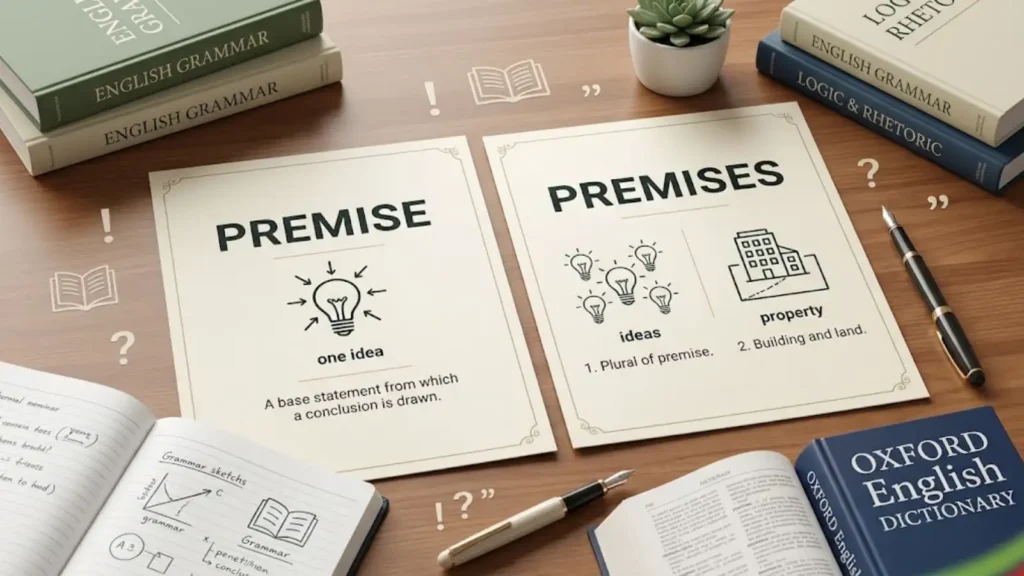
Premise is usually a singular noun. It can mean an idea, belief, or statement that supports an argument. It can also describe the basic idea behind a story, movie, or plan.
Premises has two main uses. It can be the plural of premise, or it can mean a building, property, or area.
Examples:
- The premise of the movie is interesting.
- The argument is based on a false premise.
- The writer developed several premises for the argument.
- Visitors must leave the premises by 10 p.m.
Simple Difference
| Word | Main Meaning | Example |
|---|---|---|
| Premise | A basic idea or statement | The premise of the book is unusual. |
| Premises | More than one premise | The argument has two premises. |
| Premises | A building or property | Employees must remain on the premises. |
So, premise is normally singular, while premises can be plural or can refer to a physical property.
The Origin of Premise vs Premises
The word premise comes from Latin. It developed from the Latin word praemissa, which means “something sent before.” It later entered English through Old French and Middle English.
The basic idea behind the word is something that comes before another statement or conclusion. This explains its use in logic. A premise gives information that helps support a conclusion.
For example:
- All birds have feathers.
- A robin is a bird.
- Therefore, a robin has feathers.
The first two statements are premises. They support the conclusion.
Over time, premise also became common when discussing the main idea behind a story, argument, project, or plan.
The word premises, meaning a property or building, has a related historical development. In legal and formal language, “premises” referred to matters or property previously mentioned in a document. Later, the word became widely used to describe a particular building or property.
This is why modern English has two important uses of premises.
British English vs American English Spelling
There is no major spelling difference between British English and American English for premise or premises.
Both forms are normally spelled:
- premise
- premises
The difference is mainly about meaning and usage, not spelling.
For example, both British and American English can use:
The premise of the story is interesting.
Both varieties can also use:
Security guards protect the premises.
However, premises meaning a property is especially common in formal, business, legal, and official English.
Comparison Table
| Feature | British English | American English |
|---|---|---|
| Singular idea | premise | premise |
| Plural ideas | premises | premises |
| Property/building | premises | premises |
| Spelling difference | None | None |
| Common formal use | premises | premises |
| Example | The premise is clear. | The premise is clear. |
Therefore, you do not need to choose a British or American spelling for these words. The correct spelling is the same in both varieties.
Which Spelling Should You Use?
The correct choice depends on what you want to say.
Use “premise” for one idea
Use premise when you are talking about one basic idea, assumption, or statement.
Example:
The premise of the novel is that time travel is possible.
Use “premises” for multiple ideas
Use premises when you are talking about two or more ideas or statements.
Example:
The conclusion is based on two important premises.
Use “premises” for a property
Use premises when you mean a building, land, office, store, or other property.
Example:
Please do not leave your belongings on the premises.
This usage is common in both American and British English.
For a Global Audience
If you write for an international audience, focus on the meaning rather than spelling. The spelling premise and premises is widely understood.
Common Mistakes with Premise vs Premises
Many mistakes happen because writers assume that premises is simply an incorrect version of premise. It is not.
Mistake 1: Using “premise” for a property
❌ The employees must stay on the premise.
✅ The employees must stay on the premises.
When you mean a building or property, use premises.
Mistake 2: Using “premises” for one idea
❌ The main premises of the story is interesting.
✅ The main premise of the story is interesting.
If you mean one central idea, use premise.
Mistake 3: Confusing plural ideas with property
❌ The argument has one premises.
✅ The argument has one premise.
However:
✅ The argument has several premises.
Mistake 4: Thinking “premises” always means property
The word premises can also be the plural of premise.
For example:
The researcher examined several premises before reaching a conclusion.
Here, premises means multiple assumptions or statements, not buildings.
Mistake 5: Treating “premises” as a spelling error
Some learners think premises is simply a longer spelling of premise. The two forms can have different grammatical roles and meanings.
Premise vs Premises in Everyday Examples
Knowing the difference becomes easier when you see the words in real situations.
In Emails
Premise:
The premise of our proposal is to reduce unnecessary costs.
Premises:
Please make sure all visitors leave the premises before closing time.
In business emails, premises often refers to an office, store, factory, or workplace.
In News Writing
Premise:
The film is based on the premise that technology can change human behavior.
Premises:
Police arrived at the premises after receiving a complaint.
News reports may use both words depending on the subject.
In Social Media
Premise:
The whole story has a fascinating premise.
Premises:
No unauthorized visitors are allowed on the premises.
The first example discusses an idea. The second discusses a physical place.
In Formal Writing
Premise:
The study begins with the premise that early education improves learning outcomes.
Premises:
The conclusion follows from several logical premises.
Formal writing often uses premise when discussing arguments, theories, research, and ideas.
Premise vs Premises – Comparison Table
| Word | Grammatical Form | Meaning | Example |
|---|---|---|---|
| Premise | Singular noun | One idea or assumption | The premise is reasonable. |
| Premises | Plural noun | Two or more ideas | The premises support the conclusion. |
| Premises | Noun | A building or property | The premises are secure. |
| Premise | Singular noun | Main idea of a story | The movie has a clever premise. |
| Premises | Plural noun | Multiple logical statements | The argument uses three premises. |
Easy Memory Tip
Think:
Premise = one idea
Premises = several ideas OR a property
This simple rule can help you choose the right word quickly.
Premise vs Premises – Google Trends & Usage Data
Search interest for premise and premises varies according to context. Both words are established English terms and appear frequently in books, news reports, academic writing, business documents, and online content.
The singular premise is often connected with topics such as:
- Stories
- Movies
- Arguments
- Philosophy
- Logic
- Research
- Business ideas
The word premises is commonly connected with:
- Businesses
- Offices
- Buildings
- Legal documents
- Security
- Property
- Workplace rules
Usage can also vary by country. British English commonly uses premises in formal references to a business location or property. American English also uses this meaning, particularly in legal, business, and official contexts.
Search trends should therefore be understood in context. A higher search volume for one word does not mean it is always the correct choice. The meaning of your sentence determines which form you need.
FAQs About Premise vs Premises
1. What is the difference between premise and premises?
Premise usually means one idea, assumption, or statement. Premises can mean several ideas or statements, or it can mean a building or property.
2. Is premises the plural of premise?
Yes. Premises can be the plural form of premise when you are talking about multiple ideas or statements.
3. Does premises mean a building?
Yes. Premises can mean a building, property, or area belonging to a business or organization.
4. Should I say “on the premise” or “on the premises”?
Use on the premises when you mean a physical property or location.
Correct: Employees must remain on the premises.
5. Is “premise” singular or plural?
Premise is singular. Its plural form is premises.
6. What is the premise of a story?
The premise of a story is its basic idea or situation. It explains what the story is mainly built around.
7. Are premise and premises spelled differently in British and American English?
No. Both British and American English normally use premise and premises with the same spelling.
Conclusion
Understanding premise vs premises is easier when you focus on meaning. Premise is usually a singular noun that refers to one idea, assumption, or statement. It can also describe the main idea behind a story, movie, argument, or plan.
Premises has two important uses. First, it can be the plural form of premise, meaning two or more ideas or statements. Second, it can mean a building, property, or physical location. For example, “The argument has several premises” uses the plural meaning, while “Visitors must leave the premises” refers to a property.
There is no meaningful British-versus-American spelling difference here. Both varieties use premise and premises. Therefore, the best way to choose the correct word is to identify the meaning of your sentence first. Remember: premise means one idea, while premises means multiple ideas or a property.

Hi, I’m Liam Harper, the voice behind Wordspry!
I’m here to make English grammar simple, clear, and easy to understand for learners of all levels. Through practical lessons and helpful guides, I aim to help you improve your writing and communication skills with confidence.