Have you ever typed “geez” or “jeez” and wondered which one looks right? You are not alone. Both spellings appear often in texts, social media posts, movies, blogs, and casual conversations. This makes the choice confusing, especially for English learners.
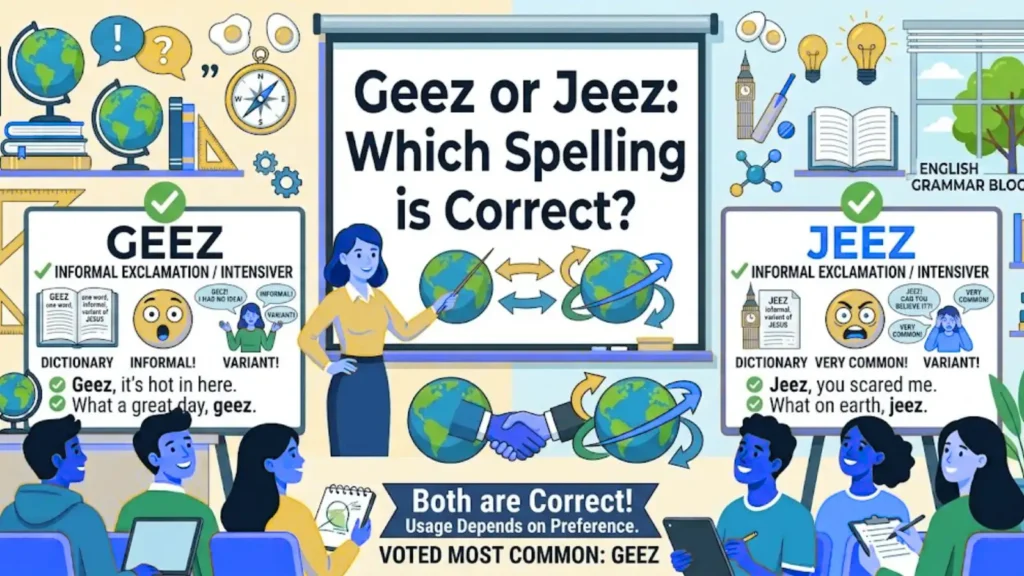
The words geez and jeez are informal expressions used to show surprise, annoyance, disbelief, frustration, or mild exasperation. In most modern English, both spellings are accepted. However, jeez is often treated as a common variant, while geez is also widely used and has a long history in English.
The confusion usually comes from pronunciation. Both words are normally pronounced like “jeez.” So, why are there two spellings? Which one should you use in American English? Does British English prefer one spelling? And is either form appropriate in formal writing?
This guide explains the difference between geez or jeez, their origins, correct usage, common mistakes, and everyday examples.
RELATED: Stigmatism vs Astigmatism: Which Term Is Correct for the Eye Condition?
Geez or Jeez – Quick Answer
Geez and jeez are both correct informal spellings. They are interjections used to express surprise, irritation, disbelief, or frustration.
Examples:
- Geez, that was loud!
- Jeez, you scared me!
- Geez, I forgot my keys again.
- Jeez, that’s expensive.
There is usually no difference in meaning between the two forms.
| Spelling | Correct? | Meaning | Common Use |
|---|---|---|---|
| Geez | Yes | Surprise, annoyance, frustration | Casual speech and writing |
| Jeez | Yes | Surprise, annoyance, frustration | Casual speech and writing |
| Geeze | Informal variant | Same basic meaning | Less common |
| Jeeze | Informal variant | Same basic meaning | Less common |
If you are writing a casual message, either geez or jeez works.
However, these expressions are informal. In formal academic or professional writing, it is usually better to state the emotion directly.
The Origin of Geez or Jeez
The history of geez and jeez is closely connected to the expression “Jesus!”
People have used forms such as Jesus, Geez, and Jeez as mild exclamations for a long time. In casual speech, the name was shortened or altered to make the expression less direct.
The spellings developed partly because English speakers often write words according to how they hear them.
Example:
Jesus → Jeez
The spelling geez developed as another way to represent the same pronunciation.
This type of change is common in informal English. Speakers may alter a word to make it shorter, softer, or easier to say.
Today, geez and jeez function as independent informal interjections. A speaker does not necessarily intend to refer directly to the religious figure when using either expression.
Example:
Jeez, it’s cold today!
Here, the speaker is simply showing surprise or annoyance about the cold weather.
Likewise:
Geez, calm down!
The speaker is expressing frustration or surprise.
The exact spelling can vary because interjections often develop through speech before becoming standardized in writing.
British English vs American English Spelling
Both geez and jeez can appear in English varieties around the world.
Unlike words such as color/colour or center/centre, however, there is no strict British-versus-American spelling rule that requires one form.
American English commonly uses both geez and jeez in informal writing.
British English also recognizes both forms, although usage can vary depending on the speaker, publication, and context.
The important point is that geez and jeez are not different American and British spellings of a standard formal word. They are informal variants.
Comparison Table
| Feature | Geez | Jeez |
|---|---|---|
| Part of speech | Interjection | Interjection |
| Meaning | Surprise, annoyance, frustration | Surprise, annoyance, frustration |
| Pronunciation | Usually /dʒiːz/ | Usually /dʒiːz/ |
| American English | Common | Common |
| British English | Used | Used |
| Formal writing | Usually avoided | Usually avoided |
| Casual conversation | Very common | Very common |
| Text messages | Common | Common |
| Social media | Common | Common |
So, unlike gray and grey, you do not need to choose based strictly on American or British spelling rules.
Which Spelling Should You Use?
Your choice depends mainly on your audience and personal style.
For American English
Both forms are acceptable.
For example:
- Geez, that’s expensive.
- Jeez, that’s expensive.
If you want to use the spelling that closely reflects the pronunciation, jeez may feel more intuitive.
For British English
Both geez and jeez can be used in informal contexts.
There is no major British English rule that makes one universally correct.
For Global English
Either spelling is understandable to most English speakers.
However, consistency is useful. If you choose jeez in an article or story, avoid switching randomly between jeez and geez unless the variation serves a purpose.
For Formal Writing
Avoid both forms when possible.
Instead of:
Geez, this report is confusing.
Write:
This report is difficult to understand.
Formal writing usually benefits from precise language rather than conversational interjections.
Common Mistakes with Geez or Jeez
People often make a few simple mistakes when using these words.
Mistake 1: Thinking One Spelling Is Always Wrong
Some writers believe geez is incorrect because jeez matches the pronunciation more closely.
That is not true.
Geez is an established informal spelling.
Mistake 2: Treating Them as Formal Words
Both forms are informal.
Avoid them in formal essays, academic papers, legal documents, and professional reports unless you are quoting dialogue.
Mistake 3: Confusing Geez With a Different Word
Geez can also refer to Ge’ez, the ancient Semitic language associated with Ethiopia and Eritrea.
These are completely different uses.
Compare:
- Geez, that’s surprising! → informal interjection
- Ge’ez is an ancient language. → language name
Capitalization and context help distinguish them.
Mistake 4: Using Too Many Interjections
Words such as geez, wow, oh, and gosh can make casual writing lively.
However, using them repeatedly can make writing sound childish or overly dramatic.
Use them when they add natural emotion.
Geez or Jeez in Everyday Examples
These words appear mostly in casual communication.
In Text Messages
Jeez, you scared me!
Geez, that’s a lot of homework.
On Social Media
Geez, this traffic is terrible today.
Jeez, that movie was intense!
In Emails
In a casual email to a friend, either spelling may work:
Geez, I completely forgot about our meeting!
For a professional email, use a more neutral expression:
I’m sorry, I completely forgot about our meeting.
In News Writing
Traditional news reports usually avoid informal interjections in their own narration.
However, geez or jeez may appear when a journalist quotes someone directly.
Example:
The witness said, “Jeez, I didn’t expect that to happen.”
In Fiction
Writers often use these words in dialogue to make characters sound natural.
“Geez, give me a minute!” Mark said.
“Jeez, what happened here?” Sara asked.
In Formal Writing
Neither spelling is normally necessary.
Instead of:
Jeez, the project took forever.
Use:
The project took much longer than expected.
Geez or Jeez – Google Trends & Usage Data
Search interest for geez and jeez can change over time and across countries. Because these are informal expressions, their popularity is strongly connected to casual communication, entertainment, social media, and conversational writing.
Search data should also be interpreted carefully. A Google search for geez may sometimes refer to Ge’ez, the ancient Ethiopian language, rather than the informal interjection.
This creates an important distinction between search popularity and actual conversational usage.
For the interjection itself, both spellings remain recognizable in English-speaking countries. Their use is more common in:
- Text messages
- Social media
- Online comments
- Fiction
- Movie and television dialogue
- Informal conversations
The spelling jeez clearly signals the pronunciation to many readers, while geez remains a familiar traditional spelling.
Because search trends can change, it is better to treat them as a measure of search behavior rather than proof that one spelling is universally correct.
Geez vs Jeez: Side-by-Side Comparison
| Category | Geez | Jeez |
|---|---|---|
| Correct spelling | Yes | Yes |
| Informal | Yes | Yes |
| Main function | Interjection | Interjection |
| Expresses surprise | Yes | Yes |
| Expresses annoyance | Yes | Yes |
| Expresses frustration | Yes | Yes |
| Pronunciation | Usually “jeez” | Usually “jeez” |
| Suitable for texts | Yes | Yes |
| Suitable for social media | Yes | Yes |
| Suitable for formal essays | Usually no | Usually no |
| Meaning changes? | No | No |
FAQs About Geez or Jeez
Is “geez” a correct word?
Yes. Geez is a recognized informal interjection. It can express surprise, annoyance, disbelief, or frustration.
Is “jeez” a correct spelling?
Yes. Jeez is also a correct informal spelling and has the same basic meaning as geez.
Is geez or jeez more common?
Both are widely recognized. Usage varies by writer, region, and context. Neither spelling is universally required.
Do geez and jeez mean the same thing?
Yes. As informal interjections, they generally express the same emotions, including surprise, irritation, or disbelief.
Is “geez” a bad word?
It is generally considered a mild informal expression rather than a strong swear word. Still, it may sound too casual for some formal situations.
Can I use jeez in a formal essay?
It is usually better to avoid it. Use precise language to describe the emotion instead.
For example:
The result was extremely surprising.
instead of:
Jeez, that result was surprising.
Is “geeze” also correct?
Geeze appears as an informal variant, but geez and jeez are the more familiar spellings. For ordinary writing, choosing one of those forms is clearer.
Is Geez the same as Ge’ez?
No. The informal geez means something like “wow” or “oh, come on.” Ge’ez refers to an ancient Semitic language associated with Ethiopia and Eritrea.
Conclusion
So, geez or jeez? The simple answer is that both spellings are correct when used as informal interjections. They normally have the same meaning and pronunciation. Both can express surprise, annoyance, disbelief, or frustration.
The main difference is spelling rather than meaning. Jeez closely reflects the common pronunciation, while geez is also a long-established informal form. Neither spelling belongs exclusively to American or British English.
For texts, social media, casual emails, conversations, and fictional dialogue, you can comfortably use either form. However, formal writing usually calls for more precise language. Instead of saying “Geez,” explain the emotion or situation directly.
Also, remember that Geez and Ge’ez can have completely different meanings. Context is important.
If you want the safest everyday choice, pick geez or jeez, stay consistent, and match your spelling to your audience.

Hi, I’m Victoria Lane, the voice behind Wordspry!
I’m passionate about helping students and readers master English grammar, vocabulary, and writing through simple, friendly, and easy-to-follow content.