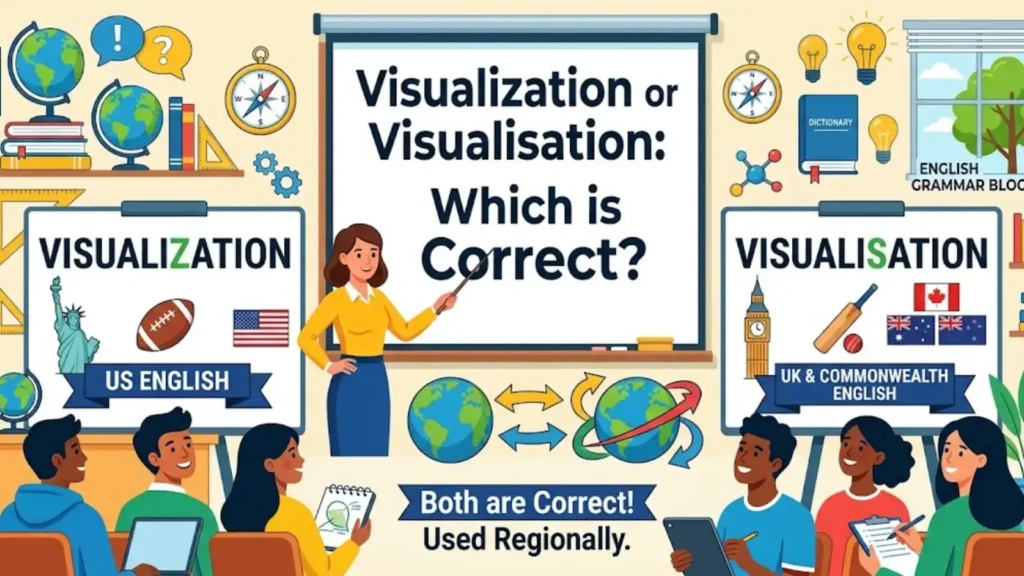
Have you ever typed visualization and wondered if visualisation would be better? You are not alone. These two spellings often confuse students, bloggers, writers, and professionals because they look almost the same. The good news is that both spellings are correct. The main difference is the variety of English being used.
Visualization is widely used in American English, while visualisation is commonly used in British English. However, British English can also use the -ize form in some dictionaries and style systems. Oxford, for example, lists visualization and notes visualisation as a British English form.
RELATED: Blatantly vs Bluntly – Which Word Should You Really Use?
Visualization or Visualisation – Quick Answer
Visualization and visualisation have the same meaning. The difference is mainly spelling.
- 🇺🇸 Visualization → common American English spelling
- 🇬🇧 Visualisation → common British English spelling
- 🇨🇦 Visualization / Visualisation → both may appear
- 🌍 Global English → choose one style and use it consistently
Example:
American English: Data visualization makes complex information easier to understand.
British English: Data visualisation makes complex information easier to understand.
“Both sentences are correct. The meaning does not change“.
The word can describe forming a picture in your mind or presenting information in a visual form. Oxford defines visualization as forming a mental picture or making something visible to the eye.
The Origin of Visualization or Visualisation
The word comes from visual, which relates to seeing or sight.
The verb visualize means to form a mental picture or make something easier to see or understand visually. The noun visualization describes the act or process of visualizing.
The spelling difference developed as English evolved in different regions.
American English generally uses -ize in words such as:
- organize
- realize
- recognize
- visualize
British English often uses -ise in everyday writing:
- organise
- realise
- recognise
- visualise
Therefore, the noun forms can appear as:
- organization / organisation
- realization / realisation
- recognization / recognisation where applicable
- visualization / visualisation
There is an important detail, though: British English is not simply an “-ise only” system. Some British dictionaries and publishers accept or prefer -ize forms. Oxford, for example, uses visualization while also listing visualisation as a British English form.
So, it is better to think of this as a regional and style difference, rather than saying one spelling is always right and the other is always wrong.
British English vs American English Spelling
The easiest rule is to consider your audience and your chosen style guide.
American English commonly uses -ize and -ization. British English commonly uses -ise and -isation, although -ize/-ization is also accepted in some British usage.
| Meaning | American English | Common British English |
|---|---|---|
| Verb | visualize | visualise |
| Noun | visualization | visualisation |
| Organization | organization | organisation |
| Realization | realization | realisation |
| Specialization | specialization | specialisation |
| Modernization | modernization | modernisation |
| Globalization | globalization | globalisation |
Example:
US:
“The software provides excellent data visualization.”
UK:
“The software provides excellent data visualisation.”
Both sentences communicate the same idea.
A Useful Spelling Pattern
A simple pattern can help:
American: -ize → -ization
Common British: -ise → -isation
However, do not treat this as an absolute rule for every British publication. British style can vary, and some major British references use -ize spellings.
Which Spelling Should You Use?
Your audience should guide your choice.
If You Write for American Readers
Use visualization.
Example:
Our team created a new data visualization.
This form is standard and familiar in American English.
If You Write for British Readers
Visualisation is a common choice.
Example:
Our team created a new data visualisation.
However, visualization is also found in British English, especially in dictionaries and academic or technical contexts.
If You Write for a Global Audience
Either spelling can work.
The most important point is consistency.
If your website uses American English, use visualization throughout your content. If you follow a British style, use visualisation where that style calls for it.
Do not randomly switch between the two forms.
Common Mistakes with Visualization or Visualisation
Many mistakes happen because writers assume one spelling must be wrong.
Mistake 1: Calling Visualisation Incorrect
❌ Visualisation is always wrong.
✅ Visualisation is a valid spelling used in British English.
Mistake 2: Calling Visualization Only American
❌ Visualization can never appear in British English.
✅ British English sources also use visualization. Oxford, for example, lists it as the main form and gives visualisation as a British English alternative.
Mistake 3: Mixing Styles
❌ The organisation created a new data visualization for its American report.
This sentence is not necessarily grammatically wrong, but it mixes spelling conventions.
A consistent British style would be:
✅ The organisation created a new data visualisation.
A consistent American style would be:
✅ The organization created a new data visualization.
Mistake 4: Changing the Meaning
The two spellings do not normally represent different meanings.
Visualization and visualisation describe the same basic concept.
Visualization or Visualisation in Everyday Examples
Both spellings appear in many areas of modern English.
In Emails
American English:
Please review the data visualization before tomorrow’s meeting.
British English:
Please review the data visualisation before tomorrow’s meeting.
In News Writing
American style:
The newspaper published a new visualization of the election data.
British style:
The newspaper published a new visualisation of the survey data.
The spelling should match the publication’s style.
In Social Media
A US-based creator might write:
This visualization makes the numbers much easier to understand.
A UK-based creator might write:
This visualisation makes the numbers much easier to understand.
Both are natural.
In Formal Writing
American:
Data visualization can help researchers identify patterns.
British:
Data visualisation can help researchers identify patterns.
In Technology
You may see phrases such as:
- data visualization
- scientific visualization
- information visualization
- visualization tools
- visualization software
- data visualisation
- scientific visualisation
- information visualisation
The spelling usually depends on the writer’s regional English.
Visualization – Different Meanings and Uses
Visualization can be used in more than one context.
Mental Visualization
It can mean creating a picture in your mind.
Visualization helped the athlete prepare for the competition.
Data Visualization
It can mean showing information through charts, graphs, maps, or other visual formats.
The dashboard uses data visualization to explain sales trends.
Oxford also gives both mental imagery and visual presentation of information among the meanings of the word.
Professional Visualization
Designers, engineers, architects, and developers may use visualization to describe visual models or representations.
The architect created a 3D visualization of the new building.
Visualization vs Visualisation: Comparison Table
| Feature | Visualization | Visualisation |
|---|---|---|
| Basic meaning | Same | Same |
| Spelling | -zation | -sation |
| Common US usage | Yes | Less common |
| Common UK usage | Yes | Yes |
| Pronunciation | Essentially the same | Essentially the same |
| Grammar | Noun | Noun |
| Verb | visualize | visualise |
| Main difference | Regional/style spelling | Regional/style spelling |
The important point is that the difference is primarily orthographic, not semantic.
Visualization or Visualisation – Google Trends & Usage Data
Google Trends measures search interest as a relative value, rather than giving an absolute number of searches. Its regional results show where a term has a higher share of searches compared with other regions and periods.
Google itself uses both forms in its international projects. Its US project is titled “Visualizing Google Trends data,” while its UK project uses “Visualising Google Trends data.”
This provides a useful real-world example of regional spelling:
- US-oriented content: visualization
- UK-oriented content: visualisation
Search behavior can also vary by country, industry, and context. For example, people searching for data visualization may have a technology or analytics goal, while people searching for visualization techniques may be interested in mental imagery or personal development.
Because Google Trends data is normalized and relative, it should not be treated as a precise count of worldwide searches.
FAQs About Visualization or Visualisation
1. Is visualization or visualisation correct?
Both are correct. Visualization is common in American English, while visualisation is common in British English.
2. Is visualization American English?
Yes. Visualization is the common American spelling.
3. Is visualisation British English?
Yes. Visualisation is a common British spelling. However, visualization is also accepted in some British English sources and styles.
4. Do visualization and visualisation have different meanings?
No. They normally have the same meaning. The difference is mainly spelling.
5. Which spelling should I use for a US website?
Use visualization if you are following American English.
6. Which spelling should I use for a UK website?
Use visualisation if that matches your chosen British style. If your style guide uses -ize, then visualization may also be appropriate.
7. Is data visualization or data visualisation correct?
Both are correct. Data visualization is common in American English, while data visualisation is common in British English.
Conclusion
The choice between visualization or visualisation is mainly a question of spelling style and regional English. Both forms describe the same basic idea: creating a mental image or presenting something in a visual form.
Visualization is widely used in American English. Visualisation is widely used in British English. However, British English can also use visualization, depending on the dictionary, publisher, or style guide.
The best approach is simple. First, identify your audience. Then choose the spelling that matches your English style. Most importantly, stay consistent throughout your article, website, report, or academic work.
If you write for US readers, visualization is a natural choice. If you follow a common British -ise style, choose visualisation. Neither spelling should be treated as a spelling error simply because it differs from the other.
Once you understand this small regional difference, choosing the correct form becomes much easier.

Hi, I’m William Parker, the creator behind Wordspry.com
I enjoy breaking down complex grammar rules into clear and practical lessons that help learners write and speak English more effectively.