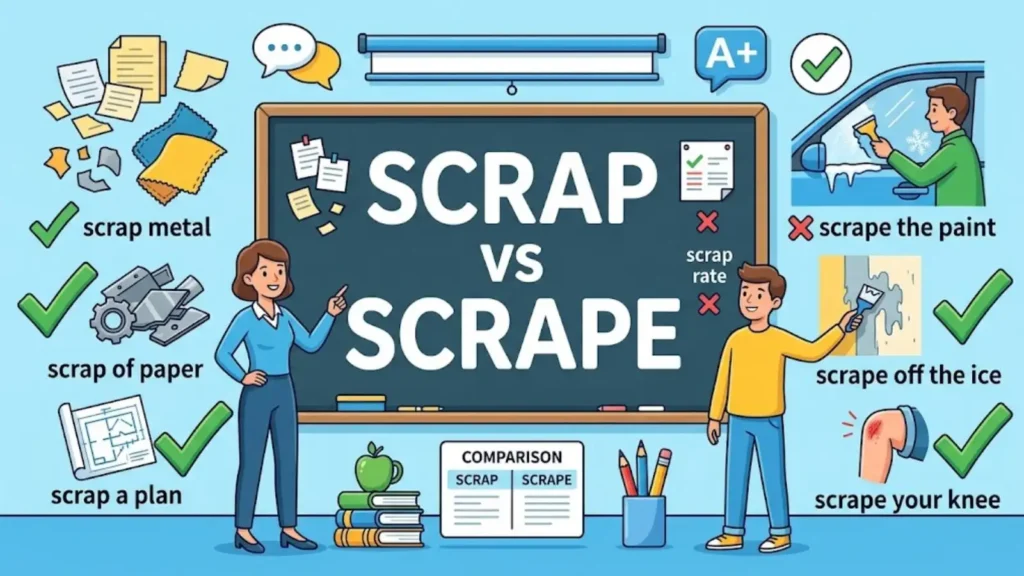
If you are unsure whether to write scrap or scrape, you are not alone. These words look and sound similar, but they usually perform different jobs in a sentence.
The simplest rule is this: scrap often refers to a small leftover piece, discarded material, or something abandoned. Scrape usually describes removing something from a surface, rubbing against something, or barely succeeding.
For example, you might scrape mud from your shoes and throw the dirty material away as scrap. Once you see the difference in action, the two words become much easier to remember.
Table of Contents
- Scrap vs Scrape: Quick Answer
- What Does Scrap Mean?
- What Does Scrape Mean?
- Scrap vs Scrape: Main Difference
- Origin and History of Scrap and Scrape
- British English vs American English
- Which One Should You Use?
- Common Mistakes With Scrap and Scrape
- Everyday Examples of Scrap and Scrape
- Usage Trends and Popularity
- Scrap vs Scrape Comparison Table
- Special Uses and Expressions
- FAQs
- Conclusion
Scrap vs Scrape: Quick Answer
Scrap is usually a noun meaning a small piece, leftover material, or discarded item. It can also be a verb meaning to abandon or throw something away.
Scrape is usually a verb meaning to remove something from a surface, rub against something, or achieve something with difficulty. It can also be a noun for a minor injury or difficult situation.
Quick examples
- I wrote the note on a scrap of paper.
- Please scrape the mud off your shoes.
- The company decided to scrap the old plan.
- She scraped her knee on the pavement.
- We only scraped through the final exam.
So, scrap often involves a piece or something discarded, while scrape often involves an action involving rubbing or removing. Cambridge Dictionary gives these core meanings for both words and also records additional uses.
What Does Scrap Mean?
Scrap can be used as both a noun and a verb.
As a noun, scrap means a small piece or amount of something. It can describe paper, fabric, food, metal, information, or another leftover material.
Examples of scrap as a noun
- I found a scrap of paper under the desk.
- The dog ate the food scraps.
- We sold the old car for scrap.
- She saved every scrap of information about the project.
The word can also refer to old or unwanted material, especially metal, that can be collected and reused. Scrap metal is a common example.
Scrap as a verb
As a verb, scrap can mean to abandon, cancel, or get rid of something.
For example:
The school decided to scrap the old timetable.
Here, scrap means to stop using the timetable.
More examples include:
- The government scrapped the outdated rule.
- We had to scrap our travel plans.
- The company scrapped the project.
- They decided to scrap the damaged machine.
Merriam-Webster defines this verb as abandoning or getting rid of something that is no longer worth keeping.
Correct and incorrect examples
❌ Please scrap the dirt off your shoes.
✅ Please scrape the dirt off your shoes.
Why? You are removing dirt from a surface, so scrape is the correct verb.
❌ I found a scrape of paper.
✅ I found a scrap of paper.
Why? You mean a small piece of paper, so scrap is correct.
What Does Scrape Mean?
Scrape is mainly used as a verb, although it can also be a noun.
As a verb, scrape means to remove something from a surface by rubbing it with something rough or sharp.
For example:
- Scrape the paint from the wall.
- He scraped the mud off his boots.
- She scraped ice from the windshield.
- I accidentally scraped my knee.
Cambridge Dictionary also includes the meaning of rubbing against a surface and causing slight damage or an unpleasant sound.
Scrape can also mean “barely succeed”
This meaning often surprises English learners.
Scrape by, scrape through, and similar expressions mean to succeed with very little money, ability, time, or margin.
For example:
- I scraped through the final exam.
- We managed to scrape by on a small budget.
- She scraped together enough money for the ticket.
Merriam-Webster also records scrape in the sense of managing or succeeding with difficulty.
Scrape as a noun
A scrape can mean a small injury caused by rubbing against something rough.
For example:
I got a scrape on my elbow.
It can also describe a difficult or awkward situation.
He got into a scrape with the police.
Cambridge Dictionary lists both the minor-injury and difficult-situation meanings.
Scrap vs Scrape: Main Difference
The easiest way to separate these words is to focus on the action or object.
Scrap usually refers to a piece, leftover, discarded material, or abandoned plan.
Scrape usually refers to removing, rubbing, scratching, or barely succeeding.
Think of these simple connections:
- Scrap = piece or discard
- Scrape = remove or rub
Compare these sentences
I saved a scrap of fabric.
The word refers to a small piece.
I scraped paint from the wall.
The word describes an action.
They scrapped the old proposal.
Here, scrapped means abandoned.
The chair scraped across the floor.
Here, scraped describes rubbing against a surface.
This distinction makes the spelling much easier to remember.
Origin and History of Scrap and Scrape
Interestingly, scrap and scrape have a historical connection.
The noun scrap appeared in English in the late 14th century. Etymonline traces it to Old Norse skrap, meaning scraps or trifles, related to skrapa, meaning to scrape, scratch, or cut.
The verb scrape is much older in English. Etymonline dates it to the early 13th century, with meanings connected to erasing and removing material with a sharp or rough instrument.
Over time, both words developed several figurative meanings.
For instance, scrap came to describe discarded metal and other reusable waste. The meaning connected with metal dates to the late 18th century.
Meanwhile, scrape developed meanings involving difficulty, collecting small amounts, and rubbing against surfaces.
So although scrap and scrape are different words today, their histories are closely related.
British English vs American English
There is no major spelling difference between British and American English for these words.
Both varieties use:
- scrap
- scrape
- scrapped
- scraped
- scrapping
- scraping
The meanings are also broadly the same.
For example:
- British English: They scrapped the proposal.
- American English: They scrapped the proposal.
Likewise:
- British English: She scraped her knee.
- American English: She scraped her knee.
Cambridge provides both UK and US pronunciations and definitions for these words.
One useful point is that scrap can be especially common in discussions about discarded material, old vehicles, manufacturing, and cancelled plans.
Which One Should You Use?
Use scrap when you mean:
- a small piece of something
- leftover material
- discarded material
- scrap metal
- leftover food
- a cancelled or abandoned plan
- something thrown away
- a fight or argument in informal English
Use scrape when you mean:
- remove something from a surface
- rub against something
- cause a minor surface injury
- make a scraping sound
- collect something with difficulty
- barely succeed
- get into a difficult situation
A simple memory trick
Remember:
Scrap = a piece.
Scrape = an action.
For example:
The scrap of metal was lying on the floor.
I scraped the metal against the floor.
This little distinction can prevent many spelling mistakes.
Common Mistakes With Scrap and Scrape
Because the words differ by only one letter, they are easy to mix up.
Mistake 1: Using scrap for removing something
❌ I scrapped the ice from my windshield.
✅ I scraped the ice from my windshield.
The action of removing ice is scrape.
Mistake 2: Using scrape for a small piece
❌ Give me a scrape of paper.
✅ Give me a scrap of paper.
A small piece is a scrap.
Mistake 3: Confusing “scrapped” and “scraped”
❌ The company scraped its new policy.
✅ The company scrapped its new policy.
Here, the company abandoned the policy.
Mistake 4: Confusing “scrape” and “scratch”
These words can overlap, but they are not always interchangeable.
I scraped my knee on the pavement.
The cat scratched my arm.
A scrape often involves rubbing against a rough surface. A scratch often involves a narrow mark made by something sharp, such as a fingernail.
Everyday Examples of Scrap and Scrape
Seeing these words in different situations makes their meanings easier to remember.
In emails
We have decided to scrap the original proposal.
Please scrape the old data from the test file.
The first sentence means “abandon.” The second describes removing or collecting data.
On social media
I found this cute scrap of paper from my childhood.
I scraped my car against a wall today.
Both words appear naturally in casual online writing.
In the news
News reports often use scrap when discussing cancelled policies, projects, or regulations.
Officials decided to scrap the proposed changes.
They may also use scrape when describing physical damage.
The vehicle scraped against the barrier.
In the classroom
Write your answer on a scrap of paper.
Scrape the dried glue from the desk carefully.
In daily life
Don’t throw away that scrap of wood.
I need to scrape the sticker off the jar.
These examples show how context usually makes the correct word obvious.
Usage Trends and Popularity
Both scrap and scrape are established English words with many everyday uses.
However, their popularity depends heavily on context.
Scrap frequently appears in phrases such as:
- scrap metal
- scrap paper
- food scraps
- a scrap of evidence
- scrap value
- scrap a plan
Scrape appears commonly in expressions such as:
- scrape off
- scrape away
- scrape by
- scrape through
- scrape together
- web scraping
- scrape the surface
Modern technology has also given scrape a strong computing meaning. Web scraping refers to collecting information from websites using software. Cambridge lists this as a specialized computing use.
Scrap vs Scrape Comparison Table
| Feature | Scrap | Scrape |
|---|---|---|
| Main use | Piece, leftover, discard | Remove, rub, or barely succeed |
| Common part of speech | Noun and verb | Verb and noun |
| Small piece | ✅ Yes | ❌ No |
| Remove from surface | ❌ No | ✅ Yes |
| Discard a plan | ✅ Yes | ❌ No |
| Minor injury | ❌ No | ✅ Yes |
| Scrap metal | ✅ Yes | ❌ No |
| Scrape paint | ❌ No | ✅ Yes |
| Scrapped plans | ✅ Yes | ❌ No |
| Scraped knee | ❌ No | ✅ Yes |
| Web scraping | ❌ No | ✅ Yes |
| British spelling | Same | Same |
| American spelling | Same | Same |
Special Rules and Important Uses
Scrap metal
The Scrap metal means old or unwanted metal that can be reused or processed.
The workers collected scrap metal from the factory.
Scrap a plan
When you scrap a plan, you decide not to continue with it.
The team scrapped the plan after discovering several problems.
Scrape off
The Scrape off means remove something from a surface.
Scrape off the old paint before applying a new coat.
Scrape by
The Scrape by means manage or survive with very little.
We can scrape by until payday.
Scrape through
Scrape through means succeed by a very small margin.
She scraped through the exam with the minimum passing score.
Web scraping
In technology, web scraping means collecting website information through software.
This is completely different from scrap, despite the similar spelling.
FAQs
Is it scrap or scrape?
Both words are correct, but they have different meanings. Scrap usually means a small piece, leftover material, or something abandoned. Scrape usually means to remove or rub something, or barely succeed.
What is the difference between scrap and scrape?
The main difference is meaning. Scrap commonly refers to a piece, waste material, or an abandoned plan. Scrape commonly describes removing or rubbing something against a surface.
Is “scrap” a verb?
Yes. Scrap can be a verb meaning to abandon, cancel, or discard something. For example, The company scrapped the project.
Is “scrape” a verb or noun?
Scrape can be both a verb and a noun. As a verb, it means to remove or rub something. As a noun, it can mean a minor injury or difficult situation.
Is it “scrap of paper” or “scrape of paper”?
The correct phrase is scrap of paper. A scrap is a small piece or fragment.
Is it “scrap the paint” or “scrape the paint”?
The correct expression is usually scrape the paint. You scrape paint from a surface because you are removing it.
Are scrap and scrape pronounced differently?
Yes. Scrap and scrape have different vowel sounds. The final silent e in scrape changes its pronunciation from the short vowel sound in scrap.
Conclusion
The difference between scrap vs scrape becomes simple once you focus on meaning.
Use scrap for a small piece, leftover material, discarded material, or something you abandon. Use scrape when you remove something from a surface, rub against something, or barely succeed.
A useful memory rule is:
Scrap = a piece or something discarded.
Scrape = remove, rub, or barely manage.
So, you scrape the mud from your shoes, but the leftover material may become scrap. Keep that distinction in mind, and these two easily confused words will be much easier to use correctly.

Hi, I’m Liam Harper, the voice behind Wordspry!
I’m here to make English grammar simple, clear, and easy to understand for learners of all levels. Through practical lessons and helpful guides, I aim to help you improve your writing and communication skills with confidence.