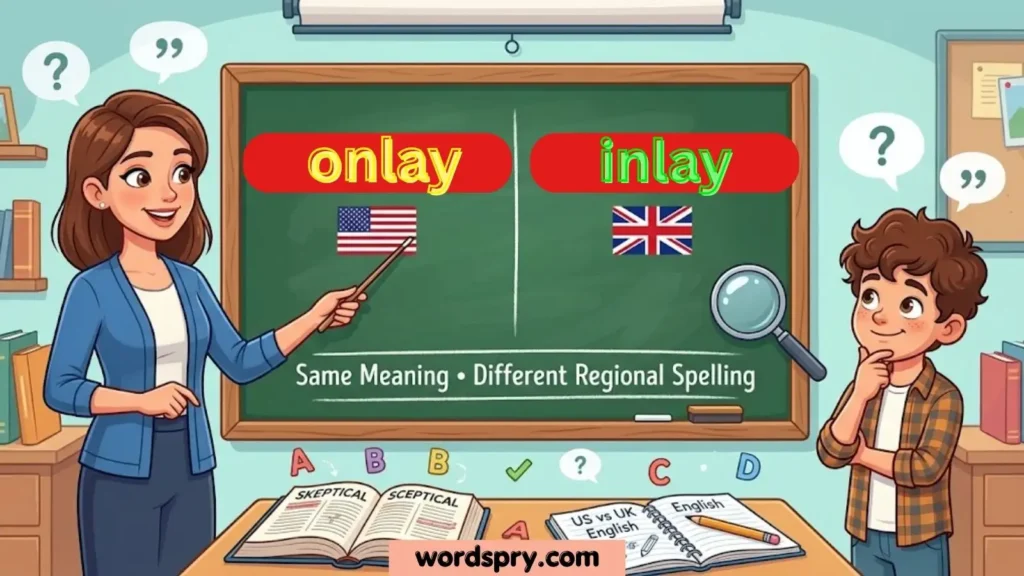
Onlay or inlay is a common question, especially when people search for the right dental term. At first glance, these words look almost identical. However, they describe two different types of dental restorations. Both are used to repair damaged teeth, but they cover different parts of a tooth.
An inlay fits inside the tooth’s cusps, while an onlay covers one or more cusps. Therefore, knowing the difference can help you understand your dentist’s treatment plan and choose the right word when writing or speaking about dental care.
People also search for onlay or inlay because the terms sound similar and often appear together in dental articles. Moreover, both restorations can be made from materials such as porcelain, ceramic, or composite resin. The main difference is not spelling or British versus American English. Instead, it is their shape, size, and placement on the tooth.
In this guide, we will explain onlay vs inlay, their origins, correct usage, common mistakes, examples, and the key differences between these two dental terms.
RELATED; No Cuts No Buts No Coconuts: Meaning, Origin and Examples
Onlay or Inlay – Quick Answer
Inlay and onlay are both correct words, but they describe different dental restorations.
An inlay sits within the grooves of a tooth and does not cover its cusps. An onlay, however, extends over one or more cusps of the tooth.
Simple example
- Inlay: A restoration placed inside the tooth.
- Onlay: A larger restoration that covers part of the tooth, including one or more cusps.
So, if your dentist says you need an inlay, the damage is usually limited to the inner part of the tooth.
If the damage reaches a cusp, an onlay may be needed instead.
Quick comparison
| Term | Meaning |
|---|---|
| Inlay | Fits inside the tooth |
| Onlay | Covers part of the tooth and one or more cusps |
| Both | Dental restorations used to repair damaged teeth |
The Origin of Onlay or Inlay
The words inlay and onlay come from ordinary English word-building.
The word inlay combines in with lay. It describes something placed or set inside another material. The term has been used in English for centuries to describe materials inserted into a surface.
The word onlay, similarly, combines on with lay. It describes something placed on a surface.
Over time, dentists began using these words to describe different types of tooth restorations.
An inlay is placed inside the prepared area of a tooth. An onlay, meanwhile, extends over the tooth’s surface and may cover one or more cusps.
Therefore, the difference between the words is closely connected to their meanings. In suggests placement within, while on suggests placement over a surface.
Importantly, neither word is a spelling mistake. Both are standard dental terms.
British English vs American English Spelling
There is no major British-versus-American spelling difference between inlay and onlay.
Both British and American English use:
- inlay
- onlay
The spelling stays the same in both varieties.
Comparison Table
| Feature | British English | American English |
|---|---|---|
| Inlay | ✅ Correct | ✅ Correct |
| Onlay | ✅ Correct | ✅ Correct |
| Spelling difference | None | None |
| Dental meaning | Same | Same |
| Common usage | Dental writing | Dental writing |
Unlike words such as colour/color or centre/center, these dental terms do not change spelling between British and American English.
Therefore, you can safely use inlay or onlay with readers from either country.
Which Spelling Should You Use?
You do not need to choose between British and American spelling here.
Instead, choose the word based on the dental treatment you mean.
Use “inlay” when:
The restoration fits inside the tooth and does not cover the cusps.
Example:
The dentist recommended an inlay to repair the damaged area.
Use “onlay” when:
The restoration covers one or more cusps.
Example:
The dentist recommended an onlay because the damage reached the tooth’s cusp.
For US readers
Use inlay and onlay in the same way.
For UK and Commonwealth readers
The same terms apply.
For a global audience
Use the standard dental terms and explain the difference clearly. This approach helps readers who may not know the terminology.
Common Mistakes with Onlay or Inlay
Because the words look similar, people sometimes confuse them.
Mistake 1: Thinking they mean the same thing
❌ An inlay and onlay are exactly the same.
✅ An inlay fits within the tooth, while an onlay covers part of the tooth and one or more cusps.
Mistake 2: Treating “onlay” as incorrect
❌ Onlay is not a real dental word.
✅ Onlay is a standard dental term.
Mistake 3: Assuming “inlay” is always smaller
An inlay is generally limited to the internal part of the tooth. However, size alone does not define the difference.
The key factor is where the restoration sits and whether it covers the cusps.
Mistake 4: Using the wrong term for treatment
❌ The dentist placed an inlay over the entire cusp.
✅ The dentist placed an onlay over the affected cusp.
Mistake 5: Confusing both terms with a crown
An inlay or onlay does not necessarily cover the entire tooth.
A dental crown, however, covers much more of the tooth.
Onlay or Inlay in Everyday Examples
These terms appear mainly in dental and medical contexts. However, you may see them in many types of writing.
In Emails
My dentist said I need an onlay to protect the damaged tooth.
Dental Articles
An inlay can repair damage within the chewing surface of a tooth.
In News Reports
The patient received a ceramic onlay as part of the dental restoration.
On Social Media
Has anyone had an inlay or onlay? I’m trying to understand the difference.
In Formal Writing
The dentist selected an onlay because the restoration needed to cover the affected cusp.
In a Dental Conversation
Is an inlay enough, or would an onlay provide better coverage?
Onlay or Inlay – Google Trends & Usage Data
Search interest for onlay or inlay generally comes from people researching dental treatment, restoration options, and differences between procedures.
The terms are often searched together because patients want to understand why a dentist recommends one restoration instead of another.
Common search contexts include:
- Dental treatment
- Tooth restoration
- Cosmetic dentistry
- Dental costs
- Porcelain restorations
- Ceramic restorations
- Dental crowns
- Tooth damage
- Cavity treatment
The exact level of search interest can change over time and varies by country. However, both terms remain relevant because dentists and patients continue to discuss tooth restoration options.
Moreover, searches often use comparison phrases such as:
- inlay vs onlay
- onlay vs inlay
- dental inlay or onlay
- inlay or onlay which is better
- onlay vs crown
- inlay vs filling
Therefore, content that clearly explains the difference can satisfy an important informational search intent.
Onlay vs Inlay Comparison Table
| Feature | Inlay | Onlay |
|---|---|---|
| Placement | Inside the tooth | Over part of the tooth |
| Covers cusps? | Usually no | Yes, one or more |
| Size | Usually smaller | Usually larger |
| Main purpose | Repairs damage within the tooth | Repairs larger areas involving cusps |
| Materials | Ceramic, porcelain, composite, gold | Ceramic, porcelain, composite, gold |
| Alternative to | Large filling | Sometimes a crown |
| Term correct? | Yes | Yes |
What Is an Inlay?
An inlay is a custom-made dental restoration that fits into a prepared area of a tooth.
It is usually used when damage is too extensive for a normal filling but does not require a crown or an onlay.
For example, a dentist may recommend an inlay when decay or damage affects the central chewing surface of a back tooth.
Because the restoration is made to fit the tooth, it can provide a precise repair.
What Is an Onlay?
An onlay is also a custom-made dental restoration. However, it covers a larger area than an inlay.
Most importantly, an onlay can cover one or more cusps of a tooth.
For example, if a tooth has significant damage that extends to a cusp, an onlay may provide the coverage needed to protect the remaining tooth structure.
For this reason, an onlay is sometimes called a partial crown.
Inlay vs Onlay vs Crown
These three treatments can sometimes cause confusion.
| Restoration | Coverage |
|---|---|
| Inlay | Inside the tooth |
| Onlay | Part of the tooth and one or more cusps |
| Crown | Covers most or all of the visible tooth |
Therefore, an inlay generally provides the least coverage, while a crown provides much more.
However, the best option depends on the condition of the tooth. A dentist should determine which restoration is appropriate after examining the tooth.
FAQs About Onlay or Inlay
Is an onlay the same as an inlay?
No. An inlay fits within the tooth, while an onlay covers part of the tooth and one or more cusps.
Which is bigger, an inlay or an onlay?
Generally, an onlay covers a larger area because it can extend over one or more cusps.
Is “onlay” a correct word?
Yes. Onlay is a standard dental term.
Is “inlay” a correct word?
Yes. Inlay is also a standard dental term.
Do British and American dentists spell these words differently?
No. Both British and American English use inlay and onlay.
Is an onlay better than an inlay?
Not necessarily. Each restoration serves a different purpose. The right option depends on the amount and location of tooth damage.
Is an onlay better than a crown?
Not always. An onlay preserves more natural tooth structure in suitable cases, while a crown provides greater coverage. Your dentist can recommend the appropriate treatment.
Conclusion
The onlay or inlay question is easy to solve once you understand what each word means. Both terms are correct, but they describe different types of dental restorations. An inlay fits inside the prepared area of a tooth, while an onlay extends over part of the tooth and covers one or more cusps.
Moreover, there is no British or American spelling difference. Therefore, you can use both terms with confidence in US, UK, Commonwealth, and international English. The important point is to choose the word that matches the dental restoration you are describing.
An inlay is generally suitable when the damage stays within the tooth’s central area. An onlay, however, can cover a larger damaged area that involves the cusps. Consequently, neither option is automatically better than the other. The right choice depends on the tooth, the damage, and the dentist’s assessment.
Overall, remember this simple rule: inlay goes inside, while onlay goes over part of the tooth. Once you remember that difference, the confusion becomes much easier to avoid.

Hi, I’m Liam Harper, the voice behind Wordspry!
I’m here to make English grammar simple, clear, and easy to understand for learners of all levels. Through practical lessons and helpful guides, I aim to help you improve your writing and communication skills with confidence.