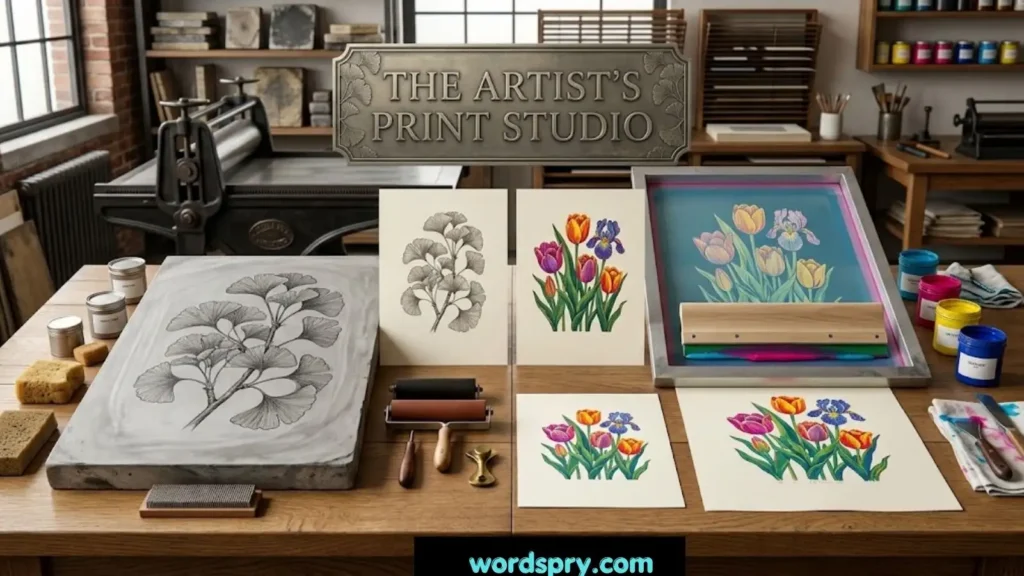
Choosing between a lithograph or serigraph can be confusing, especially for collectors, artists, researchers, and anyone interested in fine art prints. Although both techniques produce high-quality artwork, they use very different printmaking processes.
A lithograph is traditionally created using a flat surface where oil and water are used to create the image, while a serigraph, commonly known as a screen print, transfers ink through a prepared mesh screen. These differences affect the appearance, texture, production process, and value of the final print.
Understanding lithography vs serigraphy is important when identifying artwork, researching an artist’s printmaking technique, or evaluating a print for a collection. This guide explains the major differences between a lithograph and serigraph, how each process works, their advantages and limitations, and what collectors should look for.
What Is a Lithograph?
A lithograph is a type of printmaking technique that uses the principle that oil and water repel each other. The image is traditionally drawn onto a flat limestone or metal plate using a greasy medium.
During the printing process, the surface is treated so that ink adheres to the image areas while being repelled by dampened non-image areas.
How Lithography Works
Traditional lithographic printing generally involves several stages:
- The artist creates an image on a prepared stone or plate.
- The surface is chemically treated to stabilize the image.
- Water is applied to the printing surface.
- Oil-based ink is rolled over the surface.
- Ink adheres primarily to the greasy image areas.
- Paper is placed over the surface.
- Pressure transfers the image onto the paper.
The result can have subtle tonal transitions and a distinctive appearance associated with traditional fine art lithography.
Types of Lithographs
There are several forms of lithographic printing, including:
- Stone lithography
- Plate lithography
- Offset lithography
- Photolithography
For art collectors, distinguishing an original artist-created stone lithograph from a commercially reproduced image can be particularly important.
What Is a Serigraph?
A serigraph is a fine-art screen printing technique in which ink is pushed through a mesh screen onto paper, canvas, fabric, or another suitable surface.
The screen contains a stencil that blocks ink from selected areas. When a squeegee moves ink across the screen, the ink passes through the open areas and creates the image.
How Serigraphy Works
The basic serigraph printing process includes:
- Preparing a fine mesh screen.
- Creating a stencil or photographic emulsion.
- Blocking the areas where ink should not pass.
- Placing the screen over the printing surface.
- Applying ink to the screen.
- Pulling a squeegee across the mesh.
- Allowing the ink to pass through the open areas.
- Repeating the process for additional colors.
Each color usually requires a separate screen or carefully prepared layer.
Lithograph or Serigraph: Main Differences
The easiest way to understand lithograph vs serigraph is to compare how the image is transferred to the final surface.
| Feature | Lithograph | Serigraph |
|---|---|---|
| Printing method | Planographic printing | Screen printing |
| Main principle | Oil and water resistance | Ink passing through mesh |
| Printing surface | Stone or plate | Mesh screen |
| Ink application | Roller | Squeegee |
| Color process | Can use multiple stones or plates | Usually separate screen for each color |
| Typical appearance | Fine tones and subtle transitions | Strong colors and crisp shapes |
| Common materials | Paper and fine-art surfaces | Paper, canvas, fabric, and other surfaces |
| Texture | Often relatively smooth | Ink may create a noticeable surface layer |
| Artistic control | Excellent tonal effects | Excellent color and graphic effects |
Lithograph vs Serigraph Appearance
One of the easiest ways to distinguish a lithograph or serigraph is by examining the visual characteristics of the print.
Lithograph Appearance
Furthermore, lithographs can produce delicate tonal variations, soft transitions, and painterly effects. In addition, traditional lithography allows artists to create highly detailed imagery with subtle changes in value.
Under magnification, a lithographic image may show characteristics associated with the drawing and printing process rather than the uniform dot patterns found in some mechanical reproductions.
Serigraph Appearance
Serigraphs often have bold, saturated colors and sharply defined shapes. Because ink is physically pushed through a mesh screen, the finished print may contain a visible layer of ink on the surface.
Some screen prints have slightly raised or textured areas, particularly when heavier inks are used.
Key Features of Lithography
Detailed Tonal Range
Moreover, a major advantage of lithography is its ability to reproduce subtle tonal changes. As a result, artists can create effects that closely resemble drawing or painting.
Fine Artistic Expression
Traditional stone lithography provides artists with significant control over marks, textures, and tonal values.
Multiple Color Possibilities
Additionally, color lithographs can involve several printing stages, with different stones or plates used for individual colors.
Historical Importance
Lithography has played an important role in the history of art, illustration, posters, books, and commercial printing.
Key Features of Serigraphy
Vibrant Colors
Serigraphy is particularly effective for producing strong, saturated colors. Artists can layer different colors to create visually striking compositions.
Distinctive Ink Texture
The physical application of ink can give screen prints a distinctive surface quality.
Versatile Printing Surfaces
Unlike traditional lithography, serigraphy can be used on a wide range of materials, including paper, textiles, canvas, wood, and other surfaces.
Strong Graphic Quality
The technique is well suited to bold shapes, typography, patterns, and contemporary graphic artwork.
Benefits of Lithography
Lithography offers several advantages for professional artists and printmakers.
- Excellent tonal control
- Detailed imagery
- Painterly visual effects
- Strong historical significance
- Suitable for limited-edition fine art
- Excellent reproduction of artistic marks
Moreover, for researchers studying historical printmaking, lithographic techniques provide valuable insight into how artists combined drawing and printing technologies.
Benefits of Serigraphy
Serigraphy also offers important advantages.
- Bright and saturated colors
- Strong graphic appearance
- Versatile materials
- Layered color effects
- Durable printed surfaces
- Suitable for contemporary artwork
- Flexible production methods
Because of these characteristics, screen printing remains popular among contemporary artists and designers.
How to Identify a Lithograph
Identifying a lithograph requires careful examination rather than relying on appearance alone.
Step 1: Examine the Print
Look closely at the artwork and search for characteristics associated with lithographic printing.
Step 2: Check the Edition Information
Look for pencil markings such as an edition number and artist signature. However, these markings alone do not prove that a work is an original lithograph.
Step 3: Inspect Under Magnification
A magnifying glass or loupe can help reveal printing characteristics that are difficult to see with the naked eye.
Step 4: Research the Artist
Check reputable museum catalogs, exhibition records, artist archives, or established reference sources to determine whether the artist produced lithographs.
Step 5: Consult a Specialist
For valuable artwork, a professional art conservator, print specialist, or qualified appraiser can provide a more reliable identification.
How to Identify a Serigraph
Identifying a serigraph involves looking for characteristics associated with screen printing.
Step 1: Examine Ink Layers
Look for areas where the ink appears slightly raised or layered.
Step 2: Inspect Color Boundaries
Screen printing can create clean and clearly separated color areas.
Step 3: Use Magnification
A loupe can help reveal details in the ink application and screen-printing characteristics.
Step 4: Look for Edition Information
Limited-edition serigraphs may include an edition number, title, and artist signature.
Step 5: Verify Provenance
When evaluating a valuable print, documentation showing its origin and ownership history can be extremely useful.
Common Mistakes to Avoid
Collectors and beginners sometimes make incorrect assumptions when identifying lithographs and serigraphs.
Assuming Every Signed Print Is an Original
A signature does not automatically establish the printing method or authenticity of an artwork.
Relying Only on Online Images
Digital photographs can hide important printing details. Physical inspection is often necessary for reliable identification.
Confusing Offset Prints With Lithographs
The term lithograph can be used loosely in the commercial printing world. A traditional artist’s lithograph and a modern offset reproduction are not necessarily the same thing.
Ignoring Provenance
Documentation can provide important evidence about an artwork’s origin, edition, and history.
Maintenance and Care
Proper storage is important for both lithographs and serigraphs.
Keep fine-art prints:
- Away from direct sunlight
- In a stable temperature environment
- Away from excessive humidity
- Stored using acid-free materials
- Protected from dust and pollutants
- Handled with clean hands or appropriate gloves
Avoid folding, rolling, or placing heavy objects directly on valuable prints.
For historically significant works, professional art conservation advice is recommended.
Troubleshooting Guide
| Problem | Possible Cause | Solution |
|---|---|---|
| Print looks different from expected | Reproduction or incorrect identification | Compare with authoritative references |
| Colors appear faded | Light exposure | Store away from direct sunlight |
| Paper has yellowed | Aging or acidic materials | Consult a conservator |
| Ink appears damaged | Improper handling or moisture | Seek professional conservation advice |
| Print authenticity is uncertain | Limited documentation | Research provenance and consult a specialist |
| Printing method is unclear | Visual characteristics are ambiguous | Use magnification and expert examination |
Professional Tips for Collectors and Researchers
When researching a lithograph or serigraph, avoid making conclusions based on a single characteristic.
Instead, evaluate several factors together:
- Printing characteristics
- Paper type
- Ink appearance
- Edition markings
- Signature
- Artist records
- Provenance
- Publication or exhibition history
- Condition
- Expert opinions
For professional research, document observations systematically and distinguish between confirmed information and assumptions.
If the print has significant monetary or historical value, obtain an independent assessment from an appropriately qualified specialist.
Frequently Asked Questions
Is a lithograph better than a serigraph?
Neither technique is universally better. A lithograph is often preferred for subtle tonal effects, while a serigraph is well suited to bold colors and graphic compositions. The better choice depends on the artist’s intention and the characteristics being studied.
What is the main difference between a lithograph and a serigraph?
The primary difference is the printing process. Lithography uses an image-bearing stone or plate based on oil-and-water resistance, while serigraphy pushes ink through a mesh screen using a stencil.
Are serigraphs valuable?
Yes. An original, signed, limited-edition serigraph by a recognized artist can be valuable. Value depends on factors such as artist reputation, rarity, condition, provenance, edition size, and demand.
Are lithographs original artwork?
Some artist lithographs are original works created specifically for the lithographic process. However, the term can also refer to reproductions, so the exact printing method and provenance should be investigated.
How can I tell if a print is a serigraph?
Look for characteristics such as layered ink, strong color areas, and evidence consistent with screen printing. Professional examination may be necessary for definitive identification.
Do lithographs have texture?
Traditional lithographs can have subtle surface characteristics, but they generally do not have the same raised ink appearance sometimes associated with serigraphs.
Which is older, lithography or serigraphy?
Lithography was developed in the late 18th century, while screen-printing techniques have much older roots but evolved into modern serigraphy as an art-printing method later.
Should I get a valuable print professionally authenticated?
Yes. If a lithograph or serigraph has substantial financial or historical value, professional authentication or appraisal can help establish its authenticity, condition, and provenance.
Conclusion
Understanding the difference between a lithograph or serigraph is essential for artists, collectors, researchers, and anyone studying printmaking techniques. Although both methods can produce beautiful and collectible works, their underlying processes are fundamentally different.
A lithograph relies on the interaction between oil and water on a flat printing surface, allowing artists to create detailed and subtle tonal effects. A serigraph, or screen print, uses a mesh screen and stencil to transfer ink, making it especially effective for vibrant colors, strong shapes, and layered designs.
When identifying a print, consider its physical characteristics, printing process, edition information, provenance, and historical documentation rather than relying on one visual clue. With careful examination and authoritative research, it becomes much easier to distinguish a lithograph from a serigraph and understand the artistic process behind the finished work.

Hi, I’m Liam Harper, the voice behind Wordspry!
I’m here to make English grammar simple, clear, and easy to understand for learners of all levels. Through practical lessons and helpful guides, I aim to help you improve your writing and communication skills with confidence.