Quick Answer:
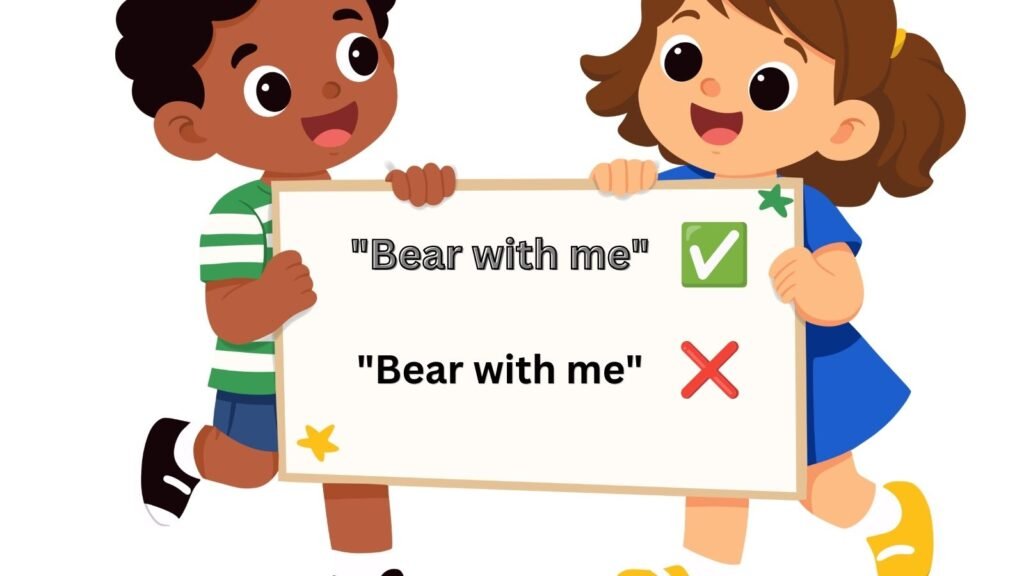
“Bear with me” is the correct English phrase. “Bare with me” is almost always a spelling mistake because bear means to be patient, while bare means uncovered or naked.
Have you ever typed a quick message saying, “Please bare with me,” only to wonder later if it was correct? You are not alone. Many people make this mistake because bear and bare sound exactly the same. They are homophones, which means they have the same pronunciation but different meanings and spellings.
The phrase bare with me or bear with me is one of the most searched English grammar questions online. People see both versions on social media, in emails, and even in business messages. This creates confusion, especially for English learners and busy professionals. Understanding the difference between bare with me or bear with me will help you avoid embarrassing mistakes and write with confidence. Once you know what each word means, remembering the correct phrase becomes easy.
Pronunciation
Bear
- US Pronunciation: /ber/
- UK Pronunciation: /beə(r)/
Bare
- US Pronunciation: /ber/
- UK Pronunciation: /beə(r)/
Note: Both words sound exactly the same. This is why many people confuse them in writing.
Transition
Now that you know the basic difference, let’s explore why “bear with me” is correct and “bare with me” is usually incorrect.
Difference Between Bare With Me or Bear With Me
1. Meaning
Bear with me means please be patient or please wait for me.
Bare with me literally means uncover yourself with me or be naked with me, which is almost never the intended meaning.
Examples:
Bear with me
- Please bear with me while I restart my computer.
- Bear with me for a few minutes.
Bare with me
- This sentence sounds strange.
- It does not mean “please wait.”
2. Correct Usage
Bear with me is the correct English expression.
Bare with me is considered a mistake in almost every situation.
Examples
Correct
- Thank you for bearing with us.
- Please bear with me during this update.
Incorrect
- Please bare with me.
- Bare with us while we fix the issue.
3. Word Meaning
Bear has many meanings. One meaning is to endure, carry, or be patient.
Bare means without covering or exposed.
Examples
Bear
- I cannot bear the loud noise.
- Bear with me while I finish.
Bare
- He walked on the bare floor.
- The trees were bare in winter.
4. Grammar
In the phrase bear with me, bear is a verb.
In bare with me, bare is also a verb, but it means to uncover, making the sentence incorrect in normal conversation.
Examples
- Bear with me while I explain.
- Please bear with us today.
Wrong:
- Bare with me while I explain.
- Bare with us today.
5. Everyday Use
People use bear with me in emails, meetings, customer support, and conversations.
People rarely use bare with me unless talking about removing clothing.
Examples
- Bear with me while I check.
- Please bear with our team.
Wrong:
- Bare with me while I check.
- Bare with our support team.
6. Professional Writing
Businesses always write bear with me.
Using bare with me can make your writing look unprofessional.
Examples
Correct:
- Please bear with us during maintenance.
- Bear with me while I locate your file.
Wrong:
- Please bare with us.
- Bare with me for a moment.
7. Dictionary Meaning
All major English dictionaries recognize bear with someone as an idiom.
Bare with me is not listed as an idiomatic phrase.
Examples
- Dictionaries explain “bear with.”
- Grammar books teach “bear with.”
Wrong:
- They do not recommend “bare with.”
8. Reader Understanding
Readers immediately understand bear with me.
Seeing bare with me may confuse readers or make them smile because of its unintended meaning.
Examples
- Bear with me while I load the file.
- Bear with us during repairs.
Wrong:
- Bare with me while I load the file.
- Bare with us today.
9. Search Popularity
Bear with me appears far more often in books, websites, and news articles.
Bare with me mostly appears because of spelling mistakes.
Examples
- Companies use “bear with us.”
- News websites use “bear with us.”
Wrong:
- “Bare with me” often appears in typo lists.
- Grammar articles correct it.
10. Best Choice
Always choose bear with me when asking someone to wait or be patient.
Avoid bare with me unless you literally mean “remove clothing together,” which is very rare.
Examples
Correct:
- Bear with me for one minute.
- Thank you for bearing with us.
Incorrect:
- Bare with me for one minute.
- Thanks for baring with us.
Nature and Behaviour of Bare With Me or Bear With Me
Bear With Me
“Bear with me” is a common English idiom. It politely asks someone to be patient while you finish something or solve a problem. It is friendly, respectful, and suitable for both formal and informal situations.
Examples:
- Bear with me while I answer your question.
- Please bear with us during the update.
Common Situations
- Customer service
- Business emails
- Phone calls
- Classroom discussions
- Online meetings
Bare With Me
“Bare with me” is not the correct phrase for asking someone to wait. Since bare means to uncover or expose, the phrase creates a completely different and often funny meaning.
Examples
- Bare your feet before entering.
- The walls were left bare.
When people write bare with me, they almost always mean bear with me instead.
Why People Get Confused About Bare With Me or Bear With Me
Many people confuse these phrases because bear and bare are homophones. They sound exactly the same, but they have different meanings and spellings.
Another reason is that most people learn the phrase by hearing it instead of reading it. When they finally write it, they guess the spelling and often choose bare because it looks familiar.
Autocorrect does not always catch this mistake because bare is a real English word. As a result, the error appears in emails, text messages, social media posts, and even business communication.
Remember the difference is this:
- Bear with me = Please be patient. ✅
- Bare with me = Remove your clothes with me. ❌
A simple memory trick is to think of bear as endure or be patient. Whenever you ask someone to wait, always choose bear with me. This small rule will help you avoid one of the most common English writing mistakes.
Comparison Table
| Feature | Bear With Me | Bare With Me |
|---|---|---|
| Correct phrase | ✅ Yes | ❌ No (usually a mistake) |
| Meaning | Please be patient | Remove clothing or uncover yourself |
| Part of speech | Verb phrase | Verb phrase |
| Common usage | Very common | Very rare |
| Formal writing | ✅ Accepted | ❌ Not accepted |
| Business emails | ✅ Yes | ❌ No |
| Dictionaries | Listed as an idiom | Not listed as an idiom |
| British English | Correct | Incorrect |
| American English | Correct | Incorrect |
| Recommended choice | Always use | Avoid in normal writing |
The Origin of the Phrase
The phrase “bear with me” comes from the old English verb bear, which means to carry, to endure, to tolerate, or to remain patient. The word has been part of English for hundreds of years and comes from the Old English word beran, meaning “to carry” or “to support.”
Over time, English speakers began using bear with to politely ask someone to stay patient during a delay or problem. Today, it is one of the most common polite expressions in spoken and written English.
The word bare has a completely different origin. It comes from the Old English word bær, meaning naked, uncovered, or without covering. Because both words sound the same, many people accidentally replace bear with bare.
Although the mistake is common, modern English dictionaries and style guides recommend bear with me as the only correct expression when asking for patience.
British vs American English
The good news is that British English and American English use the same phrase.
American English
Americans commonly say:
- Please bear with me.
- Bear with us while we update the website.
- Thank you for bearing with us.
British English
British speakers also use:
- Please bear with me.
- Bear with us for a moment.
- Thank you for bearing with us.
Is There Any Difference?
No.
There is no spelling difference between British and American English.
| British English | American English |
|---|---|
| Bear with me | Bear with me |
| Bear with us | Bear with us |
| Bearing with | Bearing with |
The incorrect form bare with me is considered a spelling mistake in both varieties of English.
Which One Should You Use?
The answer is simple.
Always use bear with me whenever you want someone to be patient or wait for a short time.
Use it in:
- Emails
- Business writing
- Customer service
- School work
- Text messages
- Social media
- Presentations
- Phone conversations
Avoid bare with me because it changes the meaning completely.
Advice by Region
United States
- Always write bear with me.
United Kingdom
- Always write bear with me.
Canada
- Use bear with me.
Australia
- Use bear with me.
Global English
- Bear with me is the accepted form everywhere.
Common Mistakes
Many writers make the same spelling mistake because the words sound alike.
Mistake 1
❌ Bare with me.
✅ Bear with me.
Mistake 2
❌ Bare with us while we fix the problem.
✅ Bear with us while we fix the problem.
Mistake 3
❌ Thank you for baring with us.
✅ Thank you for bearing with us.
Mistake 4
❌ Please bare with our team.
✅ Please bear with our team.
Mistake 5
❌ I hope you can bare with me.
✅ I hope you can bear with me.
Quick Memory Trick
Think about patience.
If you are asking someone to wait, always use bear.
If you are talking about something uncovered, use bare.
Everyday Usage Examples
In Emails
- Please bear with me while I review your request.
- Thank you for bearing with us during this delay.
On Social Media
- Bear with me. New content is coming soon!
- Please bear with us while we improve the page.
In Customer Support
- Bear with me while I check your account.
- Please bear with us during system maintenance.
In News
- Officials asked residents to bear with temporary road closures.
- Customers were told to bear with delays after the storm.
Formal Writing
- We kindly ask you to bear with us during the transition period.
- Please bear with our staff as we complete the upgrade.
In Everyday Conversation
- Bear with me. I’ll be ready in two minutes.
- Can you bear with me while I finish this call?
Usage Trends
The phrase bear with me has been used for centuries and remains the standard expression in modern English. It appears in books, newspapers, business emails, websites, customer support messages, and everyday conversations around the world.
Today, the phrase is especially common in digital communication. Companies often write “Please bear with us while we improve our service” or “Bear with us during scheduled maintenance.” It is also widely used in online meetings, video calls, and social media when someone needs a little extra time.
On the other hand, bare with me appears mainly because of spelling mistakes. Since bear and bare sound exactly alike, many people accidentally type the wrong word. Search engines frequently suggest bear with me when users search for bare with me, showing that the correct phrase is far more common.
Metaphors and Similes
Although “bear with me” is an idiom, writers sometimes use it in figurative language to show patience and support.
Metaphors
- Patience is a bridge, and “bear with me” helps us cross it.
- “Bear with me” is the key that opens better communication.
- Kindness is the heart of bearing with others.
Similes
- She waited like a patient friend who could bear with anyone.
- He stayed calm like a teacher helping a new student.
- They listened like caring parents, bearing with every question.
These examples show that patience makes conversations smoother and relationships stronger.
Connotative Meaning
The phrase “bear with me” usually has a positive or neutral meaning. It politely asks someone for patience.
Positive Meaning
It shows respect and kindness.
Examples
- Please bear with me while I learn.
- Thank you for bearing with us today.
Neutral Meaning
It simply asks someone to wait.
Examples
- Bear with me for one minute.
- Please bear with us during the update.
Negative Meaning
The phrase itself is not negative. However, saying it too often may suggest poor planning or repeated delays.
Example
- Customers became unhappy because the company kept saying, “Bear with us,” without fixing the problem.
Idioms and Proverbs
The phrase “bear with me” is itself an English idiom.
Here are a few related idioms and proverbs about patience.
1. Patience is a virtue.
Meaning: Being patient is a good quality.
Example
- Patience is a virtue, so bear with me while I finish.
2. Good things come to those who wait.
Meaning: Waiting often brings better results.
Example
- Good things come to those who wait, so bear with us.
3. Rome wasn’t built in a day.
Meaning: Big achievements take time.
Example
- Rome wasn’t built in a day. Please bear with the team.
4. Slow and steady wins the race.
Meaning: Careful work often succeeds.
Example
- Slow and steady wins the race, so bear with me.
Literature and Movies
The phrase “bear with me” appears in many novels, plays, speeches, and films because it is a natural way to ask for patience.
Literature
Many classic and modern writers use bear in the sense of endure or be patient.
Examples include:
- Hamlet (1603) uses the verb bear to mean endure.
- Pride and Prejudice (1813) contains many examples of patience and endurance in dialogue.
Although the exact phrase may not appear often, the meaning of bear as endure is common throughout English literature.
Movies
Many English-language films use “bear with me” in everyday dialogue.
Examples include:
- The King’s Speech (United Kingdom)
- The Intern (United States)
Characters often say the phrase while asking others to wait or remain patient.
Why This Difference Matters
Knowing the difference between bare with me and bear with me helps you write correct English. A single letter changes the meaning completely.
Using the correct phrase makes your writing look professional. It also helps readers understand exactly what you mean.
Small grammar improvements like this make a big difference over time.
Situational Preference
When asking someone to wait or be patient, bear with me is always the best choice. It is correct in business emails, customer service, classroom discussions, presentations, phone calls, and casual conversations. It sounds polite, natural, and professional in both British and American English. On the other hand, bare with me should almost never be used because it changes the meaning completely. Since bare means uncovered or without clothing, the phrase often sounds confusing or humorous. If your goal is clear communication, always choose bear with me. It is accepted by dictionaries, grammar experts, and style guides worldwide. Whether you are speaking to friends, writing to clients, or posting online, using the correct phrase shows that you understand standard English and care about accurate communication.
FAQs
Is “bear with me” correct?
Yes. It is the correct English phrase when asking someone to be patient.
Is “bare with me” ever correct?
Only if you literally mean “remove your clothing with me.” In normal communication, it is incorrect.
Why do people confuse these phrases?
Because bear and bare are homophones. They sound the same but have different meanings.
Is “bear with me” formal?
Yes. It is suitable for both formal and informal situations.
Do British and American English use the same phrase?
Yes. Both use bear with me.
What does “bear” mean in this phrase?
It means to endure, to tolerate, or to be patient.
How can I remember the correct phrase?
Think of bear = be patient. Whenever you ask someone to wait, use bear with me.
Conclusion
The difference between bare with me or bear with me is easy to remember once you know the meaning of each word. “Bear with me” is the correct and widely accepted phrase. It politely asks someone to be patient while you finish a task, solve a problem, or explain something. In contrast, “bare with me” is almost always a spelling mistake because bare means uncovered or without clothing.
Remember this easy rule: If you are asking for patience, always use “bear with me.” Save “bare” for talking about something uncovered. Following this tip will help you communicate confidently and avoid one of the most common English writing mistakes.

Hi, I’m Mason Clark, the writer behind Wordspry!
My goal is to make grammar learning easier with straightforward explanations, useful examples, and engaging English lessons that help you grow every day.