
Have you ever written a sentence about a picture hanging on a wall and wondered whether to use hanged or hung? You are not alone. These two words confuse many English learners, students, and even experienced writers.
Both words come from the verb hang, but they do not always serve the same purpose. For example, you say, “I hung the painting above the fireplace.” However, when you describe someone who died through execution by hanging, traditional English grammar uses “hanged.”
So, why does English have two different past-tense forms of the same verb? When should you choose one over the other? Can you use them interchangeably?
In this guide, we will explore the difference between hanged vs hung, including their meanings, grammatical rules, historical background, and everyday uses. You will also practical examples, common mistakes, and simple tricks to remember the correct form.
Whether you are writing an essay, preparing a professional email, or improving your English vocabulary, understanding this distinction will make your sentences clearer and more accurate.
Quick Answer
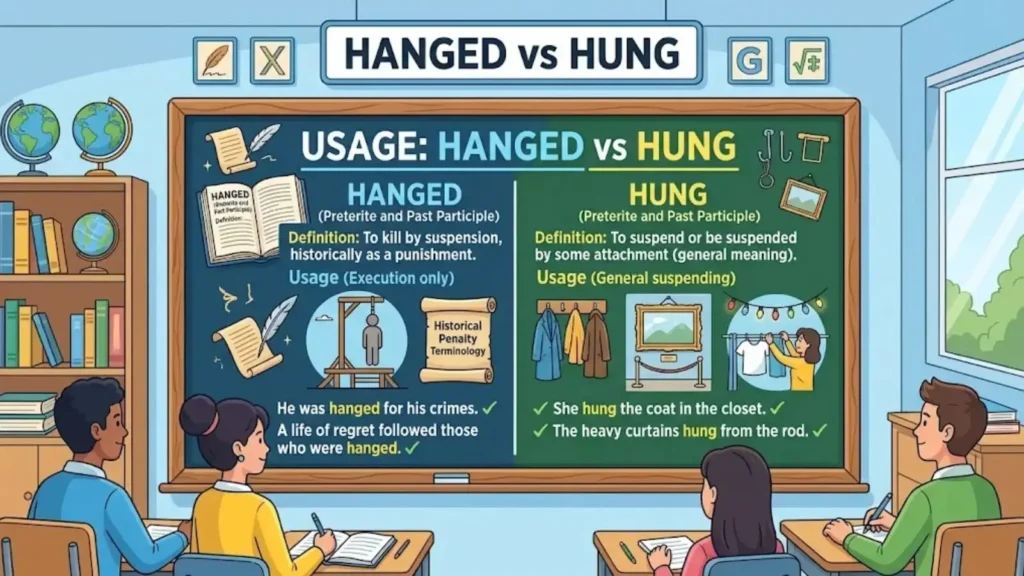
Hung is the usual past tense and past participle of “hang” when something is suspended, attached, or placed in a hanging position. Hanged traditionally describes a person who died through execution by hanging. For example, you hung a picture on the wall, but a prisoner was hanged.
RELATED: No Cuts No Buts No Coconuts: Meaning, Origin and Examples
Table of Contents
- Meaning at a Glance
- What Do Hanged and Hung Mean?
- Why Do People Search for This Difference?
- The Deeper Meaning and Grammatical Distinction
- Background and Origin
- Contexts Where These Words Are Used
- Usage Across Different Platforms
- Examples in Everyday Life
- When Should You Use Hanged or Hung?
- When Should You Avoid Using Them?
- Common Misconceptions
- Common Mistakes
- Similar Words and Alternatives
- How to Use Hanged and Hung in Sentences
- Hanged and Hung in Different Languages
- Online Conversations and Social Media
- Popularity and Usage Trends
- Trusted References
- Frequently Asked Questions
- Conclusion
Meaning at a Glance
| Aspect | Hanged | Hung |
|---|---|---|
| Basic meaning | Executed by hanging | Suspended or attached |
| Grammatical form | Past tense and past participle | Past tense and past participle |
| Common usage | Historical executions and legal contexts | Pictures, clothes, decorations, and objects |
| Literal meaning | Put to death by hanging | Placed in a hanging position |
| Figurative meaning | Sometimes appears in historical or literary expressions | Appears in expressions such as hung in the balance |
| Tone | Serious and historical | Neutral and conversational |
| Related topics | Execution, history, legal language | Decoration, suspension, grammar |
What Do Hanged and Hung Mean?
Both hanged and hung are past forms of the verb “hang.” However, their traditional uses depend on the meaning of the sentence.
Understanding their individual definitions makes the difference much easier.
What Does Hanged Mean?
Hanged is the past tense and past participle of “hang” when someone dies through execution by hanging.
Writers commonly use this form in historical accounts, legal discussions, and descriptions of capital punishment.
Examples:
- The prisoner was hanged for his crimes.
- The historical records show that several men were hanged.
- The judge sentenced the convicted criminal to be hanged.
- The rebels were hanged after the uprising.
What Does Hung Mean?
Hung, on the other hand, is the usual past tense and past participle of hang in almost every other situation. In other words, it describes placing something above the ground, attaching an object to a surface, or allowing something to remain suspended. For example, you can use hung when describing pictures, clothes, decorations, or other everyday objects.
Examples:
- She hung a beautiful painting in her bedroom.
- My mother hung the clothes outside to dry.
- We hung colorful decorations around the classroom.
- He hung his jacket behind the door.
As a result, remember that hung is the correct choice for ordinary hanging situations, while hanged traditionally refers to execution by hanging.
Hung also appears in everyday expressions and figurative language.
For example:
- The future of the company hung in the balance.
- She hung her head in disappointment.
- We hung out after school.
These examples show how widely people use hung in ordinary English.
Hanged vs Hung: The Main Difference
| Hanged | Hung |
|---|---|
| The prisoner was hanged. | She hung the picture. |
| The criminal was hanged in 1890. | He hung his coat on the hook. |
| The judge ordered the prisoner to be hanged. | They hung lights across the garden. |
| The historical records describe those who were hanged. | The flag hung above the building. |
Easy rule: Use hanged for execution by hanging and hung for ordinary suspension or other meanings of “hang.”
Why Do People Search for Hanged vs Hung?
English contains many irregular verbs, and “hang” creates an unusual grammatical situation.
Most verbs follow predictable patterns. For example, people add “-ed” to form the past tense of regular verbs. However, hang has two accepted past forms with different traditional meanings.
Here are the main reasons people search for this distinction.
1. Confusion About Past Tense
Many learners know that the past tense of “hang” is hung. Therefore, they naturally wonder why dictionaries also include hanged.
The difference becomes important when discussing historical executions.
2. School Assignments and Exams
Students frequently encounter these words in grammar exercises, reading assignments, and English examinations.
Teachers often use sentences about pictures, clothes, and historical punishments to test students’ understanding.
3. Books and Historical Stories
Historical novels, biographies, and historical documents often describe executions.
Readers may encounter sentences such as:
“The prisoner was hanged at sunrise.”
This can create confusion when they already know the word hung.
4. Movies and Television
Historical movies, documentaries, and crime dramas sometimes use both forms.
Viewers may hear characters discuss someone being hanged while another character talks about a painting that hung in a room.
5. Online Discussions
People regularly debate grammar rules on educational websites, Reddit, and social media.
The unusual difference between these words makes them a popular subject for English-language discussions.
The Deeper Meaning and Grammatical Distinction
Unlike artistic phrases or idioms, hanged and hung do not have separate symbolic meanings by themselves. Their distinction comes primarily from grammar and context.
However, both words can appear in literary descriptions and figurative expressions.
Literal Meaning
The literal meaning describes an actual physical action.
Examples:
- The artist hung the painting.
- The prisoner was hanged.
- My father hung the curtains.
- The historical account described how the convicted man was hanged.
Figurative Meaning
Hung also appears in expressions that describe emotions, uncertainty, and personal experiences.
For example:
Hung in the balance: Something remains uncertain or undecided.
Example: The future of the project hung in the balance.
Hung his head: Someone shows sadness, embarrassment, or disappointment.
Example: He hung his head after losing the competition.
Hung up on something: Someone cannot stop thinking about a particular issue.
Example: She remained hung up on her previous mistake.
Emotional Meaning
Writers sometimes use hung to communicate emotional situations.
For instance, “A feeling of sadness hung in the air” describes an atmosphere filled with sadness.
Meanwhile, hanged generally carries a serious historical or legal meaning because it refers to execution.
Background & Origin
The history of hanged and hung goes back to Old English.
Interestingly, the modern verb “hang” developed from different historical verb forms. These forms eventually merged into the modern English verb.
Historical Development
Old English included related forms that developed into the different patterns we recognize today.
One pattern produced the regular form hanged, while another produced the irregular form hung.
Over time, both forms continued to appear in English writing.
Why Did English Keep Two Forms?
During earlier periods, people sometimes used hanged and hung interchangeably.
However, writers gradually developed a stronger distinction between them.
By the 16th century, English usage increasingly favored:
- Hanged for execution by hanging.
- Hung for other meanings of the verb.
This distinction became especially common in traditional grammar guides.
Modern Development
Today, most dictionaries recognize both forms.
Cambridge Dictionary identifies hung as the standard American English past form for ordinary suspension and hanged as the form for execution.
However, some dictionaries also recognize hung in the execution sense. This means actual usage can vary.
For careful formal writing, the traditional distinction remains a useful choice.
Contexts Where Hanged and Hung Are Used
These words appear in different writing situations. Understanding the context helps you select the correct form.
Art & Painting
Artists, galleries, and exhibition organizers usually use hung when discussing displayed artwork.
Examples:
- The gallery hung several paintings along the entrance wall.
- The museum hung the portrait beside the historical photographs.
- The artist’s latest collection was hung in the main exhibition room.
Correct: The painting was hung in the gallery.
Incorrect: The painting was hanged in the gallery.
Photography
Photographers and designers use hung when discussing printed photographs or displayed images.
Examples:
- She hung her favorite photograph above the desk.
- The family hung wedding pictures throughout the hallway.
- Several photographs hung from the exhibition ceiling.
Literature
Authors use both forms in historical fiction, poetry, and storytelling.
Examples:
- The criminal was hanged according to the king’s orders.
- A portrait hung above the fireplace.
- The future of the kingdom hung in the balance.
Movies & Documentaries
Historical documentaries and crime movies may use hanged when discussing execution.
Examples:
- The documentary explained why the prisoner was hanged.
- The historical film showed a flag that hung above the castle.
- The narrator described the people who were hanged during that period.
Personal Development
Hung frequently appears in motivational expressions.
Examples:
- Don’t remain hung up on yesterday’s mistakes.
- Her dreams hung in the balance until she made a decision.
- He hung his head but continued working toward his goals.
Business & Branding
Business professionals use hung in presentations and everyday communication.
Examples:
- The company hung its new logo in the reception area.
- The project’s future hung in the balance.
- The marketing team hung promotional banners throughout the store.
Education
Teachers use these words to explain irregular verbs and past participles.
Examples:
- The student hung a chart on the classroom wall.
- The history textbook explained why prisoners were hanged.
- The teacher asked students to identify the correct past-tense form.
Social Media
Social media users commonly use hung in captions and informal posts.
Examples:
- Finally hung my favorite artwork!
- We hung fairy lights for the celebration.
- That decision really hung in the balance!
Usage Across Different Platforms
| Platform | Typical Usage | Example |
|---|---|---|
| Home decoration and photography | Hung my favorite picture today! | |
| TikTok | Grammar lessons and educational videos | Hanged vs hung explained |
| Interior design and artwork | How to hang and display paintings | |
| Personal stories and historical discussions | We hung family pictures yesterday. | |
| Professional writing and presentations | The future of the project hung in the balance. | |
| YouTube | English grammar tutorials | Learn when to use hanged and hung. |
| Blogs | Grammar explanations and educational articles | Hanged vs hung: Learn the difference. |
Examples in Everyday Life
The easiest way to understand these words involves seeing them in familiar situations.
1. Daily Conversations
- I hung my coat near the entrance.
- She hung the laundry outside.
- He hung his head after hearing the news.
- The prisoner was hanged many years ago.
2. Artwork
- We hung a beautiful painting in the living room.
- The museum hung several portraits in its new exhibition.
- A large photograph hung above the reception desk.
3. Classroom Discussions
- The teacher hung a map on the classroom wall.
- Students learned why the historical figure was hanged.
- The class hung colorful decorations for the school event.
4. Business Presentations
- Our team hung the company banner behind the stage.
- The project’s success hung in the balance.
- The manager hung the presentation charts around the meeting room.
5. Social Media Captions
- Finally hung my new wall art!
- We hung beautiful lights for the party.
- Never get hung up on small mistakes.
6. Speeches
- The speaker explained how the prisoner’s execution took place.
- Our success hung in the balance during those difficult days.
7. Blog Titles
- Hanged vs Hung: Which Word Should You Use?
- Why Was the Prisoner Hanged?
- How to Choose the Correct Past Tense of Hang
When Should You Use Hanged or Hung?
Choose the correct form according to the meaning of your sentence.
Use Hanged When:
- You describe execution by hanging.
- You write about historical punishments.
- You discuss someone sentenced to death by hanging.
- You explain an execution in a legal or historical document.
Examples:
- The prisoner was hanged in 1850.
- The king ordered the traitor to be hanged.
- Several criminals were hanged during that period.
Use Hung When:
- You describe hanging a picture.
- You discuss clothes on a washing line.
- You describe suspended objects.
- You talk about decorations.
- You use expressions such as hung in the balance.
Examples:
- I hung my new curtains.
- They hung colorful balloons.
- The flag hung above the entrance.
When Should You Avoid Using Them?
Although both words have legitimate uses, you should avoid choosing one without considering the sentence’s meaning.
Legal Writing
Use hanged when describing an execution by hanging.
Example:
The convicted prisoner was hanged following the final judgment.
Technical Documentation
Use hung when describing suspended equipment, cables, or objects.
Example:
The technician hung the device from the ceiling bracket.
Scientific Papers
Use hung when describing an object suspended during an experiment.
Example:
The researchers hung the equipment from a support frame.
Formal Contracts
Avoid using either form when a more precise technical description would communicate the intended action.
For example, use “attached to the ceiling” instead of an unclear reference to something being hung.
Situations Requiring Literal Meaning
Always consider whether your sentence describes suspension or execution.
A small grammatical difference can change the meaning dramatically.
Common Misconceptions About Hanged and Hung
Several misunderstandings make these words more difficult than they need to be.
Misconception 1: Hanged Is Always Incorrect
This statement is false.
Hanged is a recognized English word and the traditional form for execution by hanging.
Correct example:
The prisoner was hanged for his crimes.
Misconception 2: Hung Only Describes Objects
Hung can describe people in certain nonexecution situations and appears in many figurative expressions.
Examples:
- He hung his head in disappointment.
- She was hung up on the decision.
- The future hung in the balance.
Misconception 3: Both Words Always Mean the Same Thing
Although dictionaries recognize some overlap, traditional English usage distinguishes their meanings.
For careful writing, remember the execution-versus-other-meanings rule.
Misconception 4: Hanged Is the Past Tense of Every Meaning of Hang
Hanged is not the usual past form when discussing ordinary suspension.
Correct: She hung the picture.
Incorrect: She hanged the picture.
Misconception 5: Hung Cannot Appear in Historical Writing
Hung also appears in historical writing when the sentence describes suspension rather than execution.
Example:
The royal flag hung above the entrance to the castle.
Common Mistakes When Using Hanged and Hung
Avoid these frequent errors to improve your grammar.
| Incorrect Sentence | Correct Sentence | Explanation |
|---|---|---|
| She hanged the picture. | She hung the picture. | Ordinary suspension requires hung. |
| He was hung for his crimes. | He was hanged for his crimes. | Traditional usage favors hanged for execution. |
| They hanged the curtains. | They hung the curtains. | Curtains are suspended, not executed. |
| I hanged my coat on the hook. | I hung my coat on the hook. | Use hung for clothing. |
| The flag was hanged outside. | The flag was hung outside. | A flag is an ordinary suspended object. |
Remember: The meaning of “hang” determines which past form you should choose.
Similar Words & Alternatives
Several English words describe actions similar to hanging. However, they do not always carry exactly the same meaning.
| Word or Phrase | Meaning | Best Used When |
|---|---|---|
| Suspended | Held or supported from above | Describing objects in the air |
| Attached | Connected to something | Describing fixed objects |
| Mounted | Fixed onto a surface | Displaying equipment or artwork |
| Displayed | Presented for viewing | Museums and exhibitions |
| Fastened | Secured in position | Describing objects attached to something |
| Dangling | Hanging loosely | Describing something swinging freely |
| Hanging | Remaining suspended | General descriptions |
| Executed | Put to death as punishment | Discussing capital punishment |
These alternatives help writers avoid repetition while maintaining accurate meanings.
How to Use Hanged and Hung in a Sentence
Here are practical examples for different writing situations.
Professional Writing
- The company hung its new promotional banner near the entrance.
- Historical records confirm that the prisoner was hanged in 1892.
Creative Writing
- A lonely portrait hung above the fireplace.
- The condemned man was hanged before sunrise.
Social Media Caption
- Finally hung my favorite artwork!
- Don’t get hung up on yesterday’s problems.
Inspirational Quote
“Never let yesterday’s mistakes keep you hung up on the past.”
Everyday Conversation
- “Where did you hang your jacket?”
- “I hung it behind the door.”
- “The history book says the prisoner was hanged.”
Hanged and Hung in Different Languages & Cultures
Different languages express suspension and execution through different verbs. Therefore, translations do not always follow the same grammatical distinction as English.
| Language | Hung: Ordinary Suspension | Hanged: Execution |
|---|---|---|
| Spanish | Colgado / colgó | Ahorcado / ahorcó |
| French | Accroché / suspendu | Pend(u) / exécuté par pendaison |
| Arabic | مُعَلَّق (muʿallaq) | مَشْنُوق (mashnūq) |
| Hindi | लटकाया (latkāyā) | फाँसी दी गई (phānsī dī gaī) |
| Urdu | لٹکایا (latkāyā) | پھانسی دی گئی (phānsī dī gaī) |
| Tamil | தொங்கவிட்டார் (thoṅgavittār) | தூக்கிலிடப்பட்டார் (thūkkiliṭappaṭṭār) |
| Malayalam | തൂക്കിയിട്ടു (thūkkiyiṭṭu) | തൂക്കിലേറ്റി (thūkkilēṟṟi) |
| Marathi | टांगले (ṭāṅgale) | फाशी दिली (phāśī dilī) |
Cultural and Linguistic Differences
Many languages use different expressions for ordinary suspension and execution.
For example, Urdu uses “لٹکایا” for hanging an object and “پھانسی دی گئی” for execution by hanging.
Similarly, Hindi distinguishes between “लटकाया” and “फाँसी दी गई.”
These differences show why direct translation sometimes creates grammatical confusion. English learners should understand the meaning before selecting hanged or hung.
Hanged and Hung in Online Conversations & Social Media
Online discussions frequently include grammar questions, especially when two words share the same root.
Users commonly encounter hung in captions about photography, decoration, and home improvement.
Example: “Hung my favorite pictures in the hallway!”
TikTok
Short educational videos often explain irregular verbs through simple examples.
A grammar creator might explain the difference using two sentences:
- I hung a picture.
- The prisoner was hanged.
Pinterest users frequently encounter hung in interior design descriptions.
Example: “Beautiful artwork hung above a modern sofa.”
People use both words in personal conversations, educational posts, and historical discussions.
Grammar communities discuss whether the distinction between hanged and hung remains necessary in modern English.
Some discussions also explore historical examples and changing language rules.
YouTube
English teachers create grammar tutorials explaining the past tense and past participle of hang.
Creative Communities
Writers, photographers, and artists generally use hung when discussing displayed artwork, photographs, and decorations.
Popularity & Usage Trends Over Time
The distinction between hanged and hung has developed over several centuries. However, historical usage patterns should not be confused with verified Google search trends.
| Period | Historical or Usage Development |
|---|---|
| Before 1500 | Different historical forms of the verb developed and coexisted. |
| 1500–1700 | Writers increasingly favored hanged for executions and hung for ordinary suspension. |
| 1700–2000 | Grammar commentators discussed and reinforced the distinction. |
| 2000–Present | Dictionaries, educational websites, and online discussions continue to explain both forms. |
Featured Snippet Summary
Hanged and hung are two past forms of the verb “hang.” Use hanged when describing someone executed by hanging. Use hung for ordinary suspension, such as hanging pictures, clothes, or decorations. For example, “She hung a painting” is correct, while “The prisoner was hanged” follows traditional English usage.
Trusted References
The following authoritative resources provide useful definitions, examples, and grammatical explanations.
- Cambridge Dictionary: Explains the different past forms of hang and provides examples for suspension and execution.
- Merriam-Webster: Discusses the traditional distinction and historical development of hanged and hung.
- Oxford Learner’s Dictionaries: Provides definitions and examples of the verb hang and related expressions.
- Thesaurus.com: Explains the difference between these two past-tense forms with practical examples.
Frequently Asked Questions (FAQs)
1. What Is the Difference Between Hanged and Hung?
Hanged traditionally refers to execution by hanging, while hung describes ordinary suspension.
For example, you hung a picture on the wall, but the prisoner was hanged.
2. Is Hanged Grammatically Correct?
Yes. Hanged is a grammatically correct past-tense and past-participle form of “hang.”
Writers traditionally use it when describing execution by hanging.
3. Is Hung the Past Tense of Hang?
Yes. Hung is the usual past tense and past participle of hang.
Examples:
- I hung my coat.
- She hung the curtains.
- They hung the decorations.
4. Can You Say Someone Was Hung Instead of Hanged?
Yes, some speakers and writers use hung when describing execution. Dictionaries document this variation.
However, traditional formal usage generally prefers hanged for execution by hanging.
5. Why Do People Say Hanged Instead of Hung?
English developed two historical forms of the verb hang.
Over time, writers increasingly associated hanged with execution and hung with ordinary suspension.
6. Is It Hanged or Hung on the Wall?
The correct traditional form is hung.
Example: She hung a beautiful painting on the wall.
You should not use hanged for ordinary wall decorations.
7. Is It Hung or Hanged in the Past Participle?
Both forms work as past participles, but their traditional uses differ.
- Hung: The picture has been hung.
- Hanged: The prisoner was hanged.
8. Is It Correct to Say “I Hung Myself”?
The phrase can be grammatically correct in certain literal contexts, but it may communicate an unintended meaning.
If you mean that you placed yourself in a suspended position, provide additional context to make the sentence clear. For self-harm or suicide, use precise wording that reflects the intended meaning.
Conclusion
Understanding hanged vs hung becomes much easier when you remember one simple grammatical distinction. Both words come from the verb “hang,” but traditional English usage assigns them different purposes.
Use hung when describing ordinary suspension. For example, you hung a picture, placed clothes on a line, or attached decorations to a wall. The word also appears in expressions such as “hung in the balance” and “hung up on something.”
On the other hand, use hanged when describing someone who died through execution by hanging. You will commonly find this form in historical books, legal discussions, and accounts of capital punishment.
Although some modern writers use hung in both situations, the traditional distinction remains useful, particularly in formal writing.
The best way to remember these words involves practicing them in real sentences. Once you understand their meanings, choosing the correct form becomes much easier.
Remember: Pictures are hung, but people sentenced to execution by hanging are traditionally hanged.

Hi, I’m Mason Clark, the writer behind Wordspry!
My goal is to make grammar learning easier with straightforward explanations, useful examples, and engaging English lessons that help you grow every day.


Pingback: Meaning of Catch-22: Definition, Origin, and Examples - wordspry.com